

SSIS College Spotlight: Effectively Reading a College Website
volume 1, issue 3. Fall (updated September 2016)
volume 1, issue 3. Fall (updated September 2016)
Dear Seniors and Families,
While a prior Spotlight focused on processes, tools, and tips for finding the right fit, this issue of Spotlight focuses more explicitly on how to effectively read college websites.
Follow the scenario and consider the questions below to help you find schools that suit you best.
As always, take advantage of the College Counseling office space, the materials you find there, and me!
Best always,
Caroline
Your College Counselor
_________________________________

A COLLEGE SCORECARD SCENARIO — HOW DOES IT HELP ME NARROW MY SEARCH?
Let’s start at the beginning: you have a notion of what you want, but are overwhelmed by choices. Pretend the following: Based on a preference for small to medium non-profit private schools offering 4-year liberal arts degrees in California, you’ve found 42 results on College Scorecard. You sort the schools by graduation rate because you know that it is an excellent indicator of success. The graduation rate implies that many students arrive well prepared for college, and the school does a good job of providing students with support academically and otherwise. You notice the size of the schools listed and immediately rule out schools under 800 or over 6,000 students because you would prefer to get to know your professors individually and learn in a seminar setting, beginning with the freshman year. You scan the list and realize that you have heard of some but not most schools. What do you do now?
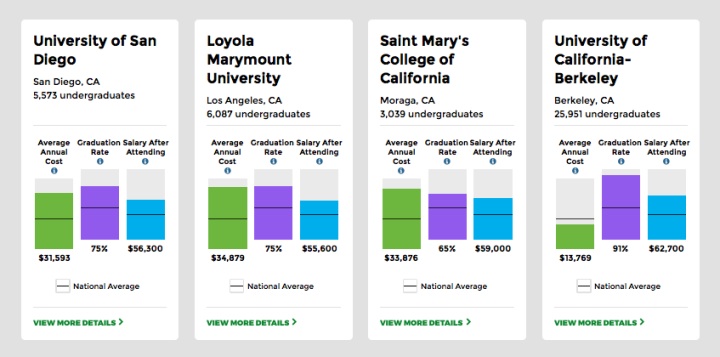
“VIEW DETAILS” SCENARIO — HOW DOES IT HELP ME USE A COLLEGE WEBSITE?
At the bottom of each scorecard you see “view more details.” You click on St. Mary’s College of California because you know that it is part of Colleges That Change Lives, and at 3,000 students seems a good size to have both classroom intimacy as well as many of the academic and extracurricular choices that larger schools provide. What do you learn? St. Mary’s is a Catholic school near Oakland, Berkeley, and San Francisco. “Student Body” reveals that 93% of students are full-time and relatively diverse, racially and economically. You see that 33% of students receive Pell Grants—an observation that may explain the comparatively lower graduation rate at St. Mary’s. Students living with economic constraints are more likely to take longer to graduate because they need to balance schoolwork with full-time employment. The tab for “SAT/ACT Scores” reveals that you are likely to qualify. “Academic Programs” indicate that the school provides a liberal arts curriculum tuned to students who also seek practical pre-professional training. You are intrigued by the business program and the fact that Psychology is the 4th most popular major… Time to click through to the school’s webpage! Whether St. Mary’s turns out to be the best fit for you or not, you have just learned enough to begin a comparative search. Be sure to log pertinent comparative criteria, application details, and related urls, for future use!

WHAT KIND OF THINGS SHOULD I PAY ATTENTION TO ON A COLLEGE WEBSITE?
The UW splash screen above is a good example—notice the panel topics and that each advertises a click-through to a well-regarded department or news article. The UW is clearly proud to have graduated students whose UW educations brought them success in medicine and business. The UW is also proud of its athletes. What have we learned? If you attend the UW, expect to be part of an enthusiastic sports community and know that you will be at a university known for the sciences and that values entrepreneurialism. The underlying message is that if you take advantage of what the UW has to offer, you will be successful after college. Are you drawn in? Does this seem like a good fit for you? With your personal criteria in hand, you will need to search deeper into the website.
Below is a short list of questions to consider while looking at the different college website pages:
SPLASH SCREEN
- What is the college advertising?
- What does it seem most proud of?
- Are there upcoming special events? What are they? Arts? Lectures? Community projects?
- Is the faculty being recognized for their achievements?
- Are students being recognized for research, athletics, and service?
- Can you find the Academic Departments and Programs page?
ABOUT PAGE(S)
- How does the college characterize itself?
- Does the school have a thriving Greek system (sororities/fraternities) or arts scene?
- How important is the idea of service?
- How important is diversity?
- Can you find the “class profile” page?
- How does the school represent its students—Scores? GPAs? Racial, regional, economic diversity? Interests and talents?
- Do the students sound like you or your kind of friends?
- Does the school share your values?
- If the school is affiliated with a religious organization, how does the school frame that? Many affiliated schools are open, liberal-minded, and religiously as well as socio-economically diverse; often they stress global outreach and a “learning for service” theme.
- Many pubic colleges have an Honors College that can give you a small liberal arts experience in the midst of big school resources. Some liberal arts schools have Honors programs. Can you find these?
ACADEMIC DEPARTMENTS AND PROGRAMS PAGE(S)
- Glance at the majors and minors list—are there interdepartmental majors?
- Do they encourage self-directed study?
- Do they have a core curriculum? What is it?
- Do they advertise research, internship, and travel opportunities? Do these occur during the school year or just in the summer months?
- Do they provide extra support in writing or math to secure academic achievement?
- Do they stress writing across disciplines?
Click through to a potential major to learn more. If the school has intrigued you enough to get to this point, copy the department page url into your college spreadsheet where you will be return to it for the purpose of comparison and review.
MAJORS AND MINORS PAGE(S)
- How does the department characterize its area of study?
- Notice the requirements and course list; what sort of capstone, independent, or non-classroom opportunities does the college provide?
- Are most classes seminars? Are they taught by professors? How accessible are professors? How hands-on are the classes?
- Does the senior year include a thesis, comprehensive exam, capstone project or other sign of mastery?
- Do faculty pages reveal interests, publications or personalities?
The truth is that “Biology,” “Psychology,” “English” and the rest are convenient labels that describe very little. Beyond introductory courses, all college majors reflect: (a) college Administration and Board of Trustees goals for the college, (b) faculty specializations and interests, and (c) regional strengths. You want to read departmental webpages to learn what these are. This will help you make happy choices and get you further along with the inevitable “why us?” supplemental essay question.
RESEARCH, INTERNSHIP, AND TRAVEL OPPORTUNITY PAGE(S)
Getting off campus, applying and testing what you learn, networking with potential employers—these are increasingly important and enjoyable aspects of college life. Make sure the college is offering ample opportunities for you to deepen your perspective and experience during your college years. Internships are important for future employment as well—many employers will prefer candidates with whom they have worked before or who come with good references from recognized sources. Most schools that offer research or writing opportunities publish student titles. Take a look, and see if any examples of student work grab your imagination! Can you picture yourself there, doing those sorts of things in a few years?
POST-GRADUATION PAGE(S)
- What kind of post-graduate fellowships are available?
- What have alumni have gone on to do?
- Does the college publish “graduate schools and employment” or “graduate schools and employment in their fields?”
CAMPUS LIFE PAGE(S)
- Going to college is so much more than academics and career development; how does the college portray itself as a community?
- What student activities does the college highlight?
- Do you see yourself fitting in?
- Is there an area of activity that you could lead?
- Do the students seem like they would be welcome colleagues an dorm-mates?
Just a glance at these few pages will give you a good idea if it is worth pausing on a school’s website to read more. You will quickly see that there is a wealth of diverse offerings, and most schools work hard to provide their students with tremendous educational opportunities and successful, happy outcomes. Have fun with the search, talk to friends, family, and teachers about their college experiences—and communicate regularly with your college counselor.

WHY HAPPINESS IN COLLEGE MATTERS
Ultimately, college is all about what you make, what you experience, how deeply you engage with the people you meet and the academic and non-academic opportunities that are available to you.
“Reading” photographs and descriptions gets you closer to understanding what you want to experience, who you want to meet, and how you want to engage. Your happiness matters.
ADMISSIONS AND FINANCIAL AID PAGE(S)
Your personal criteria drives your search. As you pull together a list of schools that seem like a good fit, you can check out the admissions, class profile, and financial aid pages to reveal which of those schools are “reach,” “target,” or “safety” and whether they are SAT optional or not. Of course it is wise to apply to one or two state public universities, but do not rule out selective private schools because of dollars. The sticker price is not the same as what you are likely to pay after merit awards and need based aid are taken into consideration. Until the application season is over, it’s all about expanding your options according to your personal criteria.
Frank Bruni of the New York Times wrote a beautiful article capturing the spirit of college success: NYT-Bruni on Why College. Please enjoy!