Today’s blog was written by Maddy Glaser, Hebaq Farah, and Meg Carrier
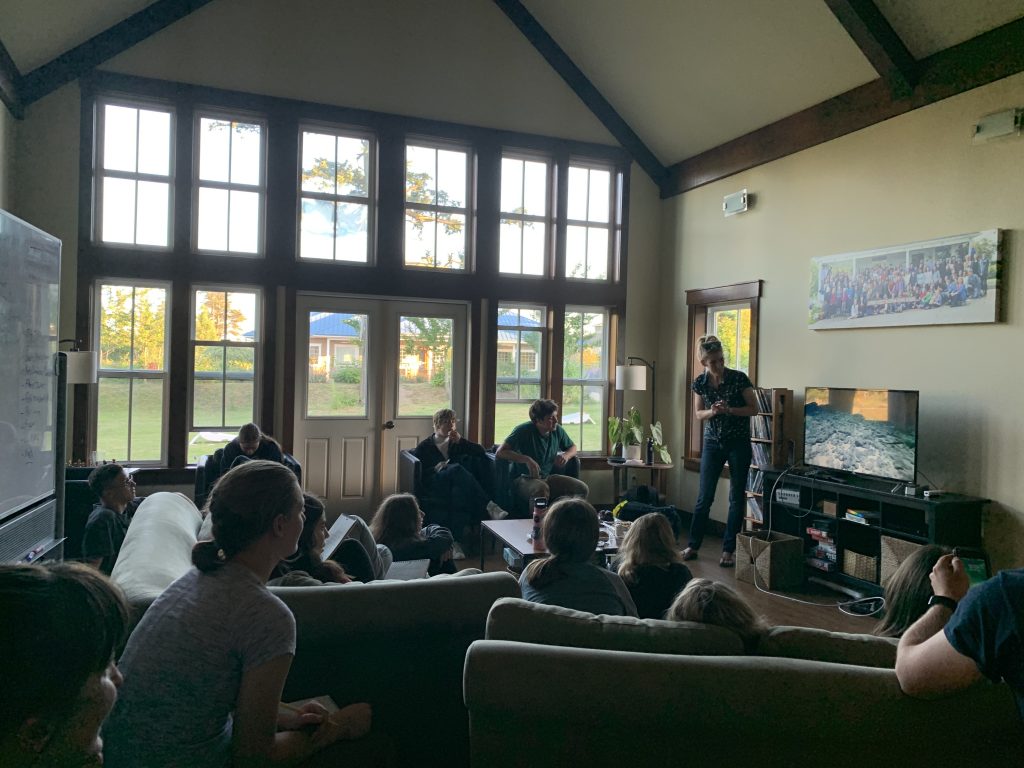
Last night, Derek Smith, a UW PhD with a specialization in subtidal communities and who is also President of the American Academy of Underwater Sciences, gave a captivating presentation following an unorthodox style – he gave us twenty different pictures, each one with a story, and instructed us to pick ones we wanted to hear. However, we could only pick ten and couldn’t go back to a picture after deciding (eek!). We sat on the edge of our seats as we struggled with our indecisiveness. Sometimes, the unveiling of a certain picture would result in an unanimous show of hands; other times, a picture would evoke nothing but a silent room. The stories we ended up picking were super entertaining and gave us a glimpse of what Derek actually does for work!
We awoke this morning pumped to go on yet another sea star surveying adventure. As we made our various breakfast meals, we told stories of the slippery rocks we faced the day before. Skimming the daily schedule and collecting our things, we wondered what the day would have in store for us. We split into teams and boarded different cars to set off for our next expedition.
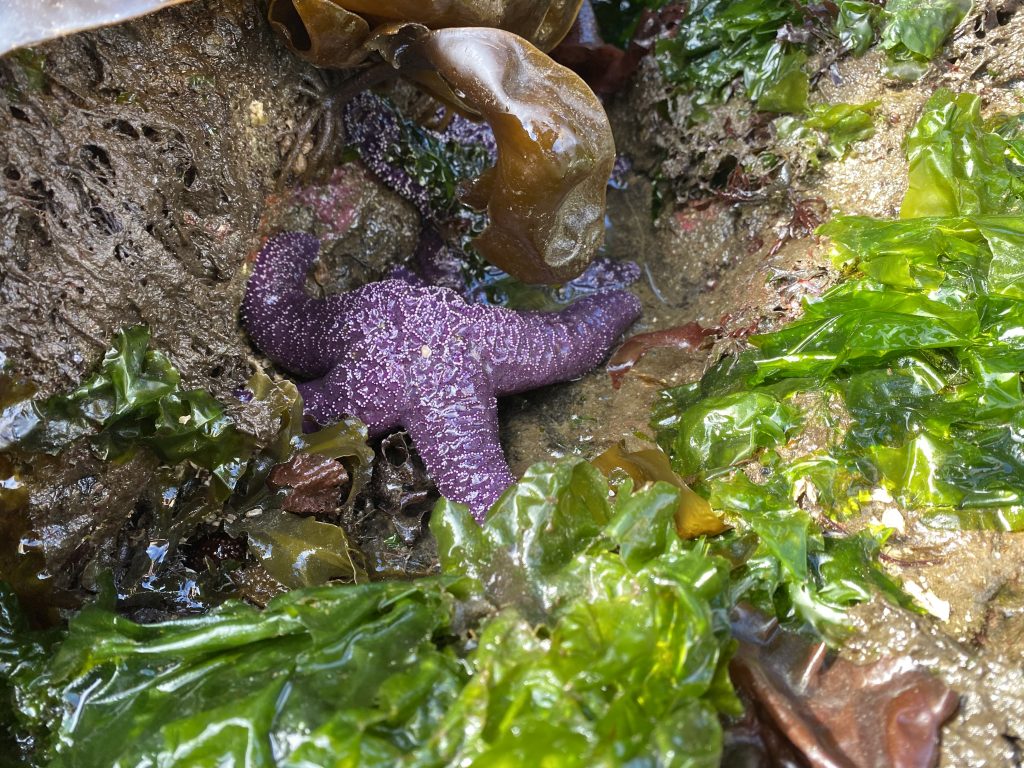
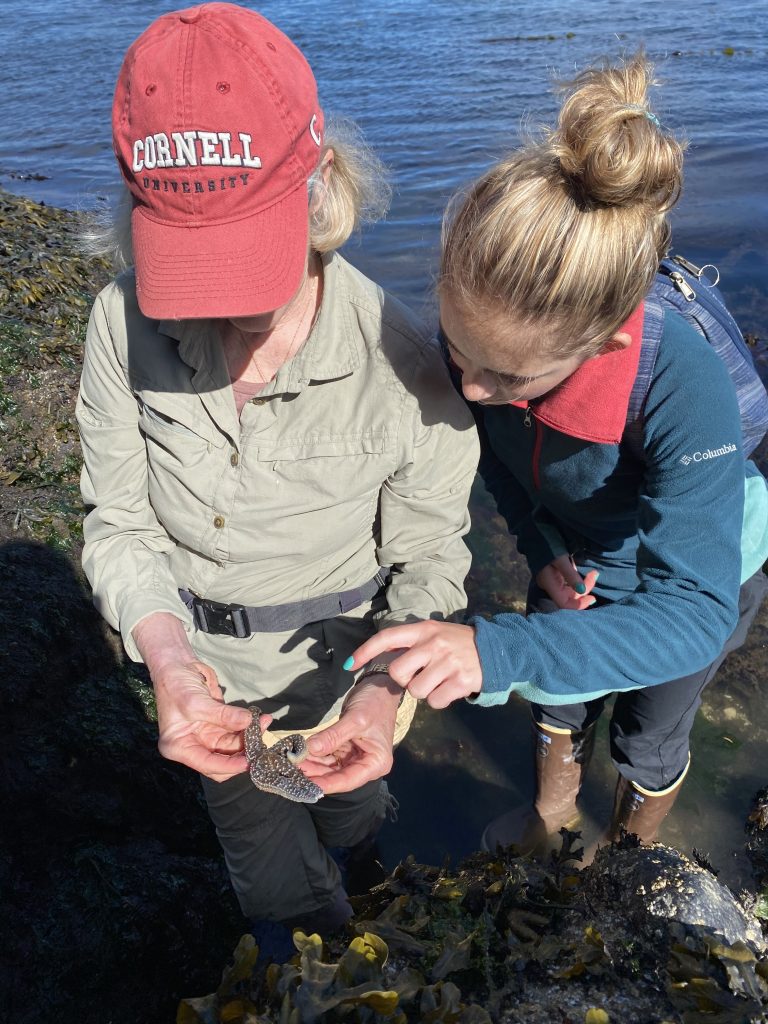
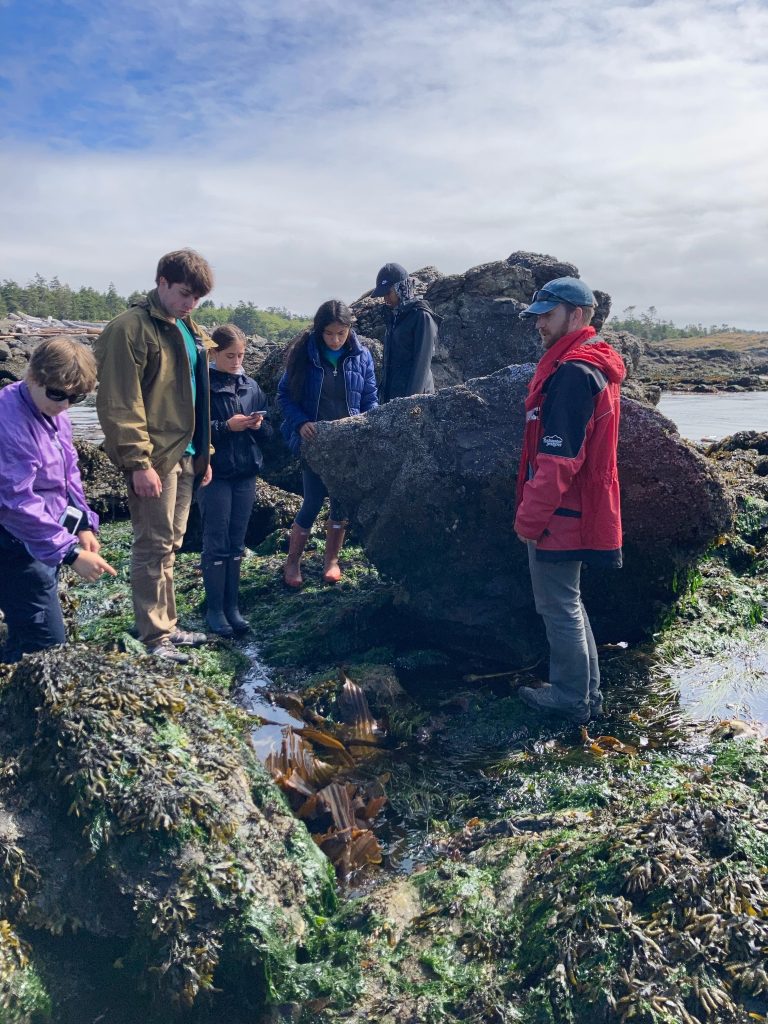
Morgan and Drew’s group: Seven of us set off to Point Caution, where we would spend the next hour and a half clambering over rocks and tide pools to find Pisaster Orchaceus, or Ochre Sea Stars with Dr. Drew Harvell, Professor of Ecology and Evolutionary Biology at Cornell University who has a lab at FHL and Morgan Eisenlord, who has been a student of Dr. Harvell and is defending her PhD thesis this summer. This summer, Morgan is Salish Sea Sciences Resident Scientist and dorm parent. Once we found the sea stars, we were told to record their size, color, and whether they had any signs of Sea Star Wasting Disease (yesterday’s blog goes more in depth on that disease and its effects!). Although we were just looking for Ochre stars, we also found Mottled sea stars, Leather stars, massive sea cucumbers, little crabs, Gunnels, and some interesting worms! Although finding the creatures was really fun, I think the most exciting part was that our data will be used by scientists around the world to potentially help the sea stars recover!
Tim and Miranda’s Group: The remaining eight of us arrived at Pile Point, excited to start surveying with Tim Dwyer, Salish Sea Sciences Science Director for this program and Miranda Winningham, a graduate of Cornell University who has done a lot of research at the Friday Harbor Labs, especially about sea stars, and at Western Washington University’s Shannon Point Marine Laboratories. Much to our surprise, a beautiful house stood at the top of the hill, overlooking it’s own private beach (the one in which we surveyed). We admired its beauty, then started the walk down to the shore, which was a bit steep and very rocky, but luckily there were no casualties. Today’s surveying seemed to go better than yesterday’s – we found fifty-two Ochre sea stars and lots of babies! We hypothesized that this was due to the lack of people using this beach as it’s privately owned.
After our surveying, we hopped back in the cars and shed off our extra layers that became unnecessary as the morning cold transitioned into afternoon warmth. We drove back to the dorms and enjoyed some reflection time – today this included classic Disney movies Princess and the Frog and Frozen.
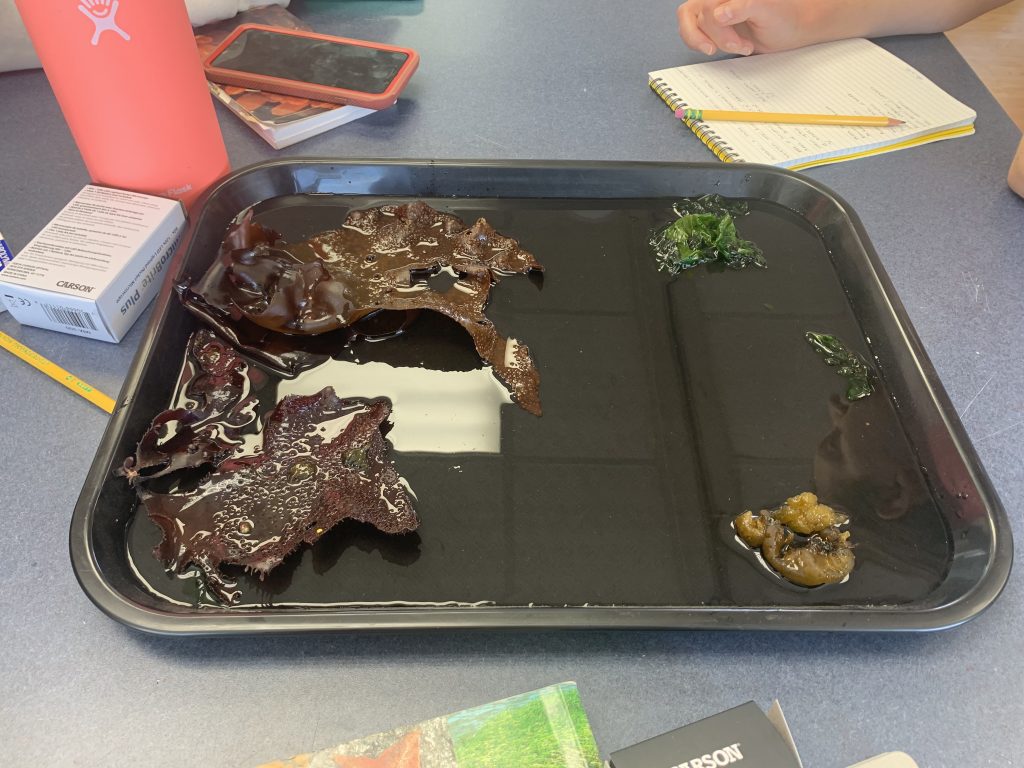
While we were enjoying the pretty sea stars, Tim was hard at work. He collected various types of seaweed and algae to bring into the classroom so that we could begin building necessary identifying skills. Derek Smith also joined bringing his container filled with Seawater. We took our picks of organisms and placed them on our desks to observe. The flipping of papers and googling of names occupied the entire classroom. We also learned the process of pressing algae to preserve the memories we made today. The combination of art and science left everyone excited for our future classes.
As we continue learning in the classroom setting, we also were given the amazing ability to look a couple years down the line through the young scientist panel. We heard from Morgan and Miranda, and also Sara Sarmiento-Ruiz—Salish Sea Sciences Communications Intern/Dorm Assistant and a recent graduate of St. Olaf’s College with majors in Environmental Studies and Mandarin (she also is a Salish Sea Sciences alumna!), Sarah Lincoln—a rising senior at MIT and researcher in the Vander Heiden lab at MIT’s Koch Institute, and Beatrice Grauman-Boss, a recent graduate of Wellesley with honors in Biology and Politics and Lab Manager and Technician for the Hemann Lab at MIT. Bea began her scientific journey studying echinoderm evolution and development at the Friday Harbor Labs. They gave great advice on how to get the most out of college experiences, research experiences, and how to apply yourself to different areas. This panel was not only interesting, it was also extremely influential and helpful when thinking about our futures.
Tonight’s presentation was hosted by Megan Cook, an ocean explorer whose primary work is Manager of Education Partnerships and Programs for Ocean Exploration Trust. She told us all about her own expeditions and the amazing things she’s witnessed aboard the Exploration Vessel Nautilus. She also described the Hercules ROV, which captures marvels of the sea, such as octopus laying eggs on hydro-thermal vents. The Hercules footage is live streamed daily on the Nautilus website, and Megan encourages everyone to tune in as she begins her cruise in July. Additionally, she stressed the fact that only 20% of the ocean has been explored! It has felt like such a privilege to be surrounded by so many brilliant scientists!