Day 23: “Why did the project workers take a break at the beach? Because they needed to “sea” the big picture!” -Caleb’s Imagination

Kindly recounted by Caleb Zulauf, Finlee Rice, and Tatum Bunting
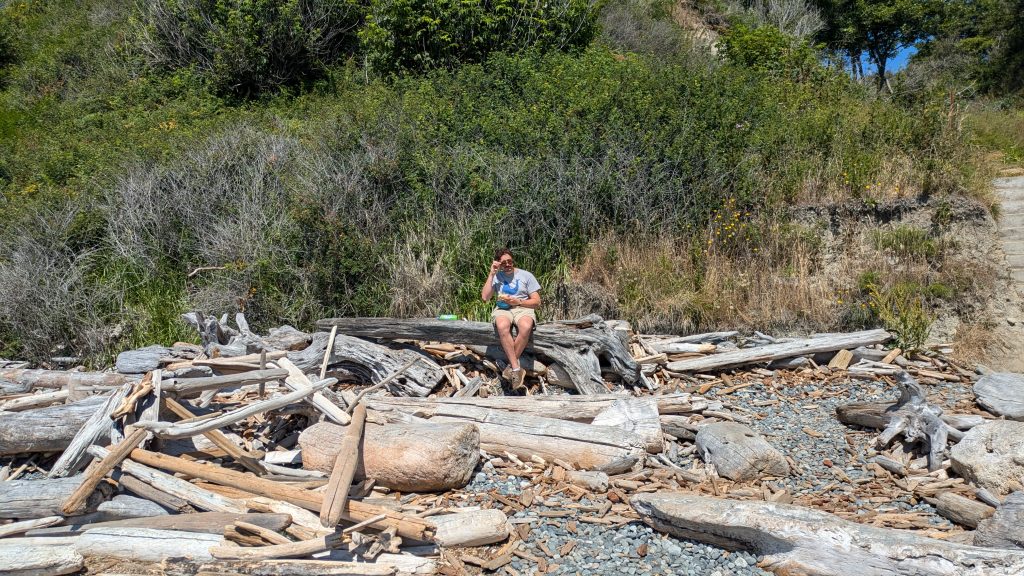
Co- Scientific Director Adam eating lunch at Eagle Cove – Photo Credits: Caleb

Today was a day. As we are all gearing up for the end of the program, the presentations that come along with it, and our posters that are due tomorrow at noon, we didn’t have much time to go out and about. For most of us, our day was dominated by statistical and graphical analysis, polishing our posters’ content, and struggling to format our long lists of acknowledgements. A few students working at FHL headed to the labs early this morning, for the first of their three trips of the day, to finalize data collection. 
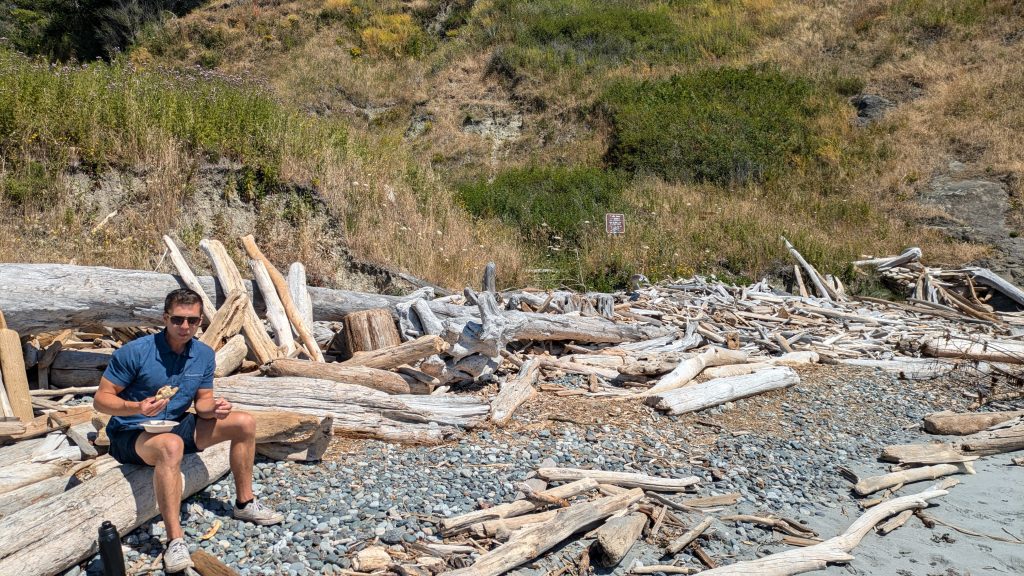
Co- Scientific Director Riley eating lunch at Eagle Cove – PC: Caleb

After a long morning of stress-fueled productivity, we regrouped at the dorms for a beach lunch at Eagle Cove.Scarlett, Nina, Max, and Caleb all went swimming while the others spent their time on the sand laughing and looking at the driftwood. So far, every workday has been broken up by a nice long lunch break, giving us students the much needed chance to touch grass and mentally refuel before returning to our work. 
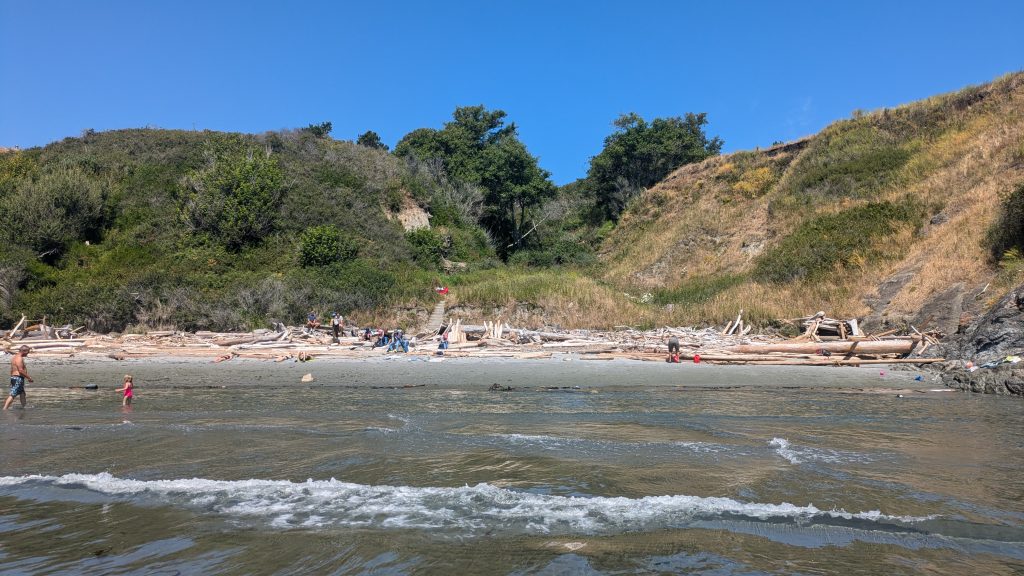
Eagle Cove from the water – PC: Caleb

The afternoon mirrored the morning in terms of productivity by the students. However, thanks to Cara, we could also snack upon delicious rice crispy treats, lemonade, and sweet tea from her very successful lemonade stand. 
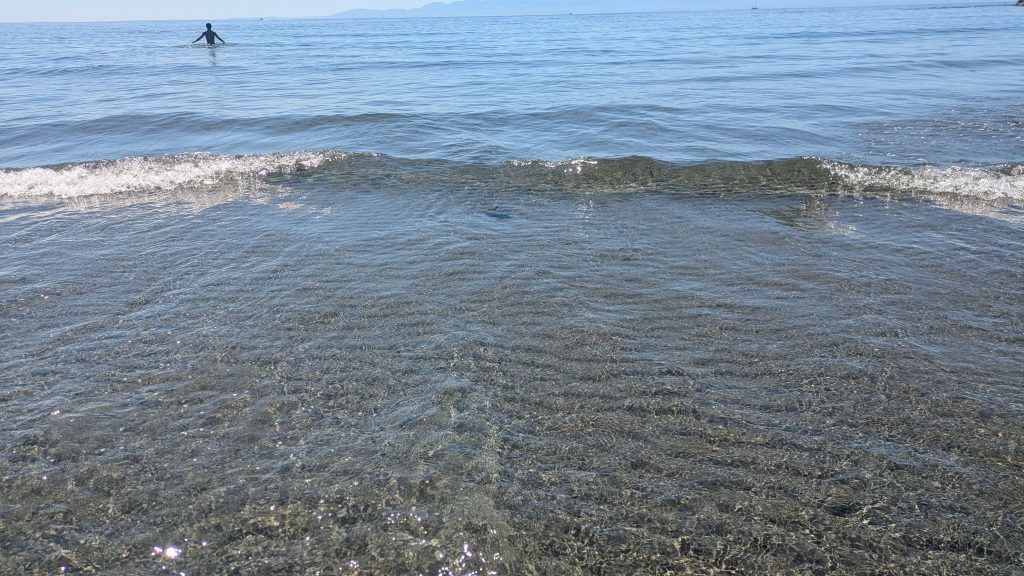
Water at Eagle Cove – PC: Caleb

Tonight Helen Yip and Dr. Joe Heras have been gracious enough to agree to join us for dinner and give a talk on both DEI and genetics. Ms. Yip has worked with WISEST (Women In Scholarship, Engineering, Science, and Technology) in order to promote the presence of women and genderqueer people in STEM (you can find the link to the very cool WISEST women-in-STEM posters here) and has a master’s in biology, with a focus on marine biology.  Dr. Heras works using gene sequencing to look at the history of evolutionary adaptations in fish. His research program also examines how gene expression and the gut microbiome of fish shape their dietary specialization.
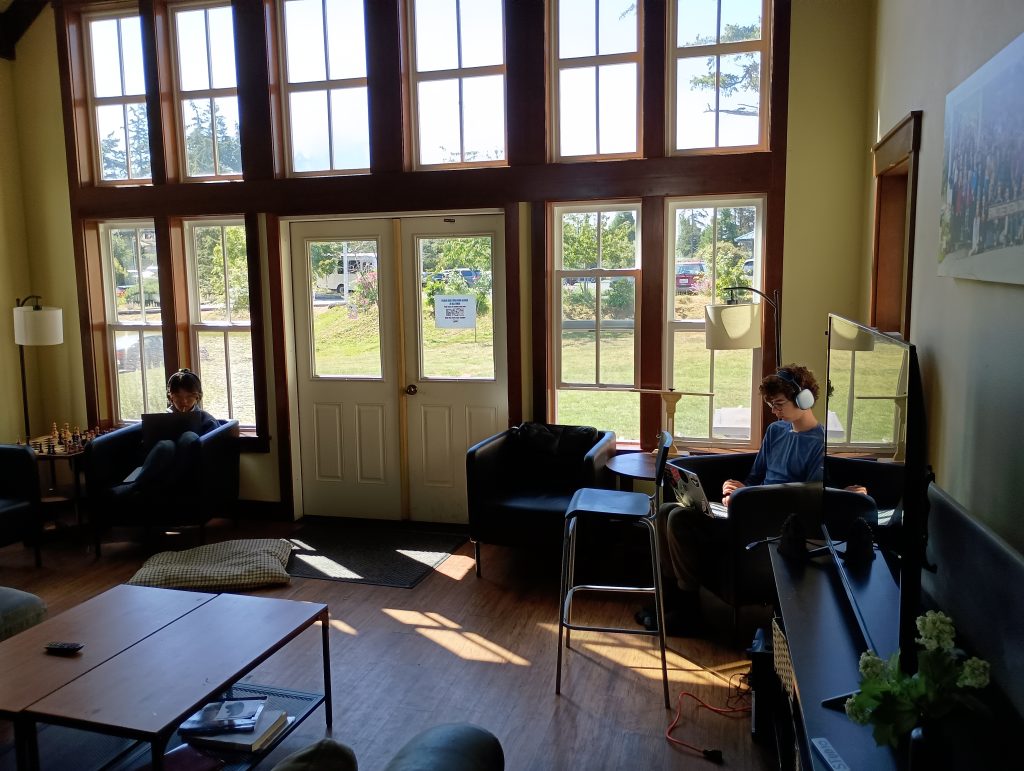
Sam and Katie working away on their projects – PC: Adam

Day 14: BUILT IN THE SILT

Kindly recounted by: Finlee Rice, Tatum Bunting, and Caleb Zulauf

This morning, Co-Science Director Adam Rogowski gifted us with a much-needed late start. After relishing in a chance to sleep in, we enjoyed a hot breakfast of waffles, eggs, sausage, bacon, and fruit.

Soon, the chaos of getting ready for the day ahead interrupted our slow morning as people slathered on sunscreen and pulled on boots. 

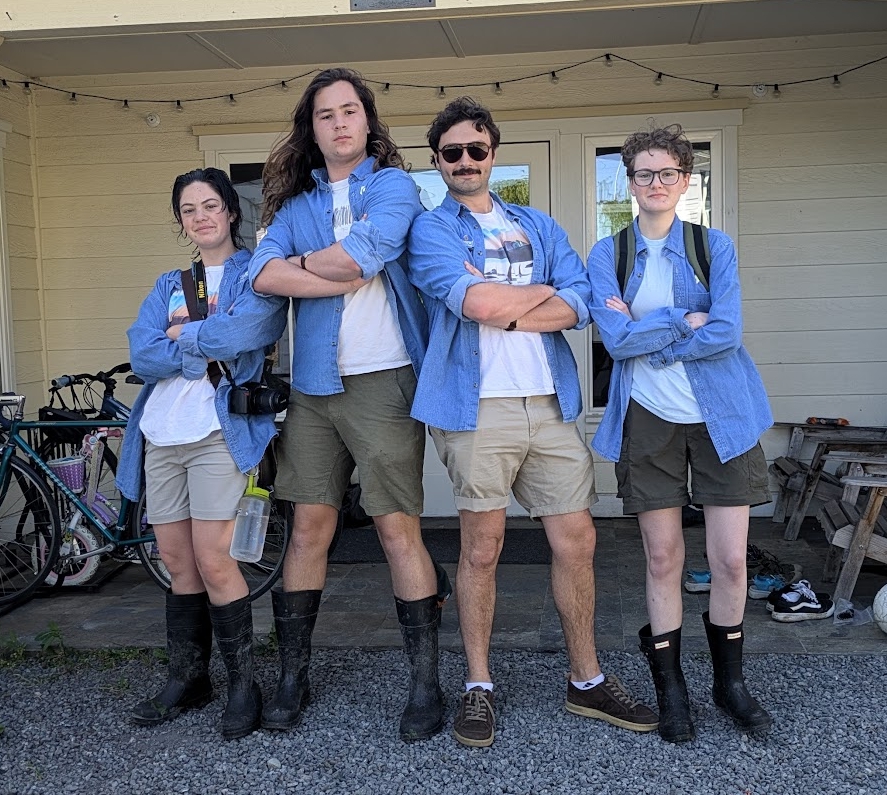
From left to right: Finlee, Caleb, Adam, and Gretchen, taken by Co-Science Director Emma Ledin

Adam arrived early this morning, and upon seeing his outfit, Caleb, Finlee, and Gretchen decided that in honor of all that Adam has done for us, the only logical way to share our appreciation would be to dress exactly like him. 

Once everyone was adequately prepared, we ventured off to Argyle Lagoon for a clam survey. 

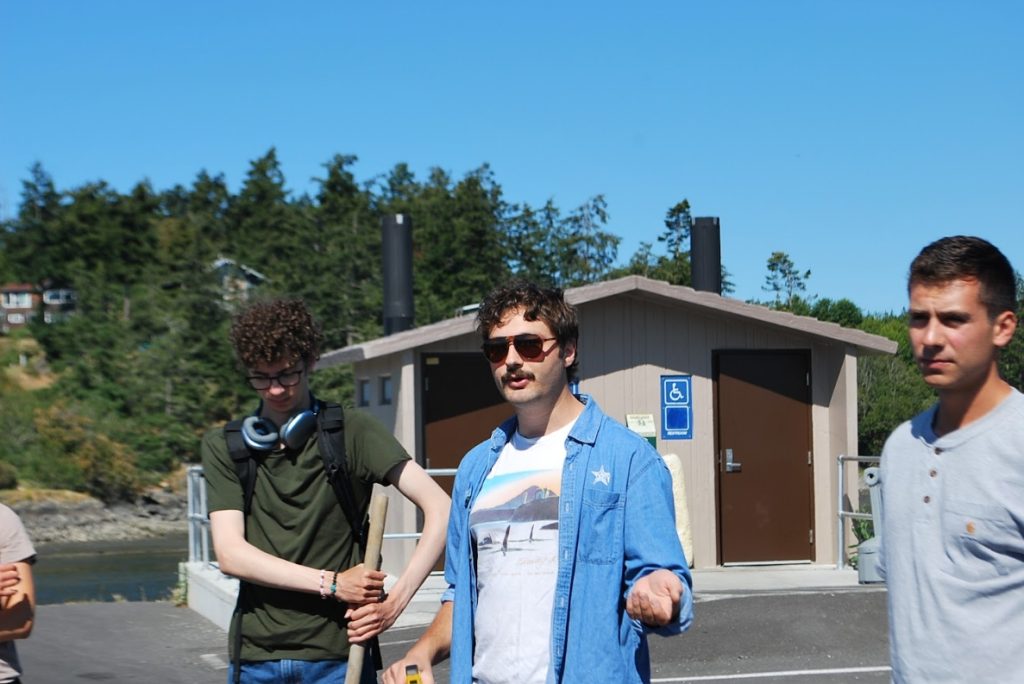
Adam and Co-Science Director Riley Conley talking to the group about Argyle Lagoon, taken by Finlee

After Adam humbled us all by handing out survey worksheets for third graders, we quickly proved our maturity by getting thoroughly stuck in the loose silty mud. We may have been handed an elementary school worksheet, but Adam and Emma worked to create a college-level discussion about the role of invasive species in the ecosystem, exploring how the data we collected will add to a decades-long survey of clams in Argyle lagoon. By the end of the morning, we even left with a Tupperware full of invasive varnish clams!

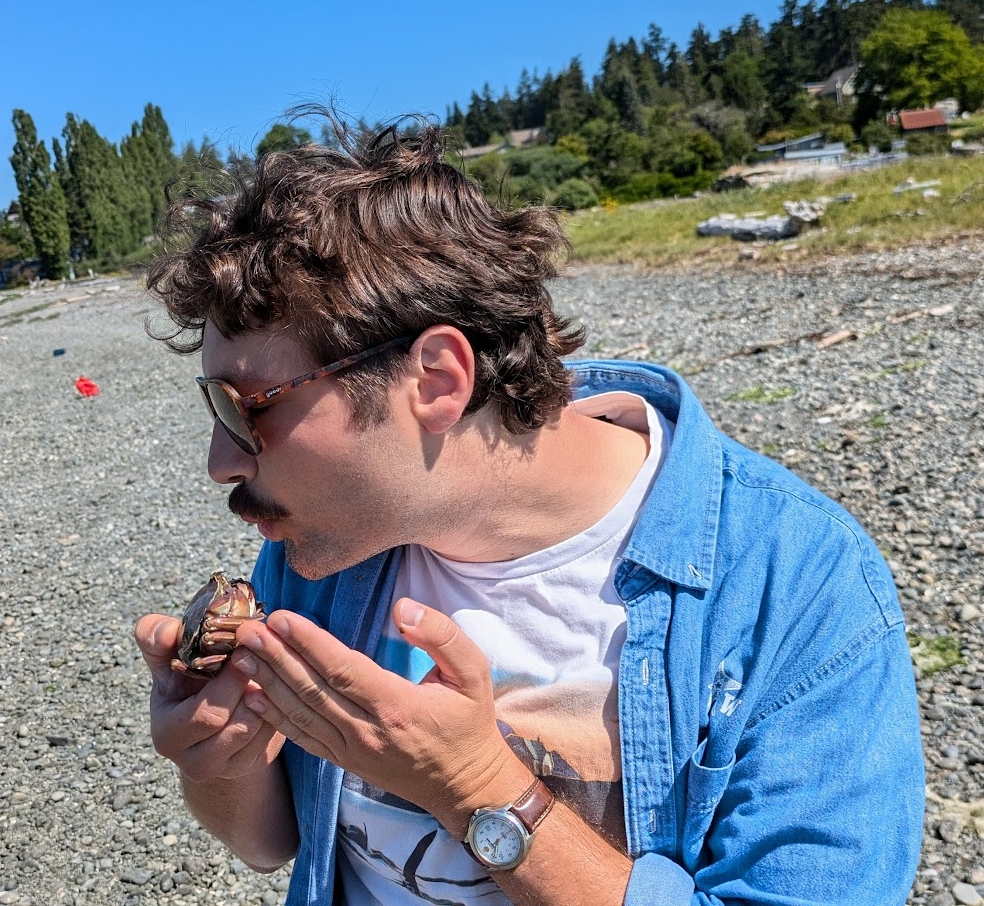
A Graceful Crab being kissed by Adam, Photo by Caleb

The rest of the day was mostly quiet. We all worked through our projects, asking Adam and Emma for help and encouragement. Over the past two days of more devoted project work time, more and more people are beginning to settle into and develop their ideas. So far, we have projects focusing on everything from limpets and lugworms to sea hares and sand dollar larvae. 

Soft shelled clams on a sieve taken by a thoroughly stuck Caleb

After picking Adam and Emma’s brain for any and all information we could get out of them, Adam took a few of us program members to FHL to look at some of the resources available to us. We took a look at the tide tables being provided to us by Dr. Billie Swalla, and talked to Michelle Herko about CRISPR. Unfortunately, some of the scientists we were hoping to run into were not available because they were preparing costumes for the “Invertebrate Ball”, a prestigious gala that happens once a year where all of the UW FHL students dress up as invertebrates for a night of fun. However, Adam decided that due to the fact that the ball serves alcohol, it would be inappropriate for 19 highschoolers to be present (some of us might just sit outside and look sad until someone lets us in though).

Tonight, we are lucky enough to be joined by Dr. Olivia Graham, an accomplished marine disease ecologist, Postdoctoral Research Associate at Cornell University, and a fellow at Friday Harbor this summer. We will look forward to discussing her current work on seagrass wasting disease. To learn more about her past work at FHL, check out this Tide Bite.

Day 9: “What do you do when you’re addicted to seaweed? You sea kelp!” -Dr. Becca Guenther

Kindly recounted by: Finlee Rice, Tatum Bunting, and Caleb Zulauf

We all rolled out of bed this morning, feeling refreshed from the night of rest following our kayaking trip. SOME ate breakfast while others slept in as we waited for the first post-sea-kayaking meeting with a scientist. Dr. Becca Guenther an accomplished scientist, professor, artist, and overqualified hot tub fixer upper with a Ph.D in Coraline Algae, gave an insightful lecture touching on the life cycles of algae, their uses, what qualifies an algae, and the polyphyletic nature of algae. She also made it amply clear that algae is already plural, and that “algaes” is grammatically incorrect.

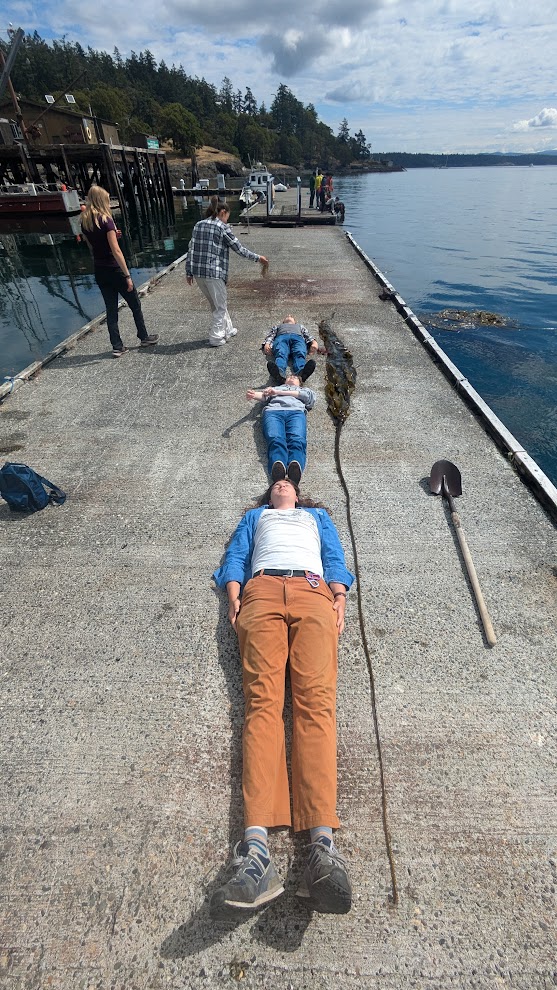
From closest to farthest, Caleb, Gretchen, and Ben lay down and measure up against a collected bull kelp on the Friday Harbor Labs docks, as Nina (far left) walks by with Scarlett (to Ninas right) who feeds ben some seaweed.
(photo credits go to Tyler)

Once our interest in seaweeds and algae was appropriately piqued, we ventured back to the increasingly familiar Friday Harbor Labs. Armed with buckets and shovels, we spread out along the docks to collect algae and seaweed samples for pressings. Tires, leveraged onto the dock with the ends of shovels, proved treasure troves for interesting specimens of seaweed (and a few well-dressed kelp crabs, sea squirts, and sponges). After a few water fights with rockweed vesicles and a bull kelp horn solo (courtesy of Sid), we lugged our overflowing buckets back to Spring Street.

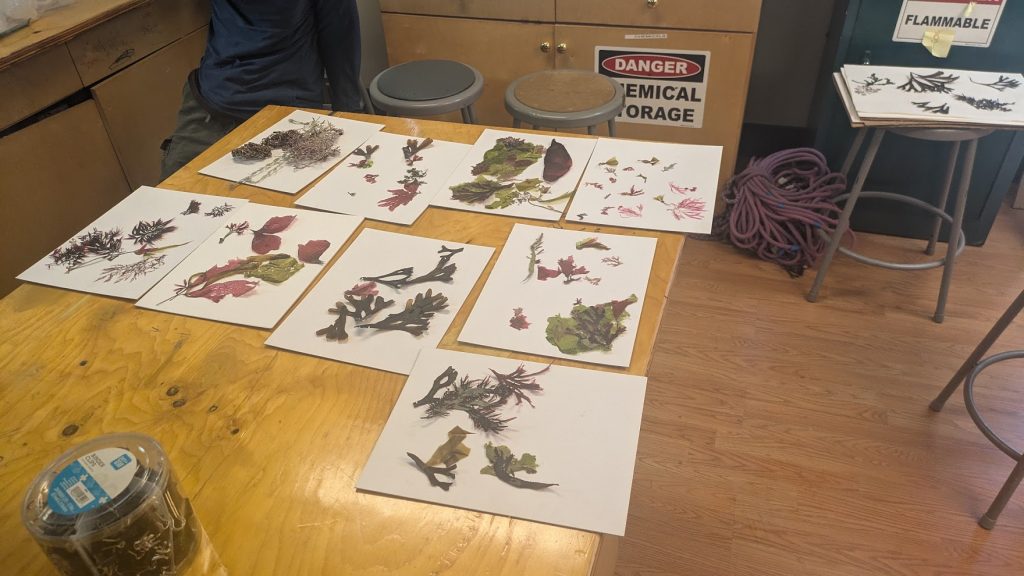
Dried and flattened seaweed, collected by Dr. Guenther
(All further photos by Caleb)

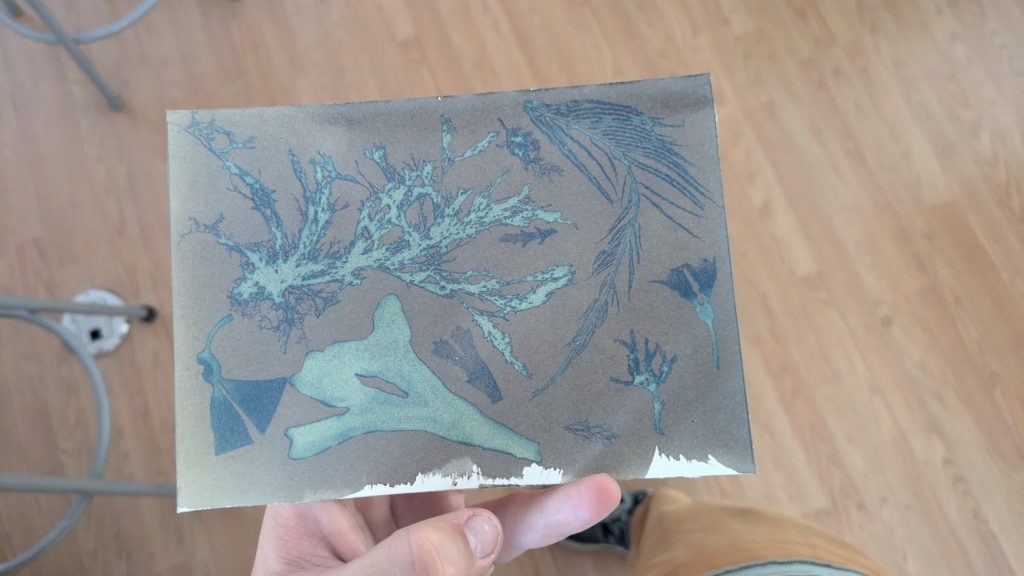
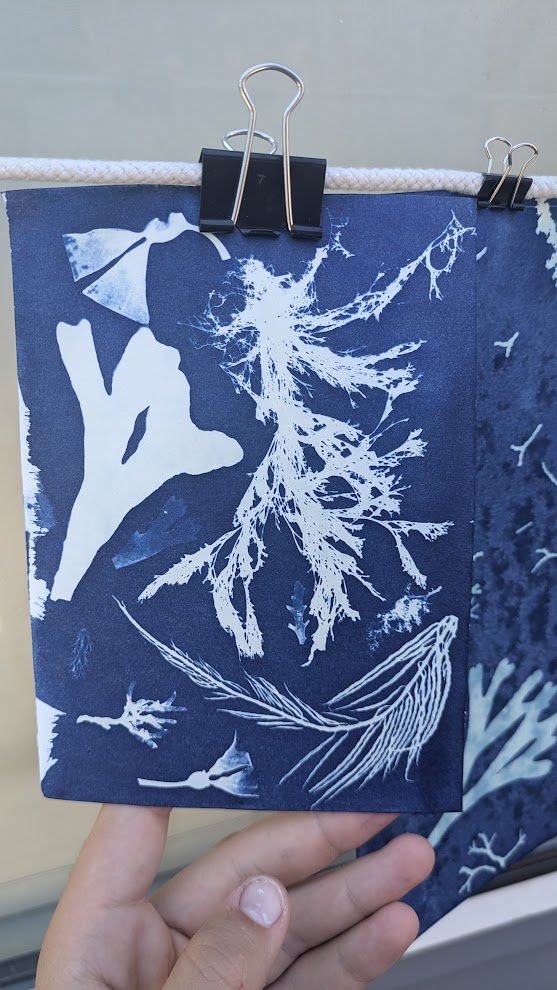
Once back at the science rooms, we started by setting up our seaweed presses in which we carefully arranged different seaweeds. Some of us made pictures while others simply arranged them in a pattern. From there we layered them between cardboard and blotting paper and placed them in a press. In a few days we are going to remove our pieces of art and observe how they have changed with time and pressure. After clamping our press down we got going on making cyanotypes. We took previously pressed and dried algae and placed them on photoreactive pieces of paper, left them in the sun to photoreact, and finally washed them in water and a diluted H₂O₂ solution and let them dry. All this work resulted in vibrant blue backgrounds with the white negative space of algal specimens.

Cyanotype after being exposed to the sun but before being washed.
Cyanotype post wash.
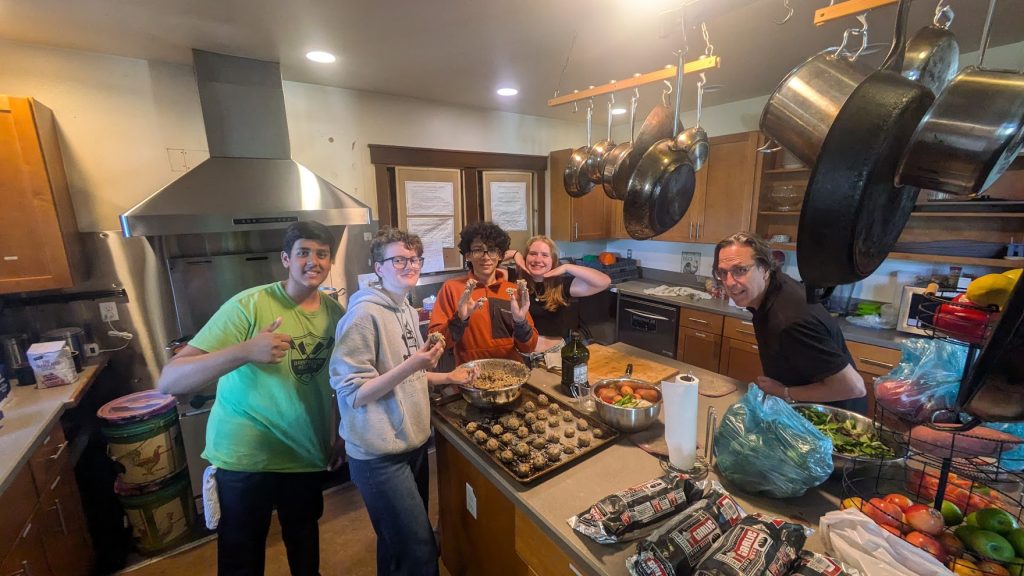
Dinner crew requested to be put in the blog during its making, so here they are making vegetarian meatballs for our guest (Dr. Sandy Wyllie Echeverria (check out some of his incredible work about eelgrass here)) as well as all the students and staff.
Listed left to right is Sid, Gretchen, Ian, Morgan, and Tom.

Day 6: Start to Our Kayaking Adventure

Hey Blog, it’s Caleb! The one that keeps getting called out. Anyhow, today we all woke up early, and took two vans. The first took us to a primary location (Port of Friday Harbor), and the second took us to a secondary location (an undisclosed beach). Anyone who has watched a decent amount of John Mullaney would know that Detective J.J. Bittenbinders first rule is to never get taken to a secondary location because if you are taken to a secondary location your chances of getting saved drops to zero. J.J. Bittenbinder apparently isn’t always right because when we arrived at the secondary location they did not handcuff us with zipties, but instead, put us in lovely kayaks! 

Once we had finally finished struggling to pack up the kayaks we suited up in lifejackets and spray skirts and then got our pedals situated for our varying heights and leg lengths. I feared it would be difficult for me due to my larger stature, and my fears were not assuaged when I was referred to as “big guy” by one of the guides.

All of us in kayaks. Photo Cred: Millie

Anyhow, once we were all situated, we launched and started paddling towards our lunch spot at Turn Island. We stuck close to the coast and coasted on the counter currents to gain a bit of a boost. There was one rock we passed that was absolutely covered in seals that hopped in the water and poked their heads out. The water was covered in little seal head bumps, all rather curious about some dinky teenagers in some weird fiberglass vessels. 

After getting to our lunch location and consuming sustenance we explored the beach we were stopped at and I found some fresh oysters attached to some rocks. I shucked one oyster and ate it raw on the halfshell even though I was warned there was a 50/50 chance of me getting sick from eating it, but you know, life isn’t worth living without a few risks. In this case I lucked out and was perfectly fine. 

Me with the open oyster and Stella looking very confused. Photo Cred: Millie

After paddling a total of ten miles we finally made it to our campground! After dinner we went on a night hike to the beach where we observed bioluminescence. We enjoyed throwing rocks into the water and watching all of the bioluminescence that was activated. After the bioluminescence we all went to our tents.

All of us bonding right after our long day. Photo Cred: Millie