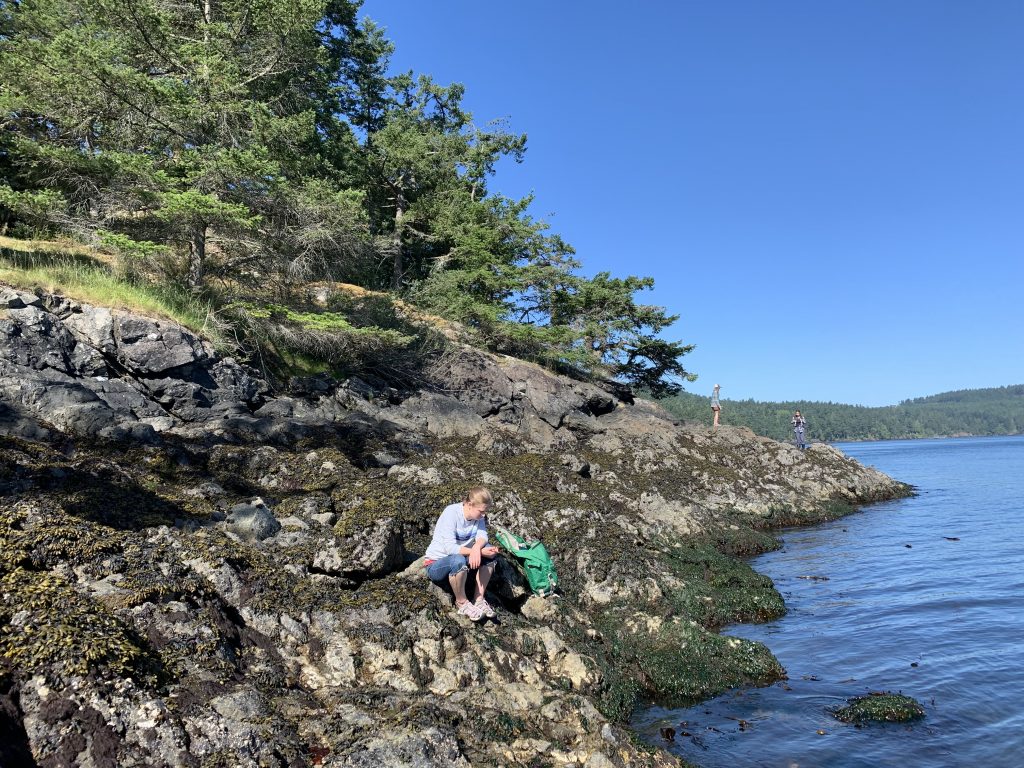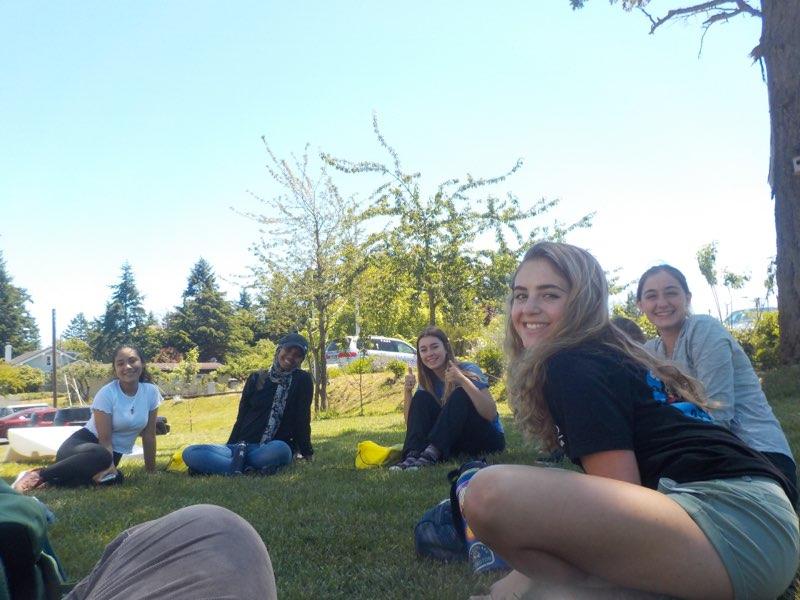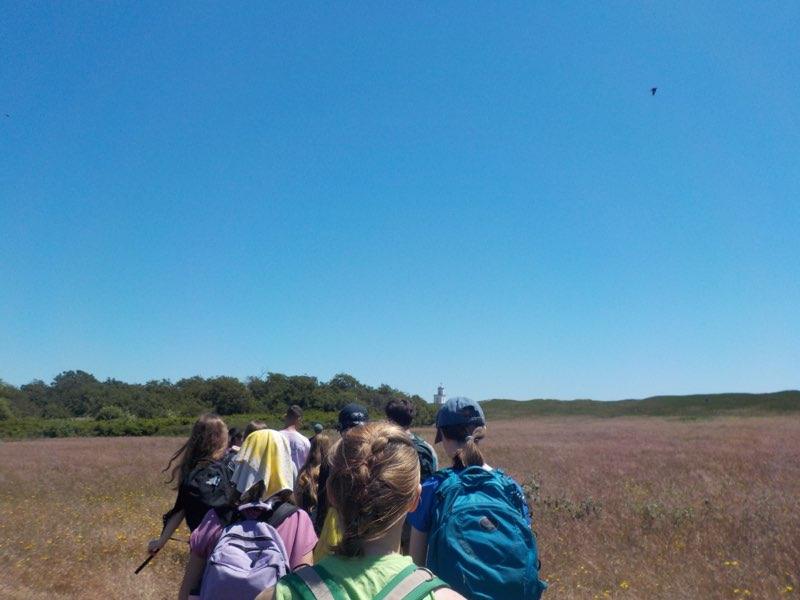
Day 9: Seals and Mountains

We woke up excited and got quickly on the move. Today we had the amazing opportunity to observe a necropsy. The San Juan County Marine Mammal Stranding Network (SJCMMSN), based at Friday Harbor’s Whale Museum, had found two harbor seal pups and would be working on them on the table this morning in collaboration with Dr. Joseph Gaydos, wildlife veterinarian and Chief Scientist for the SeaDoc Society, flagship program of the Karen C. Drayer Wildlife Health Center at the world-famous UC Davis School of Veterinary Medicine. We received the signed book written by Dr. Gaydos and Audrey Benedict, The Salish Sea: Jewel of the Pacific Northwest, as a welcome gift when we were accepted to the Salish Sea Sciences Marine Field & Lab Research program.

The summer months in the Salish Sea are also seal pupping season. Around this time, mother seals give birth to their babies who begin their journey in the ocean. Unfortunately, about half of the pups never make it to adulthood as harbor seals have reached their carrying capacity in the area. This results in more seal pup deaths which the SJCMMSN performs necropsies on.

The goal of the scientists in this setting is to try to determine the cause of death of these baby seals. Data they collect from the necropsies can be used to create effective policy to better protect marine mammals.

The cohort wasn’t sure what to expect upon arrival. Would the body smell? Would people get sick? Would it be super gross? Perched on the dock looking below, we all wondered. 

Before they cut open the first animal, we were invited down to the table to touch the dead seal pup—with gloves of course! Feeling an intelligent animal you’ve only seen from afar is a special experience that cannot be replaced.

Things did get pretty graphic, but the group handled it pretty well. We left the ideas of grossness behind and delved into exceptional science and anatomy questions. The whole experience was thrilling. 

They can’t be certain the exact cause of death from just the necrosy, but guesses were made. The next step in the process is to send the samples they collected down to a university in Florida for further examination.

Unfortunately, we can’t post photos from the necropsies, per the advice of the scientists. 

After our time at Friday Harbor Labs was up, we headed to Argyle Lagoon to study detrital composition . There we had a quick lunch and met up with marine ecologist Dr. Eliza Heery, the MarineGEO Hogan Postdoctoral Scholar for Salish Sea Research. Marine Global Earth Observatory (MarineGEO), directed by the Smithsonian’s Tennenbaum Marine Observatories Network (TMON), is “a global network of partners focused on understanding how coastal marine ecosystems work—and how to keep them working.” Dr. Heery taught us about detrital decomposition and graciously let us help her set up devices to measure sediment microbiomes. 

The survey hopes to test the hypothesis that eutrophication reduces carbon storage and increases the rate of decomposition. This can vary the microbial biodiversity of a body of water, which are essential to ecosystems. The survey also serves to measure the link between climate change and water quality. To measure this, devices made up of rebar, pvc pipes, zip-ties and tea bags had to be inserted into the sediment, under about a meter of water. 

Excited to help out with these surveys that are taking place all around the world, our entire cohort waded into the  cold water without complaint. We buried the devices in the sand and are looking forward to seeing the results of the surveys. 

After we were thoroughly soaked, we jumped back into the van and headed back to the dorms. Once we hosed off our equipment and boots, we all settled down to learn about our upcoming canoe trip from Caroline. 

We will be splitting up into two groups in the coming days to either set off on a canoe voyage to Turn Island or to stay in Friday Harbor and work on our independent projects. All of group one (including the authors of this blog) are really excited to head out on our trip!

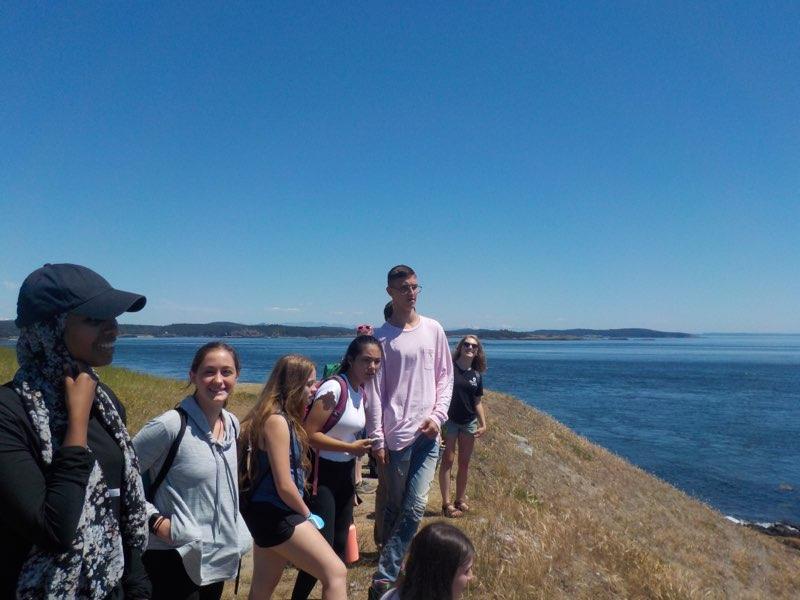
For a picnic dinner we took an adventure to the ridge of the Mount Grant Preserve, 250 acres diverse forest, woodlands, meadows and incredible view, where we had a great talk with Doug McCutchen about the work that he does with the San Juan County Land Bank. The Preserve is managed in collaboration between the Land Bank and the San Juan Preservation Trust. Doug talked to us about the process and work they put into conserving land in the islands. 

Wow! Us standing on Mount Grant! – Photo taken by Estevan Torres

Day 8: A Hot, Hot Day

Brought to you by Meg, Hebaq, and Maddy!

Today has been full of adjustments and attempts to cope with the rising temperatures. For the majority of us, ninety degree weather is a whole new territory; a few others mock us weak PNW locals for being so sensitive to the heat (yes, we mean the California folk). The heat affected us all, especially at the start of the day when we discovered the difficulty of waking up in very warm and humid rooms. From there, we gobbled up our breakfasts and headed down to our next adventure: the Friday Harbor Labs! There, we observed the light trap Tim placed in the water just days before.

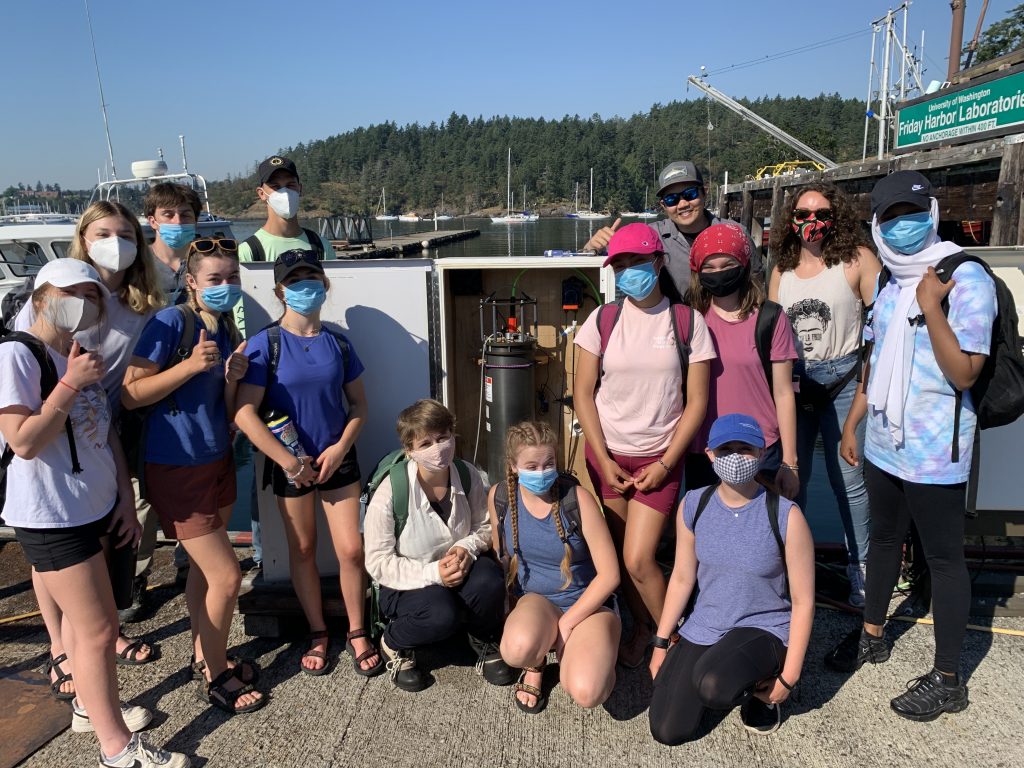
When we arrived, Sam Garson and Dr. Kirk Sato were there to guide us through the mechanics of F.H.L.O.O. (Friday Harbor Labs Ocean Observatory). F.H.L.O.O. is a brand new development for the island; it tracks pH, salinity, turbidity, carbon dioxide, oxygen, temperature, conductivity, and chlorophyll. Although these abiotic factors can be measured in other ways, the F.H.L.O.O. is special because it measures and records this data hourly (or half-hourly). Because F.H.L.O.O. is a digital, computational system, Kirk and Sam also taught us a bit about the roles of computers when working in Marine biology.

A group picture of everyone standing in front of the amazing F.H.L.O.O (Photo: Tim)

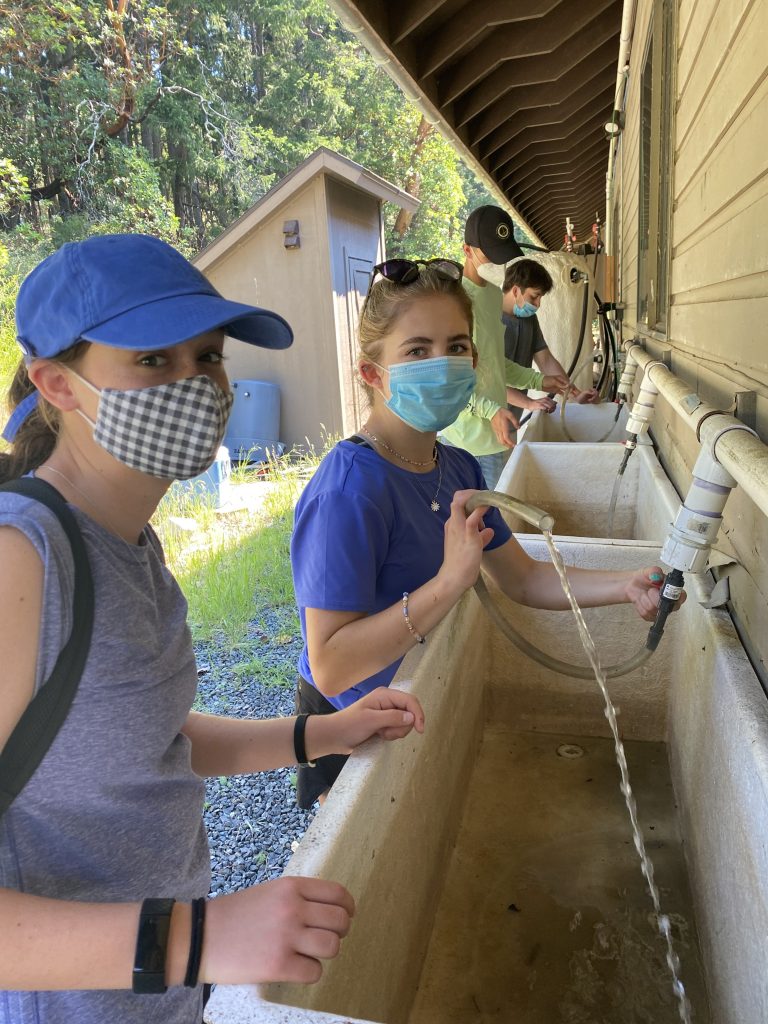
We found a break from the hot sun under the shade where we cleaned out saltwater researching tanks/sinks to prepare for our upcoming individual projects. We unclogged PVC pipes and learned the intricate saltwater system that allows for scientists to keep animals comfortable throughout their projects. As cool as it was, we will admit it was very dirty. We stuck a small metal rod up the pipe in an effort to release the pressure of the water. Although it was helpful, our help came at the expense of some of our clothes. After a while of scrubbing, we headed down to look at the shore. On our way down the rocks, we were thrilled to see a river otter on the beach!

Naomi and Colette clean a seawater tank at FHL! (Photo: Maddy Glaser)

Afternoon

We made our way over to the dorms to begin the second half of our day, expecting to begin a lesson at the labs. However, Tim let us know that the building was smoldering hot – far too hot to host a class. We transitioned the class over to the dining area, where we appreciated the newly discovered AC. Then, Tim presented us a few commonly used tools in the science arena. From Niskin Bottles to Secchi Disks, our understanding on what we have the ability to test while on our canoe expeditions expanded.

The whiteboard after one science lesson and many, many drawings. (Photo: Maddy Glaser)

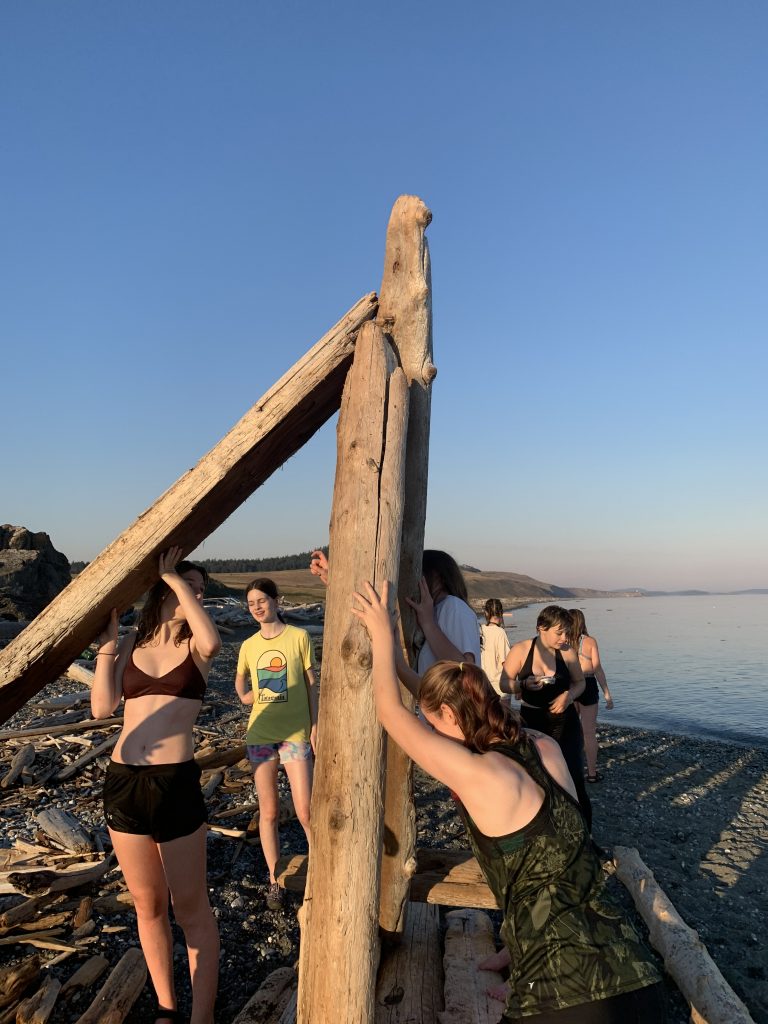
Driven by the curiosity of how pH and CO₂ measurements correlate, we also dug into the chemistry of the ocean (chemical oceanography), led by Tim. Some of us were finally able to see the struggle of Chemistry class pay off. We wrapped up the long, hot day with a picnic at South Beach; we packed paper bag meals and towels and headed down. Although the heat was nearly unbearable at times, we’re all glad we were able to get through it and are hopeful that the rest of the week will be much cooler. See you tomorrow!

An attempt at fort building on South Beach. (Photo: Sara Sarmiento)

Day 7: S’mores and More

Hey everyone! It’s Andrea, Islay, and Sonja again! Today was a very exciting day of munching, napping, ferry-ing, swimming, mutilating marshmallows, looking at plankton, and so much more! I hope you enjoy hearing about it!

We got some extra time to sleep in today, but nobody slept in except for Ana. The morning was very chill though it was super hot out. We all woke up, ate breakfast, and then watched Moana. Somebody probably did laundry, but I didn’t ask.

Look at this pretty view. It is so pretty and a view. Photo taken by Andrea.

After getting ready in the morning, we got some time to work on our independent projects. A few of us went out on a boat to go to Lopez Island. At Lopez island, we surveyed for sea stars and looked around on the rocks. It was super interesting though we had to watch out not to get sunburnt!

Decked out in hats, shades, and sunscreen, we (the people not on the boat) took a trip to the ocean survey zone at Friday Harbor Labs. We collected samples of plankton with nets, containers, and other various lab materials.  After scooping them up with tiny spoons, we crouched over the dishes of plankton with our microscopes.  By the end of the observation and identification session, we were all beautifully adorned with dents from the rocky concrete. Nevertheless, it was worth it since we got to see various spots and dots that the adults promised were actually animals.  

Once everyone regrouped later in the afternoon, we all decided to head down to Jackson’s Beach. As we walked into the water, we were all shocked by the cold, and yet we all stayed inside for a solid ten minutes. Seth decided to swim to another island.  He was successful! Resting in the sun was a good way to warm up. We listened to music and looked at the passing dogs and people with cool tattoos. Some people got a good swim, while others, like me, watched and relaxed.

Say “apostichopus californicus!” Pictured are Madi, Abby, Islay, Colette and Ana.

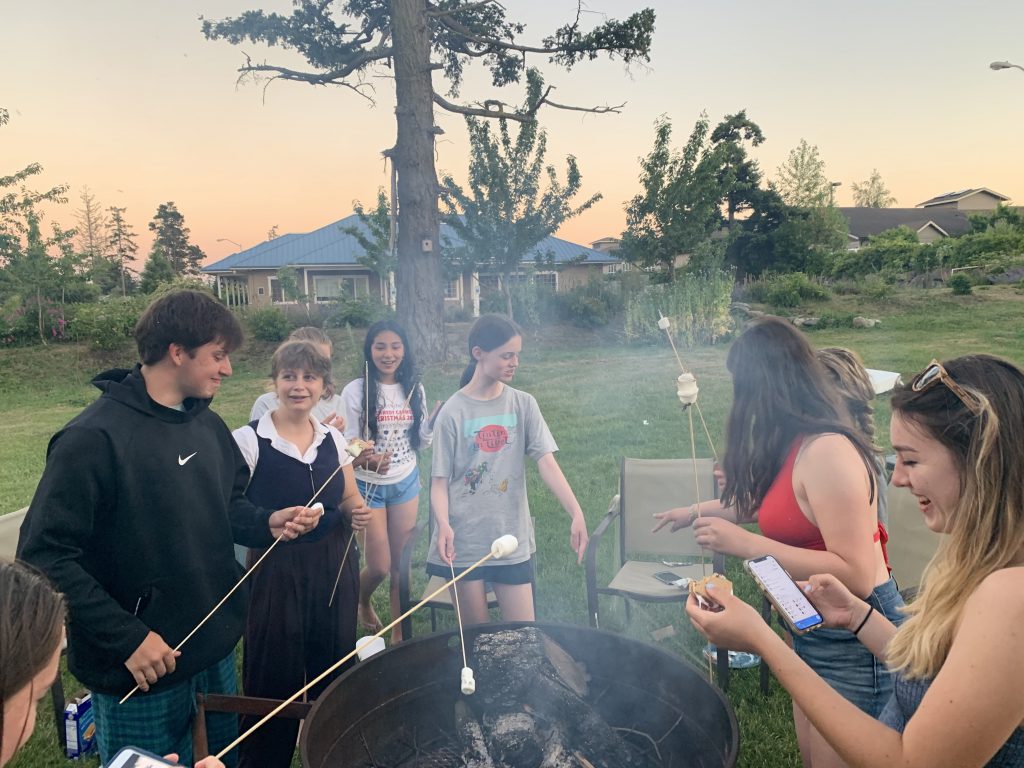
Four hours at the beach was a lot, so we decided to head back to the dorms. We started to make hot dogs in the oven and ate them around the fire. Kira, being the special person she is, decided to roast her hotdog in the fire. Good for her. Craving something sweet, we all decided it was a great idea to make some s’mores.

Joyous expressions!

It was such a great time for most of us except Sonja. She got smoke in her eyes. She’s ok now… I think.

Lighting everything on fire. Photo by Islay.

Overall, the day was a blast! It was nice to get some time to relax after spending so much time being scientists this past week. We also really enjoyed working on our independent projects and bonding with each other. I really like smores. Go make some. Thanks for reading!

Day 6: Fun in the Sun

Written by Elliott Jones, Kira Bretsky and Dustin Hendrix Photos by Kira Bretsky and Elliott Jones

We began our day by learning yet another Knot of the Day: the Sheet Bend, which is a helpful knot for tying together two lines of different diameters.  We discovered Tim is not the Master of Knots we thought he was, as he first demonstrated the same knot we had learned yesterday and then was required to look up the Sheet Bend in order to teach us correctly.  After we had all semi-successfully figured out how to tie our latest knot, we received more advice on how to get through the increased temperatures approaching the region.  Hydrate! Drink water! Intake fluids! Gulp it! Slurp it! Sip it! Better yet, guzzle it!  Anyway, you get the idea.  

Laughter during low tide! Photograph taken Sara Sarmiento

Then we went to the Lab located on campus to digitally input the lugworm data we had collected yesterday.  Tim explained the importance of quality assurance/quality control, especially in large data sets such as the one we had.  (Collectively, we had 600 values to input into a spreadsheet!)  We also learned a couple shortcuts for copying or inputting values with a pattern (for example, 1, 2, 3, 4, 5, 6, … all the way to 100).  

While the lugworm surveyors were inputting data, yesterday’s Sieve Team checked on their sediment. The night before, they had transferred sand of different densities from each of their respective Ziploc bags into aluminum trays. The aluminum trays were then placed into a dryer oven (to evaporate liquid from the sand), which was definitely smelling funny by this morning.

Various teams hard at work, setting up measurement tools for our surveys.

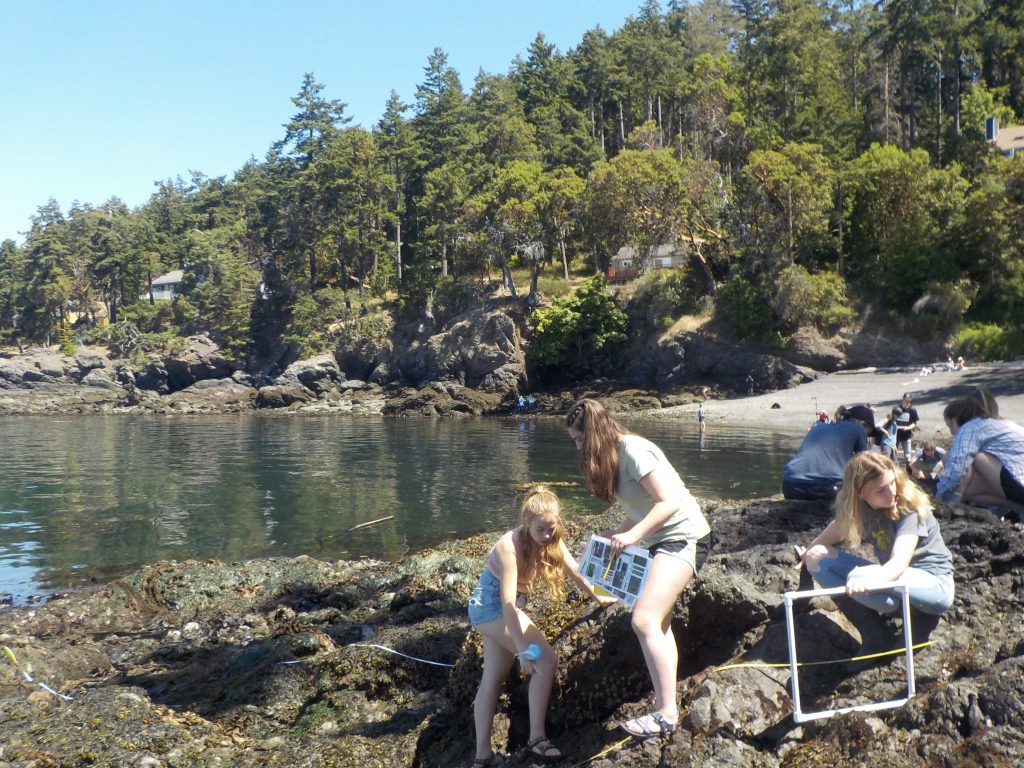
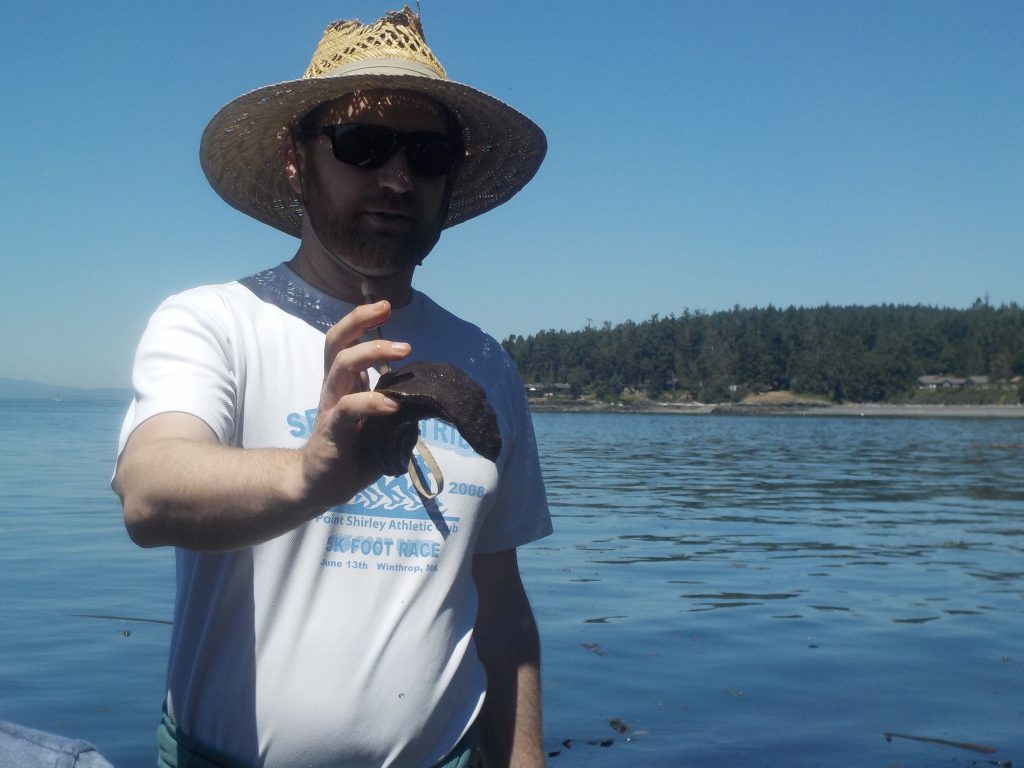
After we put in our data from yesterday, we went to San Juan County Park to collect data on what was near the shore in certain sections. We split into 5 groups of three to check the shore about every meter to see what occupied the area of about half-a-meter. We mostly found different types of seaweed and barnacles. It was quite slippery, and you should definitely ask Maddy and Kira about their pants. Tim showed us an Apostichopus californicus (which is just a fancy scientist term for Sea Cucumber), as well as a Chiton, and we passed them around in a bucket before returning our new friends to their homes.

Here, Tim is holding the Chiton we found.

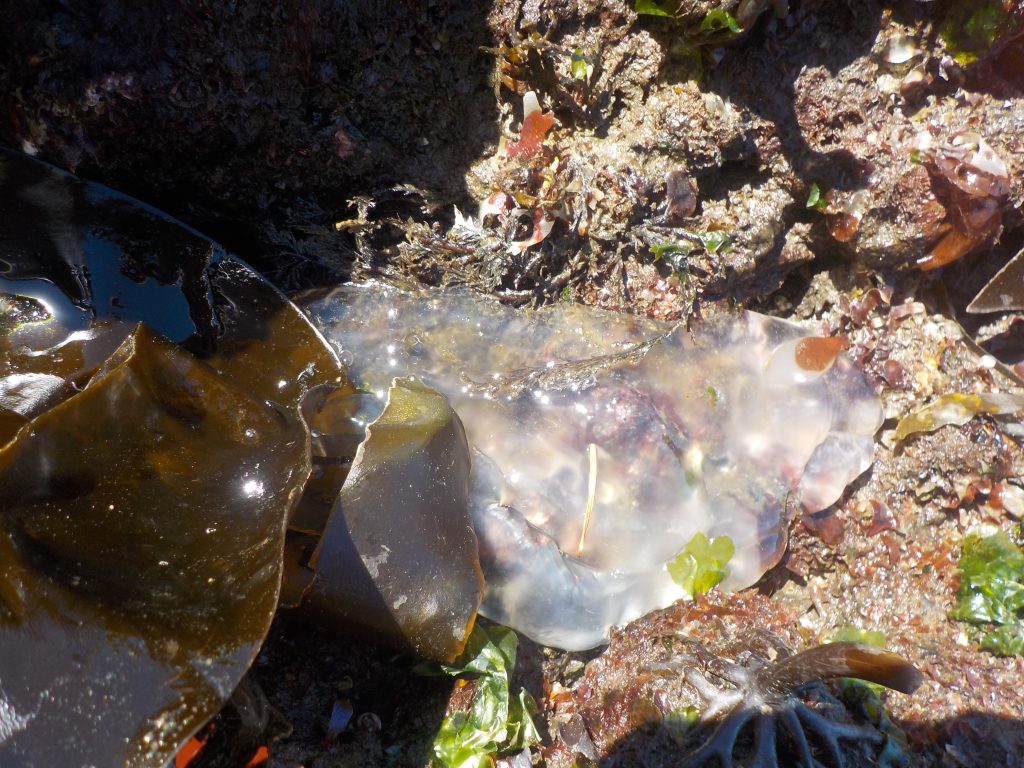
As time moves on, we’re thinking more and more about our projects. Some of us are researching Nudibranchs, while others have taken an interest in Zooplankton photography and Jellyfish in general.

A stray Jellyfish in the Intertidal Zone. This is the only one we saw out of the water.

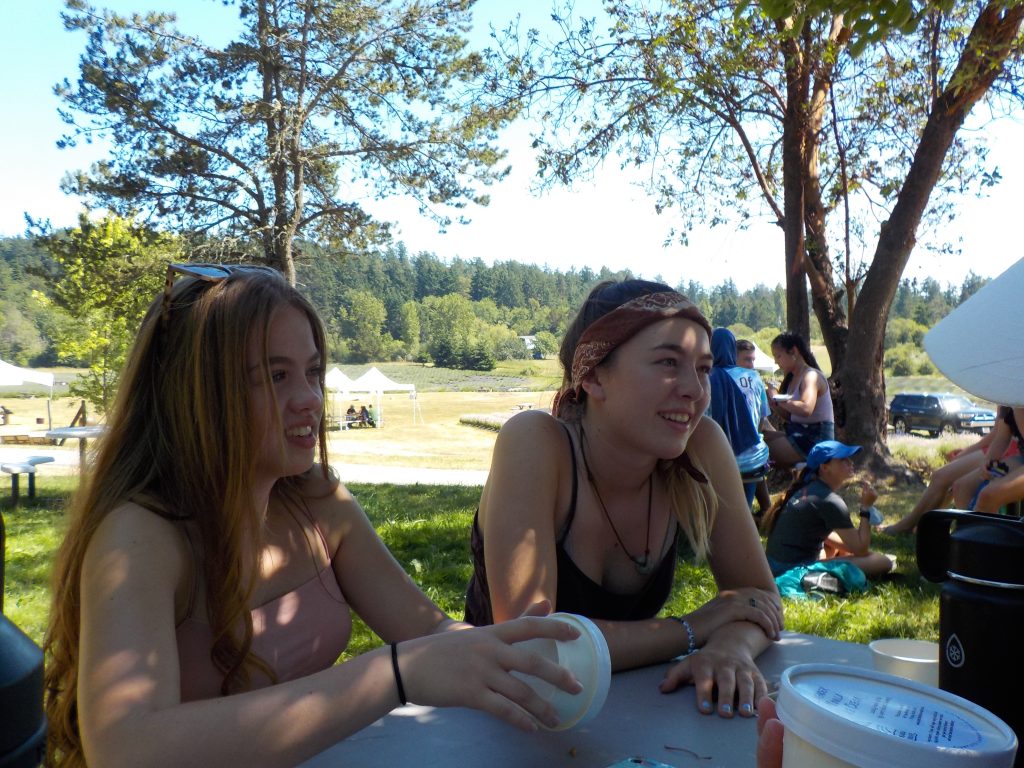
Our afternoon was hot and smelly. The bad kind of hot, and the good kind of smelly. Now before you think we’re weird (we’re not, just keep reading) we’re talking about the smell of lavender. After we stopped back at the dorms to change into something nicer and grab our small bags and some cash, we headed to a local lavender field that was nearby. Most of us took pictures of each other and of ourselves. The lavender fields smelled amazing and it was really beautiful. We also got to try some lavender ice cream, which they had many flavors. There was lavender lemon sorbet, lavender vanilla, lavender chocolate chip and lavender chocolate. Basically they had a lot of lavender which makes sense since it was a lavender field. Overall, it was a great day even though it was very hot but we’ve been finding ways to beat the heat and just finding fun ways to enjoy the sun. 

Ana and Islay with their lavender ice creams. Maddy (across the table, not pictured) has some interesting opinions on the ice cream.

Remember, HYDRATE HYDRATE HYDRATE!!!

Day 5: Looking for Lugworms

Written by Naomi Scott, Ana Matteson, and Seth Hallbert

Heading Into Heat

Our days on San Juan island are flying by! Though we’ve been here only five days, it feels as if we’ve known each other for weeks. The breakfast room atmosphere is as lively as the bustling Lugworm networks beneath the False Bay sand. 

Once we’d fueled our bodies for the day ahead of us, we completed our daily knot, the square knot. Our maritime skill improvement session was followed by a reminder to stay cool, hydrated, and protected from the sun as we head into a record-breaking heatwave that will sweep across Washington, Oregon, and other areas of the Pacific Northwest.

Talking about Tides 

Up first on the agenda for the day, we headed to the Spring Street International School science lab for a tide-chart reading lecture from Tim. As we reached into the back of our brains to remember our third-grade tide cycle lessons, Tim explained how the Salish Sea and surrounding area experience mixed tide cycles and currents.

When a location experiences mixed tides, it doesn’t have the consistency of the similarly sized, two high and two low tides every day that locations with semidiurnal tides experience. Instead, it’s more varied. 

As a refresher for those of you who are also trying to reach into the back of your brains to remember your third-grade tide cycle lessons, when the sun and moon are in line, during spring tides, they pull water towards them causing the tides. 

FHLOO (pronounced “flu”)

After a short break, we returned to the labs to speak with Mr. Samuel Garson, a researcher at FHL and high school biology teacher at Friday Harbor High School. Sam told us about his work with ocean observation systems, and how the Friday Harbor Labs Ocean Observatory (FHLOO) is using a variety of equipment and data loggers to survey the water around FHL.

Sam and his fellow researchers are responsible for the brain of the observatory, otherwise known as “The Dock Box,” on the FHL dock. The different equipment in “The Dock Box” collect data regarding the salinity, turbidity, pH, oxygen concentration, and more of the surrounding water. 

Sam showing us the FHLOO survey site on the NANOOS NVs data explorer page

With the assistance of a technologically advanced data logger, all of the collected numbers are recorded in uniformed files every thirty minutes, and uploaded to the Northwest Association of Networked Ocean Observing Systems (NANOOS) NVS data explorer page

Look at the NVS website and zoom in on San Juan Island to see FHLOO’s site!

    Sam said that all of this data could not only be used to identify potentially harmful algal blooms, but it is all accessible to the public. This means that students and researchers across the world can use the data recorded on this site, and questions that haven’t even been asked yet can be discovered through the observation of these records.

Looking For Lugworms 

Starting off in the classrooms left us with more energy for our lugworm collections at False Bay in the afternoon. After a lovely lunch break, we headed out to False Bay on the Southwest side of the island. While at False Bay, we hoped to record the population of lugworms, large marine worms in the class of Polychaeta, that lived on the beach. 

These little creatures are extremely helpful in overturning dense sand and enriching it with minerals like oxygen. They do so by ingesting the mud-like sand and excreting fecal casts of clean sand.

Fun fact, False Bay got its name from the way it completely fills when the tide comes in, then completely empties when the tide goes out! Here is False Bay at low tide.

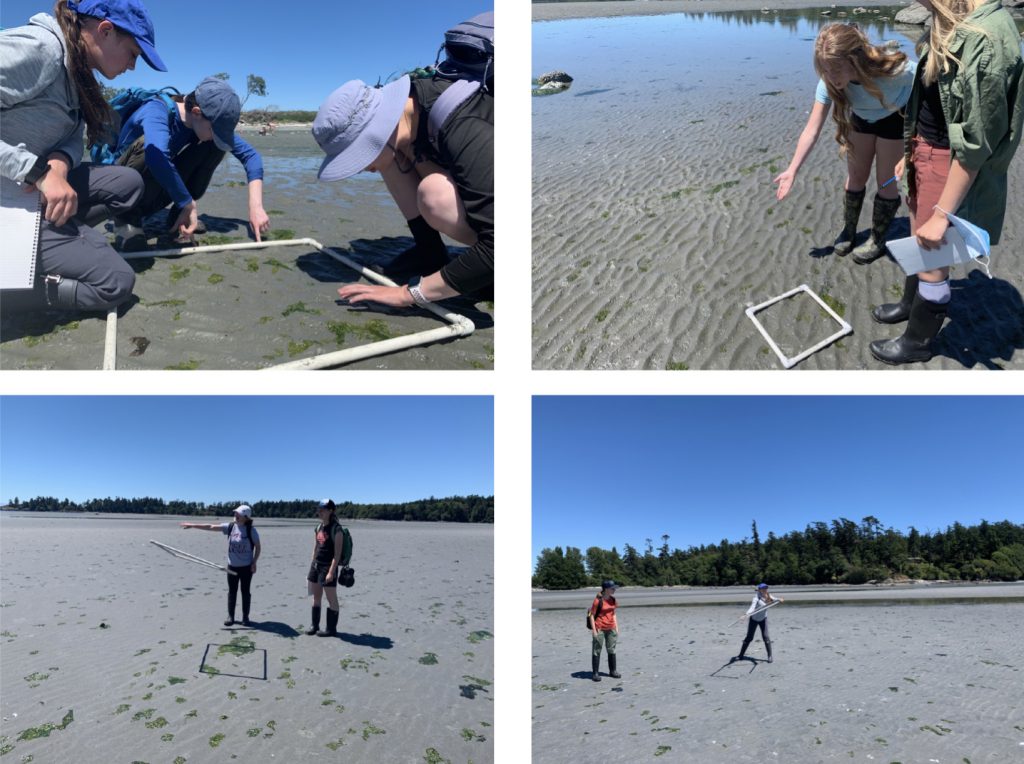
We recorded the numbers of Lugworms using quadrats, squares of PVC pipes which allow people to look at the distribution and abundance of different species in and out of the water. We used the haphazard quadrat placing method to help remove bias from our surveys; this method includes walking to different areas and tossing the quadrat in your survey site. One would then proceed to count inside of the quadrats. 

Left: Maddy taking the temperature of a pond and Islay recording the data at False Bay

Right: Sonja counting the fecal casts in a quadrat at False Bay

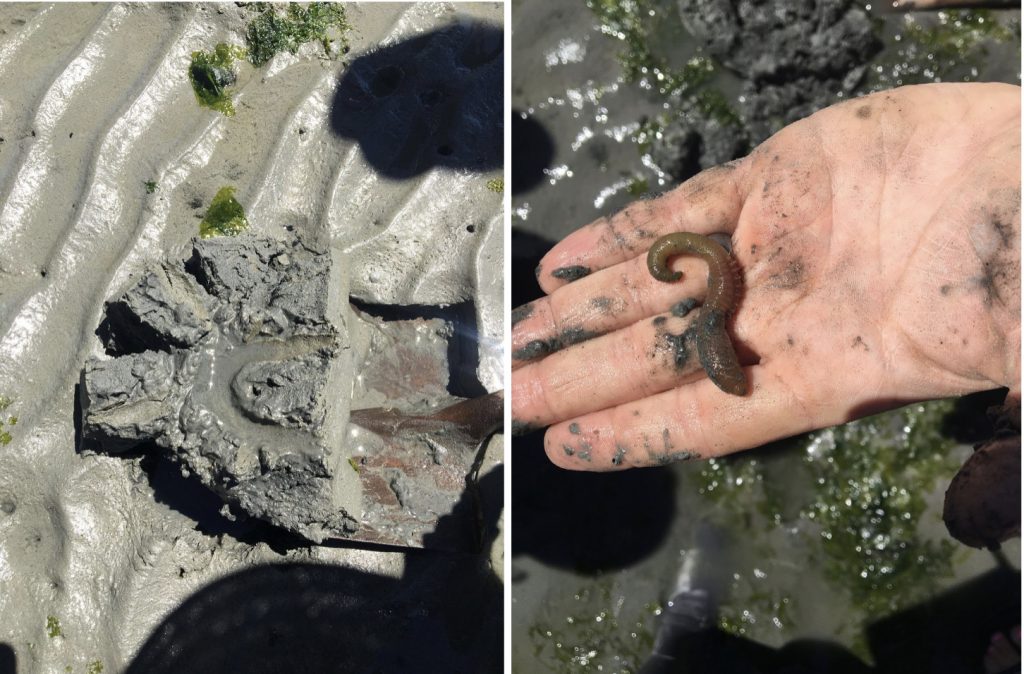
We identified the number of lugworms in the quadrats by counting the fecal casts the lugworms left behind. These swirly, soft-serve-shaped tubes of sand lay on top of the beach substrate next to their burrow holes.

Shown in the red circle is a fecal cast from a Lugworm 

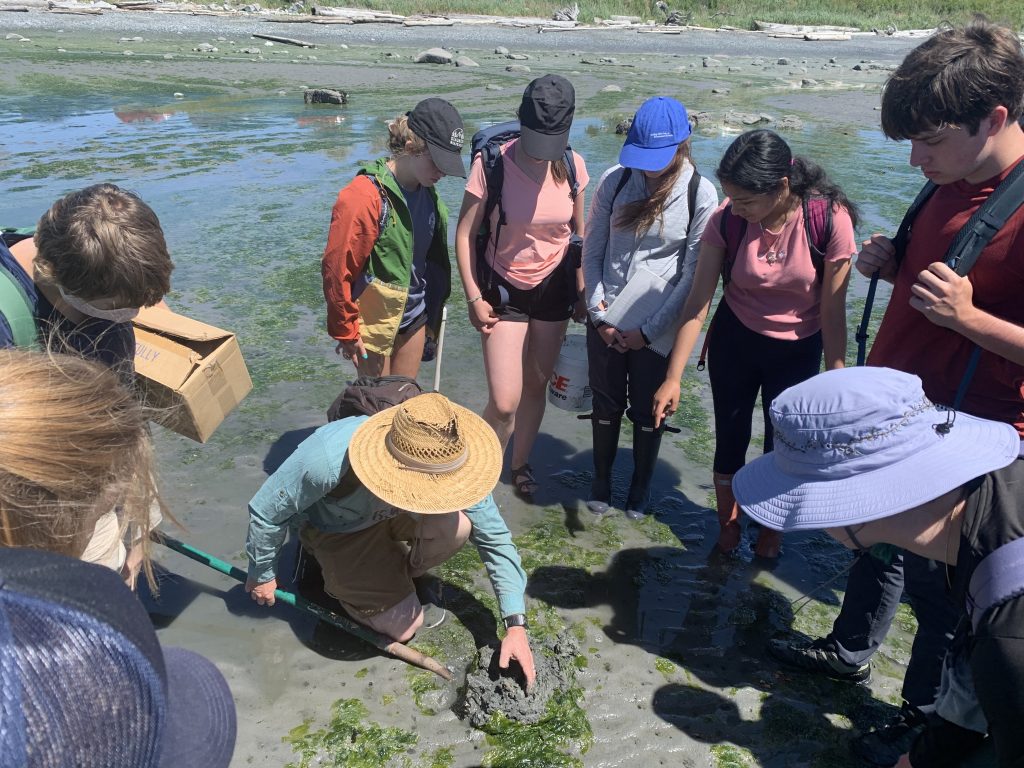
We split up into groups of two and each dropped the quadrats fifty times in two areas, one closer to shore and one closer to the water, counting the fecal casts inside as we went. There was also an additional group of three that took samples of the sediment. They filtered the beach substrate through multiple sieves and revealed the different components of the sand. 

Photo on the left: Burrow of Lugworm split vertically in half

Photo on the right: Lugworm held by Tim 

After recording our data we had some fun! We walked out to the edge of the bay where the tide was coming in to explore the calf-high puddles in our awesome boots. On our walk back we took data samples of the water temperature and salinity of different ponds and puddles on the beach.

Hebaq helping Andrea empty water out of her boot

Independent Project Introduction

After returning to the dorms from our Fales Bay surveys, we got our first look at the projects which we will have the chance to complete during our remaining time in the program. 

To complete our projects we will be asking a question and seeking to answer it using experimental or observational methods. At the end of the program, we will show and explain our research to an audience of scientists, friends, and family. 

Anything from routinely counting jellyfish at a specific beach to observing the behavioral patterns of sea slugs is a possibility. With the many resources available to us, we have the opportunity to be as creative and imaginative as we want. Despite the potential time restrictions, which will be a significant factor in the development of our projects, we can’t wait to get started.

Babies with Bea 

To end a busy day, we got a presentation from a very busy recent Wellesley graduate. Tonight we had the privilege of hearing from Bea Grauman-Boss, Tom and Caroline’s daughter. Bea grew up on the island, and told us about her journey from sea urchin and sand dollar larvae (babies) to pancreatic cancer research. A recent graduate of Wellesley College, Bea is Lab Manager and Technician in the Hemann Lab at MIT.

Though the two things may seem unrelated, there are many parallels to be drawn between the marine larvae and cancer molecular biology. Other topics of Bea’s presentation included invasive rabbit data collection and Island Marble Butterfly conservation on San Juan Island. We can’t wait to see what tomorrow brings with more exploration of the island.

More Photos!

Day 4: Identifying the Intertidal

Written by Colette Bennet, Estevan Torres, Abby Cooper

Wow! Looking at all the isopods, bryozoans, crabs, and jellyfish was a blast! Photograph taken by Abby Cooper.

We started our day off at a relaxed pace because the low tide was later in the morning than the last two. Tides usually occur 50 minutes later each day, so we were all fairly satisfied with the order of the morning and appreciative of the extra sleep. 

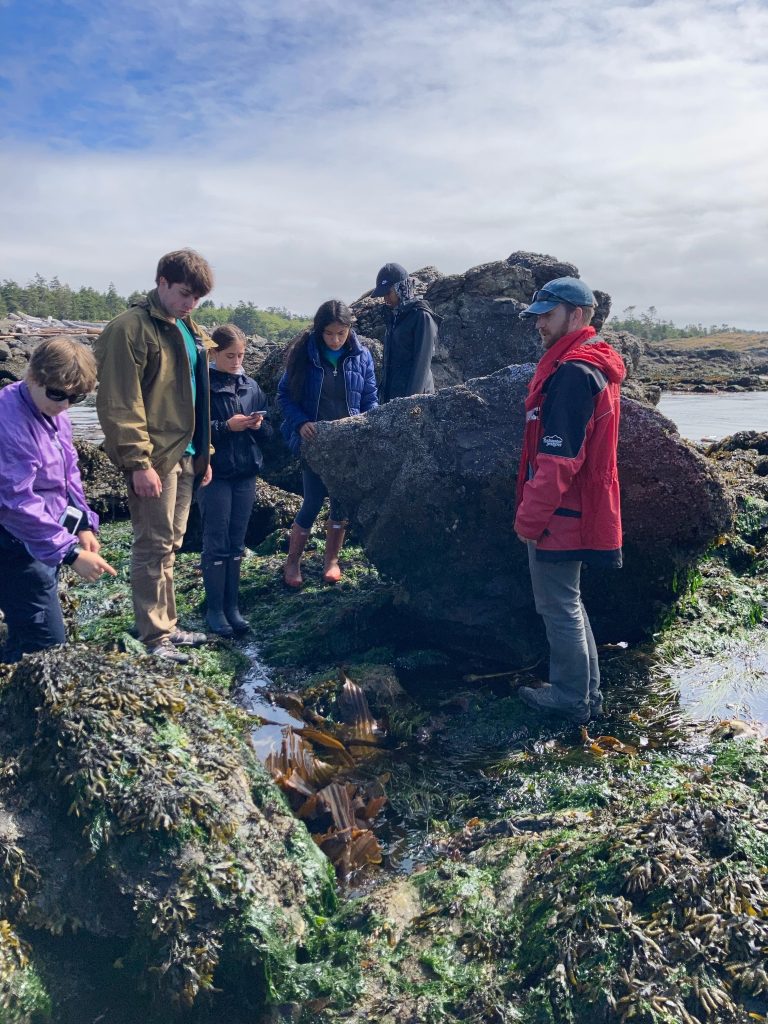
Around nine, we grabbed our field guides and rubber boots and headed to the Cattle Point lighthouse. There we met up with Dr. Katie Dobkowski, Visiting Assistant Professor of Biology at Bates College, and her University of Washington Friday Harbor Labs REU-Blinks Summer Internship undergraduates.  We practiced our algae taxonomy skills from yesterday in the field and scrambled down the rocky slope to the tide pools to do some exploring. We quickly split up in all directions. 

Throughout the time on the rocks, we bombarded Dr. Dobkowski and her student interns with extensive questions about the intertidal, especially about their knowledge of algae. The cohort almost instantly picked up on the concept of red, brown, and green algae: the taxonomic groups all algae are grouped in. 

Highlights of the outing included ruby-colored blood stars, rose anemones, sculpins, egg-yolk jellyfish, gooseneck barnacles, and a fascinating array of alga. We departed the beach feeling satisfied but full of questions. 

Above: Our cohort enjoying the tide pools at Cattle Point! Photograph taken by Abby Cooper.

After a fantastic lunch, we took an excursion to FHL. We talked about the lab’s unique water pump system that allows fresh seawater into the aquariums inside. This enables the scientists to flush out the water in old tanks and replace it to alleviate concerns about maintaining consistent water chemistry. This function is, in fact, the reason why Friday Harbor Labs is a world-renowned research destination. 

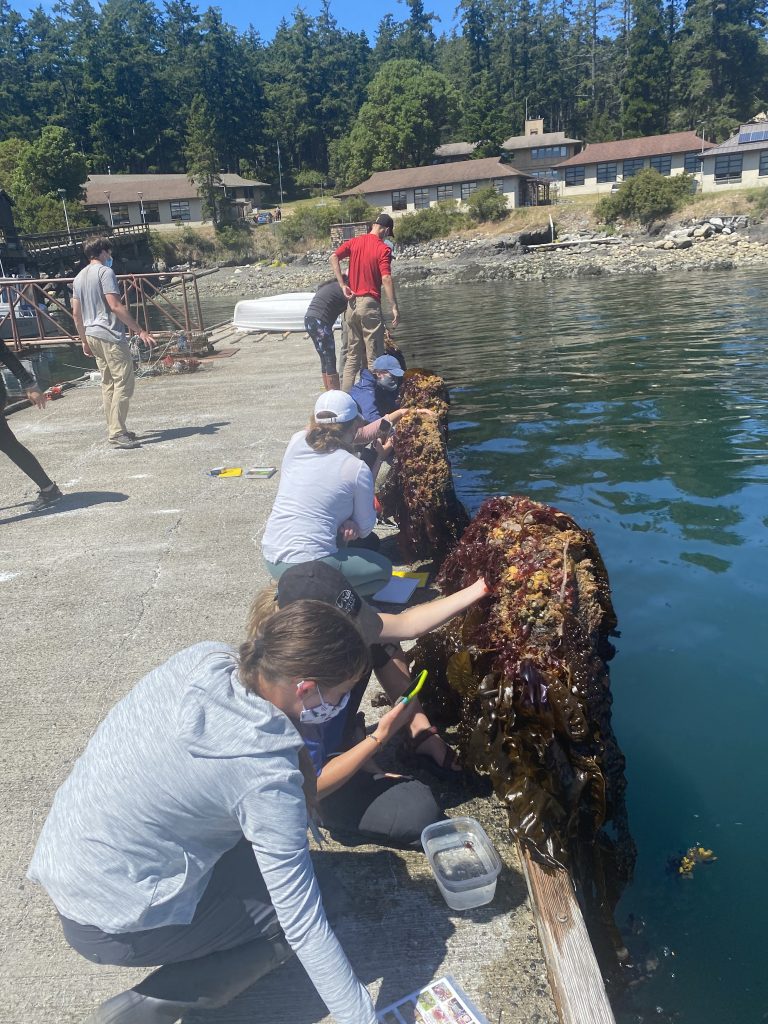
Walking down to the docks, we took a brief tour of the labs. On the docks, we were instructed to yank up the tires nailed on the sides to discover the variety of organisms occupying each one. Each tire had its miniature ecosystem, so we quickly got out our field microscopes and notebooks and began investigating. Our group identified many different organisms such as crabs, sea urchins, anemones, tunicates, and various alga. 

An undergrad student from earlier, Maria, graciously offered to show us her research on the interactions between kelp and crabs. Her goal is to determine what age of kelp the crabs prefer to eat and live in. She collected kelp of different sizes and separated them into different tanks. One tank housed the adult kelp, one had the juvenile kelp, and one was a mixture of both. Maria placed a crab in each tank, and depending on which kelp the Crabby (the kelp crab) interacted with the most; she could prove her hypothesis. It was super cool to see the experiment in action and how students and scientists set up and execute research operations in a lab setting. 

Before we left the dock, Seth, out of seemingly nowhere, pulled a giant red rock crab from one of the tires he examined. It was huge in comparison to the elementary rock crabs the rest of us observed. He held the foot wide crab proudly by its pincers. Putting it in a container, Tim then explained the crab’s anatomy, which at times was disturbing to some. The crab wasn’t a fan of all the attention he received, so we didn’t detain him for long. 

Above: Seth and a crab that had been living in one of the tires at Friday Harbor Labs! Photograph taken by Colette Bennet.
After a great home-cooked dinner, our very own Timothy Dwyer gave us a presentation on polar gigantism, where the animals in Antarctic conditions grow much more significant than any of their family members. He also told us all about giant Antarctic sea spiders, which are both incredibly interesting, and a little scary!

The adventurers in the group bombarded Tim with questions about his experiences. We’re sure Tim could tell that many of us would hope to see ourselves researching in Antarctica at some point. 

Day 3: Coastlines and Classrooms

Today’s blog was written by Maddy Glaser, Hebaq Farah, and Meg Carrier

Last night, Derek Smith, a UW PhD with a specialization in subtidal communities and who is also President of the American Academy of Underwater Sciences, gave a captivating presentation following an unorthodox style – he gave us twenty different pictures, each one with a story, and instructed us to pick ones we wanted to hear. However, we could only pick ten and couldn’t go back to a picture after deciding (eek!). We sat on the edge of our seats as we struggled with our indecisiveness. Sometimes, the unveiling of a certain picture would result in an unanimous show of hands; other times, a picture would evoke nothing but a silent room. The stories we ended up picking were super entertaining and gave us a glimpse of what Derek actually does for work!

We awoke this morning pumped to go on yet another sea star surveying adventure. As we made our various breakfast meals, we told stories of the slippery rocks we faced the day before. Skimming the daily schedule and collecting our things, we wondered what the day would have in store for us. We split into teams and boarded different cars to set off for our next expedition. 

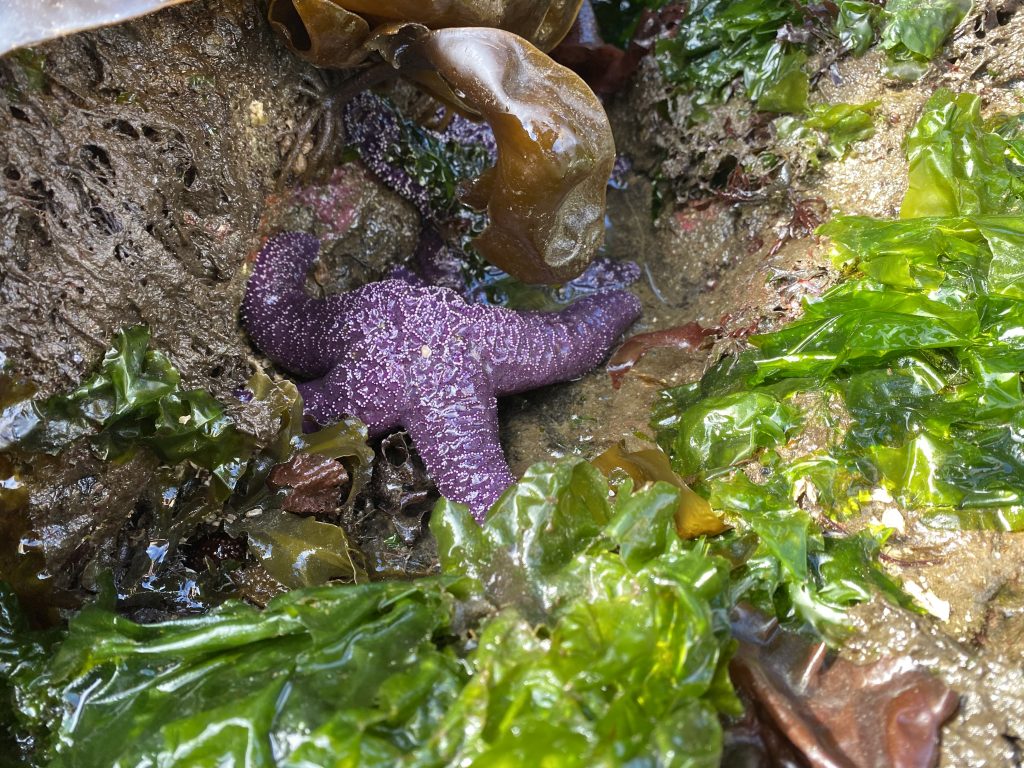
A purple Pisaster Ochre Star rests under a rock looking for food (Photos by Maddy Glaser)

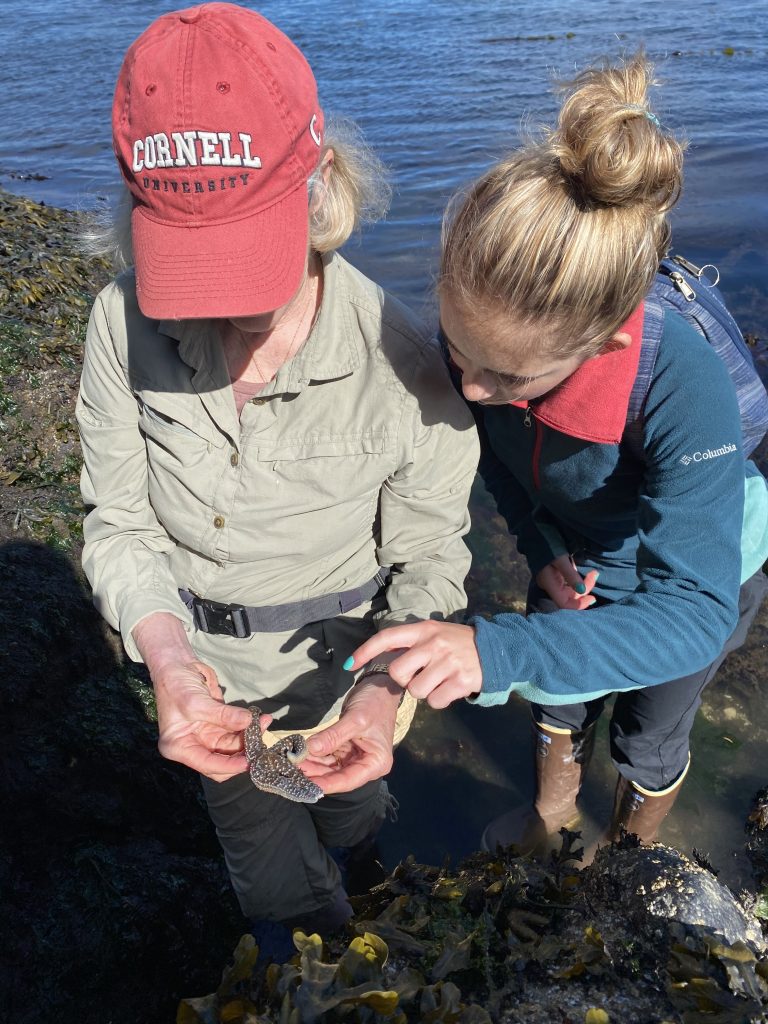
Morgan and Drew’s group: Seven of us set off to Point Caution, where we would spend the next hour and a half clambering over rocks and tide pools to find Pisaster Orchaceus, or Ochre Sea Stars with Dr. Drew Harvell, Professor of Ecology and Evolutionary Biology at Cornell University who has a lab at FHL and Morgan Eisenlord, who has been a student of Dr. Harvell and is defending her PhD thesis this summer. This summer, Morgan is Salish Sea Sciences Resident Scientist and dorm parent. Once we found the sea stars, we were told to record their size, color, and whether they had any signs of Sea Star Wasting Disease (yesterday’s blog goes more in depth on that disease and its effects!). Although we were just looking for Ochre stars, we also found Mottled sea stars, Leather stars, massive sea cucumbers, little crabs, Gunnels, and some interesting worms! Although finding the creatures was really fun, I think the most exciting part was that our data will be used by scientists around the world to potentially help the sea stars recover! 

Cornell professor Drew Harvell and Colette inspect a mottled sea star (Photo by Maddy Glaser)

Tim and Miranda’s Group: The remaining eight of us arrived at Pile Point, excited to start surveying with Tim Dwyer, Salish Sea Sciences Science Director for this program and Miranda Winningham, a graduate of Cornell University who has done a lot of research at the Friday Harbor Labs, especially about sea stars, and at Western Washington University’s Shannon Point Marine Laboratories. Much to our surprise, a beautiful house stood at the top of the hill, overlooking it’s own private beach (the one in which we surveyed). We admired its beauty, then started the walk down to the shore, which was a bit steep and very rocky, but luckily there were no casualties. Today’s surveying seemed to go better than yesterday’s – we found fifty-two Ochre sea stars and lots of babies! We hypothesized that this was due to the lack of people using this beach as it’s privately owned.

After our surveying, we hopped back in the cars and shed off our extra layers that became unnecessary as the morning cold transitioned into afternoon warmth. We drove back to the dorms and enjoyed some reflection time – today this included classic Disney movies Princess and the Frog and Frozen

Tim inspecting and explaining how Whelks eat the Barnacles attached to the rocks, showcasing the unique Ecology of the Salish Seas (Photo by Meg Carrier)

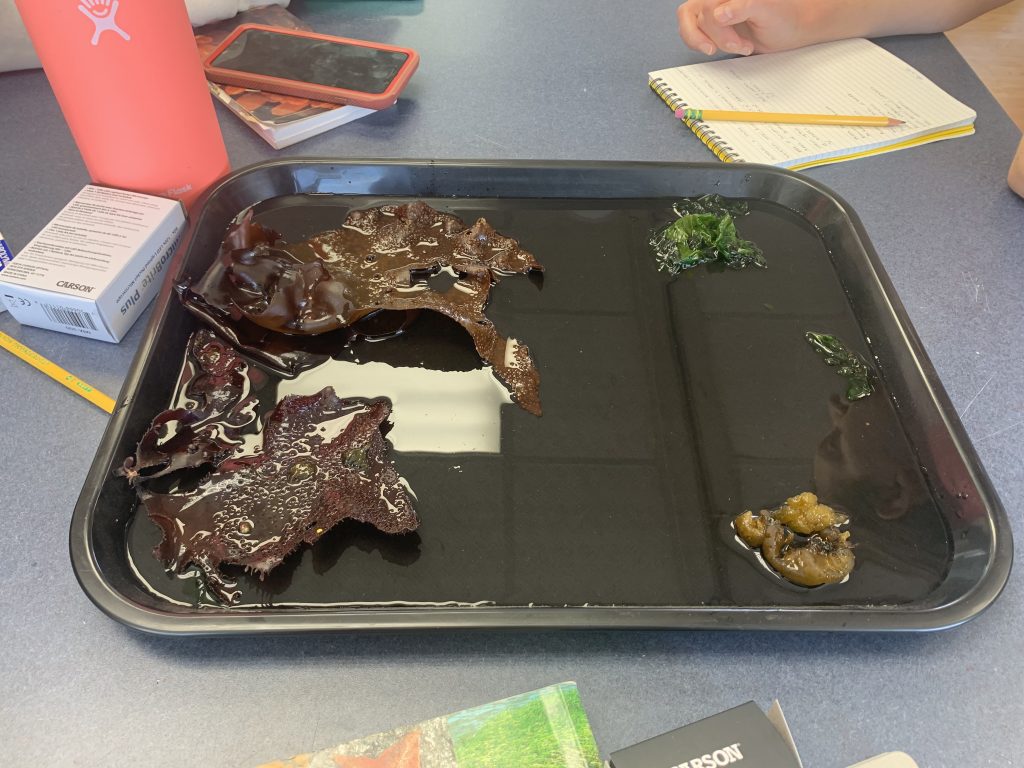
While we were enjoying the pretty sea stars, Tim was hard at work. He collected various types of seaweed and algae to bring into the classroom so that we could begin building necessary identifying skills. Derek Smith also joined bringing his container filled with Seawater. We took our picks of organisms and placed them on our desks to observe. The flipping of papers and googling of names occupied the entire classroom. We also learned the process of pressing algae to preserve the memories we made today. The combination of art and science left everyone excited for our future classes.

Four different organisms collected from Pile Point that students identified and studied with microscopes (Photo by Hebaq Farah)

As we continue learning in the classroom setting, we also were given the amazing ability to look a couple years down the line through the young scientist panel. We heard from Morgan and Miranda, and also Sara Sarmiento-Ruiz—Salish Sea Sciences Communications Intern/Dorm Assistant and a recent graduate of St. Olaf’s College with majors in Environmental Studies and Mandarin (she also is a Salish Sea Sciences alumna!), Sarah Lincoln—a rising senior at MIT and researcher in the Vander Heiden lab at MIT’s Koch Institute, and Beatrice Grauman-Boss, a recent graduate of Wellesley with honors in Biology and Politics and Lab Manager and Technician for the Hemann Lab at MIT. Bea began her scientific journey studying echinoderm evolution and development at the Friday Harbor Labs. They gave great advice on how to get the most out of college experiences, research experiences, and how to apply yourself to different areas. This panel was not only interesting, it was also extremely influential and helpful when thinking about our futures. 

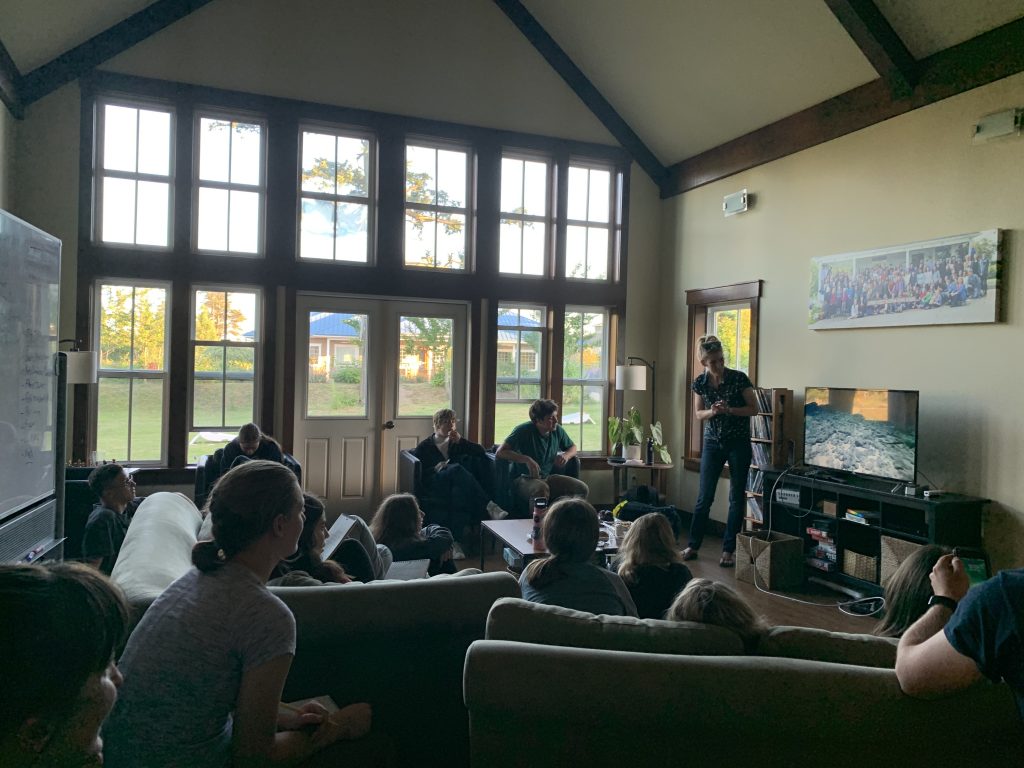
Tonight’s presentation was hosted by Megan Cook, an ocean explorer whose primary work is Manager of Education Partnerships and Programs for Ocean Exploration Trust. She told us all about her own expeditions and the amazing things she’s witnessed aboard the Exploration Vessel Nautilus. She also described the Hercules ROV, which captures marvels of the sea, such as octopus laying eggs on hydro-thermal vents. The Hercules footage is live streamed daily on the Nautilus website, and Megan encourages everyone to tune in as she begins her cruise in July. Additionally, she stressed the fact that only 20% of the ocean has been explored! It has felt like such a privilege to be surrounded by so many brilliant scientists!

Students intrigued by Megan Cook’s deep sea footage taken on the Exploration Vessel Nautilus (Photo by Sara Sarmiento)

Day 2: We’re the Real Stars Here.

Hello Salish Sea families, friends, and explorers! It is Andrea, Sonja, and Islay and we are very excited to tell you about the contributions we have made to the real world scientific field and the captivating sea stars in the Salish Sea. 

This is the double hitch knot. It’s never coming off.  Photo by Sonja Larson.

We started off the day at the too-early time of 6:45 to get ready and eat breakfast. Afterwards, we grouped up to learn our knot of the day: the double hitch knot. Apparently, it’s useful for tying things to poles, but we haven’t really gotten any practical chance to use it yet. Hopefully we will get to use them in the field soon! We then split up into two different groups to head out to survey the sea stars at different locations. One group headed to San Juan County’s Reuben Tarte Park and the other group went to the Strathmann House to collect data. Dr. Richard Strathmann, emeritus Professor of Biology at University of Washington and at Friday Harbor Laboratories, is recognized as a founder of the study of larval ecology.

These sea stars are cool, but they’re kind of hiding in a crack which makes them hard to see :’( This is a picture of two Pisaster Ochraceus, also known as Ochre Sea Stars. This photo was taken by Islay Ross.

In the field, we gathered data on disease prevalence in Pisaster Sea Stars to help with the ongoing investigation into the declining populations.  The SSWS (Sea Star Wasting Syndrome) epizootic mysteriously began spreading in around 2013, and proved extremely harmful to Sea Star species across the Pacific Northwest.  With the help of involved researchers Dr. Drew Harvell, Morgan Eisenlord and Miranda Winningham, we learned how to recognize the stages of SSWS by analyzing lesion locations.  

As we all arrived in our different locations, it was evident that there was a lot of attentive searching, squatting, and balancing to do in order to find, measure, and record the sea stars. In my location, Reuben Tarte Park, the amount of algae was tremendous. That definitely made it much more difficult to navigate the slippery rocks, especially since they were covered in barnacles. Combined, both groups found 52 sea stars!  Unfortunately, one of them appeared sick, but even then the symptoms were not severe. 

Amazing sea star here. This is a Henricia, also known as the Blood Sea Star. What do you think? This picture was taken by Andrea Arevalos.

Later, we regrouped at the dorms for ‘Reflection Time’ (or for some a quick power nap). We then all had lunch. Some of us had sandwiches, and others of us had some delicious leftover pasta. We then all traveled outside for an initially confusing discussion focusing on the question: What is Science? I felt like I had a pretty good answer to this coming into the conversation, but found myself expanding my view on the topic pretty quickly. There is so much to science and scientific theory!

Hanging out in the lab!  Photo by Islay Ross.

In the on-campus laboratory, we split back into our survey groups and added the data we had collected on the sea stars into a spreadsheet. This data is going to be added to the really long list of data that had been collected in past years so it can be put toward learning more about Sea Star Wasting Disease. It was really crazy to see the data that had already been collected, and it was really cool to know that the data we collected was being added to that spreadsheet.

Later in the afternoon, we grouped up for a scientific estimation activity.  Using tools from the lab like quadrats and transect tape, we tried to mathematically determine the mystery number of rocks in a field (without counting them).  We wandered around the yard tossing quadrats made of PVC pipes and recording our data points as we went.  After everyone had done their calculations and floated their hypotheses, the mystery number of rocks was revealed!  It was a good lesson in trusting the scientific lesson, even if some of our numbers seemed ridiculous. 

Here I am struggling to walk with water in my boots, I hope they dry soon! – Andrea. (Picture taken at Reuben Tarte) This picture was taken by Andrea Arevalos

Waking up and having to be out the door so early in the day was definitely tiresome, but looking at the colorful sea stars and feeling the cool breeze was definitely worth it! We came back to the science lab and input our findings to the extensive list of surveys on sea stars that date back to 2013, so having our data on that table is something we should all be proud of.

The Pisaster Sea Stars are often hidden in shady crevices, so we had to crouch down to get a good look at them.  Pictured are Abby Cooper and Colette Bennett, scraping their knees on barnacles for science (yikes!).  Picture taken by Islay Ross. 

First Few Days of Field & Lab Science!

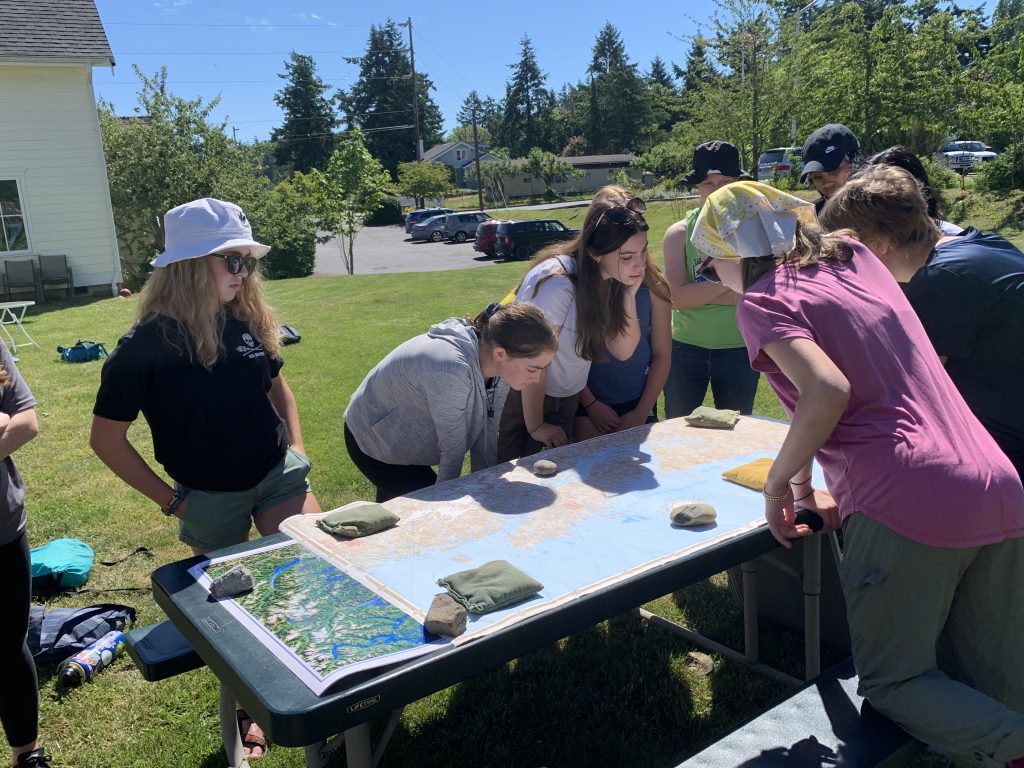
Students gathered for a geopolitical mapping exercise of the Salish Sea and surrounding land.

The Field & Lab Science portion of Salish Sea Sciences summer programs is off to a warm start! Following an evening of unpacking, settling in, and introductions, students woke up bright and early Monday morning to begin learning about their home for the next four weeks.

Students conduct population surveys on sea stars (Pisaster Ochraceus) at Strathmann’s Beach.

Our first student written blog is up! Please stay tuned for more updates to be posted soon.

Field & Lab Day 1 Summer 2021

Today’s blog written by Elliott Jones, Kira Bretsky and Dustin Hendrix
Photos taken by Kira Bretsky

We experienced our first full day in Friday Harbor together. We got to know each other a bit more and we were able to explore some of the south side of the island.


This morning we met the woman behind the emails, Caroline herself! She gave us an in depth orientation and explanation of the program we’ll be a part of this summer. We also learned our first Knot of the Day, a figure-eight knot. The early part of the day consisted of a map lesson, interrupted frequently by planes taking off from the nearby airport, and a tour of the Spring Street School Campus. After lunch, we split ourselves between a large red van and Morgan’s Subaru to be shuttled around the island.


Over the course of the first day and a half, we were able to see quite a few different organisms that call that Salish Sea their home. On the boat ride here, most of us got to see a pod of orcas, a few whales and some jelly fish. And then earlier today while we were exploring we had the ability to see a few seals, a bald eagle and a few porpoises.


We spent most of the day exploring the South side of the island and learning about the geography of the island and the area around it. We gained knowledge about who the land around Friday Harbor was named after and how if you “discovered” or map that land then you got to name it. We learned that many people from many different places from around the world came over to the Salish Seas and named different parts of the land and even the water because they were the ones to map that territory.


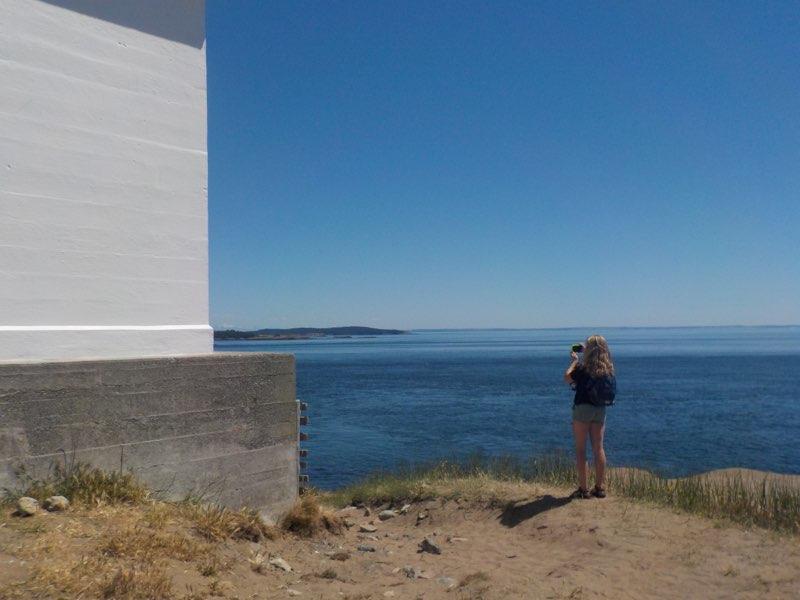
The view from the lighthouse was one of the first wonders of San Juan Island that we saw. All of us were sure to take lots of pictures for friends and family, just in case they didn’t believe how beautiful it actually was. A little while after we arrived, a few of us got text messages welcoming us to Canada. We then learned how to turn off roaming data on our phones. That way, we wouldn’t pick up cell signals from our northern neighbors.


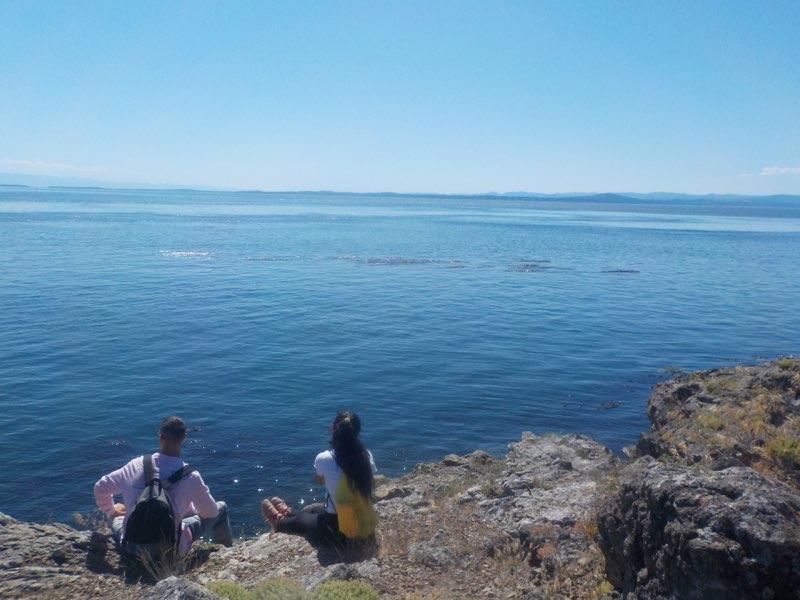
We ended the tour with a visit to the Lime Kiln Point State Park & Reserve. Tim and Morgan, our supervising scientists of the day, pointed out where to keep an eye out for wildlife, and we saw some commotion in the area even though we weren’t able to identify anything. It was exciting to use our new weather-proof notebooks for the first time, although the weather was far from needing “proofing”. Those of us from California and Texas adapted very easily, while the Seattle folk admired the clear skies and light breeze that kept us cool.

As we reflect on our day with the smell of dinner distracting us, we think about how much fun we’ve had and how much more is to come. The bar is very high, based on today’s experience!!