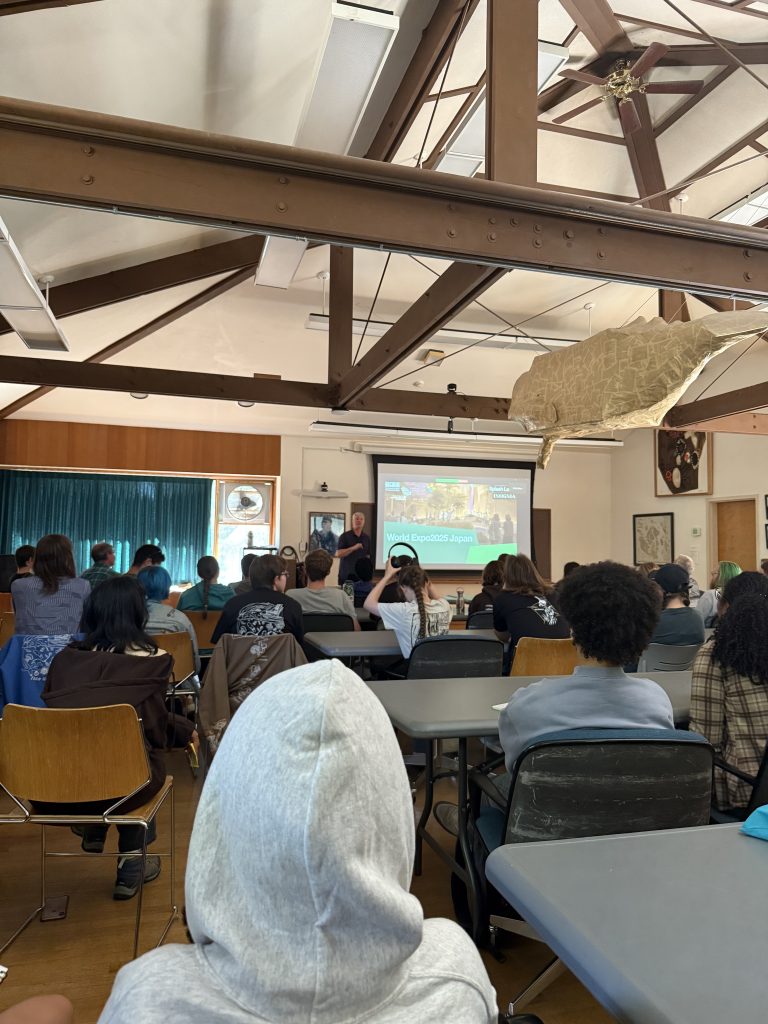
We started our day off early and headed straight to The Whale Museum, a short walk across town! Our exclusive tour was led by Tracie Merrill, the Education Director, who was avid to teach us about the importance of orcas within the Salish Sea. She led us through the different exhibits, making sure to explain the different social groups of orcas in the area, as well as the challenges they all face.
The skeleton of a three-year-old Gray Whale. Photo credits: Dylan
After Tracie’s tour, we were given the opportunity to explore the museum ourselves. Some of us watched the documentary, Sonic Sea, and others enjoyed the interactive displays and coloring pages.
Mika and Kendall’s walrus coloring sheets. Photo credits: Kendall
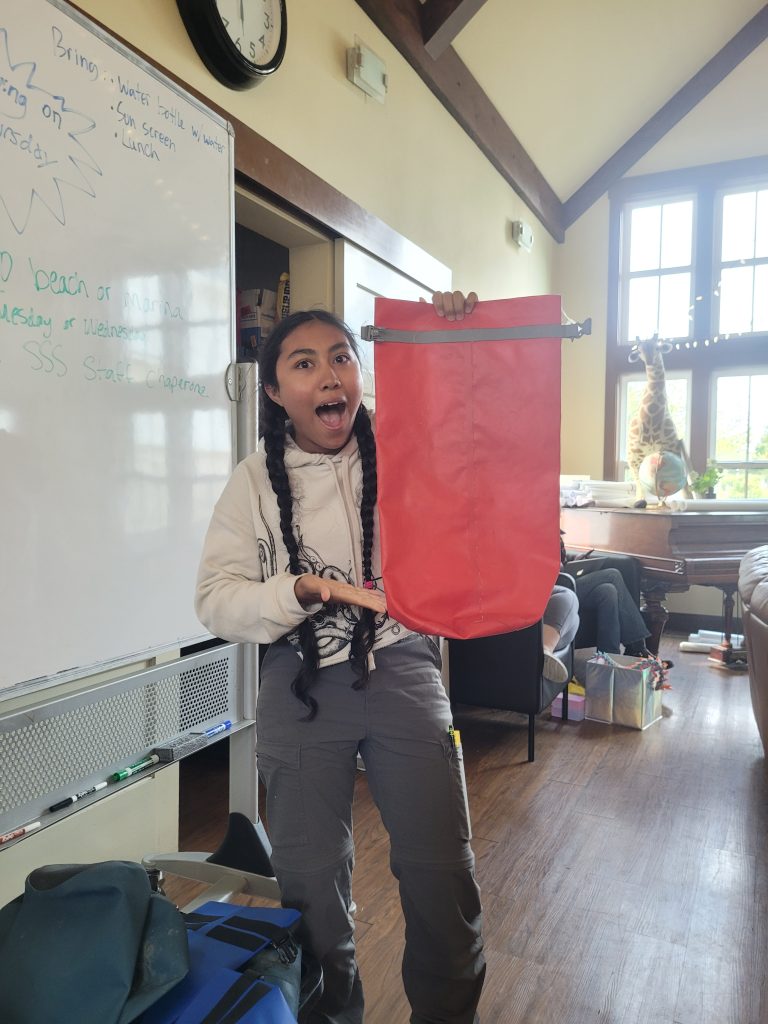
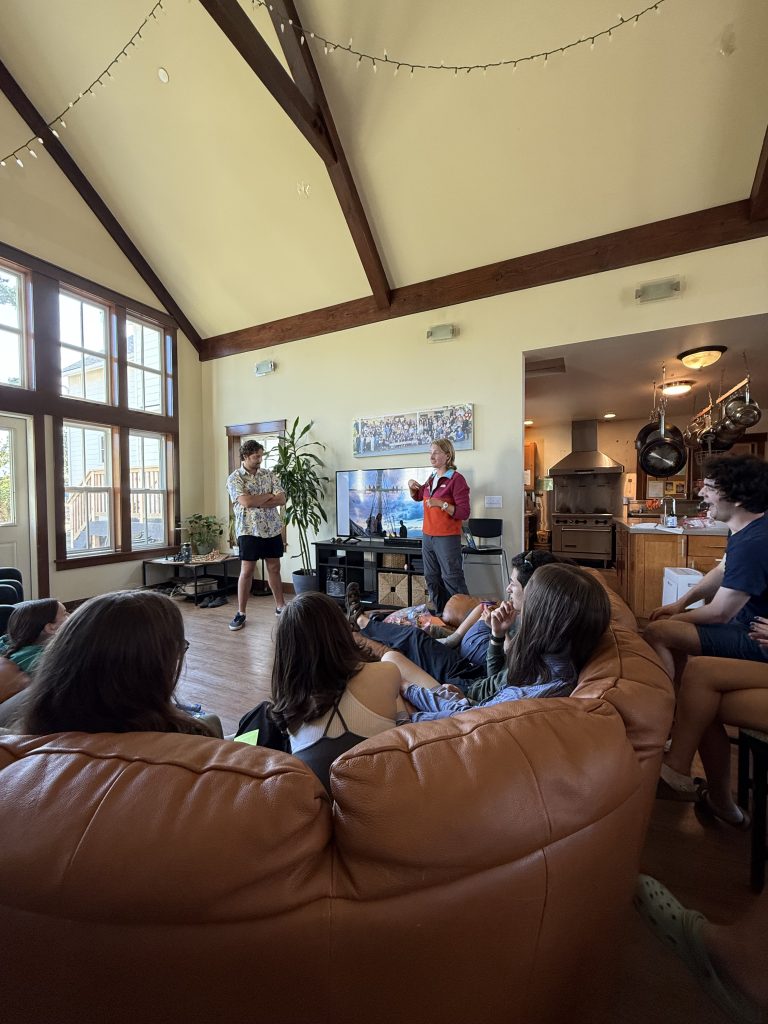
After the fun trip to The Whale Museum, we returned to the dorms to learn about the projects we’ll be working on throughout the course of the program. We discussed it for a bit, then we got a visit from one of our kayaking guides, Lauren, that will be leading us tomorrow to Jones Island. She explained to us what we need to pack and some details about the overnight trip.
Shristi with the 10-liter packing bag. Photo credits: Kendall
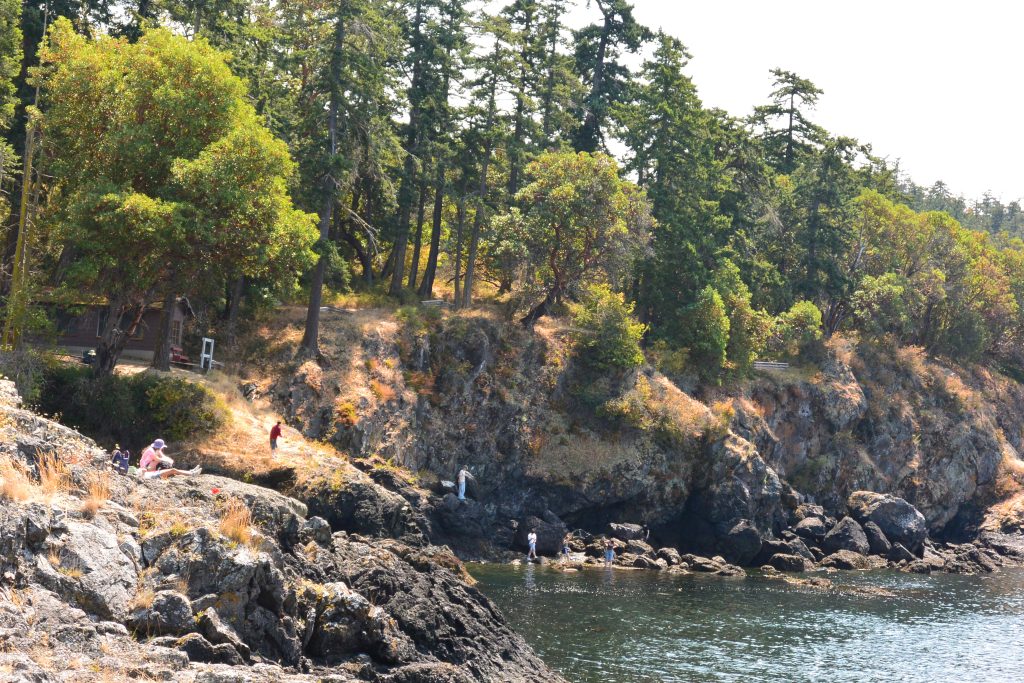
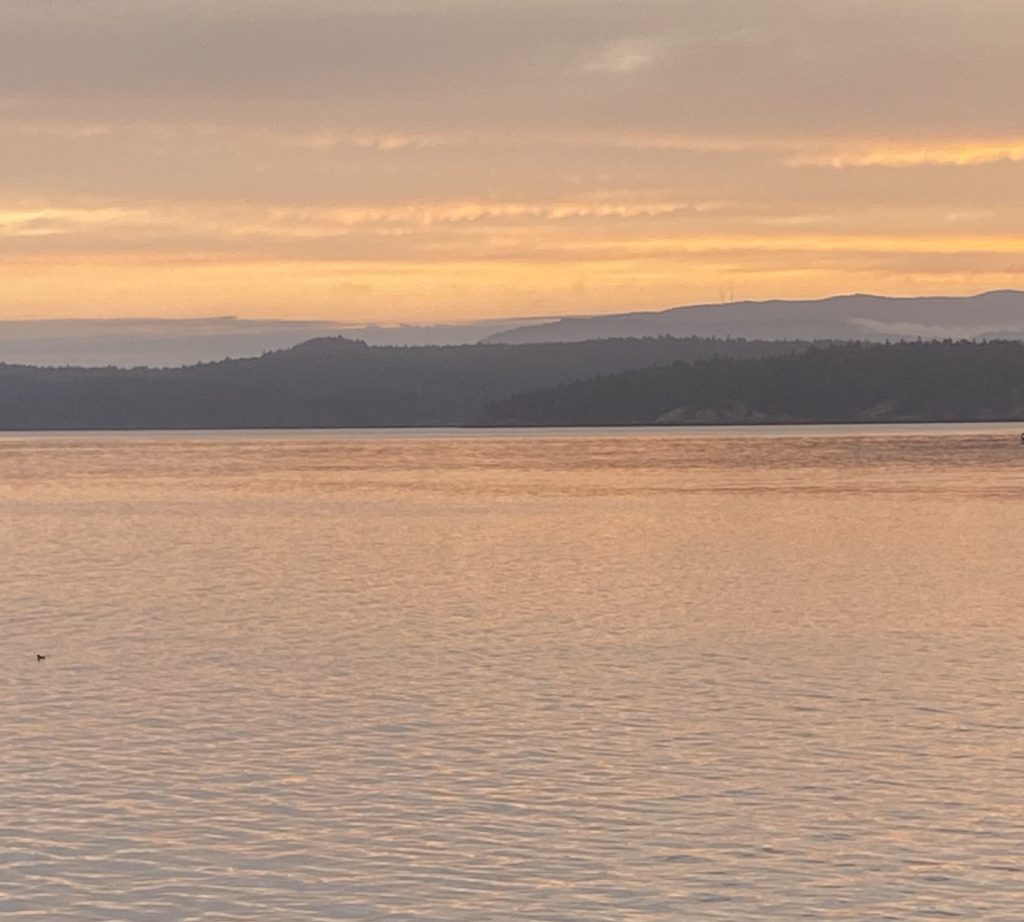
We packed our lunches and went to San Juan State Park on the west side of the island. We enjoyed our lunches with an awesome view of Vancouver Island across the water. Many of us decided to go exploring across the rocks down to the shore.
Students trekking across the shoreline. Photo Credits: Kaiya
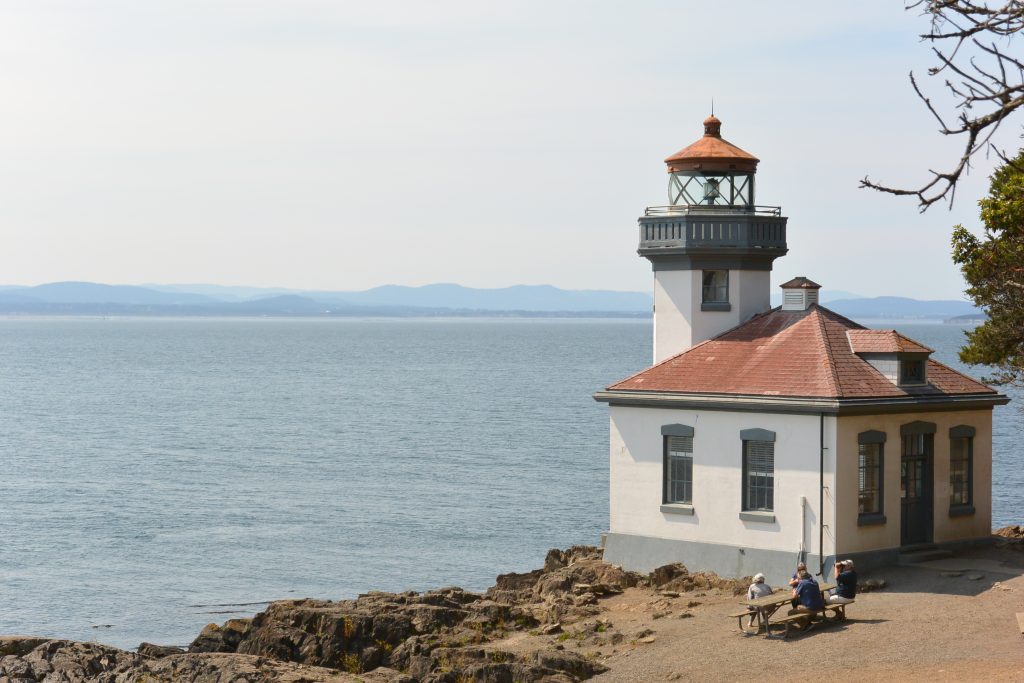
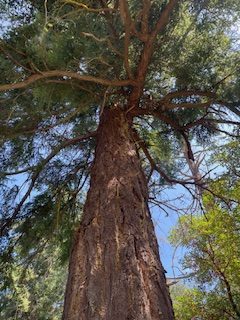
Next, we drove to Lime Kiln Point State Park to meet Errin Corra, the creator of the non-profit, FOLKS-Friends of Lime Kiln Society, as well as Josiah French-Feld, a member of the indigenous Coast Salish peoples. We received a tour of the park, learning about a few different tree species and their connections to the local indigenous culture. We ventured down to a whale-watching lookout, where we were swarmed by wasps! Then we checked out the lighthouse nearby, hearing about the history of the building and their whale tracking system. We were able to go to the top of the lighthouse, and from there we could see the hydrophone cable, allowing the researchers to hear the nearby underwater sounds.
The lighthouse overlooking the Haro Strait. Photo credits: Kaiya
To end off our night, we plan to check out JP’s Restaurant since it’s Karaoke’s night and celebrate Sophie’s birthday!
By: Max Lundin, Addy Brautigam, Kaia Wasserman, Amber Xu
After breakfast and packing lunches, we took off for the day. Our first stop was University of Washington’s Friday Harbor Laboratories. There, we received a stupendous tour from Michelle Herko, researcher and director of Friday Harbor Laboratories. She showed us the campus and research facilities unoccupied by busy scientists, but filled with marine life.
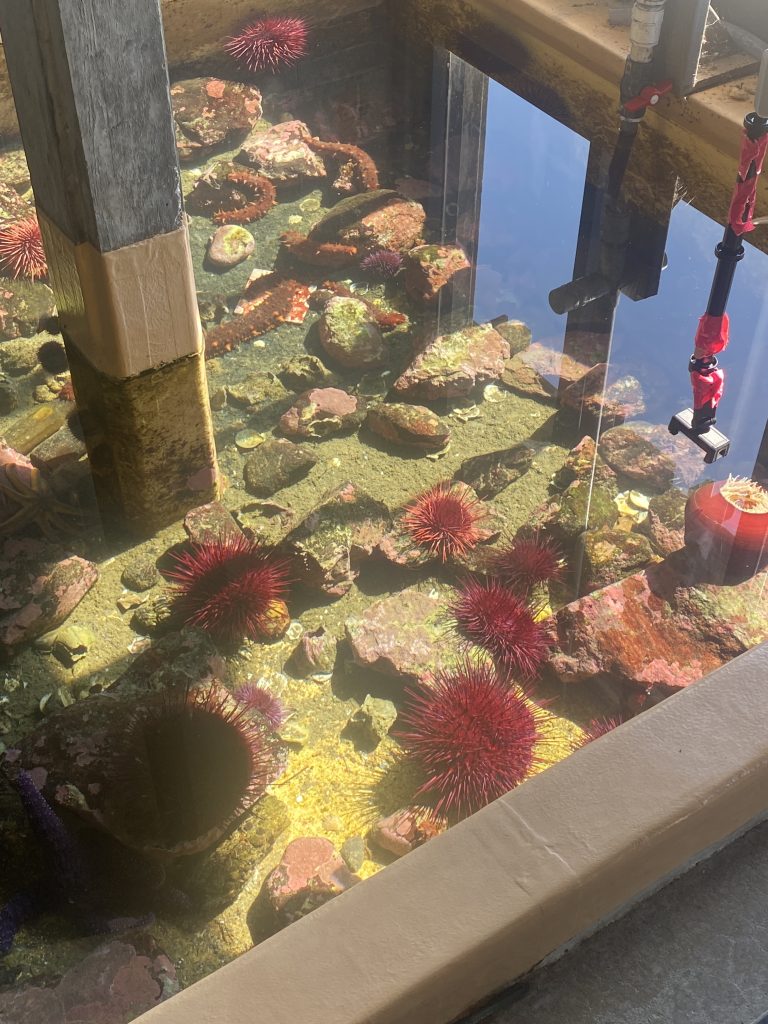
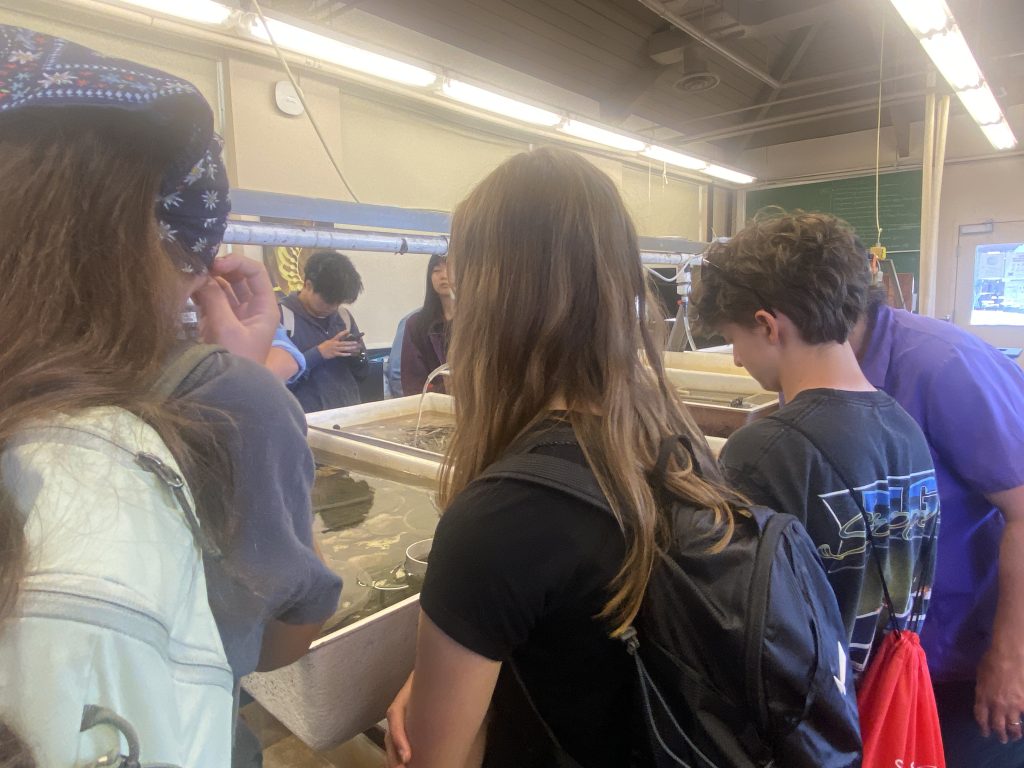
Touch tank (bellow the stairs) at UW Friday Harbor Labs. Photo credits: Kaia Wasserman.Curious students “poking around” in laboratory touch tanks. Photo credits: Kaia Wasserman.
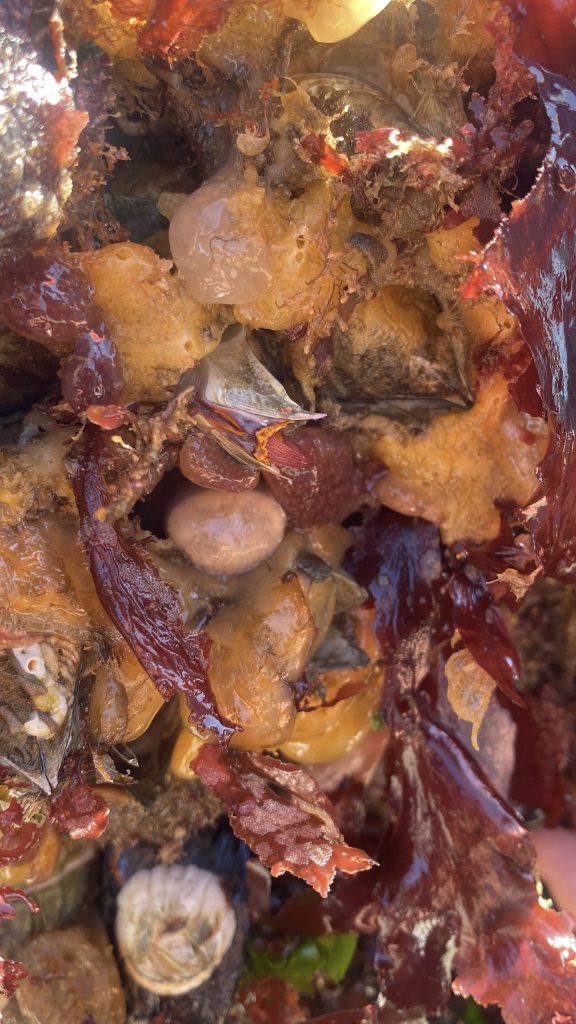
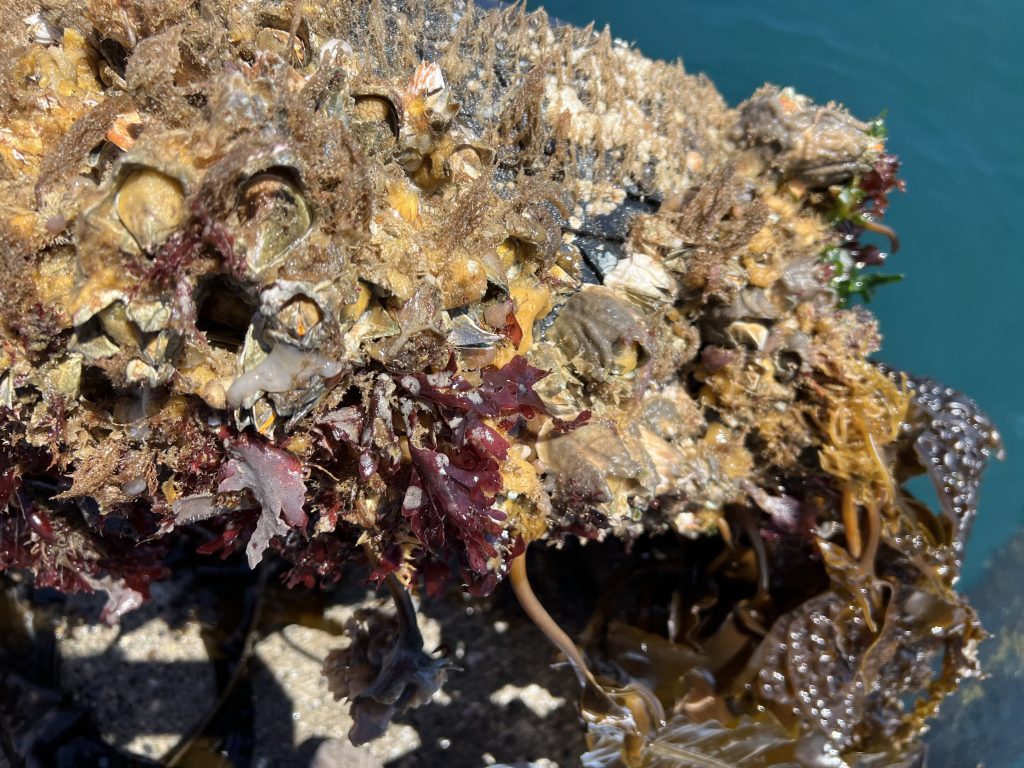
After fueling up on lunch, students were divided into three groups. One group took to the docks to investigate sea life growing upon tires hanging from the docks. This includes but is not limited to shrimp, sea squirts, barnacles of all sorts, crabs, kelp, and sponges. Those who dared took a respectful poke.
A close up of some of the life found latched onto a dock tire. Photo credits: Kaia Wasserman.Active barnacles students were lucky enough to see. Photo credits: Amber Xu.
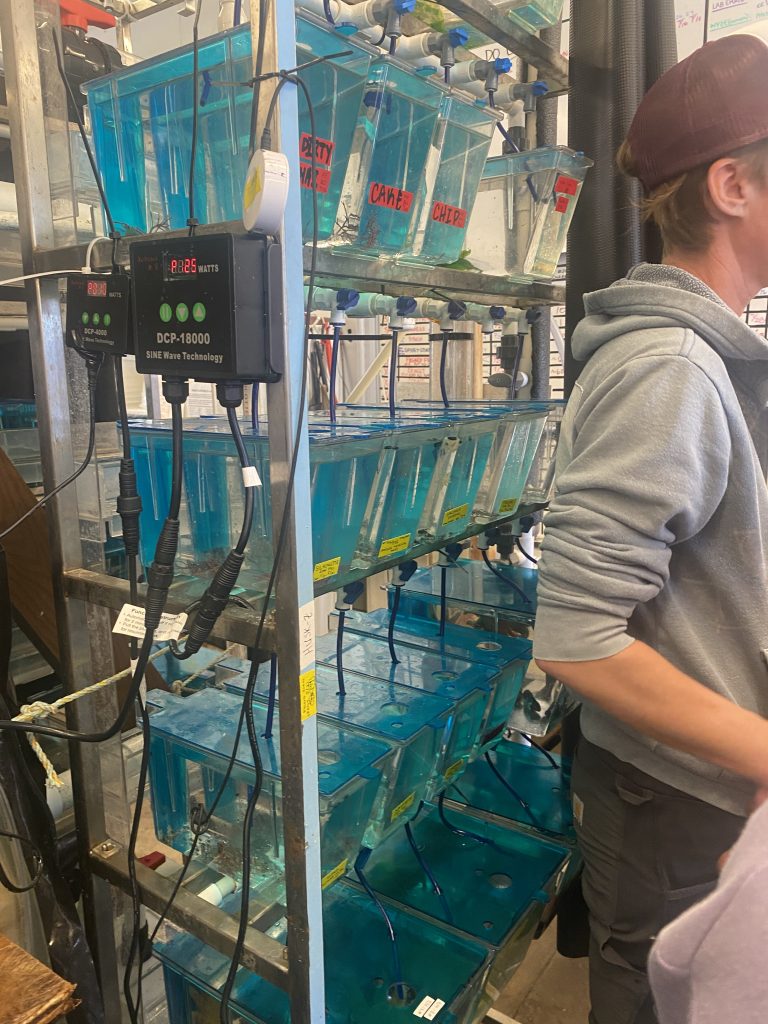
Another group was led to the sea star sanctuary where students learned about the research and restoration of the local sunflower sea stars (Pycnopodia helianthoides). Following a dramatic heatwave in 2014, these vital organisms have been plagued by Sea Star Waisting Disease (SSWD) and researchers have been working to restore the population and unveil the cause since 2019.
Baby sunflower sea stars being raised in tanks in an attempt to restore the damaged population. Photo credits: Kaia Wasserman.Juvenile starfish in their respective tank separated by generation. Photo credits: Max Lundin.
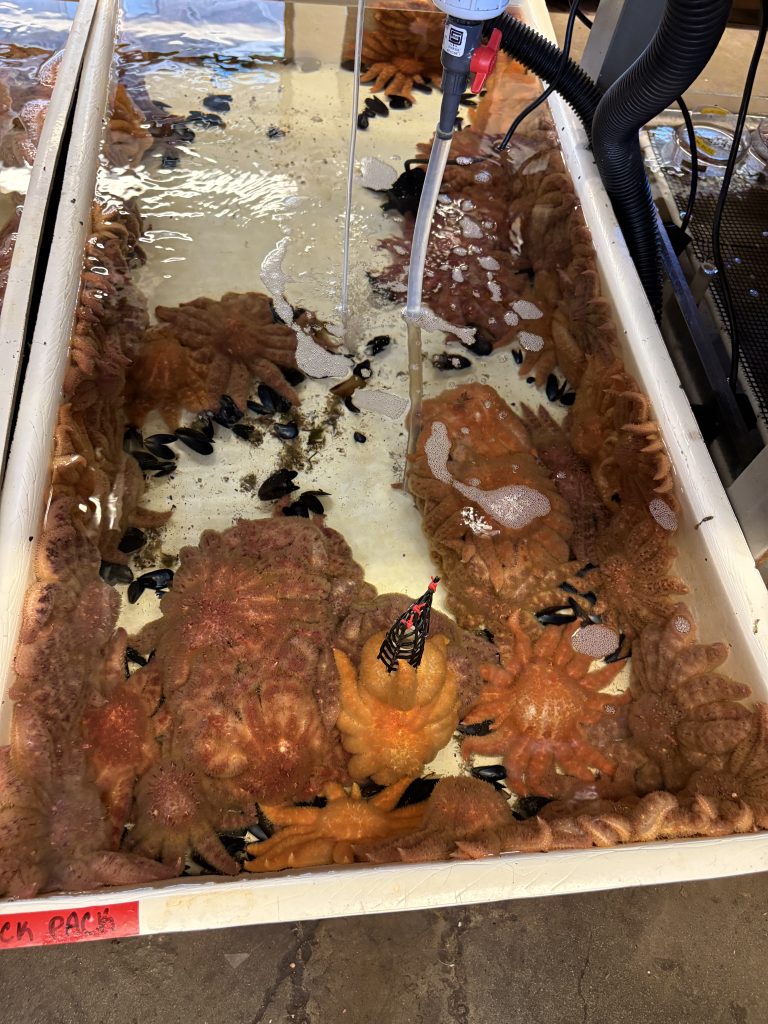
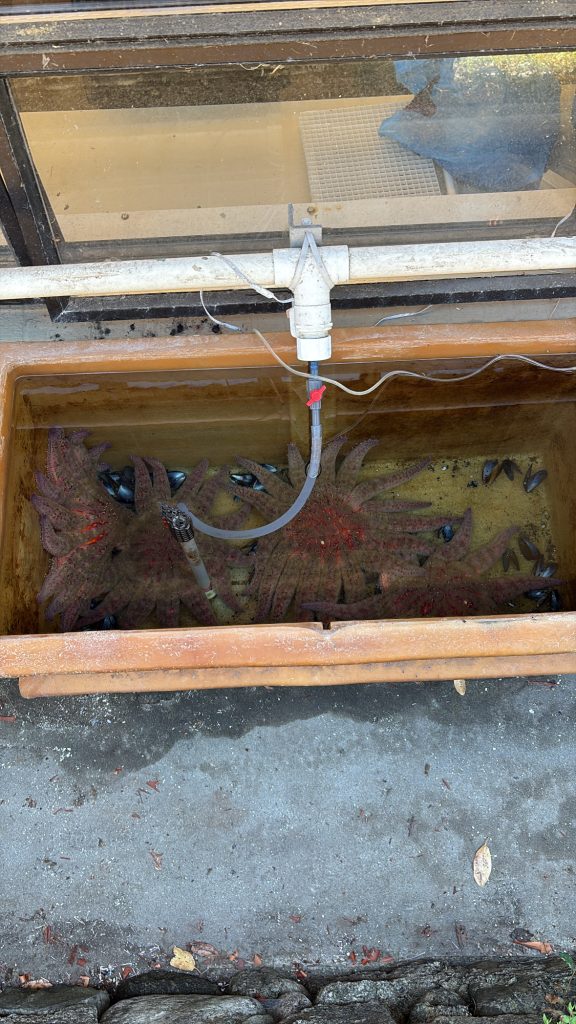
The final group was led outside the lab to view grown, ready to release, and infected sunflower sea stars under quarantine watch. Similarly to inside, each tank was separated by generation. Each generation has a theme for names chosen by research scientists, including different breakfast foods.
Adult sunflower sea stars from the outside tanks. Photo credits: Addy Brautigam.
Once we wrapped up at the labs, we took a hop, skip, and a van ride to the historical site of America Camp National Park. There we received an insightful tour all included with historic background of the area, such as the Pig War that took place. Our guide was none other than the energetic archeologist, cartographer, and Friday Harbor mayoral candidate, Emilio Santiago.
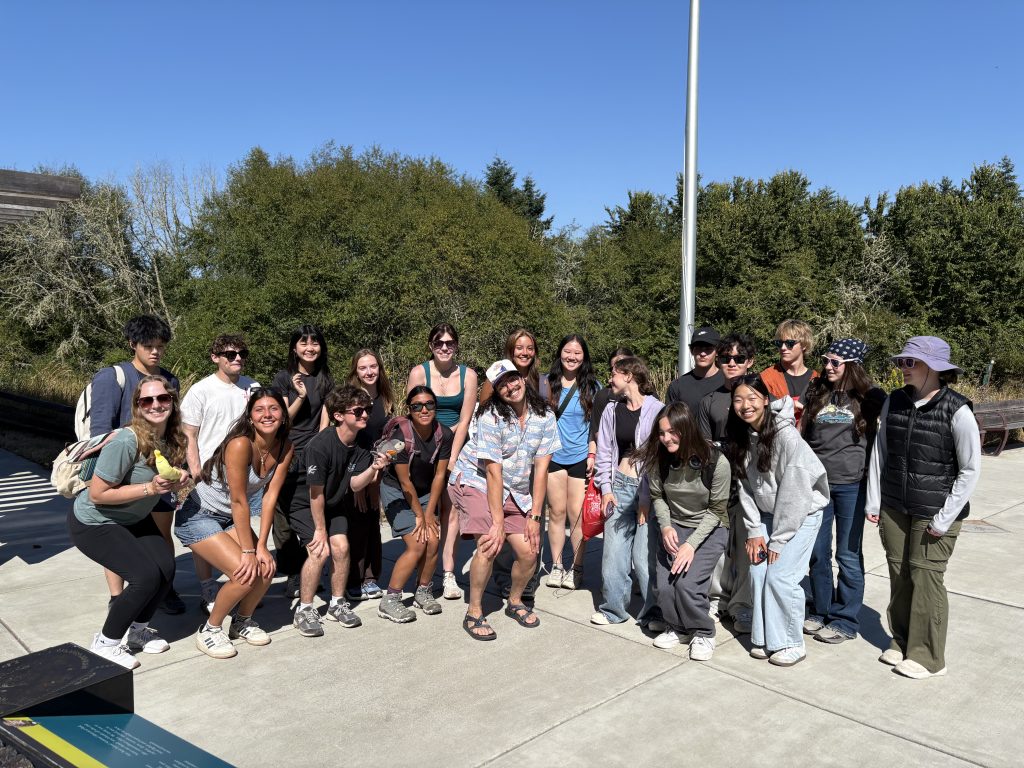
Students posing with Emilio Santiago following an amazing tour! Photo credits: Adam.
To conclude a fantastic day, we returned to Spring Street International School campus where we split off into our job groups and prepared to welcome our guest Tim Dwyer, a marine scientist who currently teaches at Friday Harbor High School and co-teaches at Friday Harbor Laboratories. He also has served as a Communications Officer on the EV Nautilus, the research vessel used by The Ocean Exploration Trust.
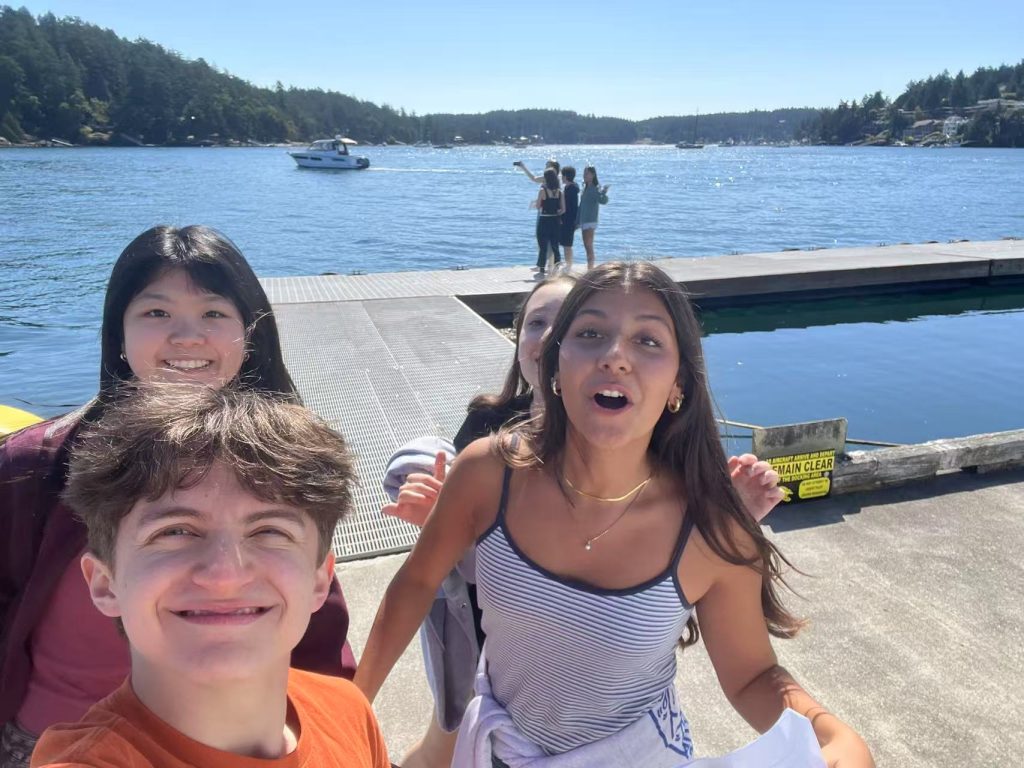
After breakfast and a brief orientation, we set off on a Friday Harbor scavenger hunt and explored the town for around 2 hours. We were tasked with taking group selfies at each subsequent location on our list. Pictured below is an image of Team Smack completing the task of “taking a photo of another group taking their photo.”
Selfie with the other team on the scavenger hunt. Photo credits: Mika
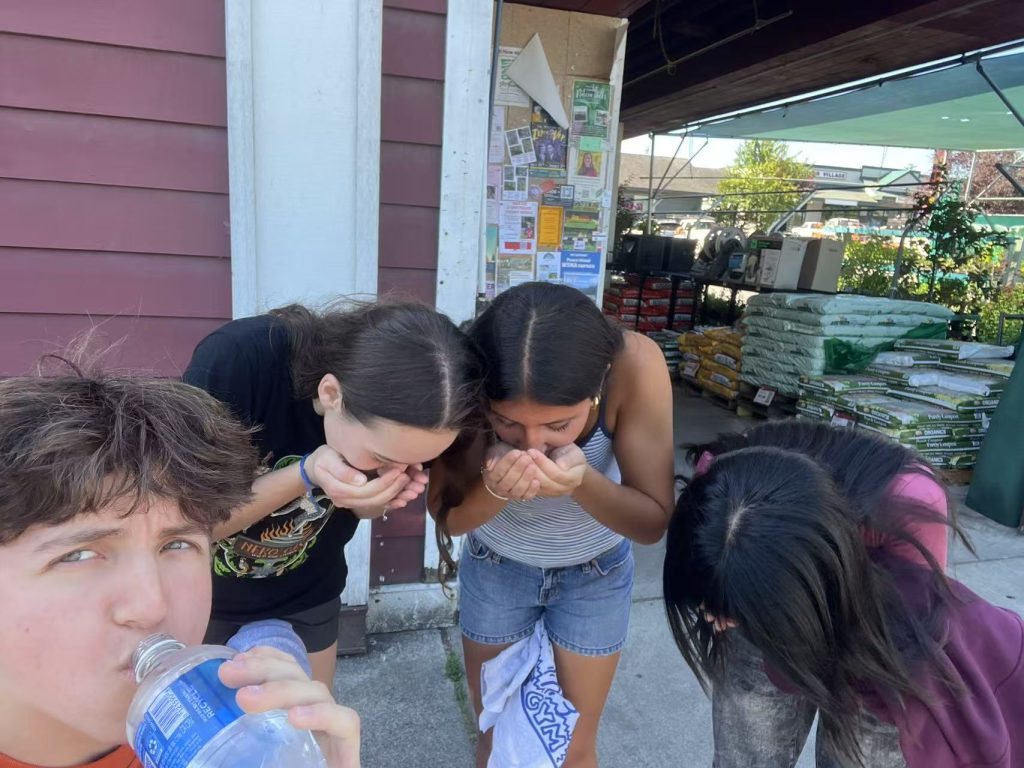
After over an hour of scavenging, teams were challenged with taking a selfie of everyone drinking water. With no water bottles handy, Team Smack made a quick stop at the gas station to pick up a drink and hydrate using their hands in order to complete the task.
Team Smack completing the “drink water” task. Photo credits: Mika
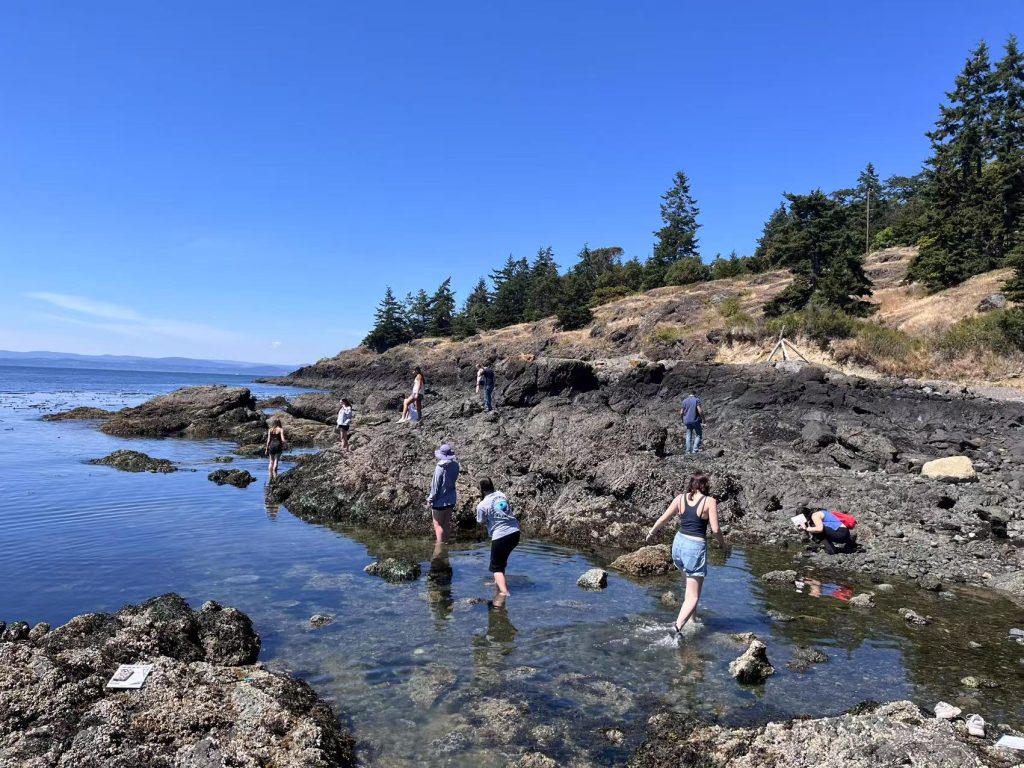
After a quick regrouping back at the Spring Street dorms, everyone packed their field lunch, and we headed out to Deadman’s Bay on the west coast of San Juan Island. Here we sat on the beach and ate our lunch while being viciously swarmed by hungry wasps. Afterwards, we spent the following couple of hours exploring the tidepools in an effort to complete the tidepool bingo.
Students exploring Deadman’s Bay tidepools. Photo credits: Kelly
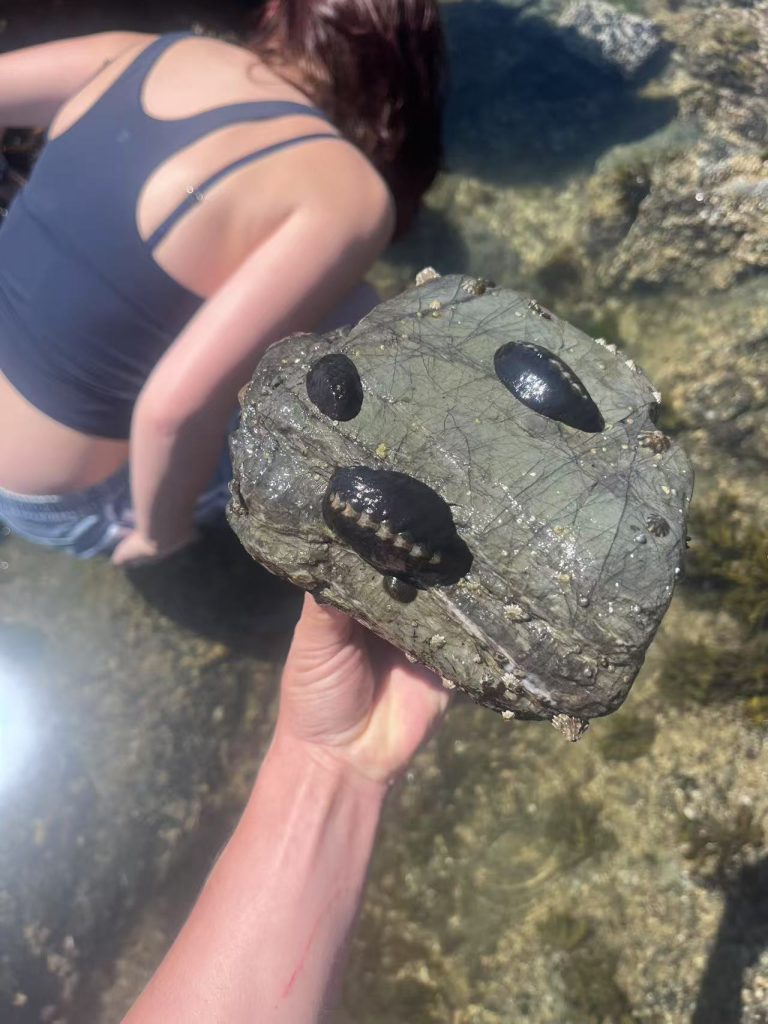
At the tidepools, we came across numerous diverse species, but something that caught our eye were the fossil-like chitons that stuck to the rocks. We later found that chitons are characterized by their eight shells and are members of the phylum Mollusca, a species that has an incredibly muscular foot, allowing them to hold on to various surfaces. Pictured below are three hairy chitons (Pos M. ciliata). These chitons were found after turning over a rock.
Three chitons occupy a rock. Photo credits: Mika
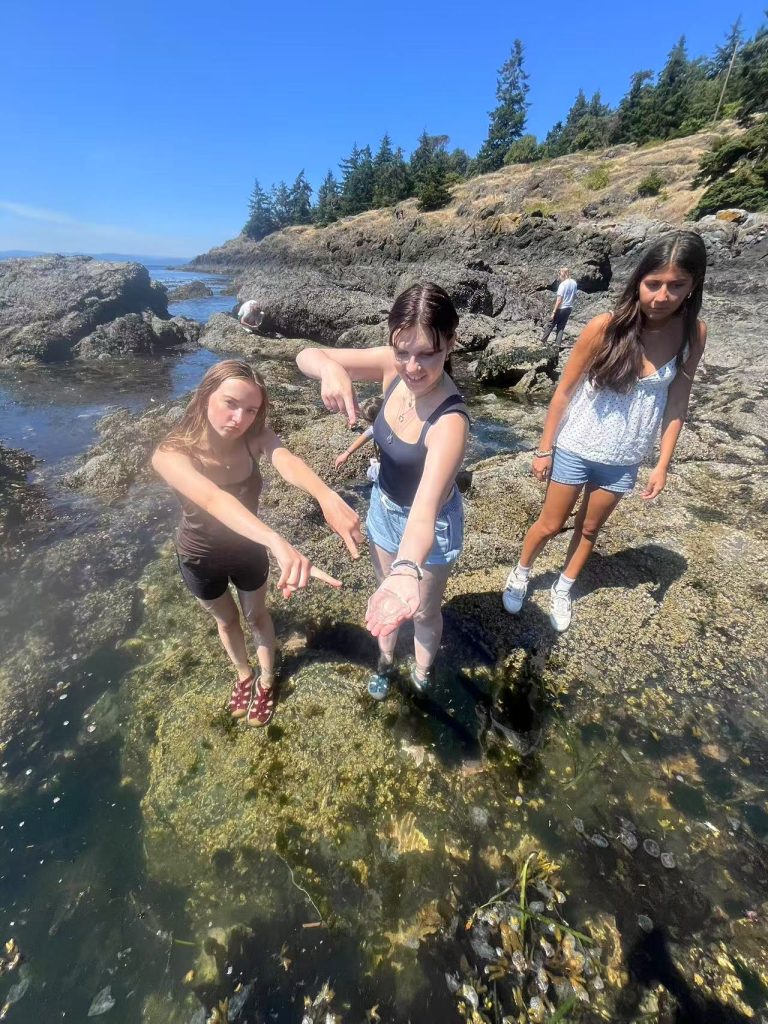
At the tidepools, we found copious amounts of moon jellies (Aurelia sp.). Although many of them seemed lethargic due to the heat, we still managed to find some lively jellies. Pictured below is an image of a particular crystal jelly (Aequorea victoria) that stood out due to its larger comparative size and intriguing radial pattern.
Photo of jellyfish with Elle and Bryce pointing, and Sophia. Photo credits: Mika
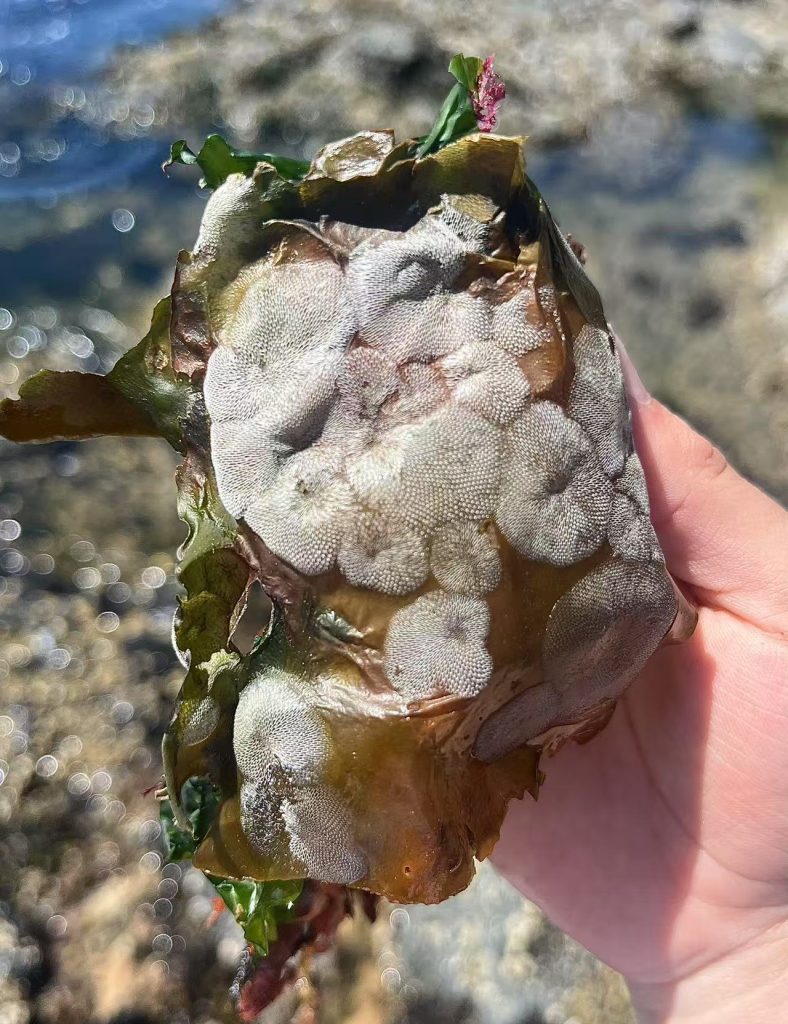
Another intriguing find was a colony of kelp lace bryozoan occupying a piece of kelp. This is a sedentary colonial organism, and each individual organism is an exact clone of the others surrounding it. Finding a colony of lace kelp bryozoan indicates a sign of good water quality due to its sole occupancy of healthy waters.
Lace kelp bryozoan. Photo credits: Mika
After our tidepooling, our science directors, Adam and Maya, led a group lesson in taxonomy and regional phyllum with a reflection on our sightings. We then left Deadman’s Bay and headed back to the Spring Street dorms. Here, Adam gave a presentation on invertebrate phylum. And we broke into our groups to complete our assigned jobs. Now we are super excited and preparing for our dinner with special guest John Michael Racy, who is a member of the University of Washington’s Illimited Lab and is currently working on integrating stingray skeletal designs into mechanical engineering, mentored by Dr. Adam Summers!
Thursday, July 24th, 2025. By: Lars, Miles, and Leah
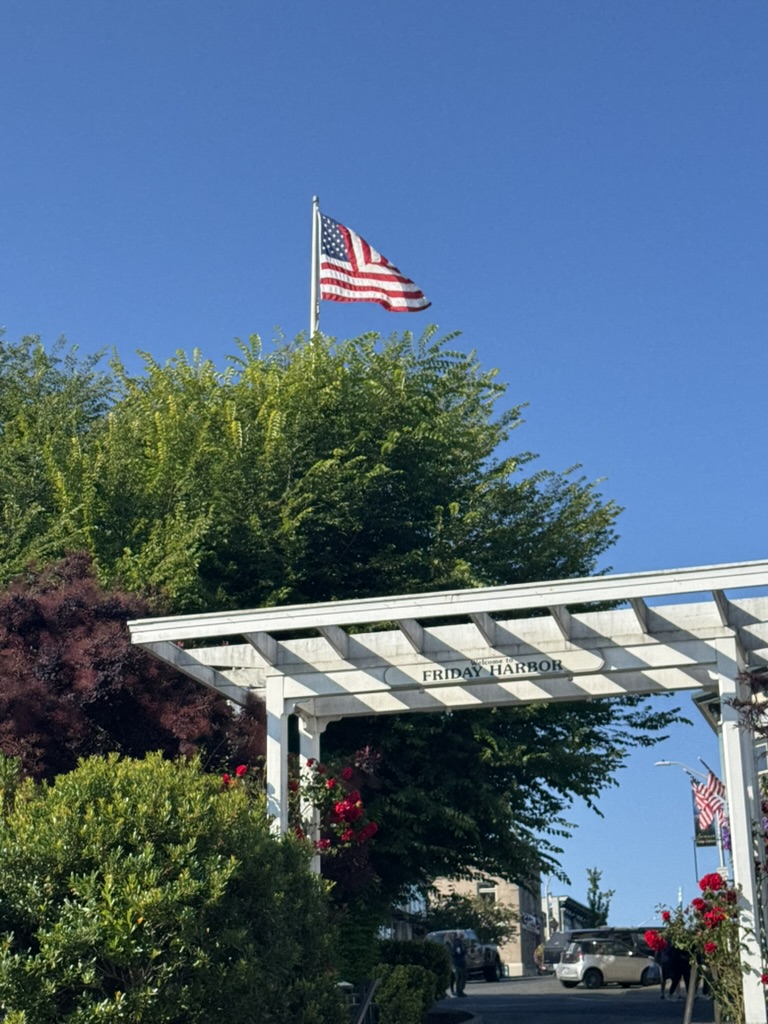
Picture from downtown Friday Harbor (photo by Lars)
I thought a lot about how I wanted to write this post. As we got towards the end of our time with Salish Sea Sciences, chore groups understood what jobs they were doing on the last day. I knew right away- I wanted this final post, this final message from our cohort, to be special. In an effort to maintain the original goal of the blog, as a daily tracker of all of our growth and learning, I will be talking about the day mostly as normal. Please, if you have any inclination to click off the blog now, don’t.
Although some of us were gifted the luxury of waking up peacefully, others had a violent awakening. With an extra hour of beauty sleep under our belts, we each approached the big day excited! Pumped to see our families again, share with the science community all of our findings, and give the 2025 Field Science Cohort one last “hurrah!”.
Our first activity of the day was cleaning! We wanted the dorms and labs to be spotless for the next group of kids to enjoy the space as much as we did. So, in typical fashion, we cleaned to music! Pop songs playing on Ella’s speaker, trumpet noises coming out of Miles’s mouth, and piano notes bouncing off the walls all the way up to the top floor. Similar to science, music is all about communication. We have grown together in that way, playing different songs with each other, dancing to new tunes, being amazed at all of the positive energy each one of us brings to the table.
We also began to pack up some of our belongings during this time. For some, this was done in a neat, organized manner. Separating clean clothes from dirty, neatly folding shirts and shorts, even organizing clothing items into packing cubes! For others, it was more of a shove everything into the bag and see if it fits.
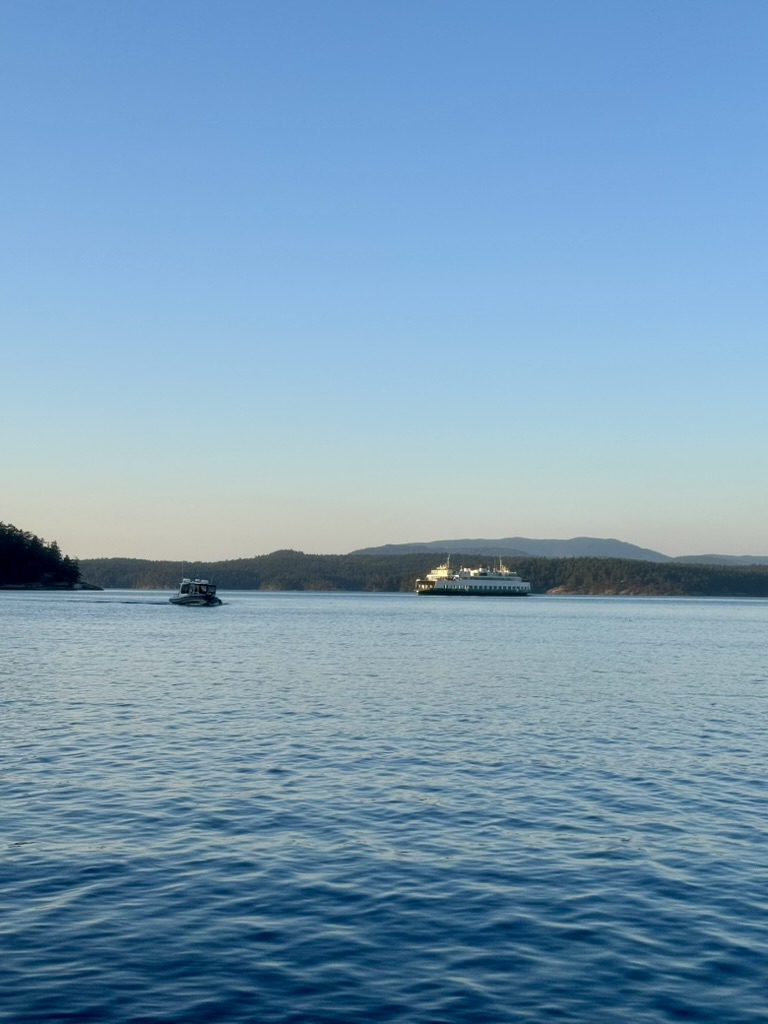
Photo of post-sunset from Friday Harbor Marina (photo by Lars)
Next, we had an hour to write thank you notes to all of the amazing people who inspired us this summer! Whether that’s scientists at the labs, educators on restoration for the San Juan Islands, people who kept the dorms from burning down, or helped us with each step of our projects. There was a broad spectrum of how many cards people wrote, and how well they wrote them. The science team challenged us to write as many as possible! Orrin beat Wyatt over some clear differences in card quality. They both wrote a total of 22 cards!
Our final piece on the agenda before the big project symposium was structured recreational free time! We went to go get ice cream downtown, many of us enjoying a variety of flavors on a waffle cone. We took our time to enjoy the moment, each other’s presence, and our ice cream, before heading back to the dorms to get symposium ready!
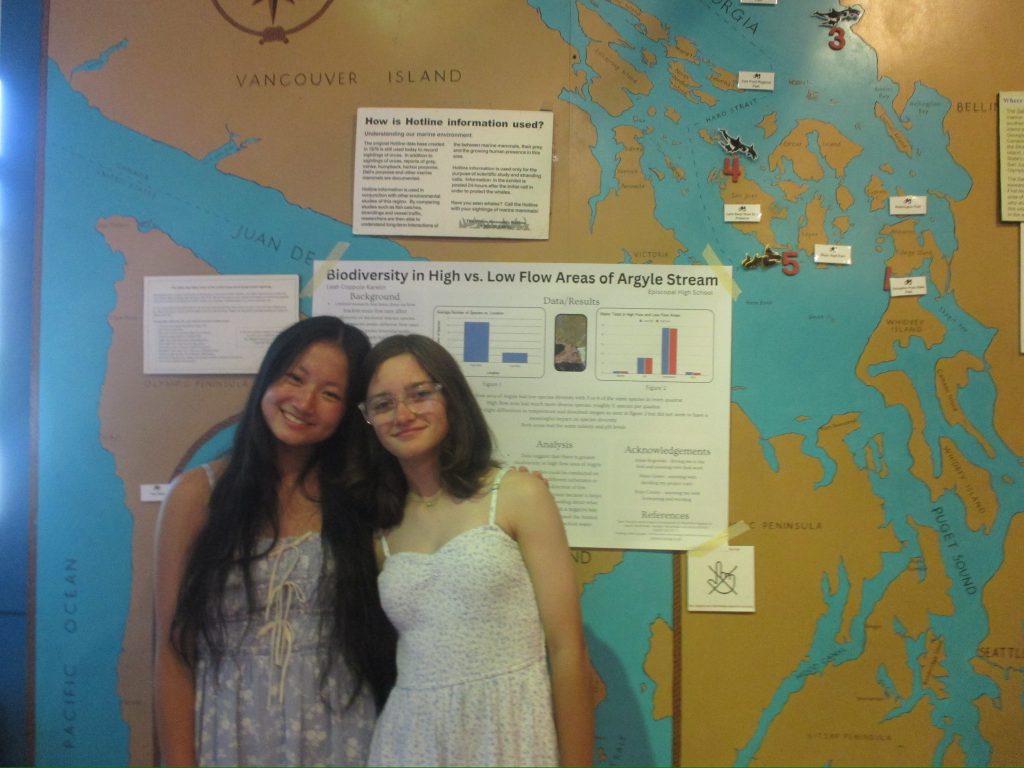
Annika and Leah symposium ready! (photo by Hitomi)
For the first time ever, the project symposium was being held at a very special place. Whale Museum Research Director Jessica Farrer (who had had dinner with us earlier) invited the idea that our program share our posters to the scientific community, our parents, and the public at The Whale Museum! This is such a huge step towards furthering our understanding of youth science communication, and I was honestly stoked we could make it happen! At 5 pm it started. Quickly the room filled up with mentors, families reunited, and friends from all around came together. It didn’t feel like a room full of strangers, it felt like a room full of knowledge, and appreciation, and science.
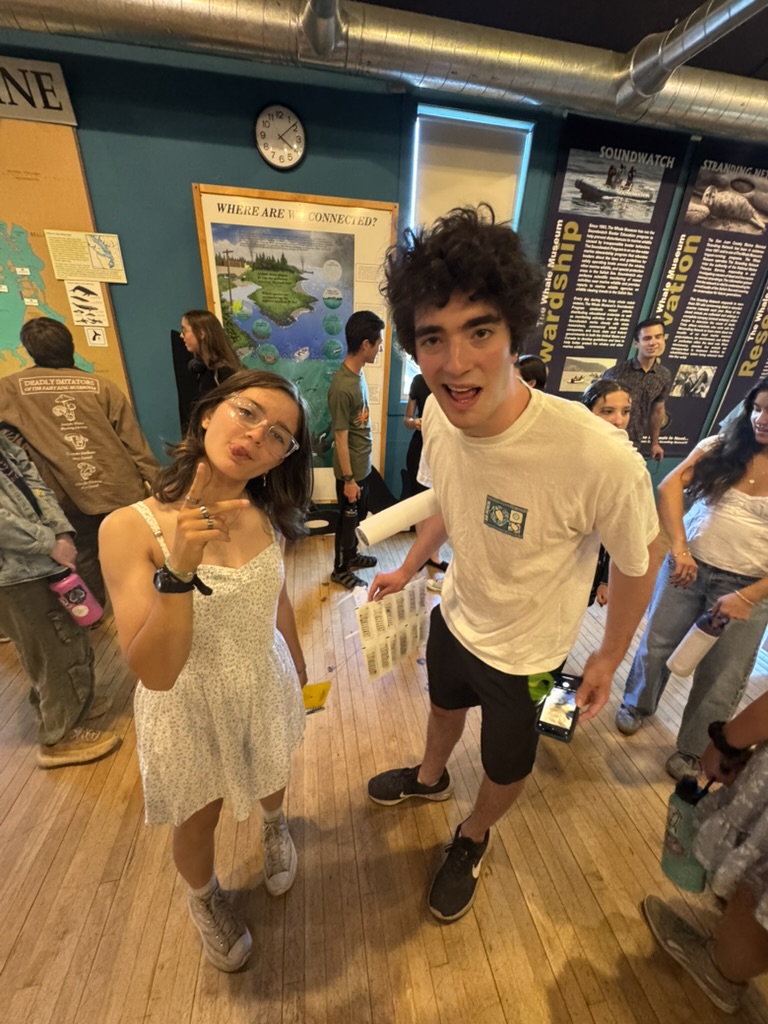
Leah and Miles at symposium (photo by Lars)
It is a beautiful thing when you realize that although you’re practically shouting to make sure the person you’re talking to can hear you, you have to shout because there is so much going on! So much of the information being shared was newly learned through our own hard work! To see so many brilliant minds in one room discussing their passions was simply astounding. You can’t recreate it; it’s a one-time thing. We all came to Salish Sea Sciences for different reasons. Maybe some of us really wanted to learn about one marine organism, or maybe some of us were looking for something fun to do over the summer. No matter what the circumstance was that brought us here – we all arrived on June 29th. Bags in hand, maybe a little nervous of what was to come in the next month–Completely a different person than who we each were in that room. Experiences build us as people. They change who comes forward when you present yourself at a time and place. Obviously Salish Sea Sciences built us up to be better scientists. But it also built us up to be better roommates, better town citizens, better conversation listeners, better note takers, and better friends. All of this hard work got all 19 of us in that room with an amazing poster right behind us. That is special, that is unique, and it deserves to be cherished.
Our throats sore, and legs a little wobbly we returned to the vans for our final ride back to the dorms. Met with warm burgers, bags of potato chips, and yummy fruit we chatted with symposium participants, and reflected on the event with friends and family.
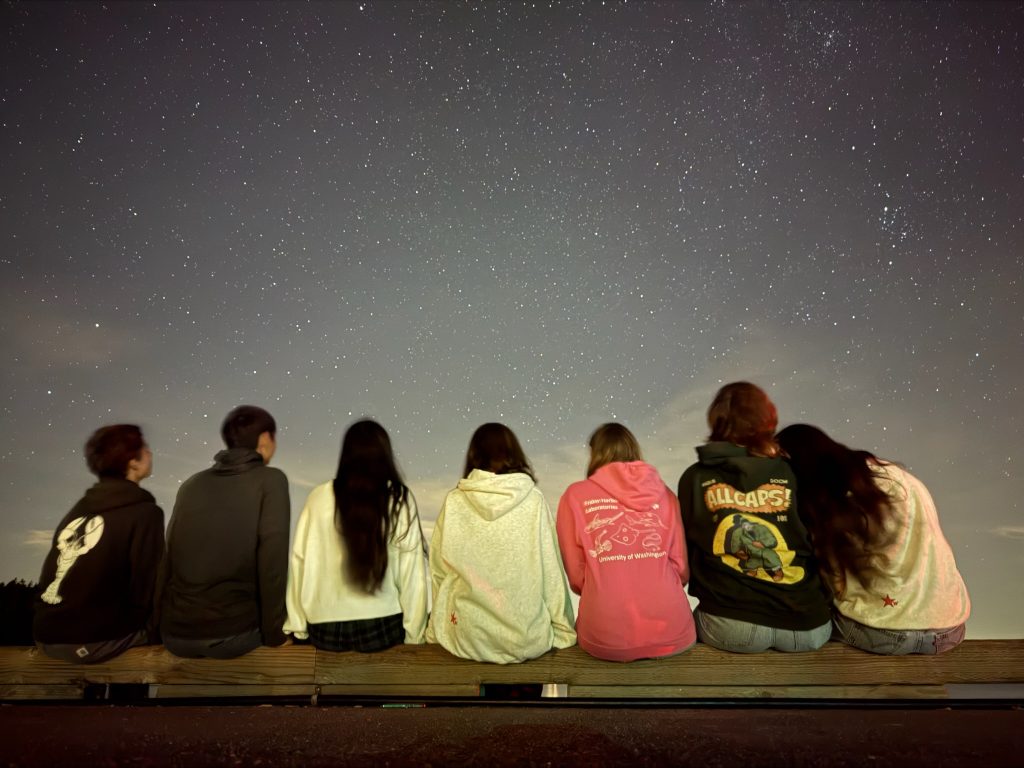
The night ended with bowling and stargazing together. All of the 2025 Field Sciences cohort relaxed for the final time together. Pointing our constellations, cheering each other on when we knocked out all the pins. Cherishing our final hours together.
Stargazing (Photo by Orrin)
The next morning, the majority of us departed at 7 am in a van with bags in hands. Tearful goodbyes were had, long hugs, and plans of reunions in the air. What we did this summer was once in a lifetime. You can only be in Friday Harbor in July of 2025 with the same 19 amazing people once. It was a rare summer, no matter where we end up, we had this summer together and we’ll all remember it. Nothing can replace it, no one can redo it. It’s like finding the perfect beach to watch an amazing sunset on. It’s a moment where everything was timed up right with the people and the place. It is so perfect, and then it ends. And you get back in your car, and think “wow what a great sunset,” you go home and tell your family about this great sunset, maybe you even took lots of sunset pictures! Every so often you bring up that sunset again and it’s just warm fuzzy feeling takes hold of you. and your back in the sunset, or watching the constellations, or seeing orcas from Deadman’s Bay.
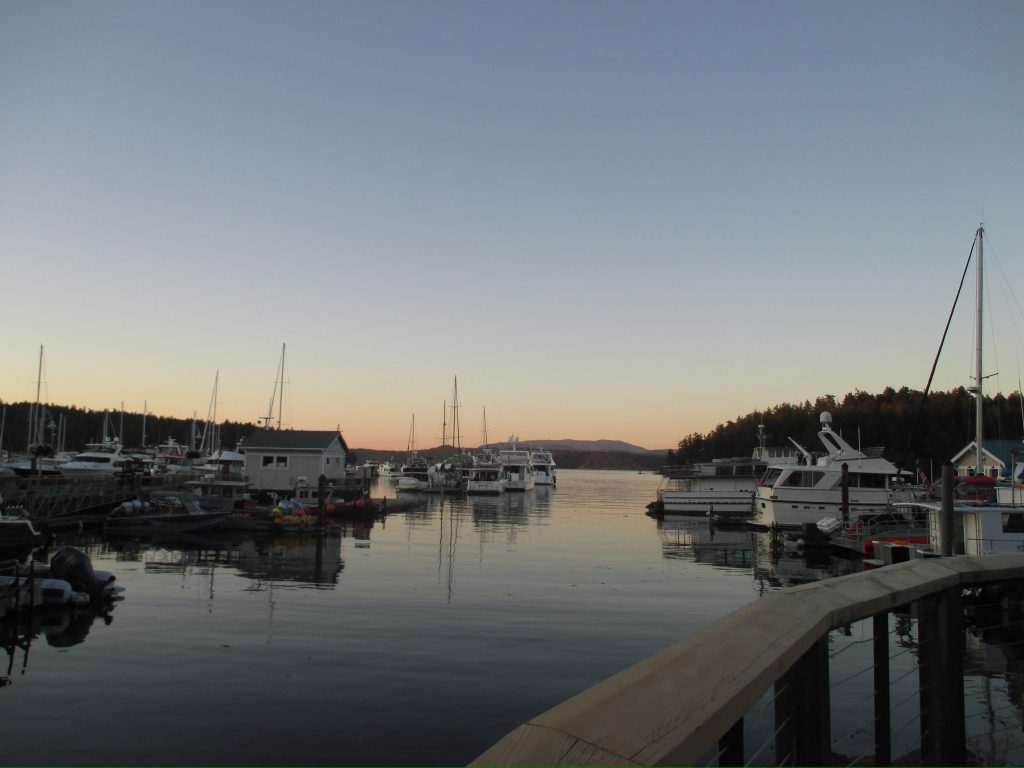
Sunset at marina (photo by Hitomi)
Thank you for the summer of our lives Field Science Cohort of 2025. Thank you to Maya, Adam, and Riley for your science and advice support. Thank you to Cassandra and Cara for being the most welcoming dorm family. Thank you to Tom and Caroline for running the whole program, keeping dinners yummy, and everything in tip top shape. And thank you again- to the science nerds. “A dream you dream alone is only a dream. A dream you dream together is reality.”
This morning we all locked in after breakfast for the last stretch of project time! Some were done while others were making final touches and getting peer checked. Everyone dreaded getting checked by Maya as we all know she’s the master of poster making and will make a thousand small corrections to our posters. Despite the corrections, her wise words payed off in the end and we can’t wait to show off our amazing work tomorrow evening!
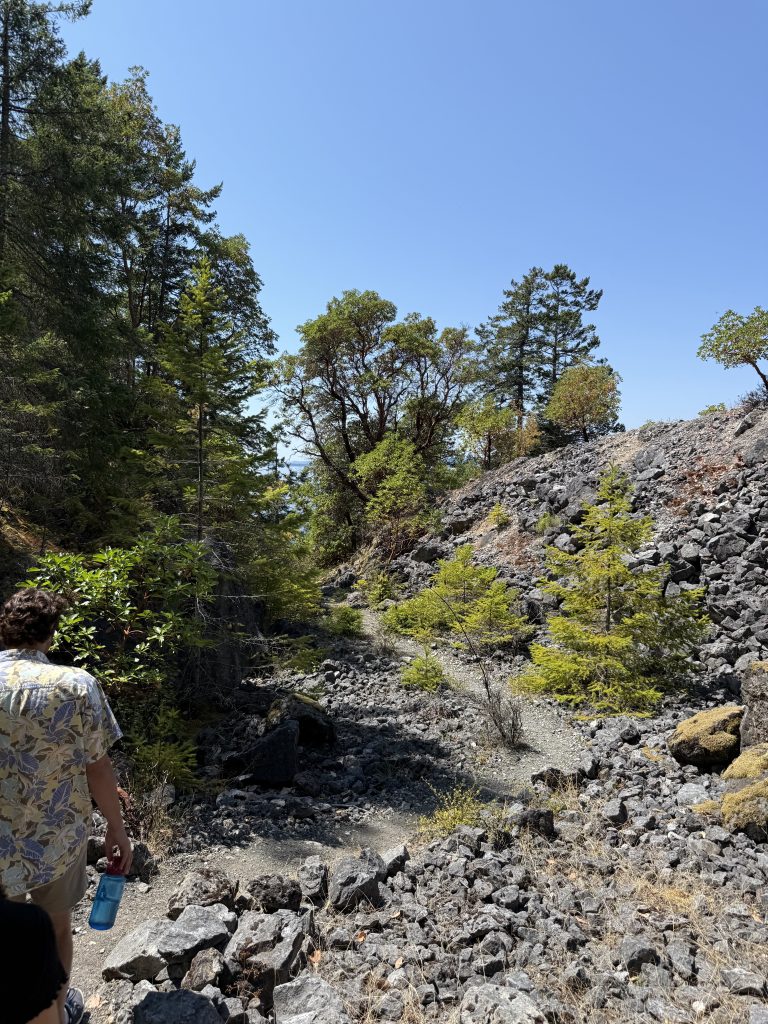
Limekiln hike (photo by Hitomi)
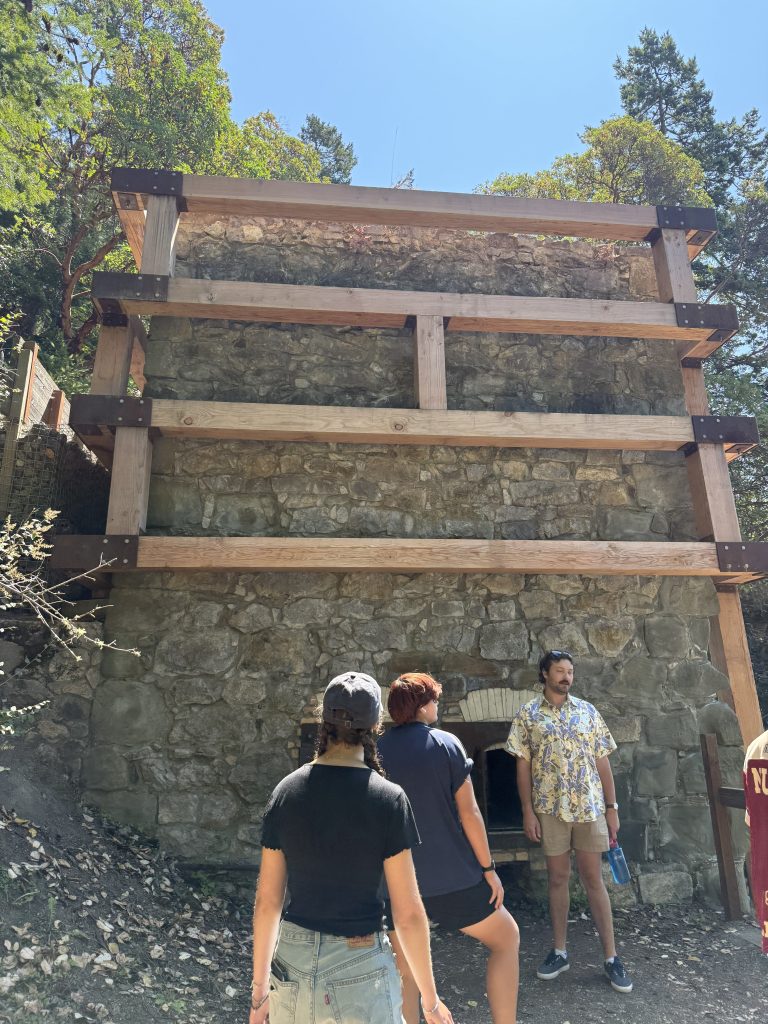
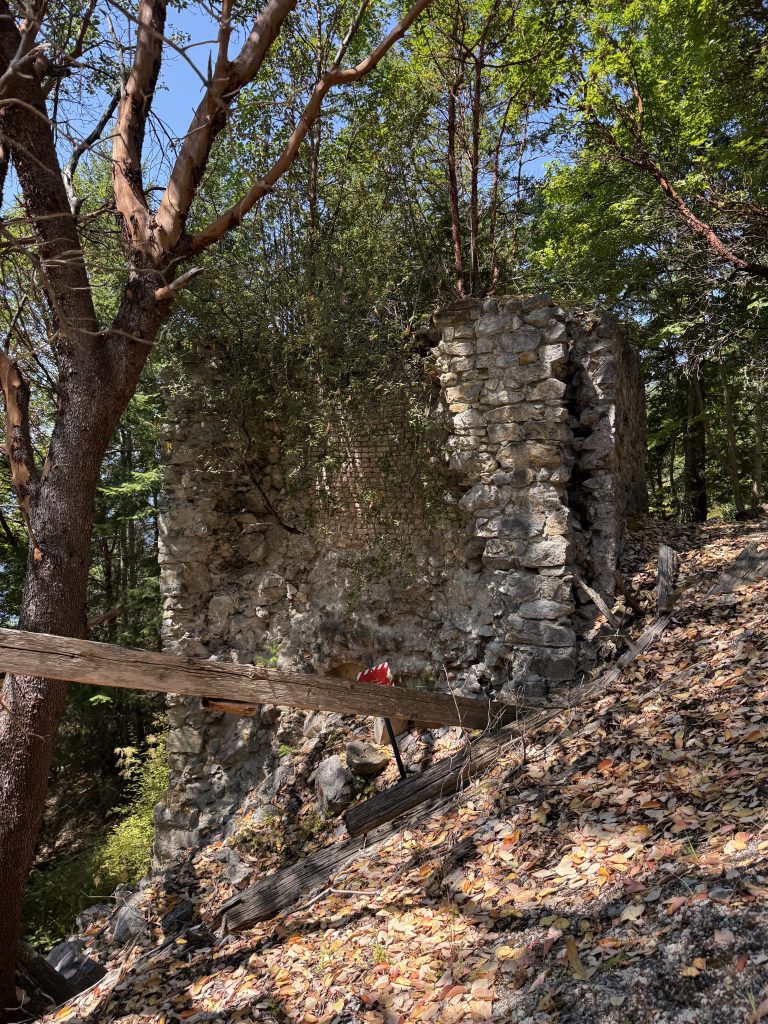
To get a refresher from sitting, and to celebrate being done with projects, we went out for a peaceful hike at Limekiln State Park. Adam talked us through the unique landscape and interesting artifacts that still lay in the park. We hiked to a few view points and got to see a few Limekilns of course!
Limekiln (photo by Hitomi)Inside a Limekiln (photo by Hitomi)
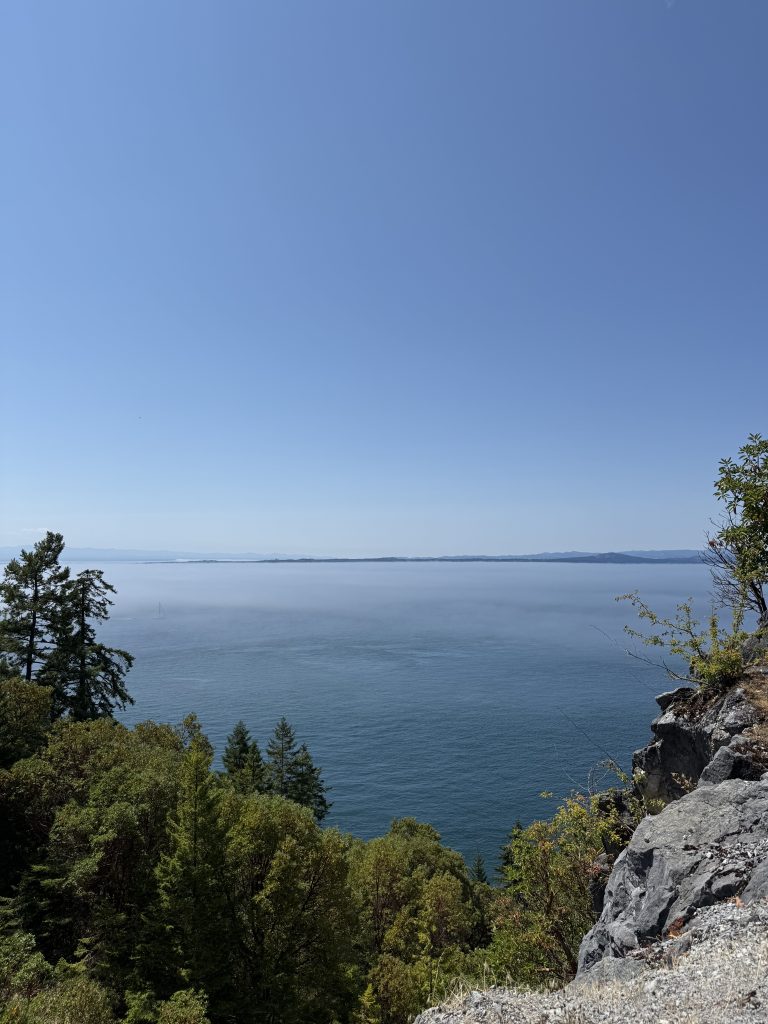
The first view point we made it to was absolutely stunning, but slightly scary! We saw some super cool marine fog, blocking any chance we had of seeing orcas (tragic).
Marine fog at Limekiln (photo by Hitomi)
After the walk we helped ourselves to a mid-day snack while listening to Maya and Adam talk about their experience with SEA (Sea Education Association). We got the inside scoop on what it’s like to do the SEA program as a study abroad option which sounded pretty cool!
Maya and Adam’s SEA talk (photo by Hitomi)
After the amazing talk we made our way over to Friday Harbor Labs for the last time during this program. We got some time to look at the stockroom (merch) before going to a talk about Thermodynamics of Coral with Dr. Truscott. The talk brought some interesting discussion to dinner where we enjoyed some delicious mac n cheese and lasagna!
FHL “Thermodynamics of Coral” talk (photo by Hitomi)
The 8am breakfast slowly transitioned into project worktime, and soon we were deep into it—three hours of focus with varying degrees of confidence and success. We kept moving forward, cutting down or building up our data, depending on where we were in our projects. Many of us ran into struggles: some trying to make graphs, others trying to fittoo many into their presentations. Nonetheless, we persisted. The time flew by, with Adam, Maya, and Riley offering support and helpful feedback on what to adjust and what to keep. Before we knew it, lunch had snuck up on us, and people began eating and frantically plugging in their inevitably dying laptops.
After lunch came our “brain break,” which was announced as the English camp hike—something we had missed earlier in the week due to fatigue. It was advertised as a short, one-mile walk up a small hill. But I don’t know what mountain-loving giant considered that hill “small,”. By the time we reached the top, everyone was drenched in sweat and gasping for air. A few unfortunate souls hadn’t changed out of their pajama pants and deeply regretted that decision. The misinformation led many astray, and legs were on fire long before the top. But once we made it, we were greeted with an incredible view—and for at least some of us, it was definitely worth the struggle.
After a short downhill walk, we loaded back into the vans and returned to the dorms. Once there, it was time to jump back into our projects—crunch time had officially begun, and many people were in the final stretch. About an hour and a half later, we shifted gears to start our jobs and prepare for our evening guest: Khrista Nicholas, a RED student from the University of Miami who is now an incoming master’s student at the University of Alaska Fairbanks.
After a delicious dinner of fried rice, we all enjoyed hearing about Khrista’s path thought college and her current topic of study. She had a beautiful presentation with photos detailing her fascinating and incredible journey. Following our guest we all gathered to have a joint movie night, relaxing while watching Finding Nemo with ice cream.
Sunday, July 20. By: Mira, Vidita, Asher, and Noam
This morning’s sunrise (photo by Eden)
This morning, many of us woke up at 6 am to get ready to go out into the field. A group of eight, six people doing research, along with two helpers, went down to Fourth of July Beach to collect data on eelgrass. One person was looking at plots set by San Juan Island Conservation District, one was looking at environmental effects on eelgrass wasting disease, another was seed coring and plotting flowering eelgrass heads, one was looking at trampling and harvesting effects on eelgrass wasting disease, another at percentages of ulva versus percentages of eelgrass, while a last student looked at distance from the shore in relation to eelgrass density. We had a good time, but it was very,very cold. Despite the cold, however, we all managed to collect data, and headed back home.
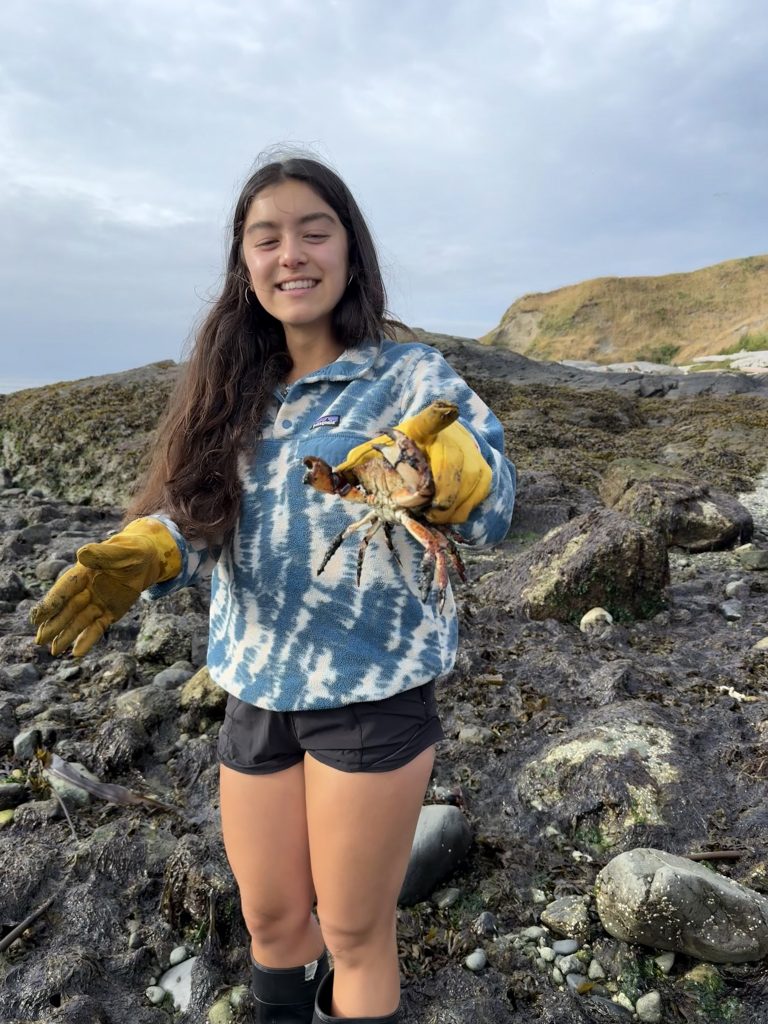
Hitomi posing with a red rock crab (photo by Lars)
Four students headed off to Cattle Point to collect further research. One student was collecting phytoplankton, the second was randomly sampling biodiversity, a third collecting and measuring crabs along a transect, and the last conducting experiments on anemones,
While most were freezing out in the field, a few lucky students who were working nearby got to sleep in. After a nice, relaxing breakfast, we set out for a busy day of working on projects. Many students spent the morning working at the dorms or in the lab. Others headed down to gather data at the Marina or Jackson Beach. From observing fly species to looking at sculpins, everyone was trying to make the most of these final days before our presentations.
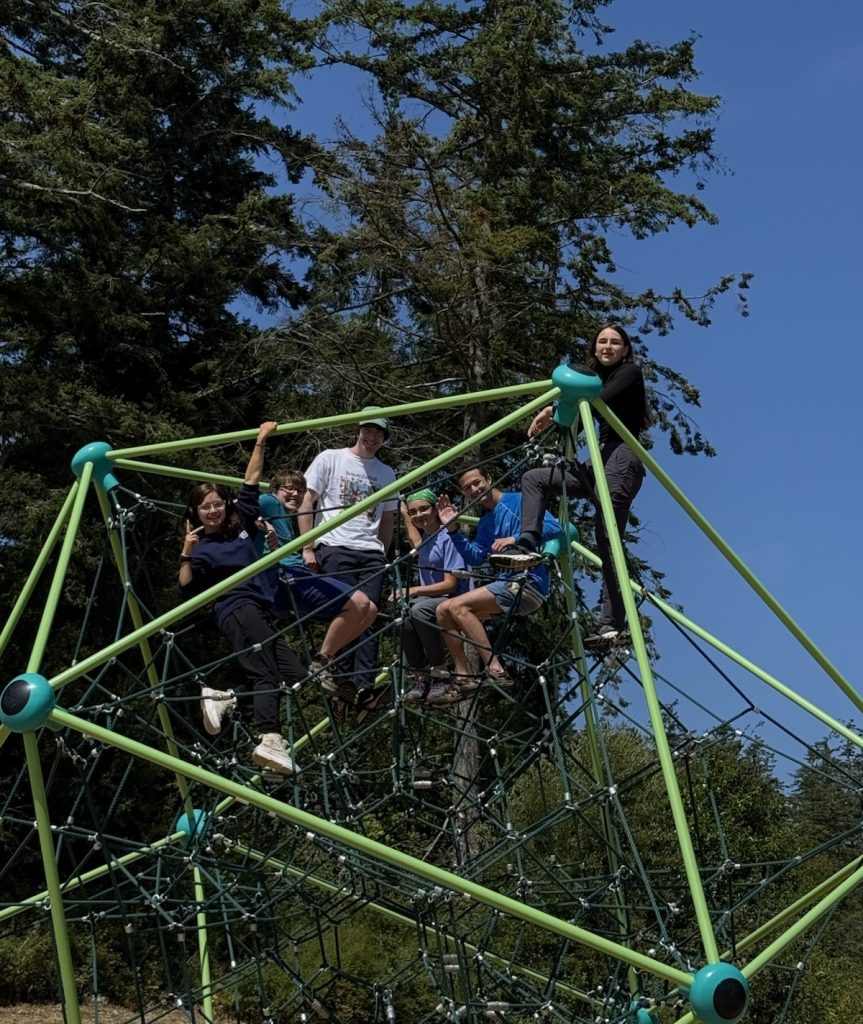
Fun at the playground (photo by Hitomi)
After everyone regrouped (and showered, for those that had been in the water), there was an option to go on a walk through Linde Park, where the San Juan Land Bank keeps native species abundant, including delicious thimble berries, and a playground. We then returned home for project work time, to create our posters.
Caroline and Tom’s daughter, Bea Grauman-Boss took the time to have a call over zoom to talk about her science journey. She spoke about beginning her research in irregular growth in echinoderms based on the presence of predators and availability of resources. From that, she transitioned to capsid presence in cells after virus treatment, specifically yellow fever and dengue. She ended with her most recent ventures in cancer research and general advice on prioritizing one’s own interests and seeking out mentors that also center your endeavors.
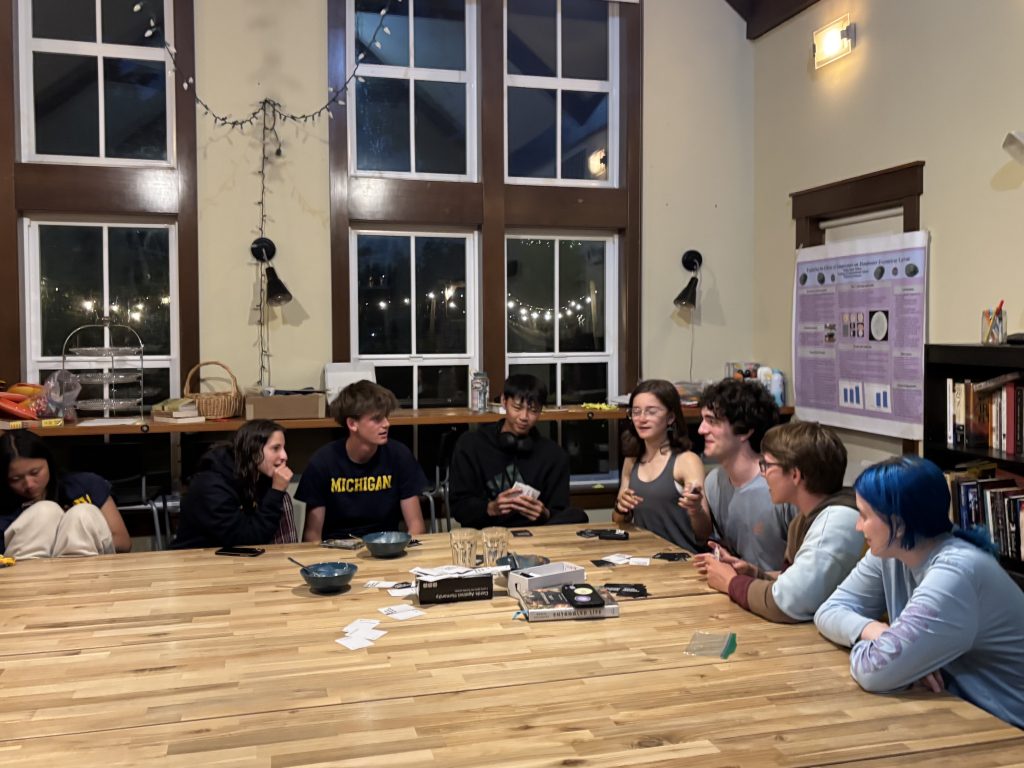
Playing Cards Against Humanity (photo by Mira)
For our delicious dinner of vegan chili, we were accompanied by Katherine Dietzman, a shoreline and mapping specialist working with Friends of the San Juans (a non-profit organization dedicated to protecting the San Juan Islands). She talked about the work she does with Friends of the San Juans, including shoreline restoration and looking at forage fish. Our evening ended with ice cream, The Lord of the Rings, Cards Against Humanity, and other fun activities.
Salish Sea Sciences Blog, Saturday, July 19th, 2025. By: Lars, Leah, and Miles
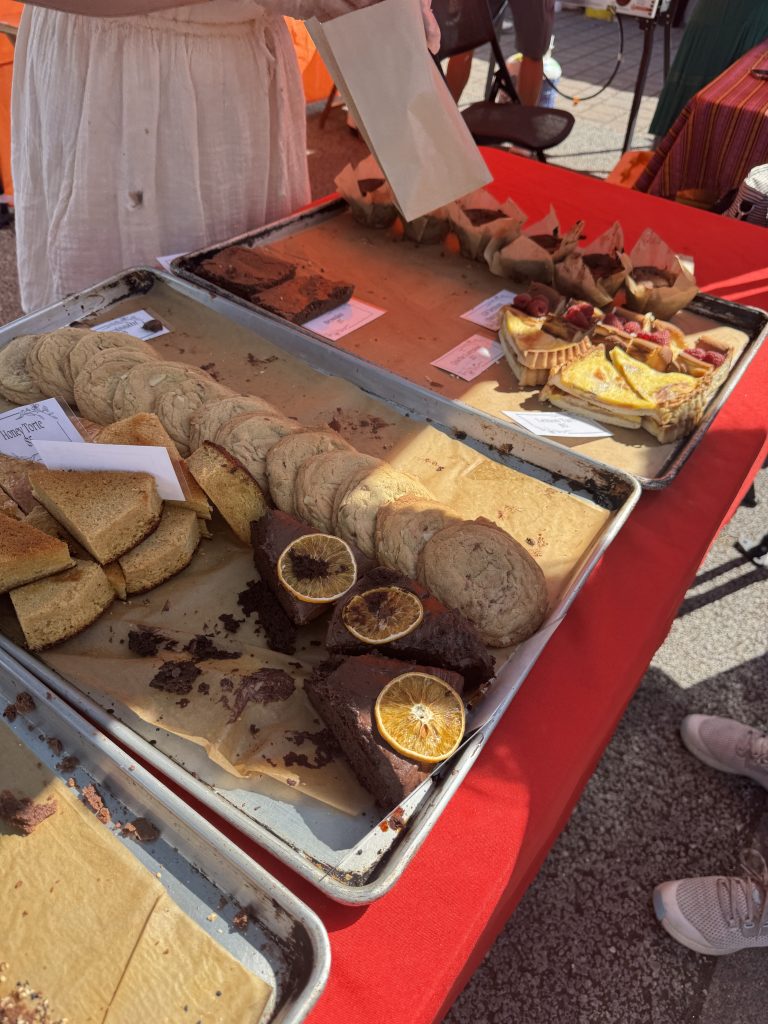
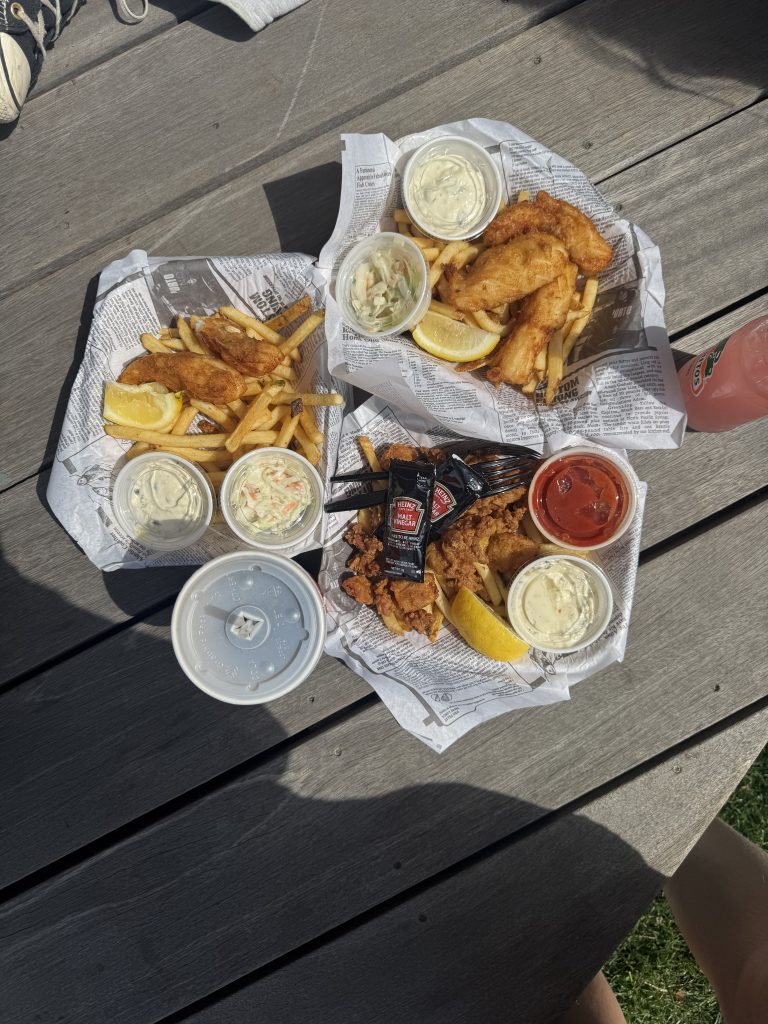
Welcome back to another day in the life of a Salish Sea Science student! Your hosts, Miles, Leah, and Lars are going to take you through the final Saturday with the Field Science cohort. After a super late night night lighting at the dock, with an inspiring appearance by a local Harbor Seal, everyone got at least an extra hour of sleep. At 10 am, we all sprinted towards Brickworks, excited to frolic in the town as Caroline locked the doors to the dorm behind us. Our science directors gave us the second gift of the day – an opportunity to hit up the Friday Harbor Farmers Market with a bit of cash in our pockets! Miles packed his lunch beforehand to save some money, Leah had a bagel when the dorms were unlocked after, and Lars tried some yummy local fish and chips with a side of calamari! Sooo yummy!
Assortment of pastries at Friday Harbor Farmers Market (photo by Lars)Fish and Chips, and Calamari from The Bait Shop (photo by Lars)
At 12:30, the crew, full and content with any purchases made, headed back to the dorms to cool off and get ready for a conversation about college with Caroline. She helped us better understand what aspects of a college decision may be important to consider, some less obvious to us than others! She also strongly encouraged us to further look into liberal arts colleges. She stressed understanding whether you prefer a degree focused on getting you job ready right after college, or well rounded life learning, and possibly a further degree from a professional or graduate school.
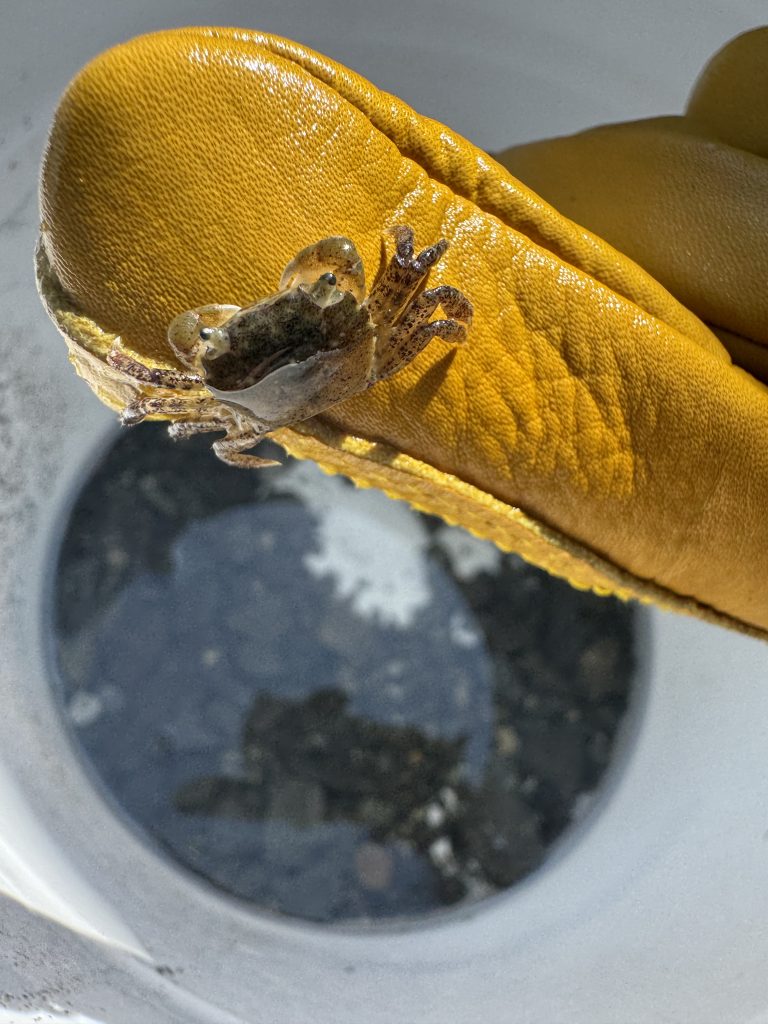
2 to 4pm was our project work time! Miles found a new species of seaweed fly only identified in Canada before! Leah polished her data collections and progressed steadily on her poster. Lars studied crabs righting response times with the boat noise treatment.
Hairy Shore Crab clinging to Lars’s glove (photo by Lars)
Finally, to wrap up our day, we are welcoming Shauna Barrows from The Land Bank for a mac and cheese dinner! Shauna, raised amid California’s droughts and wildfires, followed her passion for water, wild places, and poetic inquiry to the Pacific Northwest—earning degrees in Environmental Education and English, working in conservation, and ultimately returning to the San Juan Islands with deep gratitude and love for nature.
Shauna Barrows defines restoration as fixing the relationship between people and land. People who are connected to the land—and therefore to the nature around them—develop a deeper sense of care and responsibility for its protection. She began by sharing her own story, reminding us that it’s okay (and often necessary) to change paths—she herself started out in computer science before finding her passion in environmental work. Shauna now works with the San Juan County Land Bank, one of only two land banks in the U.S., funded entirely by a 1% tax on property sales in Washington. She described her role in reducing wildfire risk on the island through controlled burns, and how restoration isn’t just ecological—it’s deeply cultural. She encouraged us to question the Western idea of nature as something separate from humans, and instead consider how Indigenous communities have long maintained reciprocal relationships with the land through traditional knowledge and practices—many of which were disrupted or erased by colonization. We also explored the complex politics that often accompany restoration efforts.
One example Shauna shared that brought these ideas to life was the story of camas flowers, a striking purple bloom native to the Pacific Northwest. Coast Salish peoples once cultivated extensive camas prairies, using controlled burning and seasonal harvesting to manage the landscape and sustain this vital food source. These were not untouched wild spaces—they were shaped by generations of stewardship. What truly surprised us was learning that camas prefer disturbed soil and actually rely on being harvested by hand in order to pollinate and reproduce. Without that human relationship, camas populations can decline. Today, Shauna and her team are working to reintroduce camas as part of larger efforts to restore not only ecosystems, but cultural memory and interdependence. Her story helped us see that restoration isn’t about returning land to a “natural” state, but about remembering and reactivating the connections between people and place.
As the sun sets on another incredible day with the Salish Sea Sciences cohort, we’re left with a deeper appreciation for the land, the sea, and the dynamic relationships between people and nature. From the joy of local flavors at the Farmers Market to eye-opening conversations about college choices and career paths, today was packed with learning and connection. Shauna Barrows’ visit reminded us that restoration begins with relationship—an idea that resonated deeply as we reflected on our own paths and roles in environmental stewardship. Whether it’s discovering a new fly species or questioning societal narratives around land, our journey as young scientists continues to evolve with each experience. Here’s to waking up early and staying curious.
EV car built by Friday Harbor High School students (photo by Hitomi)
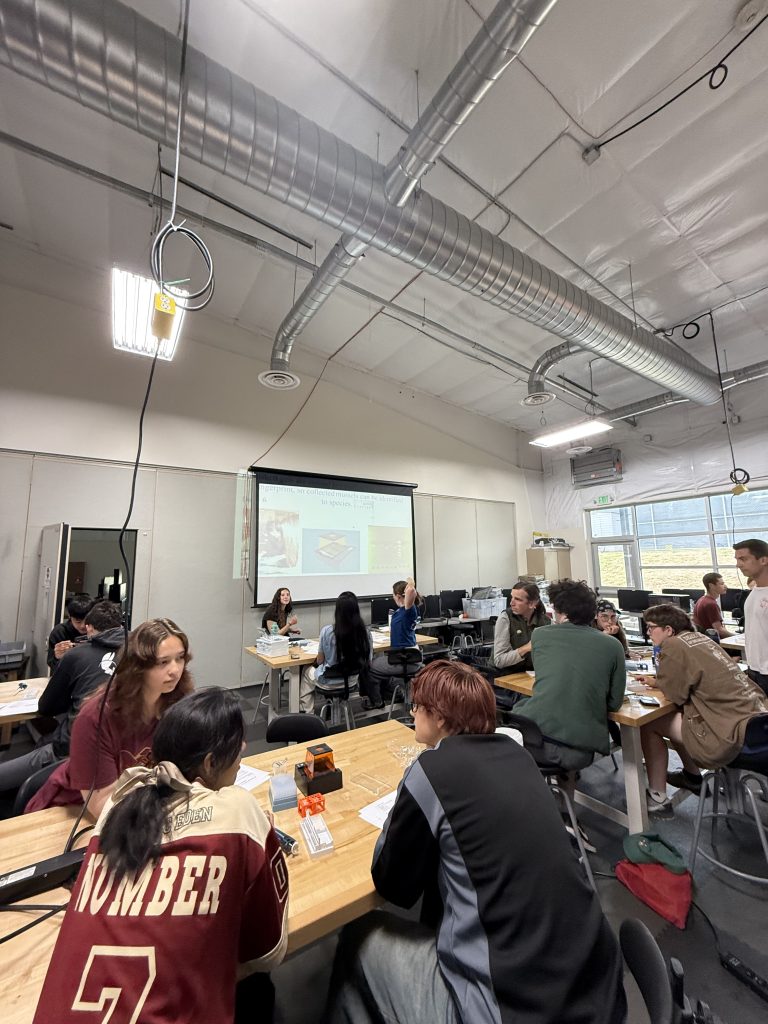
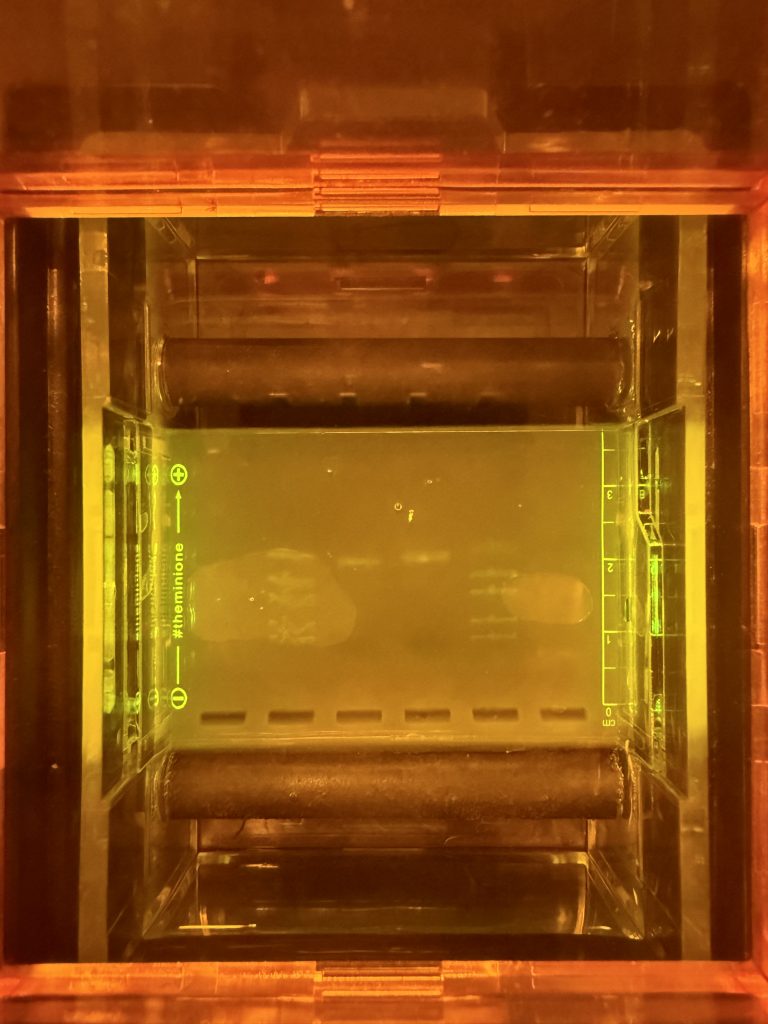
This morning, we enjoyed a short walk a few blocks to Friday Harbor High School where we helped Sam Garson with his Invasive Mussel Project. In groups we were given mussels collected from the local area (native) and a mussel bought from the grocery store (invasive – Mediterranean mussels). Using PCR and electrophoresis, we identified if the mussels we had were invasive, native or hybrid. The data we collected will be used to further Mr. Garson’s study which is cool! We also tested a new and faster method for data collection, shortening the data collecting process from multiple days to 90 minutes!
PCR lab (photo by Hitomi)
While we were waiting for our DNA ladders to appear, we were given the opportunity to take the high school’s makeshift electric car for a spin in the parking lot! Only licensed students were allowed to drive, but those of us without licenses took turns riding in the back. The car itself has some impressive capabilities, being able to drive for 80 miles on a charge, and having a top speed of over 90 mph. However, when we asked Mr. Garson about driving it on the road, he said that his last attempt led to an encounter with a sheriff, which is why he only keeps it in the parking lot. Even though we were confined to the parking lot, driving the car was still fun (and scary at times), and we were still able to go quite fast. Once we were done with the car, we ended up analyzing our DNA ladders and walking back to the dorms for lunch.
Electrophoresis! (Photo by Hitomi)
Following lunch, we were joined by Dr. Donatelli. She walked us through a workshop on using the coding language R. R is a statistical coding language that many scientists use to analyze large data sets. We downloaded software onto our computers and began our coding class. We learned how to insert, look at, calculate, and even plot different sets of data. Overall, we all were happy to gain new knowledge and hopefully now we will be able to put our skills to good use in the future.
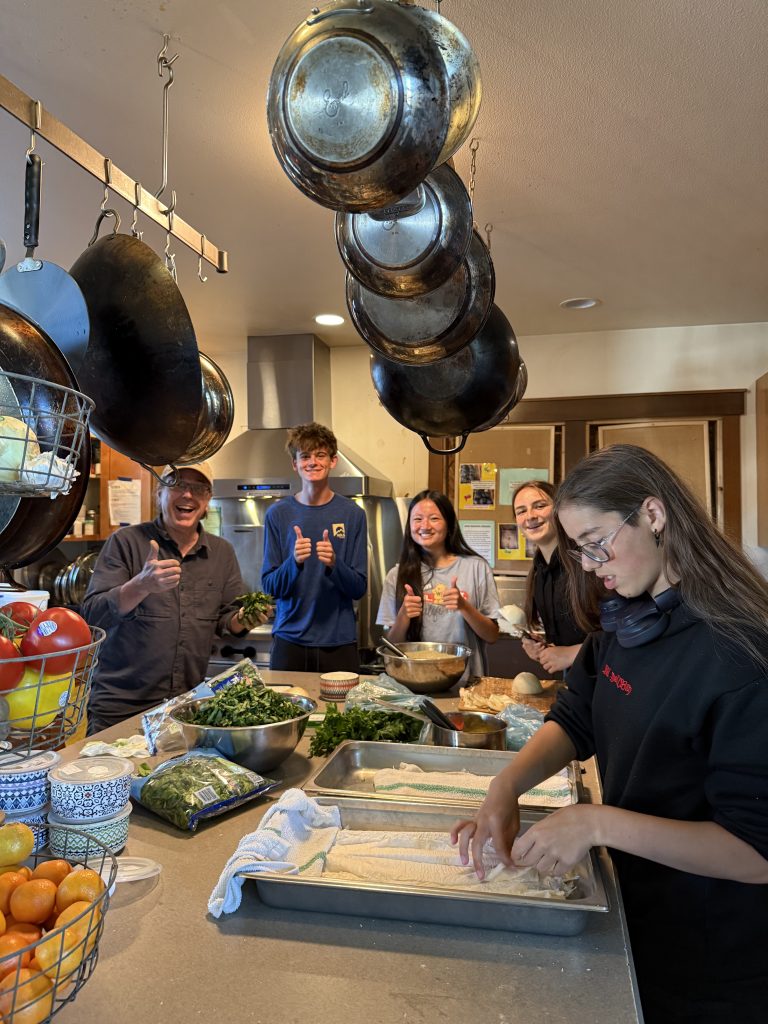
Dinner Crew making spanakopita! (Photo by Hitomi)
After working on our research projects for a while, some of us went to prepare dinner as we set up the dining room for tonight’s guest: Mr. Tim Dwyer. Tim is a science teacher at Friday Harbor High School who specializes in Chemistry, Physics, Oceanography, and Environmental Science (and who was the science director of our very own Salish Sea Sciences for 8 years!) He graduated from Bowdoin College with a degree in biology and from Central Washington University with a degree in education before earning a master’s degree in biology at Northeastern University. In his long career, Tim has worked as a marine science instructor for the Catalina Island Marine Institute, as a teaching fellow at Harvard Medical School, and even as a science communicator on the PolarTREC program based in Antarctica! During Tim’s after-dinner lecture, he discussed the subject of polar gigantism as well as his time spent at Antarctica’s McMurdo Station where he studied the physiology of sea spiders (which are more related to ticks than spiders.) According to Tim, there are lots of theories on the cause of polar gigantism, with the most likely theory being that larger bodies result in greater speed, allowing for organisms to scavenge for prey more effectively in the sub-freezing waters beneath the Antarctic ice. After Tim left with his adorable research assistant Wookie, some of us prepared to head off to bed while the rest of us made ready to head down to the marina with Maya to go night lighting.
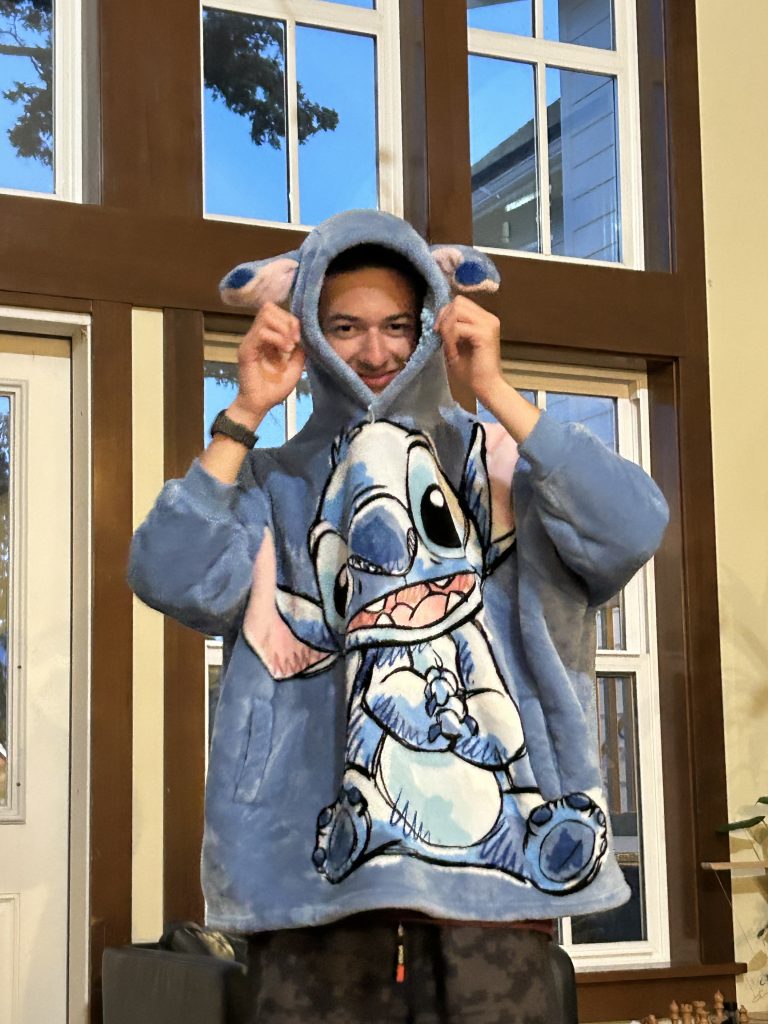
Noam looking so kawaii in Cara’s Stitch hoodie (Photo by Harper)
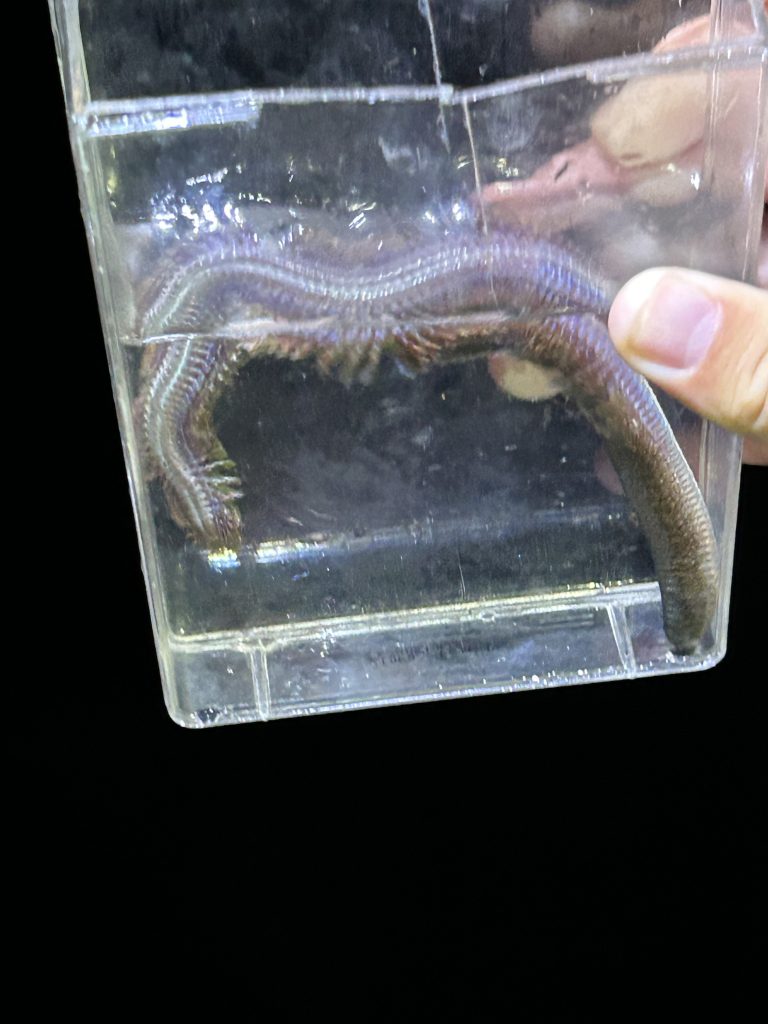
Tonight, we are going to go night lighting with Maya. Night lighting is when you take lights down to the dock and lookout for marine organisms. We are all excited so see what we will find, but we are going to have a late night. Good night, see you tomorrow!
Huge marine worm captured on the dock (Photo by Harper)
Ringing met us as we awoke to start a new day. Many alarms and sleepy faces rose from bed covers as everyone headed down for a horribly early 7am breakfast with 30 minutes until the vans needed to be loaded. Today, we headed to Orcas Island via the ferry for some much-needed R&R after many hours of project work time (some having more fun than others). It was an interesting morning that led into an amazing day hiking, eating, and swimming.
First, we loaded into the vans to drive onto the ferry; this was followed by around an hour in the van and then even more time in the ferry, where 3 stops were made. Although that might sound unfortunate, the time was spent quite peacefully; some people worked on puzzles while others chatted, looking at the view. We even saw some baby seagulls and a harbor seal!
After taking a tour of the islands, we arrived at our destination for the day: Orcas Island. A wonderful small town with major beach vibes greeted us while we drove through town for our next activity. This activity consisted of a short hike around the only known salmon spawning location in the San Juan Islands. The water looked gorgeous and the hike was very pleasant with the forest surrounding us and nothing but lunch and swimming to look forward to.
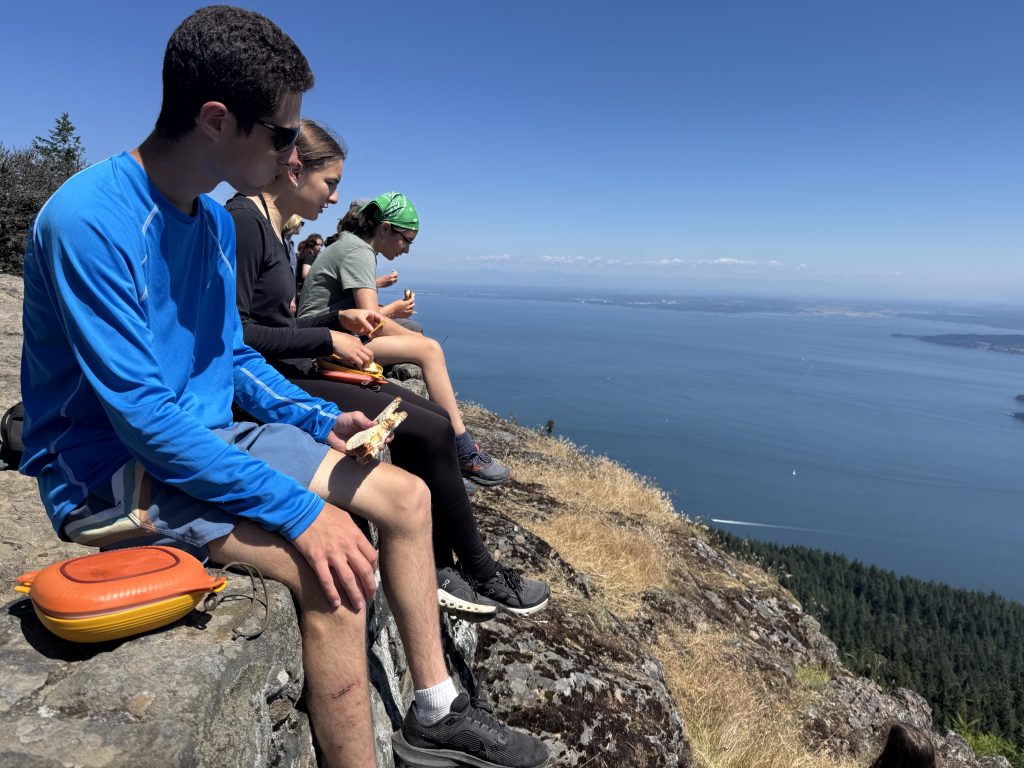
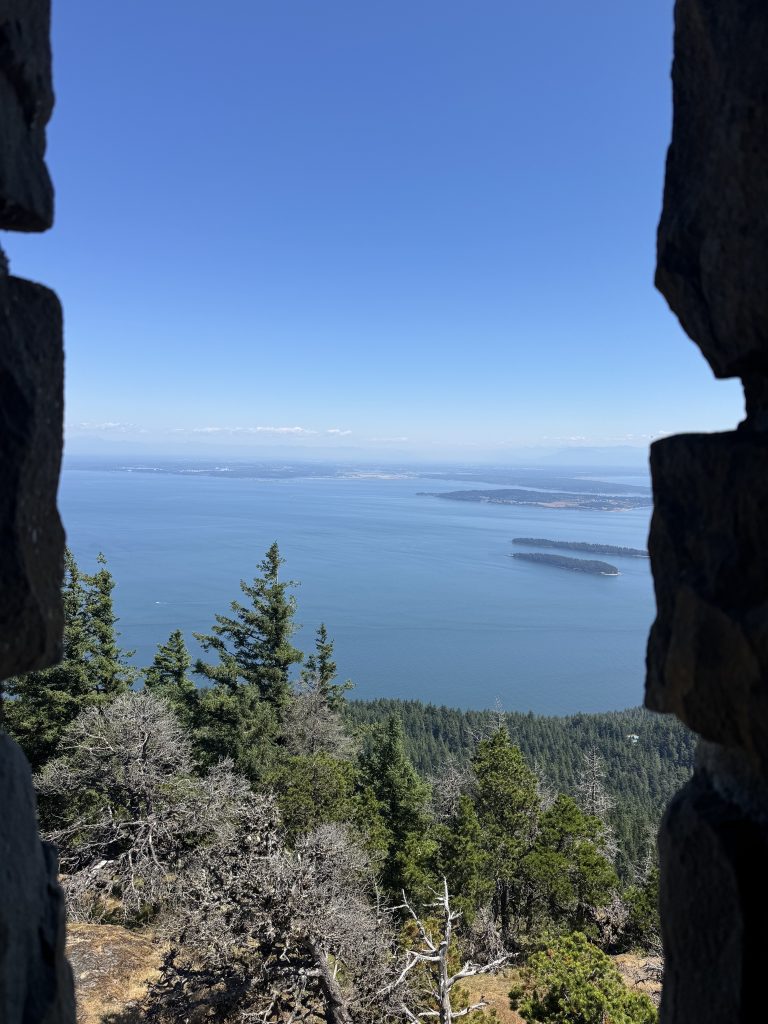
Eating lunch atop Mount Constitution (photo by Orrin)
Speaking of lunch, after the hike, we made our way back to the vans and made our way to one of the most beautiful views on the island: Mount Constitution. A windy road later, we were at the mountains’ summit and the highest point in all of the islands. We ate lunch quickly while bald eagles and hawks flew around and above us. Then, we prepared for the highlight of the whole day. It was time to swim.
Another view from the watchtower on Mount Constitution (photo by Orrin)
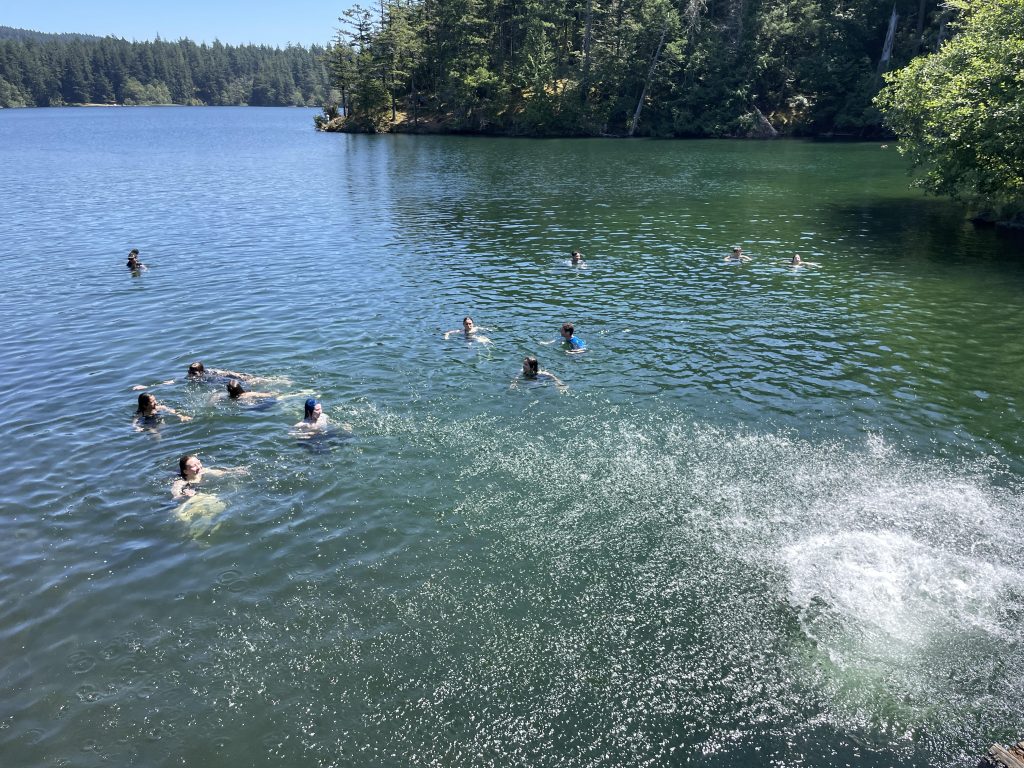
We arrived at one of Orcas Islands many lakes. After some inflating of paddle boards, complaining about cold water and splashing around in the water we headed to our final location. Some of us headed around the lake on foot (with some having better visibility than others) while others paddled to the location. No matter how we got there we all arrived at a bridge which spanned the lake. We wasted no time, we put our stuff down, ran to the bridge, climbed to the edge and JUMPED!. Laughter and the splash of water could be heard from all of us. We spent the time exploring the area, swimming and jumping from the bridge. The travel back to the vans was no less chaotic. How do four people on one paddleboard get across a lake is a question that has now been answered: slowly but surely, with a lot of flailing about.
Cooling off in Paradise Lake (photo by Maya)
After a long, fun day we were all ready to head back the Friday Harbor. The ferry ride back was entertaining as the first one with plenty of puzzles and gorgeous views to admire. The day ended with a great dinner and relaxing free time.