Wednesday, July 9th, 2025. By: Lars, Miles, and Leah
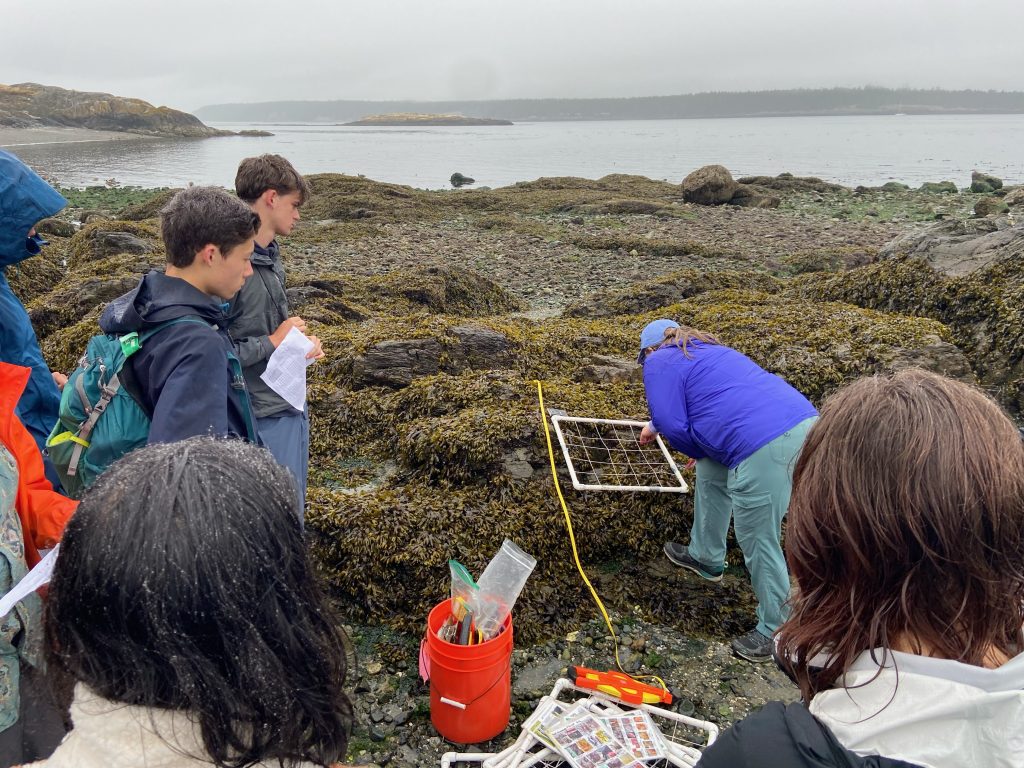
Our day started out at an ungodly hour .. 7 am! We had to get up and out the door by 8 am to catch the low tides to for our surveys. We were also charmed by the piercing winds on the coast, a kind drizzle from the sky by mother nature, and the overall dewy weather. Despite all odds against us, many of our spirits remained lifted!
We started our surveying with a warm up led by Dr. Katie Dobkowski and her undergraduate research assistant Gabby. They asked us to walk arms length apart, in an even line down the beach for 1 minute. Searching intensely for crab molts. The goal was to understand weather any of the crabs living in this area were part of the invasive green crab species. We did a total of 3 of these walks, finding many crab molts varying in size along the way – none were green crabs! Currently, European Green Crabs are considered one of the most invasive species in the marine environment. Efforts from university researchers, and state researchers are coming together to prevent the spread of this species into the beautiful marine ecosystem surrounding the San Juan Islands. “Green crab could potentially damage Alaska’s multi-billion dollar fisheries industries, especially for salmon, crab, and mariculture operations.” (NOAA Alaska Regional Office, 2023)
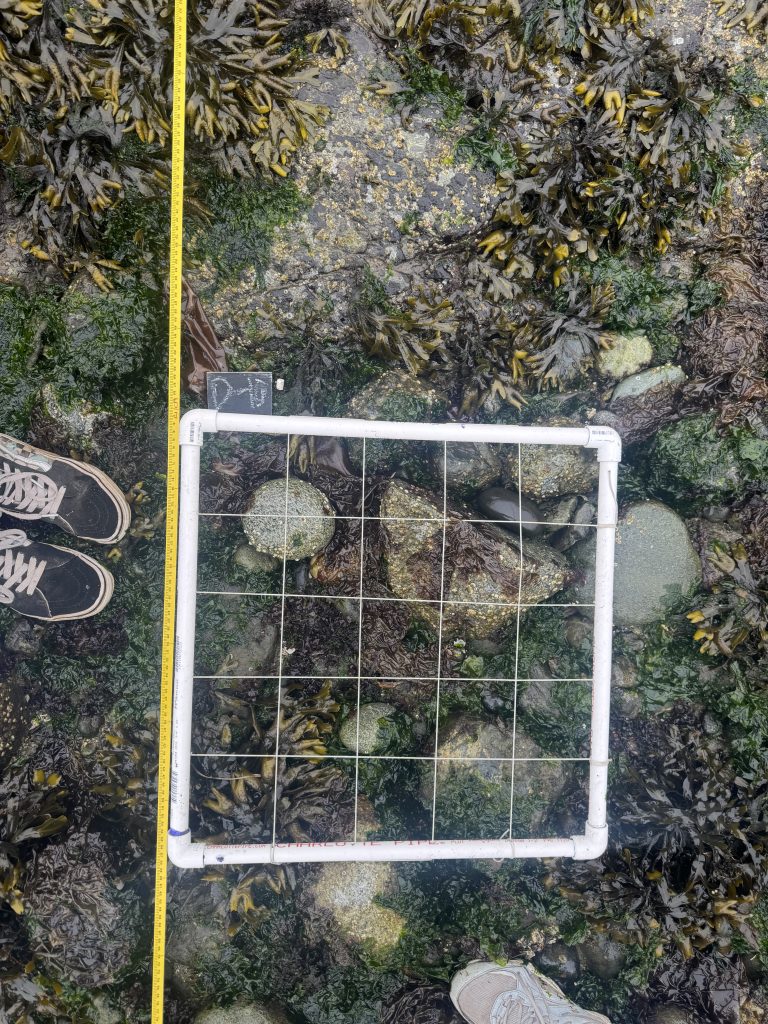
Continuing on with our deep dive scientific studying, we moved onto instruction and participation in a continuous survey Dr. Dobkowski keeps up on seaweed species on Cattle Point. We scaled down the dangerous-ly slippery rocks COVERED in seaweeds of red, green, and brown. Our quadrads were used to identify the various species within them. Our groups identified lots of rock weed, rusty rock, and Turkish towel. We layed out our measuring tape from the sector identifier at the top of the rock, and laid a quadrad down at each even meter on the line. Based on speed, some groups did many quadrads while some only completed one. On our survey sheets, we would make note of many things, most notably how much of the identified species of seaweed was identified within each section of the quadrad. Some sections were identified with having a 5 level, or 50 to 100% seaweed within the section. Others were identified with 1 or 0, 5% to 0%. Feeling pretty accomplished, we spent some time reflecting on our work with Dr. Dobkowski spotted many foxes and retreated to our warmer vans.
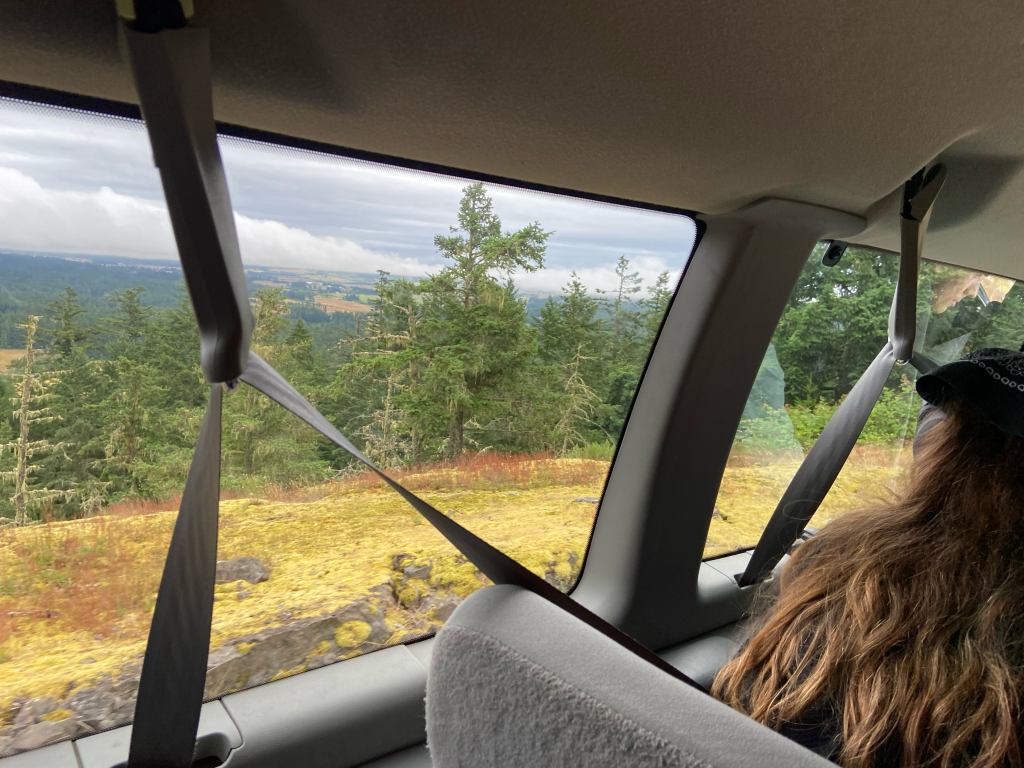
We stopped at the lovely Jackson Beach to get a quick bite and rest our bodies and minds before returning out to the field. While at Jackson Beach, we met more scientists from the Washington Department of Fish and Wildlife attempting to trap our enemies, the European Green Crab. Next, we slid on over to Mt. Grant, and met up with the wonderful Shauna Barrows from the San Juan County Land Bank. She shared some thought provoking insights on the local water sheds on the island and the role they play in marine organism health, specifically salmonids. The County Land Bank is putting in a lot of effort into conserving the watershed, but the large amount of local agriculture causes degradation on the streams and creeks. They have began problem solving ways to keep the water quality up, without the full support of the land owners. I had no idea that there was a time when salmon spawned in the San Juan Islands watersheds every fall, and its sad to know that they no longer do that due to our impacts.
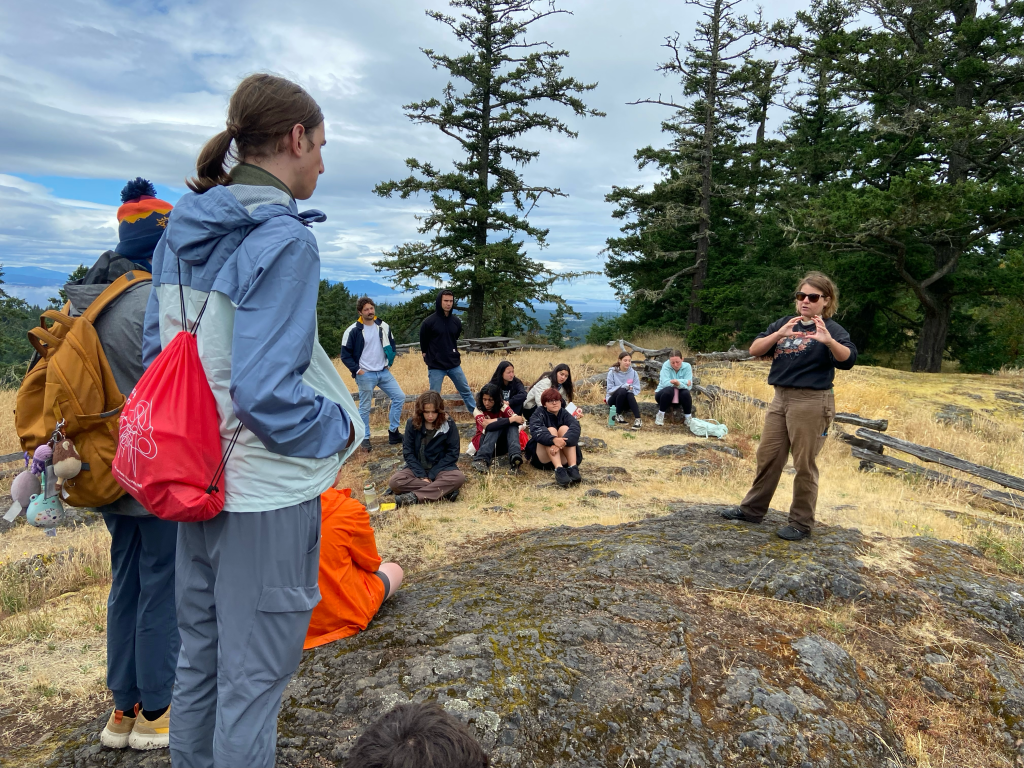
We concluded our journey at Zystera Lake, and discussed the history and cultural significance of that specific man-made lake. The lake is currently having a lot of problems with toxic algea blooms due to an abundance of nutrients in the water. As a solution, the County Land Bank is attempting to built these “beaver damns” in order to better slow down and filter the water coming from the creek to the lake. They are currently only working on this at a small scale, but hope to expand in the near future. Finally, Shauna drove home the point that conservationist like herself have to continuously think of ways to conserve the depleting nature around them without attempting to control the locals, because at the end of the day us, and her have no control over how the publics actions influence the environment if we don’t make an attempt to repair it, and educate.
We returned to the dorms briefly for a quick bite, and maybe an outfit change and heading out one final time! This time we were catching one of the weekly seminars hosted by UW at the Friday Harbor Labs. This talk by Shirel Kahane-Rapport on filter feeding in mobuilds (manta rays). She dove right into the fascinating topic of how she used models in person and on a computer to simulate the lobes in a mobulids filter and how changes may impact a mobulids ability to feed. The talk was super physics, data, and graphs heavy but the majority of our students seemed to stick onto her train of thought super well. In fact, I would say our body of students asked her more questions at the end than the other researchers at the lab! My favorite feature of her talk was her opening of background information on mobulids, how they feed. She made it possible for those outside of her area of study to understand her work without any background experience. Although that seems like it should be obvious, it is not always a given in the scientific community! If your interested in learning more about ricochet separation and the science behind how manta rays feed, we recommend skimming through this paper! https://pmc.ncbi.nlm.nih.gov/articles/PMC6157963/#:~:text=Our%20results%20indicate%20that%20manta,flow%20rates%2C%20and%20resists%20clogging.
Finally, we relaxed after a long, eventful day! Food on our plates, minds full of new knowledge, we begin to reset for another adventurous day ahead!