SSIS College Spotlight: Financial Fit — Public and Private

FinalBanner

SSIS College Spotlight: Financial Fit — Public and Private
volume 2, issue 2. Fall 2016
 
Dear Seniors and Families,
 
Not all state schools cost the same and many private colleges publish a sticker price that is much higher than what the average family contributes. This Spotlight focuses on the cost of college—private and public—and how to evaluate the value of each in light of your own situation. 
 
Please remember that individual ambitions and circumstances as well as the policies and endowments of individual schools dictate how any individual financial package is put together and interpreted. Read all college website information carefully and do not be afraid to call a college’s financial aid office—their counselors are available to talk. It’s part of what they are paid to do.
 
As always, take advantage of the SSIS College Counseling office space, the materials you find there, and me!
 
Best always,
Caroline
Your College Counselor
_________________________________
  

 COLLEGE IS REALLY EXPENSIVE OR WHAT?
Short answer: yes. Longer answer: “sort of and not necessarily.” It all depends…
 
 The trick: which, where, what, who, why.
 
Colleges are non-profit institutions that are either funded publicly or privately (we are ignoring for-profits: perhaps there are some that are valuable, but many—if not most—are scams). State-funded schools, despite dollars from boosters and patent dividends from research, depend largely on state tax revenues and politics. Private institutions rely on tuitions, patents, and donations. As a rule, they enjoy greater discretion, but can experience their own financial challenges, often depending on their size, location, corporate sponsorships, alumni network, and length of existence. Some schools, such as the Ivies, are fortunate to have grown large endowments over time that make it possible for them to offer students financial packages that are competitive with local public institutions. A great student from the San Juan Islands can attend MIT, Amherst, Brown or Swarthmore for the same price or less than the cost of Western, Central, Eastern, WSU, Evergreen or the UW.
 
 PUBLIC INSTITUTIONS
 
 WHICH: State schools tend to fall into two categories, internationally competitive research universities (University of Washington) and regional schools (Western, Central, Eastern, Washington State, and Evergreen State College). Each has its own culture, academic strengths and admissions criteria—all have a mission to serve students whose families contribute to the state tax base, and all are competitive with national and world measures for distinction.
 
 Did you know?—Eastern is part of a nationwide program that brings undergraduates together annually at a research conference sponsored by the Council on Undergraduate Research. WSU is noted for an exceptional record in many faculties, including teaching, communications, and pre-veterinary medicine. Western offers small class sizes, has a global focus, is recognized for being green, and is first among mid-sized universities for students joining the Peace Corps. The Evergreen State College is part of the national Colleges That Change Lives consortia, Central is highly ranked for excellence and affordability, and its students and departments regularly achieve national recognition. And, the University of Washington ranks globally at #11 overall and #3 for public universities (2015).
 
 What do state schools cost? Tuition, room and board, student fees, books, and incidentals add up, but state school sticker prices for in-state students are the best deal you can get. For example: full price at Central comes to just under $22,000 a year (2016-2017). Good grades and scores can bring down the cost, financial need can bring down the cost, department or region specific scholarships can bring down the cost, ethnic or first-generation status can bring down the cost. CWU, like many other colleges and universities, offers a host of merit and need-based scholarships and grants as well as opportunities for work-study. By the time you have exhausted all merit and need-based options, Central can become increasingly affordable.
 
 What about the UW? The published total cost per year comes in at just under $26,000 (2016), It is the most expensive of the (heavily subsidized!) Washington public institutions, but the UW also offers the Husky Promise, a promise that full tuition and standard fees will be covered by grant or scholarship support for eligible Washington state students. Work study and other grants and scholarships can help with room and board. The University of Washington is among a select group of public universities that has agreed to the terms of the Coalition for Access and Affordability to meet the full demonstrated need of every student accepted.
 
 WHERE: Western Undergraduate Exchange (WUE) universities make it possible to attend public institutions in neighboring western states for the same or competitive price as schools in one’s own state. For some students, this is very important. If, for example, you hope to specialize in southwestern or mayan archeology, you would do well to research schools in Arizona and take advantage of their WUE membership. Here is a list of WUE schools offering 4-year degrees and a 2015 list itemizing WUE cost savings. California State schools are included—for example, California State Polytechnic University, Pomona—but, unfortunately, not the University of California schools. These, like other selective public research universities across the nation, charge out-of-state tuitions comparable to private universities—it is one way they work to make up the gap between their actual cost and their tax-based revenues and in-state tuitions.
 
 WHAT, WHO, WHY: This is the part where you have to know something of your own ambitions, learning style, preparedness, and so on. What depends on what you want to study and therefore which schools offer you the best programs. Who depends on who you are: are you driven to take advantage of a everything a large university has to offer or would you do better in an undergraduate-focused program that stresses close collaboration with professors and colleagues? Consider also whether you should work with specific area specialists. “Who” also goes to how prepared you are to qualify for merit-based or department-based aid. Why? Money matters—you want to get a 4-year degree with no loans (or so low in amount—and preferably without interest—so as to be able to pay them off very quickly). The object is to find the most appropriate educational fit for your future that you actually can afford.
 
 As a financial matter, be clear: in comparison with private schools most state schools cost less to begin with because they are already supported by significant tax dollars. Reducing the cost further can be tricky, especially if you do not qualify for a Pell grant or other federal aid. State schools just don’t have as much financial leeway. Private schools are more expensive—sometimes a lot more. Their value cannot be understated—many can offer scholarships and grants that will provide you with tremendous, personalized educational opportunities, support, and services. Figuring out which schools offer what and how they make themselves affordable is key.
 
 PRIVATE INSTITUTIONS
 
 Private schools fall into several categories: national, regional, religiously-affiliated, members of various academic or regional consortia or partnerships, and Coalition for Access & Affordability members. National private colleges and universities draw students from everywhere and award degrees in over 50% of liberal arts disciplines. They are generally quite competitive. Regional institutions also can be quite competitive, but they offer fewer graduate degrees and more than 50% of their undergraduate degrees are in areas not traditionally recognized as liberal arts. Many religiously affiliated schools welcome students of all beliefs and backgrounds. Consortia members and those with partnership arrangements between schools enhance learning opportunities and tend to have national reputations, and Coalition schools share a pledge to meet 100% of demonstrated need.
 
 Consortia members or those schools with partnerships can be very attractive, sometimes these are called:
  • 3-2 Programs (B.A. and B.S. degree program)
  • Exchange Programs
  • Cooperative Programs
 The objective is to give ambitious students a chance to engage deeply with the liberal arts even as they accelerate their educations as engineers, research scientists, lawyers, artists, or other professional designation. There is a cost savings associated with these kinds of programs as well. For example, check out Occidental College and its relationship with Cal Tech, Columbia University School of Engineering, Columbia School of Law, Art Center College of Design, and the Keck Graduate Institute. Occidental is but one of many colleges that offer such tremendous opportunities.
 
 All these private school designations affect cost. Schools with a national draw and reputation tend to attract more donation dollars, which can translate into more money for scholarships. Regional and religiously affiliated schools tend to have less money to spread around overall, but they do offer a handful of merit awards that can bring tuition down to zero.For example, Santa Clara University merit awards can covers 4-years of college. For the right student, one of these colleges might be a terrific fit between academics, social life, experiential opportunities, and price.
 
 Sadly, you can’t know the real cost of college—public or private—until you have applied, been accepted, and received your financial package—but you can guess. Please see the Spotlight devoted to the terms, tools, and tips for financing college.

SSIS College Spotlight: Financial Terms, Tools, and Tips

FinalBanner

SSIS College Spotlight: Financial Terms, Tools, and Tips
volume 2, issue 1. Fall 2016
 
Dear Seniors and Families,
 
This Spotlight focuses on college finances. 
 
One of the things that can be especially exasperating with the college application process is that each college and university has its own mechanisms for determining your financial package. In so many instances, you simply won’t know how much a college truly will cost until you receive an offer. However, you can make a “best guess” if you understand the financial language these schools employ and take advantage of online and other resources.
 
As always, feel free to make use of the SSIS College Counseling office and me! I am available by appointment during Flex and after school.
 
Best always,
Caroline
Your College Counselor
_________________________________
  

COST OF ATTENDANCE
Colleges publish the cost of attendance (tuition, room and board, books and supplies, student fees, transportation, and living expenses. Depending on the school and where it is located, the total cost of attendance (COA) can range widely. For example, for the 2017-2018 school year, Western Washington University’s COA comes to $22,828 and Harvey Mudd College’s COA is $71, 917.
 
Before you go into sticker shock, consider that three-quarters of Harvey Mudd students attend with substantial financial support from both college scholarships and grants as well as from federal and state government funds. Harvey Mudd’s policy is to meet 100% of a family’s demonstrated need. The comparison with Western Washington Scholarships is intriguing—a high school student with great grades, scores, and other aptitudes who is accepted at both schools may not have to make a choice on financial grounds. 
 
FINANCIAL PACKAGE
Your financial package may include one or several of the following:
 
  • merit scholarships and grants (these are gifts and do not need to be repaid)
  • need-based scholarships and grants (these are gifts and do not need to be repaid)
  • work-study (on-campus jobs)
  • loans (some loans may be interest free, deferred until graduation, and provided by the school, other loans may be offered by the government at a low interest rate; expensive private loans are explicitly discouraged)
100% DEMONSTRATED NEED
Many colleges and universities are now using this language to convey that they are prepared to make their college a reality for you by meeting you where you are financially.
 
There are three primary categories: 
  • * 100% demonstrated need, regardless of family income — without loans
  • * 100% demonstrated need for families within a specific income range — without loans
  • * 100% demonstrated need, but may include loans  
Here is a link to a September 2015 list of schools offering 100% demonstrated need by category; here is an August 2016 list (each school listed has a category notation, but the list itself is organized alphabetically)
 
EXPECTED FAMILY CONTRIBUTION
Colleges and universities determine “demonstrated need” by analyzing the financial data you provide them with the FAFSA (Free Application for Federal Student Aid) and/or CSS (College Scholarship Service) financial aid forms. These forms establish your personal financial profile and therefore determine your expected family contribution.
 
FAFSA
The Free Application for Federal Student Aid (FAFSA) functions like a national clearing house for financial aid. Because the FAFSA application involves verification of prior year household and income data from the IRS, most colleges depend on it as a reliable basis to ascertain your expected family contribution. Even if you do not qualify for federal or state financial aid, it is wise to complete the FAFSA. Many colleges use FAFSA information to help determine whether you might qualify for other cost reductions such as grants, scholarships, and work-study. 
 
CSS
The College Board provides a College Scholarship Service (CSS) that many of the nation’s most selective colleges and universities also require. Its purpose is to help them determine their allocation of non-government financial aid such as the college’s own grants, scholarships, and loans. The CSS application demands more detailed information than the FAFSA, including whether you own a home, and is specific to each college to which you apply. This feature allows college financial aid officers greater discretion than is possible with only the FAFSA. There is a small application fee, but some families may qualify for a fee waiver.
 
FULL RIDE
Exceptional high school scholars who have demonstrated leadership, innovation, service or other such qualities have the opportunity to vie for merit scholarships that cover full tuition or even a full-ride (tuition plus other expenses). Here is a 2015 list of 79 colleges with full-ride scholarships. Check individual colleges for their financial aid policies and opportunities. There are many more than 79 schools offering full-tuition or other significant merit aid that celebrates any number of capacities and talents, including the arts and athletics, not just test scores and academics.
 
PELL GRANT
Students with considerable financial need may qualify for a Pell Grant—a federally funded grant that does not have to be paid back. The maximum award is $5,815 for 2016-2017.
 
ESTIMATED NET COST
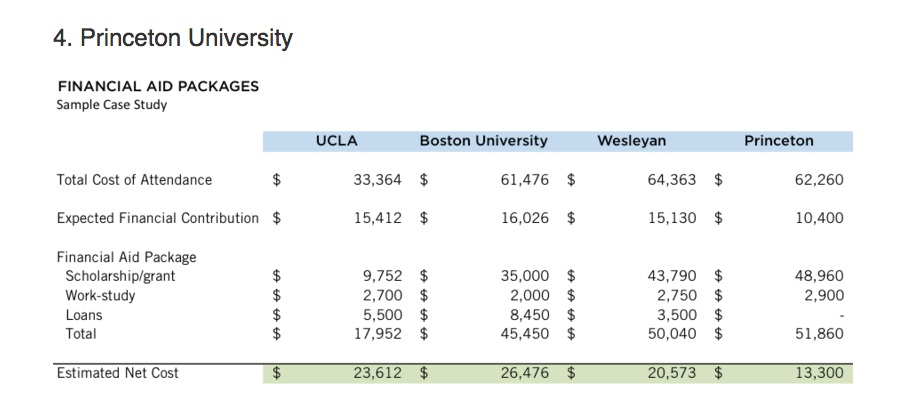
Subtracting the expected family contribution and financial aid package from the total COA reveals your estimated net cost. College Kickstart has published a blog that illustrates by example how to make sense of financial aid packages. Because colleges have different endowments and scholarship funds, and they use CSS and FAFSA information differently, their calculations of your expected family contribution can vary as will their financial aid offers.
 
HERE IS AN EXAMPLE COMPARING UCLA, BOSTON U., WESLEYAN, AND PRINCETON: 
 
kickstartdollars

From College Kickstart

 The premise of the case study above is that the student is a California resident and therefore has in-state tuition at UCLA. She is an excellent student who was accepted by all four selective schools. The family’s household includes two parents and a sibling, the parents have a combined income of $110,000 with $50,000 in savings, and the student has no assets. The schools themselves are committed to meeting 100% demonstrated need, but one can afford to do so without loans as well as estimate a significantly lower EFC for the family. Your takeaway: read the details of your package carefully. The big difference between Wesleyan and UCLA is that UCLA would cost $282 more in cash and $2,000 more in loans, and save $50 in work-study. With its long history of developing its endowment and other financial resources, Princeton is the least expensive option. 
 
TOOLS:
  • College website financial aid pages
  • College net price calculators (for example, here is the Princeton U. Estimator)
  • FAFSA and CSS websites
  • For FAFSA, you will need a FAFSA ID and you will want to use the IRS Data Retrieval Tool.
  • Scholarship websites, including national scholarships and those targeting Washington State residents (please consult the Spotlight focused on scholarships).
  • For income under $50,000 use ScholarMatcher to find colleges that retain and graduate students on time, offer generous financial aid, and provide ample student affairs services.
TIPS:
  • FAFSA and CSS applications are published on October 1st; do not wait to complete these. Most states, including Washington, disburse state financial aid on a first-come, first-serve basis.
  • FAFSA considers parent and student income, size of household, number of children in college, assets other than a primary resident, and excludes retirement savings and some non-discretionary expenses such as taxes and medical expenses.
  • Federal and individual college formulas can vary, for example: federal methods exempt the primary residence altogether whereas colleges may consider home equity; federal methods consider only custodial parent (and spouse) assets whereas individual colleges demand information from the non-custodial parent (and spouse) as well; and, individual colleges tend to use modified income assessment rates that can help relieve the financial burden of middle-class families.
  • Always apply to a public university in your state, then take a look at other options!

SSIS College Spotlight: Liberal Arts College or Research University?

FinalBanner

SSIS College Spotlight: Liberal Arts College or Research University?
volume 1, issue 5. Fall 2016
 
Dear Seniors and Families,
 
The United States offers a dizzying array of colleges: technical, community, and liberal arts—some of which are religiously affiliated. Universities—large and small—house one or several colleges within them. Universities are where you also find graduate programs and professional schools such as those for medicine, law, engineering, and business. The focus of this Spotlight is to compare liberal arts colleges with universities, however I mention the others as well—they offer significant opportunities to gain valued skills and pathways to a four-year baccalaureate degree.
 
Choosing between a liberal arts college and a university setting raises several questions: what kind of learner are you? Do you have a sense of direction career-wise? Are there research facilities that you must have? Are you seeking technical or pre-professional training? Do you prefer to be in a smaller or a larger learning community? What sort of diversity in the student body do you seek? What is your educational philosophy? Are you worried about employment immediately after college or are you planning to attend a graduate or professional school? The information below provides some tips and information to help you understand the difference between colleges and universities and make choices that are the “right fit” for you.
 
As always, take advantage of the College Counseling office space, the materials you find there, and me!
 
Best always,
Caroline
Your College Counselor
_________________________________
  
COLLEGE VERSUS UNIVERSITY: WHAT IS THE BIG DIFFERENCE?
 
The primary difference between a college—any kind of 4-year college—and university is implied in the name. A university has a “universal” aspect: It houses both 4-year college baccalaureate degree programs as well as graduate and professional degree programs. The mission of a university—whether private or public—is to give students the very best possible professional training.
 
 
For example: Gonzaga University in Spokane, Washington is a private Jesuit university home to 5,041 undergraduates working toward a 4-year college baccalaureate degree in 75 areas of study in the College of Arts and Sciences—its mission: building a better world through “education, character, service, and faith.” In the 2015-2016 school year, 2,111 students also were working toward a masters degree in 26 areas of study or a doctoral degree in three areas of study; 331 students were attending Gonzaga’s law school. Gonzaga offers professional training in the schools of business, engineering, nursing, education, science, and law. It has an Institute for Hate Studies and a robust Peace Corps Master’s International (PCMI) program.
 
Other distinguishing characteristics of a university:
 
  • Universities are generally larger than colleges both physically as well as in total student population
  • The university student population age-range is greater
  • University professors tend to receive promotions, if not exclusively than primarily, on their research, publications, and patents whereas college professors are expected to devote significant time to their students as well as their research
  • University undergraduate classes, especially for freshman and sophomores, are often quite large
  • University undergraduate classes and labs, especially for freshmen and sophomores, are often taught by graduate students
  • University undergraduates often must compete with graduate students for access to professors and research facilities
  • Public universities (state funded and controlled) confer baccalaureate degrees in technical and pre-professional fields such as accounting, nursing, communications, and engineering whereas most non-denominational private universities do not
  • Universities often attract funding for state-of-the-art facilities and engage in cutting-edge work
  • Universities often attract more frequent guest researchers, speakers, arts performances, etc.

The list above generalizes across many different kinds of universities—please research individual schools to learn more about their undergraduate programs.

WHAT MAKES A COLLEGE “LIBERAL ARTS?”

Liberal Arts College (LAC) curricula reflect a tradition of education that values breadth as well as depth. Students are expected to achieve mastery across the humanities, arts, mathematics, the social and natural sciences, and in a foreign language not just for professional growth, but because study across disciplines enriches the human spirit, hones critical reasoning and the ability to communicate effectively, and is considered foundational to a philosophy of citizenship that originated in the Greco-Roman world and remains current today.  
 
  • LAC classes and labs are taught exclusively by professors
  • LACs usually offer seminars of 10-30 people where students are expected to participate
  • LACs do not employ graduate students; often the student/professor ratio is near 1:10
  • LACs rarely, if ever, offer courses such as accounting and nursing, unless they are religiously affiliated—in which case they offer pre-professional programs that run in tandem with a deep liberal arts core
  • LAC graduates frequently attend graduate and professional schools such as schools of medicine, however most do not refer to their science majors as “pre-med” or their economics and political science majors as “pre-law” or “pre-business;” for example, English and Psychology majors have done well in all three fields
  • LACs are generally smaller and may therefore not offer as many courses as are available at universities
  • It is more common at LACs to double-major across disciplines, for example: Biochemistry and Religious Studies or Mathematics and Dance
  • LACs expect you to want to be well-rounded—if you are a driven engineer-in-the-making, it may not be the best environment for you—check individual schools! Some have 5-year dual major or master-degree plans associated with some of the finest engineering schools in the country. For example, check out Muhlenberg College in Pennsylvania or Occidental College in California.
Please research individual schools, they are not uniform in what they offer and how they approach teaching, and talk to your college counselor. 

SSIS College Spotlight: Why College Location Can Matter

FinalBanner

SSIS College Spotlight: Why College Location Can Matter
volume 1, issue 4. Fall 2016
 
Dear Seniors and Families,
 
You’ve heard of the “right fit.” This Spotlight focuses on why the location of a college might matter to you. 
 
Where are you most comfortable and what sort of challenges are you open to? Lifestyle and learning style play important roles in location decisions. Often, it comes down to issues like a personal preference for quiet or excitement or climate and extracurricular opportunities such as skiing or snorkeling. I encourage you to think about your personal predilections. However, there are also additionally important location questions: What breadth of experience do you need? What post-college employment or further education are you thinking about? Consider below two primary considerations: the benefits of being in or near an urban core or in a rural college setting.
 
As always, take advantage of the College Counseling office space, the materials you find there, and me!
 
Best always,
Caroline
Your College Counselor
_________________________________
 
 BESIDES LIFESTYLE, WHY BE IN OR NEAR AN URBAN CORE? 
 
columbiaPic

photo credit: Columbia University

Seattle, Atlanta, Boston, New Orleans, Chicago, New York, Los Angeles, Washington D.C. Why would you choose to go to college in or near any of these cities—or any other city for that matter? 

The draw of a particular college has to be an obvious reason, but more than that consider the following:

Internships, research, and employment. These are increasingly crucial components of a college career and can significantly enhance your options after college. Look carefully at whether the colleges that interest you incorporate such opportunities into their curriculums and/or have robust career centers to help you gain practical experience both while still enrolled at school as well as at graduation. Urban and suburban colleges are not the only colleges with these attributes, but cities provide a diversity of opportunities unequalled elsewhere. Think about your likely major(s) and where you might gain the best experience beyond the classroom—it is possible that location may be among the deciding factors for your college list. 

What kind of experience will you get where? Consider the following example, comparing Massachusetts and Washington State.

Massachusetts leads in bio-tech, pharmaceuticals, medical research, related high-tech start-ups, financial services, hospitality and tourism, and the manufacture of electronics. Click here to review Boston’s top employers by name, industry sector, and size (2012).

Washington State leads in agriculture, lumber, aerospace, technological innovation and manufactures, clean energy, life sciences and health, hydroelectric power, and the maritime sector. The top sectors of Seattle’s economy include the aerospace industry, innovations in information and communications, tourism, clean technologies, and life sciences and medicine—Seattle is a leader in global health initiatives.

  • Situate yourself where you can maximize your opportunities.
  • Realize that colleges play an integral role in sustaining and growing a region’s economy. 
  • Consider whether one location is better for the college years or for graduate or professional school.
  • Ask yourself where you can imagine working someday, where should you be networked?
  • If, like in the above example you find two locations with great college options with both areas known for similar sectors related to your interests, by having considered location, you would have the information you need to dig deeper into the specializations of professors, college departments, and the college’s track record for providing internships, research, and employment opportunities in the greater area.

Photo Credit: Montana State

WHY CHOOSE RURAL?

Again, aside from lifestyle considerations, there are many reasons why a person would choose a rural setting for college. Here, consider the specific opportunities associated with the country. 

  • Industries associated with rural development. For example: clean energy, geological research and services, civil and environmental engineering, agricultural science and development, and sustainability studies—to name a few.
  • Studies that are best pursued in specifically rural or nearly rural locations. For example: the marine sciences, ecology, forestry, conservation, mining, maritime, astronomy, animal husbandry, and sustainability studies as well as cultural, anthropological or archeological studies that allow proximity to populations and areas of concentration such as First Nations history, art, and politics, migrant populations, prison populations, and other discreet groups.

IS THERE CROSS-OVER BETWEEN RURAL AND MORE URBAN COLLEGES?

Yes, absolutely! Check out whether schools of interest offer inter-collegiate relationships, travel and research programs, a “January” term or other alternative to the semester system, summer institutes, and other means of blending the best of both worlds.

SSIS College Spotlight: Effectively Reading a College Website

FinalBanner

SSIS College Spotlight: Effectively Reading a College Website
volume 1, issue 3. Fall (updated September 2016)
 
Dear Seniors and Families,
 
While a prior Spotlight focused on processes, tools, and tips for finding the right fit, this issue of Spotlight focuses more explicitly on how to effectively read college websites. 
 
Follow the scenario and consider the questions below to help you find schools that suit you best.
 
As always, take advantage of the College Counseling office space, the materials you find there, and me!
 
Best always,
Caroline
Your College Counselor
_________________________________
  

ScorecardLogo

A COLLEGE SCORECARD SCENARIO — HOW DOES IT HELP ME NARROW MY SEARCH?
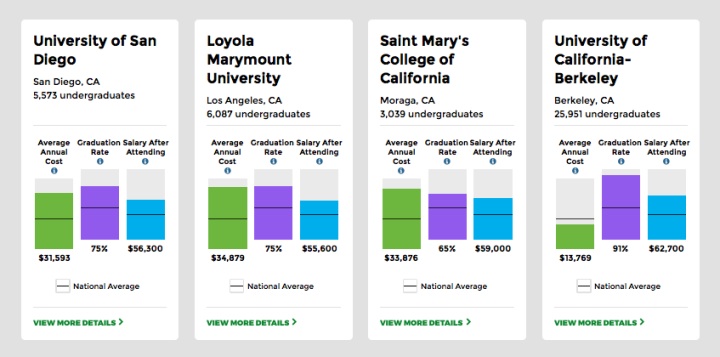
Let’s start at the beginning: you have a notion of what you want, but are overwhelmed by choices. Pretend the following: Based on a preference for small to medium non-profit private schools offering 4-year liberal arts degrees in California, you’ve found 42 results on College Scorecard. You sort the schools by graduation rate because you know that it is an excellent indicator of success. The graduation rate implies that many students arrive well prepared for college, and the school does a good job of providing students with support academically and otherwise. You notice the size of the schools listed and immediately rule out schools under 800 or over 6,000 students because you would prefer to get to know your professors individually and learn in a seminar setting, beginning with the freshman year. You scan the list and realize that you have heard of some but not most schools. What do you do now?


Scorecard_Search

 
“VIEW DETAILS” SCENARIO — HOW DOES IT HELP ME USE A COLLEGE WEBSITE?
At the bottom of each scorecard you see “view more details.” You click on St. Mary’s College of California because you know that it is part of Colleges That Change Lives, and at 3,000 students seems a good size to have both classroom intimacy as well as many of the academic and extracurricular choices that larger schools provide. What do you learn? St. Mary’s is a Catholic school near Oakland, Berkeley, and San Francisco. “Student Body” reveals that 93% of students are full-time and relatively diverse, racially and economically. You see that 33% of students receive Pell Grants—an observation that may explain the comparatively lower graduation rate at St. Mary’s. Students living with economic constraints are more likely to take longer to graduate because they need to balance schoolwork with full-time employment. The tab for “SAT/ACT Scores” reveals that you are likely to qualify. “Academic Programs” indicate that the school provides a liberal arts curriculum tuned to students who also seek practical pre-professional training. You are intrigued by the business program and the fact that Psychology is the 4th most popular major… Time to click through to the school’s webpage! Whether St. Mary’s turns out to be the best fit for you or not, you have just learned enough to begin a comparative search. Be sure to log pertinent comparative criteria, application details, and related urls, for future use!
 

UWashingtonHomePage

 
WHAT KIND OF THINGS SHOULD I PAY ATTENTION TO ON A COLLEGE WEBSITE?
The UW splash screen above is a good example—notice the panel topics and that each advertises a click-through to a well-regarded department or news article. The UW is clearly proud to have graduated students whose UW educations brought them success in medicine and business. The UW is also proud of its athletes. What have we learned? If you attend the UW, expect to be part of an enthusiastic sports community and know that you will be at a university known for the sciences and that values entrepreneurialism. The underlying message is that if you take advantage of what the UW has to offer, you will be successful after college. Are you drawn in? Does this seem like a good fit for you? With your personal criteria in hand, you will need to search deeper into the website.

 
Below is a short list of questions to consider while looking at the different college website pages:
 
SPLASH SCREEN
  • What is the college advertising? 
  • What does it seem most proud of? 
  • Are there upcoming special events? What are they? Arts? Lectures? Community projects?
  • Is the faculty being recognized for their achievements? 
  • Are students being recognized for research, athletics, and service? 
  • Can you find the Academic Departments and Programs page?
ABOUT PAGE(S)
  • How does the college characterize itself? 
  • Does the school have a thriving Greek system (sororities/fraternities) or arts scene? 
  • How important is the idea of service? 
  • How important is diversity?
  • Can you find the “class profile” page? 
  • How does the school represent its students—Scores? GPAs? Racial, regional, economic diversity? Interests and talents? 
  • Do the students sound like you or your kind of friends? 
  • Does the school share your values? 
  • If the school is affiliated with a religious organization, how does the school frame that? Many affiliated schools are open, liberal-minded, and religiously as well as socio-economically diverse; often they stress global outreach and a “learning for service” theme.
  • Many pubic colleges have an Honors College that can give you a small liberal arts experience in the midst of big school resources. Some liberal arts schools have Honors programs. Can you find these?
ACADEMIC DEPARTMENTS AND PROGRAMS PAGE(S)
  • Glance at the majors and minors list—are there interdepartmental majors? 
  • Do they encourage self-directed study?
  • Do they have a core curriculum? What is it? 
  • Do they advertise research, internship, and travel opportunities? Do these occur during the school year or just in the summer months?
  • Do they provide extra support in writing or math to secure academic achievement?
  • Do they stress writing across disciplines? 
Click through to a potential major to learn more. If the school has intrigued you enough to get to this point, copy the department page url into your college spreadsheet where you will be return to it for the purpose of comparison and review.
 
 MAJORS AND MINORS PAGE(S)
  • How does the department characterize its area of study?
  • Notice the requirements and course list; what sort of capstone, independent, or non-classroom opportunities does the college provide?
  • Are most classes seminars? Are they taught by professors? How accessible are professors? How hands-on are the classes?
  • Does the senior year include a thesis, comprehensive exam, capstone project or other sign of mastery?
  • Do faculty pages reveal interests, publications or personalities?
The truth is that “Biology,” “Psychology,” “English” and the rest are convenient labels that describe very little. Beyond introductory courses, all college majors reflect: (a) college Administration and Board of Trustees goals for the college, (b) faculty specializations and interests, and (c) regional strengths. You want to read departmental webpages to learn what these are. This will help you make happy choices and get you further along with the inevitable “why us?” supplemental essay question.
 
RESEARCH, INTERNSHIP, AND TRAVEL OPPORTUNITY PAGE(S)
Getting off campus, applying and testing what you learn, networking with potential employers—these are increasingly important and enjoyable aspects of college life. Make sure the college is offering ample opportunities for you to deepen your perspective and experience during your college years. Internships are important for future employment as well—many employers will prefer candidates with whom they have worked before or who come with good references from recognized sources. Most schools that offer research or writing opportunities publish student titles. Take a look, and see if any examples of student work grab your imagination! Can you picture yourself there, doing those sorts of things in a few years?
 
POST-GRADUATION PAGE(S)
  • What kind of post-graduate fellowships are available?
  • What have alumni have gone on to do?
  • Does the college publish “graduate schools and employment” or “graduate schools and employment in their fields?”
CAMPUS LIFE PAGE(S)
  • Going to college is so much more than academics and career development; how does the college portray itself as a community?
  • What student activities does the college highlight?
  • Do you see yourself fitting in? 
  • Is there an area of activity that you could lead? 
  • Do the students seem like they would be welcome colleagues an dorm-mates?
Just a glance at these few pages will give you a good idea if it is worth pausing on a school’s website to read more. You will quickly see that there is a wealth of diverse offerings, and most schools work hard to provide their students with tremendous educational opportunities and successful, happy outcomes. Have fun with the search, talk to friends, family, and teachers about their college experiences—and communicate regularly with your college counselor.
 

smile_wallpaper_2-wide

WHY HAPPINESS IN COLLEGE MATTERS
Ultimately, college is all about what you make, what you experience, how deeply you engage with the people you meet and the academic and non-academic opportunities that are available to you.
“Reading” photographs and descriptions gets you closer to understanding what you want to experience, who you want to meet, and how you want to engage. Your happiness matters.
 
ADMISSIONS AND FINANCIAL AID PAGE(S)
Your personal criteria drives your search. As you pull together a list of schools that seem like a good fit, you can check out the admissions, class profile, and financial aid pages to reveal which of those schools are “reach,” “target,” or “safety” and whether they are SAT optional or not. Of course it is wise to apply to one or two state public universities, but do not rule out selective private schools because of dollars. The sticker price is not the same as what you are likely to pay after merit awards and need based aid are taken into consideration. Until the application season is over, it’s all about expanding your options according to your personal criteria.
 
Frank Bruni of the New York Times wrote a beautiful article capturing the spirit of college success: NYT-Bruni on Why College. Please enjoy!

SSIS College Spotlight: Tools For Finding the Right Fit

FinalBanner

SSIS College Spotlight: Tools For Finding the Right Fit
volume 1, issue 2. Fall (updated September 2016)
 
Dear Students and Families,
 
With over 2000 colleges to choose from the college search process can appear daunting, but it need not be so. The focus of this Spotlight is on processes, tools, and tips for finding the right fit.
 
As always, my door is open. Come in, sit down and peruse the brochures, ask questions, have a cup of tea. You are also free to use the office as a quiet study space. Please know that I am happy to meet with you during non-school hours by appointment.
 
Best always,
Caroline
Your College Counselor
_________________________________
 
magnify
 
THERE ARE SO MANY COLLEGES AND UNIVERSITIES! HOW DO I START LOOKING?
The simplest answer is: start with you. There are a lot of choices out there and many might be right for you. The only way you can assess which they are is to get to know your own needs and desires. Here is a short list of questions that can help you narrow down your choices:
 
Academics and Extracurriculars
* What subject areas and projects most interest you? 
* What are you good at; what achievements are you proud of?
* What do you enjoy doing, perhaps so much you don’t realize how much time has gone by?
* Have you considered a career goal or goals? What are they?
 
Personal Traits and Predilections
* Are you fairly self-sufficient or do you do better with more structure supporting you?
* Can you learn in a large lecture hall or do you prefer the intimacy of the seminar classroom?
* What are your favorite topics of conversation and activities with friends and/or family?
* Are you an all-weather person or do require a specific climate?
* Do you like the excitement of the city? Do you want to be in it or near it?
* How important is it for you be in a culturally diverse environment?
* How much do you want to live abroad, do research or apply new skills in an internship or job?
* What hobbies and interests do you intend to continue through college?
 
Your answers to these few questions above already narrow your search considerably. Be aware too, that as you get more into it, you may find some surprises along the way. We have had students who swore off the cold midwest only to find themselves happily thriving in that very location.
 
Fit
 
I GET THAT I SHOULD LOOK FOR THE “RIGHT FIT,” BUT HOW DOES THAT TRANSLATE INTO A COLLEGE SEARCH?
Once you have a sense of what you are looking for, you are ready to create a college checklist. The checklist should include data from your self-reflection. It is important to note that you may have some blanks on your checklist; that is okay! Some blanks such as “financial need” can be addressed by using an online college calculator (more on that later). Other information like “career interest” may remain blank until you are a junior in college. It is very common, and often preferable at liberal arts colleges, not to declare a major until then as the idea is for you to have enjoyed the discoveries of your freshman and sophomore years, before narrowing your curriculum. That said, this is a great time to let yourself wonder “what you want to be when you grow up.”
 
Here is a sample checklist:
 
PersonalCollegeChecklist
 
When you have completed your personal checklist, you are ready to ask useful questions of family, friends, and community members. Your use of college search tools will be more meaningful and efficient. You will get a lot more out of your review of individual college websites. And, you will be prepared to make a college list using three important categories: reach, target, and safety.
 
BeamReach
 
WHAT ARE “REACH,” “TARGET,” AND “SAFETY” SCHOOLS?
Reach schools are those that are desirable but may be difficult to get into. For every person “difficult” means something different. For some people it implies “wow, their median SAT math score is 790!” For others, it may mean “I doubt that I can afford it, but it’s worth applying and seeing what the financial aid package turns out to be if I get in.” For most people, it means “thousands of people are applying to this school and there are only 500 seats in the freshman class, I have to be realistic about this.”
 
A “safety” school is not a worse school. The market for outstanding college professors is tough—there is more talent out there than there are jobs. This is good for you, the student. Did you know that the new president of Cornell University, one of the Ivies, began her illustrious career as a graduate of the University of Oklahoma? Ultimately what makes a college career successful is what you put into it, what you leave there, and where you take those experiences next. A safety school is no less capable of helping you get where you want to go, it is just easier to get into. What makes it easier? The number of applicants to available spaces, the location, whether the school has a specialization or religious affiliation, and whether the school is part of your state’s public university system.
 
toolbox
 
WHAT TOOLS WILL HELP ME FIND SCHOOLS THAT MIGHT BE THE RIGHT FIT?
The websites of individual schools provide you with crucial information, but you can’t just march from A-Z through every school in the country! 
 
The Internet is your friend. Two websites in particular, one provided by the Department of Education and the other by the New York Times, are great compare and contrast resources. 
 
Here are several Internet tools that when used together are especially helpful:
 
College Board BigFuture
The College Board BigFuture college search tool allows you to mix and match variables to arrive at different kinds of college lists.
 
This website is the work of a non-profit organization of the same name (CTCL) and provides great advice and information; the best part is that they list 40 small to medium liberal arts colleges from 24 states that are distinguished by their commitment to undergraduates. The organization looks for schools that provide significant opportunities for community engagement, undergraduate research, networking and post-college placements, small student-professor ratios, and high happiness ratings as determined by student surveys. SSIS graduates have done well with their CTCL college experiences.
 
US Department of Education Scorecard
Launched on September 14, 2015, the Scorecard web app may lack the ranking component the Obama administration promised, but it nonetheless provides students and families with valuable information. Select a state, a program, a size and you get a reasonable number of colleges and universities to consider. Further refine your search by sorting the list by indicators such as average out-of-pocket costs for lower income families, graduation rates, and post-graduation earnings 10-years out. The only caveat is that you need to “read between the lines” (another issue of Spotlight explicitly addresses how to do this).
 
paintbrushes
EXAMPLE: 
For example, compare the Scorecard salary data: the average salary after attending the Art Center College of Design in Pasadena, California is $51,700. Seattle’s Cornish College of the Arts compares at $29,900. Can it be that Cornish is that much worse a school? Probably not. If you flip open “More Details” for each school, you will find that 89% of Cornish students receive federal loans and 39% represent economic diversity whereas only 51% of Art Center students have those loans and 37% represent economic diversity. Federal loans go to families earning less than $70,000. The greater financial burden may affect earnings outcomes as students scramble to pay bills. 
 
It is also possible that there are a greater number of Arts Center students who go into commercial art rather than fine art. It can make a difference which arts their students pursue. Some artistic pursuits pay more than others; freelance artists have a harder time making ends meet. Let’s also not forget that Los Angeles has a much greater market for artists than Seattle. It is much bigger, economically more diversified, and home to a thriving film and television industry.
 
Lastly, we do not know whether salary outcomes are skewed by the percent of students who did not need financial aid. In an entirely different search, you can discover that Bennington College in Vermont, a school with a tremendous, longstanding reputation for excellence, does very poorly on the salary scale; the average salary 10 years after graduation is reported at $26,500. 60% of Bennington students manage federal loans, but only 22% come from economically stressed homes with less than $40,000 annually. Bennington is a liberal arts school with 45% of its students majoring in the arts. It is a magnet school for reasonably secure families. Bennington’s graduates in the arts may be just fortunate enough to take the time to hone their crafts without worrying over rising rents and student loans. Bennington is a superb college for many students, despite what the numbers imply. It is currently seeking to diversify its student body—post-grad. incomes will likely trend upward as a result.
 
The New York Times: Upshot College Access Index
The College Access Index is a new tool aimed at measuring efforts toward economic diversity by the nations top colleges as indicated by those colleges with a five-year graduation rate of 75 percent or higher. They provide three very interesting pieces of information: 1) the percent of low-income students, (2) what middle-income parents are likely to pay out of pocket (as compared to the school’s sticker price), and (3) the schools endowment per student. The latter indicates the resources available to colleges and has some bearing on student success. The graduation rate is a useful indicator as it implies students received the necessary financial and academic support to receive a degree within a 5-year window. 
 
National Center for College Statistics Navigator
The Navigator is an essential tool. For every college you find on a college search, you will want to check out some of their statistics. This website has the stats on all schools in one convenient spot.
 
According to the New York Times article, Wellesley College economist Phillip Levine designed a superior calculator that is easier to use than most. Calculator tools are intended to help you get a decent idea about how much you can expect to pay out of pocket each year. 
 
BunnyInHat
 
ARE THERE ANY TRICKS THAT CAN HELP ME WITH MY RESEARCH?
Yes! Here are a few tips:
 
When a school’s website is too complicated, type “[schoolname] student profile” into the browser search field. For many schools, current freshman class statistics become immediately available. There, you will learn who was admitted last spring—where they are from, what their backgrounds and interests are, what their average scores were, and what percent got what kind of financial package. Here is an example from Williams College and another example from the University of Washington. This is valuable information when you are trying to decide if a school is a reach, target, or safety. It may also help you learn whether you have a shot at being able to afford it, if it seems like a school with like-minded people, and whether their strongest academic departments align with your interests. It is an excellent partner to the College Statistics Navigator (above).
 
DigDeep
 
Once you are looking at a potentially interesting college, you need to dig deep. Don’t just look at the list of majors, click through to a department or two. Look at the courses offered. Click through to faculty pages. Let’s say you are interested in Biology and what excites you most is pathogens in the human body. While every school will teach you the necessary introductory material, you want to be sure that your professor’s specialties are in your general area of interest or you could be in for quite a shock. You do not want to discover too late in the game that your Biology faculty is especially focused on forest ecology. 
 
Engineers and pre-meds beware! Yes, the rest of you too. Please pay attention to the industries and businesses in close proximity to the schools you are interested in. For example, in Seattle, University of Washington and Seattle University students have ample opportunity to engage in research pertaining to genetics whereas in Boston, students will find many more opportunities to learn about bio-technologies. Of course there is is a bit of both, but look at the big picture! You don’t want to go to an “engineering” program that turns out to specialize in aerospace when what you had in mind was web apps.
 
There are many more tools and search details to share. You want to get a feel for who your fellow students are likely to be and what sort of lifestyle is common on campus. But, this is already a long list. Get started at the beginning: YOU. Focus on the academics, location, and size first, but don’t ignore the rest. And have some fun. There is a “right fit” out there, more than one.

SSIS College Spotlight: SAT, ACT, SAT 2, SAT-Optional

FinalBanner

SSIS College Spotlight: SAT, ACT, SAT 2, and Test Optional Colleges
volume 1, issue 1. Fall 2015 (updated August 2017)

Because registering for standardized tests is the most pressing agenda item for the beginning of the senior year, our first topic is the SAT. The SAT registration deadline for the October exam  is in the first week of September. The ACT registration deadline for the October exam is mid-September.
 
While many colleges are moving away from SAT and ACT standardized testing, most colleges still want those scores. That is why at SSIS we encourage you to take the SAT and try to improve your scores over two or three attempts. At SSIS, our primary objective is to keep as many options open for you as possible. As with all things educational, please be aware that different individuals require different strategies. We will work together to determine the strategy that suits you personally.
 
Please consider the following general remarks and links concerning SAT and ACT; you may find them helpful. If you have any further questions, please write! I am always happy to answer questions or concerns by e-mail, phone, or in person.
 
Yours respectfully,
Caroline
(College Counselor)
 
———————————————————-
 

SAT-Blocks

 
WHAT IS THE SAT?
SAT used to refer to scholastic aptitude or assessment, now it is just called “SAT.” It is administered by the College Board, a private, non-profit entity that provides standardized and subject-based tests, test support, and college search and planning information for students and families. According to the College Board: “The SAT tests the reading, writing and math skills that you learn in school and that are critical for success in college and beyond. It gives both you and colleges a sense of how you’ll be able to apply the thinking, writing and study skills required for college course work.” The College Board recently claimed it is, “the nation’s most widely used college admission test” though ACT may now be more popular.
 
act_sat_l
 
HOW IS SAT DIFFERENT FROM ACT?
Traditionally, ACT and SAT testing were primarily regional phenomena, and the differences in the exams reflected the needs of both colleges and students in those regions. Today, both exams are accepted everywhere. As of March 2016, the current SAT is nearly identical to the ACT, however there remain some slight differences:
* ACT questions are more straight-forward but there is less time.
* SAT provides more time per section, but the information may take longer to get through.
* ACT has a science section and SAT does not.
* ACT allows calculator use for all math questions whereas SAT has a math without calculator section.
* Both tests offer a  “with writing” or “without” option—as some colleges still want writing scores, we recommend that you take the exam with writing.
If it helps at all, 2017 SSIS seniors who tried both exams found that their scores were comparable between the two exams. 
For a more detailed account of similarities and differences, take a look at this Magoosh webpage.
 
 
satBad-bubble
 
WHAT ARE THE ARGUMENTS AGAINST STANDARDIZED TESTING?
Standardized testing has many arguments against it, and those arguments go well beyond the public’s general distaste for being assessed or being assessed for something that people may not have been taught or taught particularly well. It is hard to measure the achievements and aptitudes of college-bound young people living in a large, federated, locally-controlled, and culturally and economically diverse nation.
There are two arguments against standardized tests that stand out among the rest: 1) the tests preference the children of well-off, educated families, and (2) the tests do not adequately measure what they purportedly should measure: a student’s potential academic success in college.
 
This US News (Sept. 6, 2013) article written by Ithaca College president Thomas Rochon explains the case against standardized tests for college admissions. This PBS NewsHour Blog (February 18, 2014) further explains the latest research behind the increase in colleges implementing test-optional policies.
 
SATUnfair Bubble
 
WHY DO MANY COLLEGES STILL DEMAND STANDARDIZED TEST SCORES, DESPITE THEIR MARGINAL BENEFIT?
Schools overwhelmed by record numbers of applicants are not in a hurry to loose a tool to help them evaluate applications, even if that tool is only marginally helpful. Grades and course rigor are much better indicators of future academic success, and therefore are the most important aspects of a college application portfolio. That said, many colleges will want to confirm there is some consistency between a students “A” grades in English courses and the student’s critical reading score on a national exam. Some schools use standardized test scores to differentiate between students whose applications will or won’t be read. With thousands of applications coming in, it is not hard to understand why some schools pursue this course of action. If you are aiming to get into a highly selective school or honors program and/or you are hoping to obtain a merit scholarship, you will need to have achieved a baseline score for consideration.
Please look at individual college websites to learn specifically what they expect. Many college search tools like Scorecard or Navigator publish individual college score ranges. Colleges vary considerably!
 
This article from the Huntington Post (January 13, 2014) provides a thorough analysis of how standardized tests affect college applications.
 
find_scholarship_money
 
WHICH SCORES ARE THE MOST IMPORTANT?
Math and Critical Reading. That said, because each college is different, we always recommend that students take the writing section as well “just in case.” It is best to be prepared with a full array of tests as well as test-optional portfolio pieces such as graded problem sets and research papers.
 
BuzzLightyear
 
WHY SHOULD I SIT FOR MORE THAN ONE EXAM?
The reason students commonly take two or three tests, beginning in the junior year, is because statistics show that students tend to do better a second time, even if they did not prepare for the exam. Knowing what the experience is like can eliminate anxieties that can get in the way of clear thinking. The second reason it is good to take a test for a second or third time is that it is easier to study to improve a score when one has a benchmark score to improve from.
Your objective is to know where you are, take a realistic look at what a short period of intense study can do for you, set a realistic goal, decide where you want to be, and do what you can to make it happen. Keep in mind, your goal may not be your friend’s goal. Just like college essays and college choices, your testing goals belong to you alone. You may even decide that you do not want to take the test again—the key is to make an informed decision that does not impede future choices.
 
If you are aiming to get into a highly selective school or honors program and/or you are hoping to obtain a merit scholarship, you will need to have achieved a baseline score for consideration; please look at individual college websites to learn specifically what they expect.
 
Also remember: colleges really do weigh your grades and what courses you took above standardized tests; a test of a few hours can never be as strong an indicator of your college readiness and future academic success as your efforts over four years of high school.
 
ruralMedia
 
WHY DOES SSIS HAVE SEVERAL SAT TEST DATES BUT ONLY TWO FOR ACT?
We are too small for ACT. To be an ACT testing center we would have to test many more students. We are fortunate to offer the October and April ACT. SSIS was more successful in negotiating with the College Board for SAT test dates.
 
act_logo
 
IF I PREFER TO TAKE ACT, HOW DO I DO THAT?
Register for the ACT online for the October test. For other test dates, you will need to select a testing center that is convenient for you and your family. Traditionally, Friday Harbor High School has offered ACT in December.
 
KahnSATlogo
 
HOW SHOULD I PREPARE FOR STANDARDIZED TESTING?
Off-island, you can arrange for Kaplan or Princeton Review test prep. On island, you can take advantage of online opportunities. The test prep centers provide a range of online prep options between $750 – $3,500.
 
The College Board website provides help with strategies, sample questions, practice tests as well as the option of ordering SAT workbooks and practice tests. These you can also purchase for approximately $12.00 from sources like the Barnes & Noble bookstore. The ACT website also offers test tips, prep, and question descriptions. Several prep books are available for borrowing in the SSIS College Counseling Office. Borrow freely, but please don’t write in the books, allowing others to use them as well.
 
Khan Academy, in partnership with the College Board, now provides free, well-designed, all-encompassing online test prep. These organizations created this program to provide the best possible prep opportunities for all students, regardless of income or location.
 
What is the one thing you can do to improve your vocabulary and critical reading score that is more fun than test prep? Read! Read literature. Read non-fiction. Read the New York Times and the Christian Science Monitor. Read poetry. Read a play. Pay attention to all those graphs and charts—read them carefully. Ask your English, History, and Science teachers, family members, friends, and librarians for book suggestions. Here is a wonderful reading list provided by the National Endowment for the Arts.
WHAT IS THE SAT 2; SHOULD I TAKE IT?
SAT 2 tests are content-driven exams based on national standards for college-bound high school students regarding subjects like Mathematics, English Literature, US History, World History, the sciences and languages. Several selective colleges ask for two SAT 2 exams. If you are interested in pursing science, math or engineering in college, you will need one SAT 2 exam to cover math or a science. Please see the College Board SAT 2 website to learn more.
 
FairTestlogo
 
WHAT IS TEST-OPTIONAL ADMISSIONS? WHICH COLLEGES OFFER THESE OPPORTUNITIES?
“Test-optional” comes in four flavors: “test optional, “test-blind,” “test-flexible,” and test-conditional.” In each instance, the college begins with the underlying assumption that standardized tests do not represent what you can achieve during and after college. The range of “test-opitonal” types reflect whether colleges completely exclude standardized testing altogether, whether you have to meet some other criteria, and whether you need to provide other forms of assessment such as graded writing samples or subject-area exams like APs.
 
College Kickstart provides a full account of test-optional college descriptions and choices.
FairTest is an advocacy organization that provides a thorough account of non-SAT/ACT dependent colleges.
 
sat-changes
 
IN 2016 THEY REVISED THE SAT. WHY?
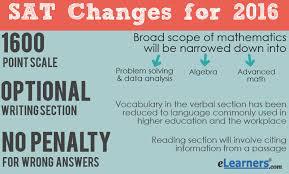
For a long time, students, educators, and college admissions officers have complained that the old SAT gave a significant edge to kids who come from higher socio-economic backgrounds who can afford test prep services. Their reasoning was that too much of the test’s design depended on a student’s ability to game the answers with test-taking strategies rather than simply reveal the student’s knowledge. Getting reliable access to those strategies has been the basis of a very lucrative prep business. The new test is more focused on mastery of topics learned in school. The most significant changes were removing the penalty for wrong answers and losing the obscure vocabulary section.
 
[UPDATED: September 11, 2015] 


SSIS College Spotlight: Fall Milestones for Juniors and Seniors

FinalBanner

SSIS College Spotlight: Fall Milestones for Juniors and Seniors
volume 1, issue 1. Fall 2016
 
Dear Students and Families,
 
The SSIS College Spotlight brings attention to different aspects of the college search and application process. The focus of this Spotlight is on Fall Term college-readiness and application milestones for Juniors and Seniors. 
 
For Juniors, Fall Term offers a mid-high school moment to reflect on one’s academic and personal experiences of the past two years and set goals that will bring shape to one’s journey through the high school years. For Seniors, Fall Term is a time to capture meaning from the past, imagine the future, and articulate both in college applications. Most of the Seniors’ milestones that appear below are driven by college application processes and deadlines—the timeline does not take into consideration Questbridge or Early Decision applications. Applicants for these programs need to have completed many of the steps listed below during the junior year and over the summer (see me for details). 
 
Always, please feel free to take advantage of the College Counseling office, the materials you find there, and me! Enjoy a cup of tea—just remember to wash your cup and put it back in its place.
 
Best always,
Caroline
Your College Counselor
_________________________________

clip_image001

BEGIN YOUR ACADEMIC YEAR WITH CONFIDENCE

Review your schedule with Heather, SSIS’s Academic Dean. The SSIS team carefully constructs a high school class schedule to align with college preparedness and admissions, Washington State high school graduation requirements, and your particular needs and interests. By talking over your schedule with Heather, you begin your Junior and Senior years confident that your schedule reflects your post-graduation needs and ambitions.

DEEPEN, EXTEND YOUR INTERESTS AND RESPONSIBILITIES

As a SSIS student, you know it—learning and life are about the doing. Reflect on what you’ve done in the past and what you want or need to change or continue doing. Engage fully, seek mastery, be generous with what you know and contribute to your family and community. When you leave high school, colleges and employers will want to know what you’ve done and who you’ve become over the last four years. One way to do that is to let them know about your activities—especially those activities that have shaped your goals and aspirations. If you have an activity you would like to pursue but are shy about reaching out, please involve your advisor, teacher or the college counselor. We are glad to help.

For inspiration, here are some activities that have guided the futures of SSIS graduates: 

  • theater/film (acting, stage managing, directing, writing, filming, editing, collaborating, teaching)
  • music/dance (practicing, solo performing, band performance, ensemble work, teaching)
  • community service (care-giving, fund-raising, organizing, building, publicizing, leading initiatives)
  • science and art (field work, lab work, studio work, publications, art shows)
  • athletics of all kinds (local, regional, national—personal or team-based)
  • internships and jobs (retail shops, restaurants, news outlets, professional offices, non-profits, marine and land preservation, the Fire Department and other public services). 

In addition, if you have the interest and opportunity to get certified or qualify with some distinction, do it—you will be demonstrating your depth of engagement and improving your future employment! Remember to create a resume, accounting for your time, responsibilities (active, strong verbs please!), and any recognition or awards that you might receive.

TAKE NATIONAL STANDARDIZED TESTS

Some combination of the PSATSATSAT 2 Subject TestsACT, and APs are part of your college portfolio. Juniors take the PSAT in October and follow up with other tests beginning in the second semester of the junior year. Seniors complete the testing cycle in the fall of the senior year. The object is to broaden one’s choices when it comes time to apply to schools. You may end up not using your scores—over 700 colleges, many of which are highly selective, don’t even ask for these tests—however, you take the tests (with the writing section!) because you want your final college list to reflect your interests and needs, not whether or not you fulfilled application requirements. Tests can also affect college merit awards—for some families, this is an important way to reduce cost.

Juniors take the October PSAT — it provides a personalized diagnostic tool that can shape your learning path in your second semester (results come out in December/January), and you may qualify for a National Merit Scholarship. It also doesn’t hurt to practice the standardized testing format. Unless you wish to be considered for the scholarship award, you need not prepare for the PSAT. You can link your PSAT scores to free Khan Academy/College Board SAT prep. Junior year winter/spring testing sets a baseline and provides the opportunity to complete the testing cycle during the junior year—if you can do this, your Senior self will thank you. 

Usually, Seniors take October SAT 1 and/or ACT and often take November or December SAT 2 Subject Tests. Check with individual college websites for their deadlines and requirements AND BE AWARE that different circumstances and needs dictate different approaches to testing. Please meet with the SSIS college counselor to personalize your testing plan.

ATTEND THE NATIONAL COLLEGE FAIR IN SEATTLE

Juniors, become acquainted with colleges online and visit with representatives at the College Fair. Learn about the diversity of choices out there and use the experience to talk with your family about their college experiences and expectations. Initiate conversations with SSIS faculty and the college counselor. Seniors, the College Fair brings college representatives from everywhere to nearby Seattle—take advantage!  

PLAN COLLEGE VISITS

Juniors, talk with your family about visiting a few colleges during the SSIS winter break when colleges are in session. Even if the colleges you visit are not likely to be ones to which you apply, you can learn a lot about the diversity of the college experience and what you can expect generally. Choose to visit large and small, rural and urban, liberal arts and research university campuses. Take the tour, sit in on classes, read the student newspaper, talk with students, and if possible, arrange to spend the night in a dormitory. Many colleges provide this opportunity, but it does require several weeks notice. Summer visits can be valuable too. Visits beyond the immediate Vancouer-Victoria-Seattle-Tacoma area can become more expensive and time-consuming and therefore need more advanced planning. Seniors, if you did not have the chance to visit schools, take advantage of the virtual tours available on most college websites and please talk with the SSIS college counselor.

clip_image001-1

  • Register for and take the SAT or ACT
  • Prepare for the tests using preparation and practice books, Khan Academy, and possibly a tutor
  • Play a leadership role on the SSIS Fall Backpack
  • Determine whether to register for a future SAT or ACT
  • Either take, register for or determine whether to take SAT 2 subject test(s)
  • Complete an activities list and resume
  • Complete a personalized college criteria checklist
  • Research colleges by using a variety of search tools as well as speaking with people, including the college counselor
  • If you have a special school in mind, attend a Seattle college visit and speak with their college admissions representative
  • Formally or informally interview family friends, teachers, community members, etc. about their career and college experiences
  • Create a college spreadsheet and fill in an array of college choices, noting pertinent details such as location, size, department strengths, internship, research, travel, and scholarship opportunities, admissions requirements and deadlines, costs and financial aid, their url, etc.
  • Review and sign off on a final copy of your transcript
  • Determine whether to apply Early Decision I or II, Early Action I or II, or Regular Decision
  • Structure your time well, allowing for both work and play
  • Maintain good grades

October 1st is the new FAFSA publication day

By October 15th, you:

  • Followed through with all of the above, and…
  • Completed all non-essay sections of at least one college application, ideally including the Common App
  • Identified which colleges on your list require official test scores and which will recognize scores published on transcripts
  • Asked teachers (and possibly others) for recommendations, providing log-in information, deadlines, and a thank-you note
  • Peeked at the new FAFSA with your parents

Pumpkin-Patch

By November 1st, you:

  • Had your college counselor review your application thus far
  • Analyzed Common App and other college essay choices
  • Played with several college essay choices, jotting down a few concepts, anecdotes, and strong, descriptive verbs
  • Reviewed college essay ideas with a parent or teacher
  • Completed at least one draft of a college essay
  • Shared a draft of your college essay with the college counselor
  • Ideally you would have worked through several drafts with your college counselor by this time
  • Reviewed your college list with the college counselor as well as any teachers related to specific subject/career areas of interest
  • Arranged Interviews with colleges for which an interview is appropriate
  • Attended the National College Fair in Seattle, possibly also interviewing with college representatives
  • Stayed current with classes and other activities, and remembered to take a break from time-to-time (!)
  • Kept parents and the college counselor informed of your needs
  • Reminded recommenders of any approaching deadlines and thanked them for their time
  • Taken a serious look at FAFSA — maybe completing it!

November 15 is Early Decision Day

Autumn-leaves-wallpaper

During the remainder of November, you will:

  • Concentrate on college essays
  • Revise your college list
  • Review your essay(s) with the college counselor
  • Identify which schools require supplementary essays or short answers, and begin the process of addressing these
  • Review and revise your college list spreadsheet, noting deadlines for applications, tests, transcripts, recommendations, and supplementary materials
  • Interviewed with colleges for which an interview is appropriate
  • Taken any further tests as is appropriate for you and the schools to which you are applying
  • Kept parents and the college counselor informed of your needs
  • Completed applications to schools with November 30 or December 1 deadlines

November 30 and December 1 are application deadlines for many public colleges, including the University of Washington and the University of California system.

By December 15, you will:

  • Finalize essays
  • Further revise your college list
  • Complete applications to schools with December 15 or January 1-15 deadlines
  • Work with parents towards completing FAFSA, if you haven’t done so already
  • Complete first semester classes, maintaining good grades

December 15 and January 1 are application deadlines for many colleges. Many other college deadlines fall between January 1 – 15.

Enjoy a well-earned break!

Happy_Skiing