

SSIS College Spotlight: SAT, ACT, SAT 2, and Test Optional Colleges
volume 1, issue 1. Fall 2015 (updated August 2017)
Because registering for standardized tests is the most pressing agenda item for the beginning of the senior year, our first topic is the SAT. The SAT registration deadline for the October exam is in the first week of September. The ACT registration deadline for the October exam is mid-September.
While many colleges are moving away from SAT and ACT standardized testing, most colleges still want those scores. That is why at SSIS we encourage you to take the SAT and try to improve your scores over two or three attempts. At SSIS, our primary objective is to keep as many options open for you as possible. As with all things educational, please be aware that different individuals require different strategies. We will work together to determine the strategy that suits you personally.
Please consider the following general remarks and links concerning SAT and ACT; you may find them helpful. If you have any further questions, please write! I am always happy to answer questions or concerns by e-mail, phone, or in person.
Yours respectfully,
Caroline
(College Counselor)
———————————————————-

WHAT IS THE SAT?
SAT used to refer to scholastic aptitude or assessment, now it is just called “SAT.” It is administered by the College Board, a private, non-profit entity that provides standardized and subject-based tests, test support, and college search and planning information for students and families. According to the College Board: “The SAT tests the reading, writing and math skills that you learn in school and that are critical for success in college and beyond. It gives both you and colleges a sense of how you’ll be able to apply the thinking, writing and study skills required for college course work.” The College Board recently claimed it is, “the nation’s most widely used college admission test” though ACT may now be more popular.

HOW IS SAT DIFFERENT FROM ACT?
Traditionally, ACT and SAT testing were primarily regional phenomena, and the differences in the exams reflected the needs of both colleges and students in those regions. Today, both exams are accepted everywhere. As of March 2016, the current SAT is nearly identical to the ACT, however there remain some slight differences:
* ACT questions are more straight-forward but there is less time.
* SAT provides more time per section, but the information may take longer to get through.
* ACT has a science section and SAT does not.
* ACT allows calculator use for all math questions whereas SAT has a math without calculator section.
* Both tests offer a “with writing” or “without” option—as some colleges still want writing scores, we recommend that you take the exam with writing.
If it helps at all, 2017 SSIS seniors who tried both exams found that their scores were comparable between the two exams.
For a more detailed account of similarities and differences, take a look at this Magoosh webpage.
WHAT ARE THE ARGUMENTS AGAINST STANDARDIZED TESTING?
Standardized testing has many arguments against it, and those arguments go well beyond the public’s general distaste for being assessed or being assessed for something that people may not have been taught or taught particularly well. It is hard to measure the achievements and aptitudes of college-bound young people living in a large, federated, locally-controlled, and culturally and economically diverse nation.
There are two arguments against standardized tests that stand out among the rest: 1) the tests preference the children of well-off, educated families, and (2) the tests do not adequately measure what they purportedly should measure: a student’s potential academic success in college.
This US News (Sept. 6, 2013) article written by Ithaca College president Thomas Rochon explains the case against standardized tests for college admissions. This PBS NewsHour Blog (February 18, 2014) further explains the latest research behind the increase in colleges implementing test-optional policies.

WHY DO MANY COLLEGES STILL DEMAND STANDARDIZED TEST SCORES, DESPITE THEIR MARGINAL BENEFIT?
Schools overwhelmed by record numbers of applicants are not in a hurry to loose a tool to help them evaluate applications, even if that tool is only marginally helpful. Grades and course rigor are much better indicators of future academic success, and therefore are the most important aspects of a college application portfolio. That said, many colleges will want to confirm there is some consistency between a students “A” grades in English courses and the student’s critical reading score on a national exam. Some schools use standardized test scores to differentiate between students whose applications will or won’t be read. With thousands of applications coming in, it is not hard to understand why some schools pursue this course of action. If you are aiming to get into a highly selective school or honors program and/or you are hoping to obtain a merit scholarship, you will need to have achieved a baseline score for consideration.
Please look at individual college websites to learn specifically what they expect. Many college search tools like Scorecard or Navigator publish individual college score ranges. Colleges vary considerably!
This article from the Huntington Post (January 13, 2014) provides a thorough analysis of how standardized tests affect college applications.

WHICH SCORES ARE THE MOST IMPORTANT?
Math and Critical Reading. That said, because each college is different, we always recommend that students take the writing section as well “just in case.” It is best to be prepared with a full array of tests as well as test-optional portfolio pieces such as graded problem sets and research papers.

WHY SHOULD I SIT FOR MORE THAN ONE EXAM?
The reason students commonly take two or three tests, beginning in the junior year, is because statistics show that students tend to do better a second time, even if they did not prepare for the exam. Knowing what the experience is like can eliminate anxieties that can get in the way of clear thinking. The second reason it is good to take a test for a second or third time is that it is easier to study to improve a score when one has a benchmark score to improve from.
Your objective is to know where you are, take a realistic look at what a short period of intense study can do for you, set a realistic goal, decide where you want to be, and do what you can to make it happen. Keep in mind, your goal may not be your friend’s goal. Just like college essays and college choices, your testing goals belong to you alone. You may even decide that you do not want to take the test again—the key is to make an informed decision that does not impede future choices.
If you are aiming to get into a highly selective school or honors program and/or you are hoping to obtain a merit scholarship, you will need to have achieved a baseline score for consideration; please look at individual college websites to learn specifically what they expect.
Also remember: colleges really do weigh your grades and what courses you took above standardized tests; a test of a few hours can never be as strong an indicator of your college readiness and future academic success as your efforts over four years of high school.

WHY DOES SSIS HAVE SEVERAL SAT TEST DATES BUT ONLY TWO FOR ACT?
We are too small for ACT. To be an ACT testing center we would have to test many more students. We are fortunate to offer the October and April ACT. SSIS was more successful in negotiating with the College Board for SAT test dates.

IF I PREFER TO TAKE ACT, HOW DO I DO THAT?
Register for the ACT online for the October test. For other test dates, you will need to select a testing center that is convenient for you and your family. Traditionally, Friday Harbor High School has offered ACT in December.
HOW SHOULD I PREPARE FOR STANDARDIZED TESTING?
Off-island, you can arrange for Kaplan or Princeton Review test prep. On island, you can take advantage of online opportunities. The test prep centers provide a range of online prep options between $750 – $3,500.
The College Board website provides help with strategies, sample questions, practice tests as well as the option of ordering SAT workbooks and practice tests. These you can also purchase for approximately $12.00 from sources like the Barnes & Noble bookstore. The ACT website also offers test tips, prep, and question descriptions. Several prep books are available for borrowing in the SSIS College Counseling Office. Borrow freely, but please don’t write in the books, allowing others to use them as well.
Khan Academy, in partnership with the College Board, now provides free, well-designed, all-encompassing online test prep. These organizations created this program to provide the best possible prep opportunities for all students, regardless of income or location.
What is the one thing you can do to improve your vocabulary and critical reading score that is more fun than test prep? Read! Read literature. Read non-fiction. Read the New York Times and the Christian Science Monitor. Read poetry. Read a play. Pay attention to all those graphs and charts—read them carefully. Ask your English, History, and Science teachers, family members, friends, and librarians for book suggestions. Here is a wonderful reading list provided by the National Endowment for the Arts.
If you are aiming to ace these national exams, please consider reading this New York Times article written by a recent college graduate: How I Learned to Take the SAT Like a Rich Kid (April 27, 2017).
WHAT IS THE SAT 2; SHOULD I TAKE IT?
SAT 2 tests are content-driven exams based on national standards for college-bound high school students regarding subjects like Mathematics, English Literature, US History, World History, the sciences and languages. Several selective colleges ask for two SAT 2 exams. If you are interested in pursing science, math or engineering in college, you will need one SAT 2 exam to cover math or a science. Please see the College Board SAT 2 website to learn more.

WHAT IS TEST-OPTIONAL ADMISSIONS? WHICH COLLEGES OFFER THESE OPPORTUNITIES?
“Test-optional” comes in four flavors: “test optional, “test-blind,” “test-flexible,” and test-conditional.” In each instance, the college begins with the underlying assumption that standardized tests do not represent what you can achieve during and after college. The range of “test-opitonal” types reflect whether colleges completely exclude standardized testing altogether, whether you have to meet some other criteria, and whether you need to provide other forms of assessment such as graded writing samples or subject-area exams like APs.
College Kickstart provides a full account of test-optional college descriptions and choices.
FairTest is an advocacy organization that provides a thorough account of non-SAT/ACT dependent colleges.
IN 2016 THEY REVISED THE SAT. WHY?
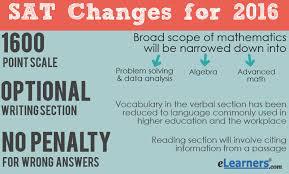
For a long time, students, educators, and college admissions officers have complained that the old SAT gave a significant edge to kids who come from higher socio-economic backgrounds who can afford test prep services. Their reasoning was that too much of the test’s design depended on a student’s ability to game the answers with test-taking strategies rather than simply reveal the student’s knowledge. Getting reliable access to those strategies has been the basis of a very lucrative prep business. The new test is more focused on mastery of topics learned in school. The most significant changes were removing the penalty for wrong answers and losing the obscure vocabulary section.
[UPDATED: September 11, 2015]