Written by Colette Bennet, Estevan Torres, Abby Cooper
We started our day off at a relaxed pace because the low tide was later in the morning than the last two. Tides usually occur 50 minutes later each day, so we were all fairly satisfied with the order of the morning and appreciative of the extra sleep.
Around nine, we grabbed our field guides and rubber boots and headed to the Cattle Point lighthouse. There we met up with Dr. Katie Dobkowski, Visiting Assistant Professor of Biology at Bates College, and her University of Washington Friday Harbor Labs REU-Blinks Summer Internship undergraduates. We practiced our algae taxonomy skills from yesterday in the field and scrambled down the rocky slope to the tide pools to do some exploring. We quickly split up in all directions.
Throughout the time on the rocks, we bombarded Dr. Dobkowski and her student interns with extensive questions about the intertidal, especially about their knowledge of algae. The cohort almost instantly picked up on the concept of red, brown, and green algae: the taxonomic groups all algae are grouped in.
Highlights of the outing included ruby-colored blood stars, rose anemones, sculpins, egg-yolk jellyfish, gooseneck barnacles, and a fascinating array of alga. We departed the beach feeling satisfied but full of questions.

After a fantastic lunch, we took an excursion to FHL. We talked about the lab’s unique water pump system that allows fresh seawater into the aquariums inside. This enables the scientists to flush out the water in old tanks and replace it to alleviate concerns about maintaining consistent water chemistry. This function is, in fact, the reason why Friday Harbor Labs is a world-renowned research destination.
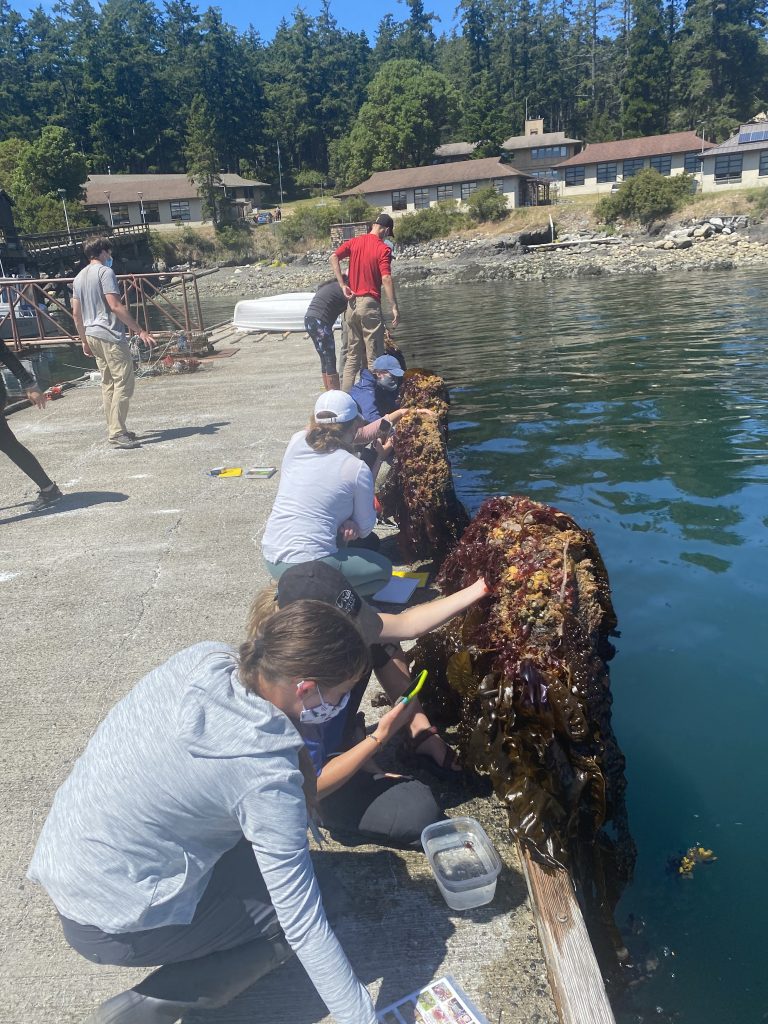
Walking down to the docks, we took a brief tour of the labs. On the docks, we were instructed to yank up the tires nailed on the sides to discover the variety of organisms occupying each one. Each tire had its miniature ecosystem, so we quickly got out our field microscopes and notebooks and began investigating. Our group identified many different organisms such as crabs, sea urchins, anemones, tunicates, and various alga.
An undergrad student from earlier, Maria, graciously offered to show us her research on the interactions between kelp and crabs. Her goal is to determine what age of kelp the crabs prefer to eat and live in. She collected kelp of different sizes and separated them into different tanks. One tank housed the adult kelp, one had the juvenile kelp, and one was a mixture of both. Maria placed a crab in each tank, and depending on which kelp the Crabby (the kelp crab) interacted with the most; she could prove her hypothesis. It was super cool to see the experiment in action and how students and scientists set up and execute research operations in a lab setting.
Before we left the dock, Seth, out of seemingly nowhere, pulled a giant red rock crab from one of the tires he examined. It was huge in comparison to the elementary rock crabs the rest of us observed. He held the foot wide crab proudly by its pincers. Putting it in a container, Tim then explained the crab’s anatomy, which at times was disturbing to some. The crab wasn’t a fan of all the attention he received, so we didn’t detain him for long.

After a great home-cooked dinner, our very own Timothy Dwyer gave us a presentation on polar gigantism, where the animals in Antarctic conditions grow much more significant than any of their family members. He also told us all about giant Antarctic sea spiders, which are both incredibly interesting, and a little scary!
The adventurers in the group bombarded Tim with questions about his experiences. We’re sure Tim could tell that many of us would hope to see ourselves researching in Antarctica at some point.