Day 23: Diving Into the End

Today’s blog entry is brought to you by Meg, Naomi, and Ana. Enjoy!

Project Time

The familiar sound of a beeping alarm clock symbolized the start of the day for us here at Salish Sea Sciences this morning. Although it takes most of us a while to qualify as fully functioning after waking up, we were excited to get some project work time following breakfast. Some of us worked on our univariate and multivariate graphs with the help of Derek and Tim, and others worked on more research and additional project concerns. Anxiety has set upon all of us as the deadline for projects – and the final day of the program – creeps closer. 

Photo on the left: Derek Smith helping analyze data with Sonja and Dustin. Photo on the right: Islay and Maddy discussing their poster projects. Pictures: Ana.

Spineless

After some much needed project time, we had a special treat. Susan Middleton, amazing photographer and storyteller, came to speak with us about her work! While she passed around copies of her remarkable marine invertebrate book, “Spineless”, we had the pleasure of hearing about all of her adventures; she told us of her photo-shoots alongside Richard Avedon (an American fashion and portrait photographer for Vogue and Harper’s Bazaar), her NOAA voyages, and her University of Washington courses with Gustav Paulay (Professor of Biology at UW) right here at Friday Harbor Labs. From the moment she set eyes on the NOAA scientist’s invertebrates, she never went back to terrestrial organisms.

Spineless by Susan Middleton Picture: Susan Middleton’s Website

Susan Middleton’s discussion on her path to marine invertebrates portraiture Photo: Miranda

If you have not seen her work, Susan Middleton is best known for the isolation of her photography subjects. Her portraiture pieces encapsulate the unique essence of individual animals, not just the on-the-surface beauty. Though often she is the one learning from her research colleagues, sometimes her photographs are able to reveal brand new behaviors that researchers and students have never seen before. By shooting each animal – and not just the charismatic ones – on a simple black or white background, she is able to convey the story of often forgotten animals. She uses her powerful pieces to advocate for the protection of animals and land across the world.

The stories she told us led to discussions and questions; before we knew it our time was up. We thanked her for sharing all of her fascinating experiences and prepared for today’s trip to FHL.

Diver for a Day

After lunch, we set out to the Friday Harbor Labs to observe Tim and Jason Wood diving! We sat down in front of a T.V. that was hooked to a camera that Tim and Jason took down when they dove. It was awesome to see all that is going on below the docks: we saw large crabs, lots of seaweed, henricia sea stars, sponges, hydroids, white plumose anemones, nereocystis, and sea squirts! Additionally, we learned all about the proper scuba diving equipment and attire, and how to communicate underwater when you can’t speak aloud.

Tim during the Diver for a Day demonstration! Pictures: Naomi

Thanks to the Buddy phone, we were able to speak to Tim underwater, ask him questions, and ask him to focus the camera on especially cool marine organisms. Unfortunately for Tim, he was not able to respond. Anyways, we hope he enjoyed our group rendition of Let it Go!

Tim Dwyer and Jason Wood exiting the water and coiling hydrophone wire. Picture: Naomi

Surprise Guests

After heading back from the labs and having exploration time to work on projects or relax, we had dinner with two special guests: Abby and Ana’s sisters, Gabrielle and Zoe. Both Gabrielle and Zoe attended the Salish Sea Science program in 2018 and continued work in sciences. 

Gabrielle attended the Robinson center, which is a program through the University of Washington, where the kids have one transition year after middle school and then go straight into college at UW. She is majoring in Neuroscience and studying neurocircuitry and how it affects mice behavior. Zoe, after the Salish program, completed a capstone-like project through the Marine Chemistry program at Bellarmine Prep high school on the CO2 intake of Eelgrass. Next year she will be attending UC Davis majoring in agriculture and environmental science. We are so glad to have two amazing guests who can share their experiences since attending Salish Sea Sciences.

Gabrielle on the left and Zoe on the right. Picture: Ana.

As project crunch-time continues, the ice cream tubs keep getting lower and our excitement keeps growing. We can’t wait to see what tomorrow will bring!
Day 10: Canoes and Karaoke

Hello everyone! Today’s blog comes from Ana, Andrea, Maddy, Sonja, Meg, Hebaq, Dustin, and Kira.

Today was a little different for everyone. We woke up at our normal time and Morgan told us that we were finally allowed to go into town! We celebrated this by going out and buying coffee from a local shop. Some of us even explored the grocery store. Afterwards, we had a sad goodbye with Group 1 who left for an overnight canoe trip with Kaigani Canoe Voyaging. We think they’ll have a great and safe trip with Matt Wickey (the boating guide) and his crew! The remainder of us had time to work on our independent projects until lunch. 

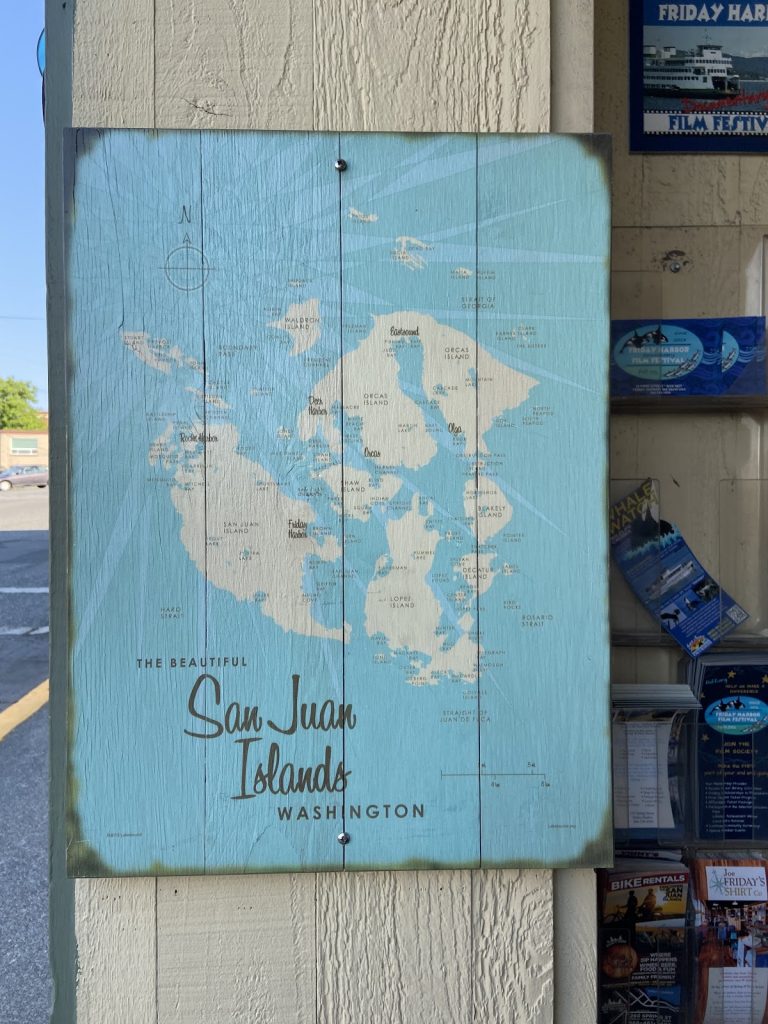
Map of San Juan Islands we found at a little shop in town!

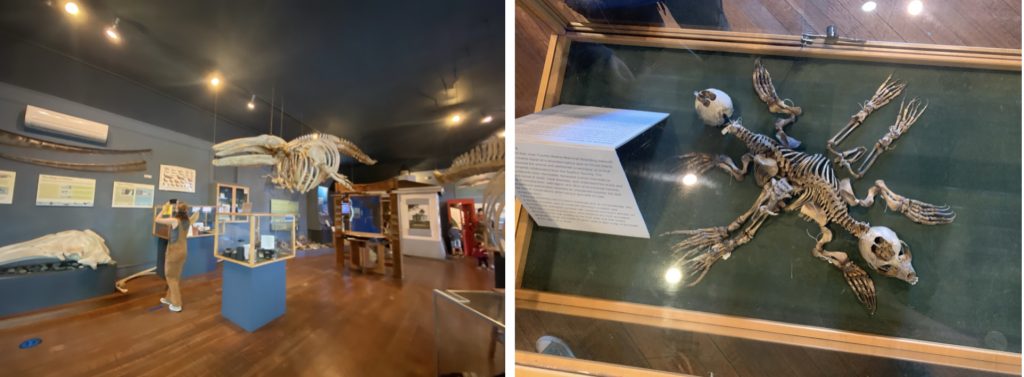
After lunch, we headed to the Friday Harbor Whale Museum where we received a very informational tour. We learned all about the different species of marine mammals and their importance to the San Juan area and to the Native American Coast Salish peoples. We then had the chance to look around at fun exhibits like the whale brain, whale calls, and beautiful stained glass of whale species. 

Later, Tim handed us packets with historical pictures of the Friday Harbor Town. He told us to find each building and attempt to replicate the picture we saw. We only had an hour and a half, so we split off into groups and started to explore! The scavenger hunt was really fun, and both groups stopped in different shops along the way…to look for historical sites of course. Ana’s team won!

After we found all the images, we headed back and made a delicious dinner for our smaller-than-average sized group. We chatted about finances over our meal, which was a little surprising but overall pretty interesting. We washed the dishes and then started to sing/ shriek karaoke in the living room. We plan to have a movie night and eat plenty of ice cream!!

Day 5: Looking for Lugworms

Written by Naomi Scott, Ana Matteson, and Seth Hallbert

Heading Into Heat

Our days on San Juan island are flying by! Though we’ve been here only five days, it feels as if we’ve known each other for weeks. The breakfast room atmosphere is as lively as the bustling Lugworm networks beneath the False Bay sand. 

Once we’d fueled our bodies for the day ahead of us, we completed our daily knot, the square knot. Our maritime skill improvement session was followed by a reminder to stay cool, hydrated, and protected from the sun as we head into a record-breaking heatwave that will sweep across Washington, Oregon, and other areas of the Pacific Northwest.

Talking about Tides 

Up first on the agenda for the day, we headed to the Spring Street International School science lab for a tide-chart reading lecture from Tim. As we reached into the back of our brains to remember our third-grade tide cycle lessons, Tim explained how the Salish Sea and surrounding area experience mixed tide cycles and currents.

When a location experiences mixed tides, it doesn’t have the consistency of the similarly sized, two high and two low tides every day that locations with semidiurnal tides experience. Instead, it’s more varied. 

As a refresher for those of you who are also trying to reach into the back of your brains to remember your third-grade tide cycle lessons, when the sun and moon are in line, during spring tides, they pull water towards them causing the tides. 

FHLOO (pronounced “flu”)

After a short break, we returned to the labs to speak with Mr. Samuel Garson, a researcher at FHL and high school biology teacher at Friday Harbor High School. Sam told us about his work with ocean observation systems, and how the Friday Harbor Labs Ocean Observatory (FHLOO) is using a variety of equipment and data loggers to survey the water around FHL.

Sam and his fellow researchers are responsible for the brain of the observatory, otherwise known as “The Dock Box,” on the FHL dock. The different equipment in “The Dock Box” collect data regarding the salinity, turbidity, pH, oxygen concentration, and more of the surrounding water. 

Sam showing us the FHLOO survey site on the NANOOS NVs data explorer page

With the assistance of a technologically advanced data logger, all of the collected numbers are recorded in uniformed files every thirty minutes, and uploaded to the Northwest Association of Networked Ocean Observing Systems (NANOOS) NVS data explorer page

Look at the NVS website and zoom in on San Juan Island to see FHLOO’s site!

    Sam said that all of this data could not only be used to identify potentially harmful algal blooms, but it is all accessible to the public. This means that students and researchers across the world can use the data recorded on this site, and questions that haven’t even been asked yet can be discovered through the observation of these records.

Looking For Lugworms 

Starting off in the classrooms left us with more energy for our lugworm collections at False Bay in the afternoon. After a lovely lunch break, we headed out to False Bay on the Southwest side of the island. While at False Bay, we hoped to record the population of lugworms, large marine worms in the class of Polychaeta, that lived on the beach. 

These little creatures are extremely helpful in overturning dense sand and enriching it with minerals like oxygen. They do so by ingesting the mud-like sand and excreting fecal casts of clean sand.

Fun fact, False Bay got its name from the way it completely fills when the tide comes in, then completely empties when the tide goes out! Here is False Bay at low tide.

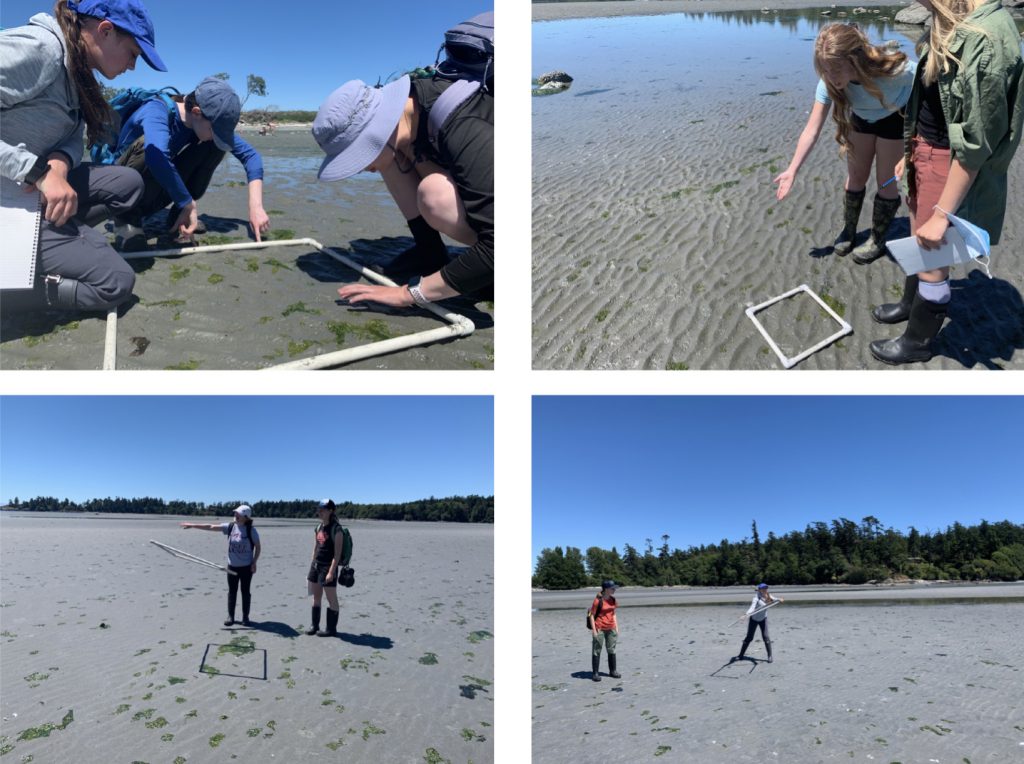
We recorded the numbers of Lugworms using quadrats, squares of PVC pipes which allow people to look at the distribution and abundance of different species in and out of the water. We used the haphazard quadrat placing method to help remove bias from our surveys; this method includes walking to different areas and tossing the quadrat in your survey site. One would then proceed to count inside of the quadrats. 

Left: Maddy taking the temperature of a pond and Islay recording the data at False Bay

Right: Sonja counting the fecal casts in a quadrat at False Bay

We identified the number of lugworms in the quadrats by counting the fecal casts the lugworms left behind. These swirly, soft-serve-shaped tubes of sand lay on top of the beach substrate next to their burrow holes.

Shown in the red circle is a fecal cast from a Lugworm 

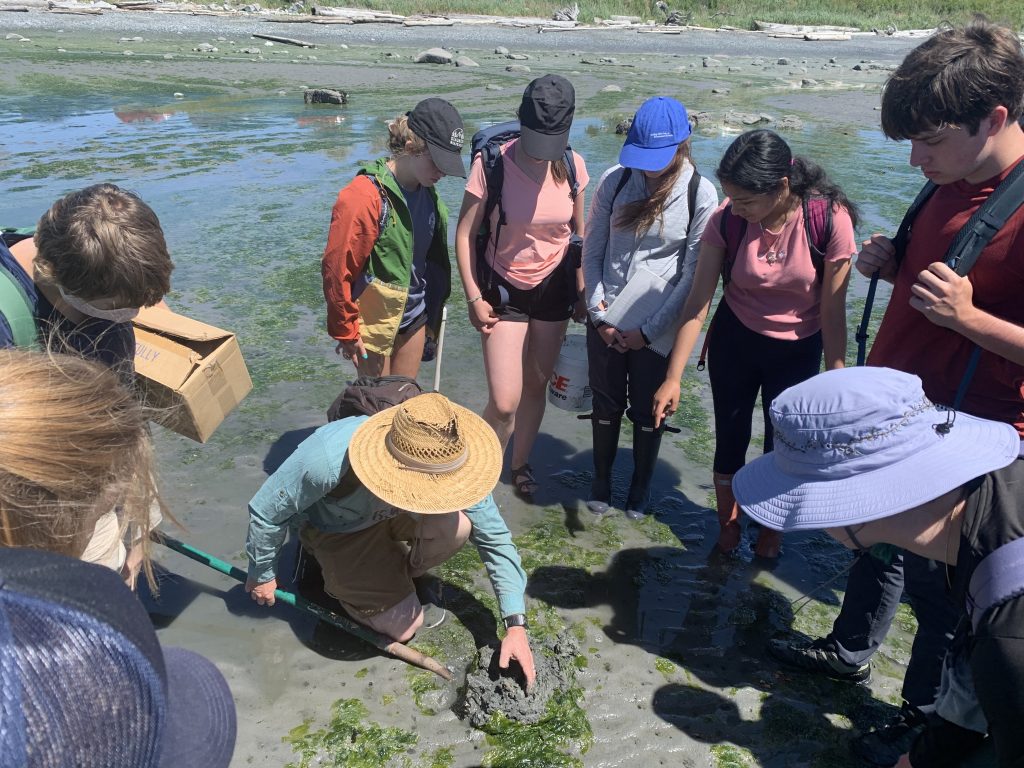
We split up into groups of two and each dropped the quadrats fifty times in two areas, one closer to shore and one closer to the water, counting the fecal casts inside as we went. There was also an additional group of three that took samples of the sediment. They filtered the beach substrate through multiple sieves and revealed the different components of the sand. 

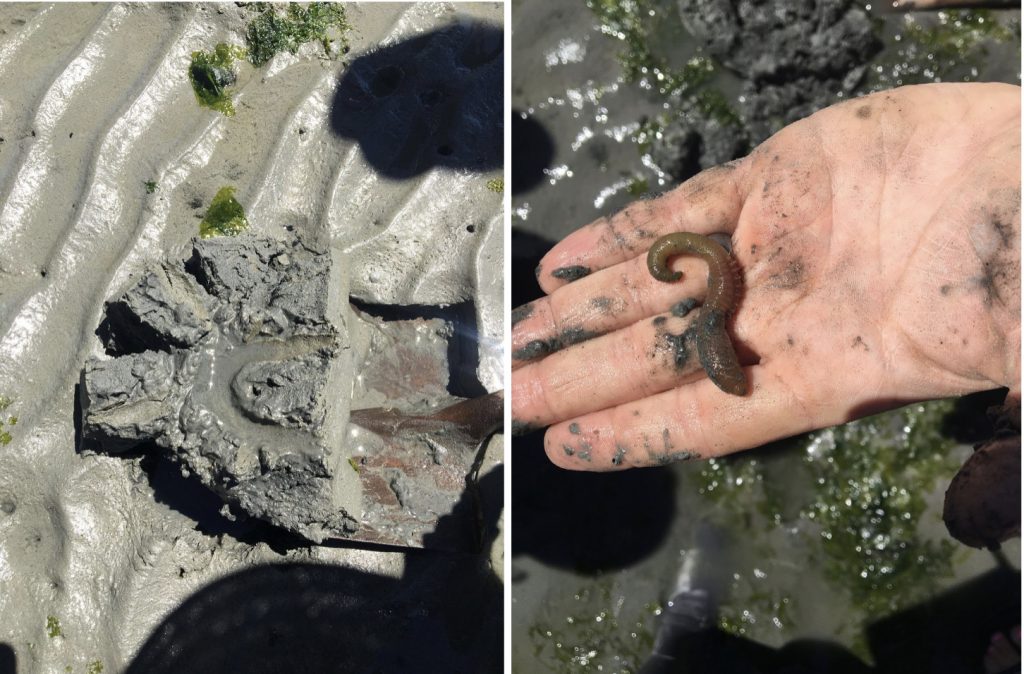
Photo on the left: Burrow of Lugworm split vertically in half

Photo on the right: Lugworm held by Tim 

After recording our data we had some fun! We walked out to the edge of the bay where the tide was coming in to explore the calf-high puddles in our awesome boots. On our walk back we took data samples of the water temperature and salinity of different ponds and puddles on the beach.

Hebaq helping Andrea empty water out of her boot

Independent Project Introduction

After returning to the dorms from our Fales Bay surveys, we got our first look at the projects which we will have the chance to complete during our remaining time in the program. 

To complete our projects we will be asking a question and seeking to answer it using experimental or observational methods. At the end of the program, we will show and explain our research to an audience of scientists, friends, and family. 

Anything from routinely counting jellyfish at a specific beach to observing the behavioral patterns of sea slugs is a possibility. With the many resources available to us, we have the opportunity to be as creative and imaginative as we want. Despite the potential time restrictions, which will be a significant factor in the development of our projects, we can’t wait to get started.

Babies with Bea 

To end a busy day, we got a presentation from a very busy recent Wellesley graduate. Tonight we had the privilege of hearing from Bea Grauman-Boss, Tom and Caroline’s daughter. Bea grew up on the island, and told us about her journey from sea urchin and sand dollar larvae (babies) to pancreatic cancer research. A recent graduate of Wellesley College, Bea is Lab Manager and Technician in the Hemann Lab at MIT.

Though the two things may seem unrelated, there are many parallels to be drawn between the marine larvae and cancer molecular biology. Other topics of Bea’s presentation included invasive rabbit data collection and Island Marble Butterfly conservation on San Juan Island. We can’t wait to see what tomorrow brings with more exploration of the island.

More Photos!