By Grace Davis, Jeremy Davis, Faith Jayaram, and Tony Yuan To
For most people, collecting, researching, and scanning eelgrass isn’t the first career path that comes to mind. But this is not the case for Morgan Eisenlord, who spends her life working with sea stars and eelgrass. Today she taught us about the latter. Dodging giant red rock crabs and clams that were spraying water everywhere, we collected eelgrass samples and took them back to the Spring Street International School campus to clean them and create scans.
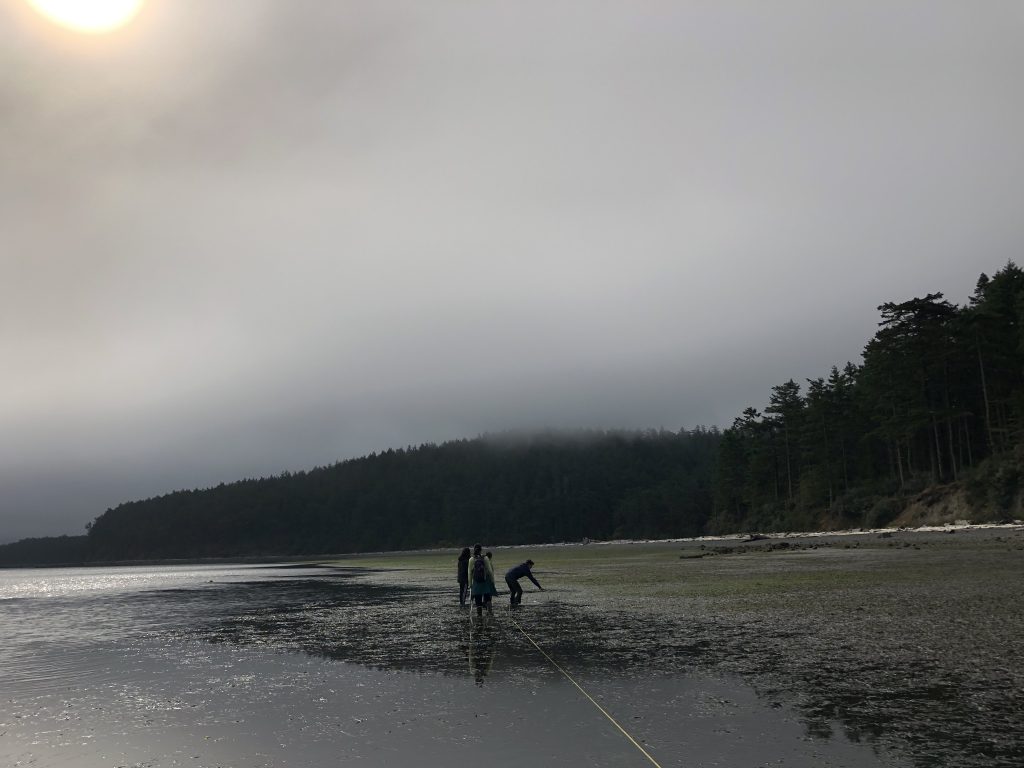
The process began with laying out measuring tapes across the beach. We were split into three groups, each one working on a separate transect. Two people collected samples of the slimy but interesting eelgrass every 5 meters. Another person counted the eelgrass plants at 5, 10, and 15 meters along the transect in order to document the density. The final person recorded everything in their notebook.
After our successful morning of eelgrass research, we returned to the dorms to shower and eat lunch. Many of us then joined Morgan in the classroom to finish organizing the eelgrass. We ended three hours early! This extra time was spent on research projects and other activities.
This sunny, beautiful day ended with an exciting performance of the Merchant of Venice by Shakespeare. Even though we were cold, it was definitely worth it. Goodnight!
By Grace Davis, Jeremy Davis, Faith Jayaram, and Tony Yuan To
Today we had the oppurtunity to work with composer Alex Shapiro in bioacoustics. While traveling around San Juan Island, we took field recordings and wrote about the myriad of noises that were present. The roar of a ferry, the soothing crash of waves, the sweet melody of birdsong–we were surrounded by the sound of our environment, slowing down from our usual routine. During our travels, we stopped in Friday Harbor, South Beach, and the San Juan National Forest. In each location, we made a point to individually spend some time with just the sounds of our surroundings.
When we visited a prairie, we heard crickets singing and birds chirping. However, there was one significant noise that kept appearing: planes. Derek told us that planes were constantly creating noise over the field, so the island was never left in complete silence.
By Grace Davis, Faith Jayaram, Jeremy Davis, and Tony Yuan To
Sleeping in was a luxury meant solely for the Fourth of July. With a good night’s rest, the members of Salish Sea Sciences were excited for San Juan Island’s annual parade held in honor of the independence of the United States. Many cars, people, horses, and dogs were involved in the celebration. It was great to be a part of the island community and participate in Friday Harbor’s events.
After the parade, some people went to the Pigs War barbecue. At the picnic, food and drink were provided, along with live music and games. While this was one option for the students of Salish Sea Sciences, others went souvenir shopping, got ice cream, or simply enjoyed the Fourth of July fun and nice weather of the island.
To further the festivities, a trip to Roche Harbor added to the holiday cheer. With the hundreds of tourists walking around the north side of the San Juan island, it was difficult to keep our large group of twenty people together (scrambling ensued). Even though parking also proved to be a major issue, we had a great time anyway.
We ended our trip to Roche Harbor by visiting a peaceful sculpture garden– a large contrast to the loud crowds of the harbor. It was interesting to see the talent of so many artists on display. There was also many interesting quotes scattered around the garden which we found hilarious.
Returning to the dorms that night, we ate burgers, a classic Fourth of July dinner. Thank you Tom for your amazing cooking!
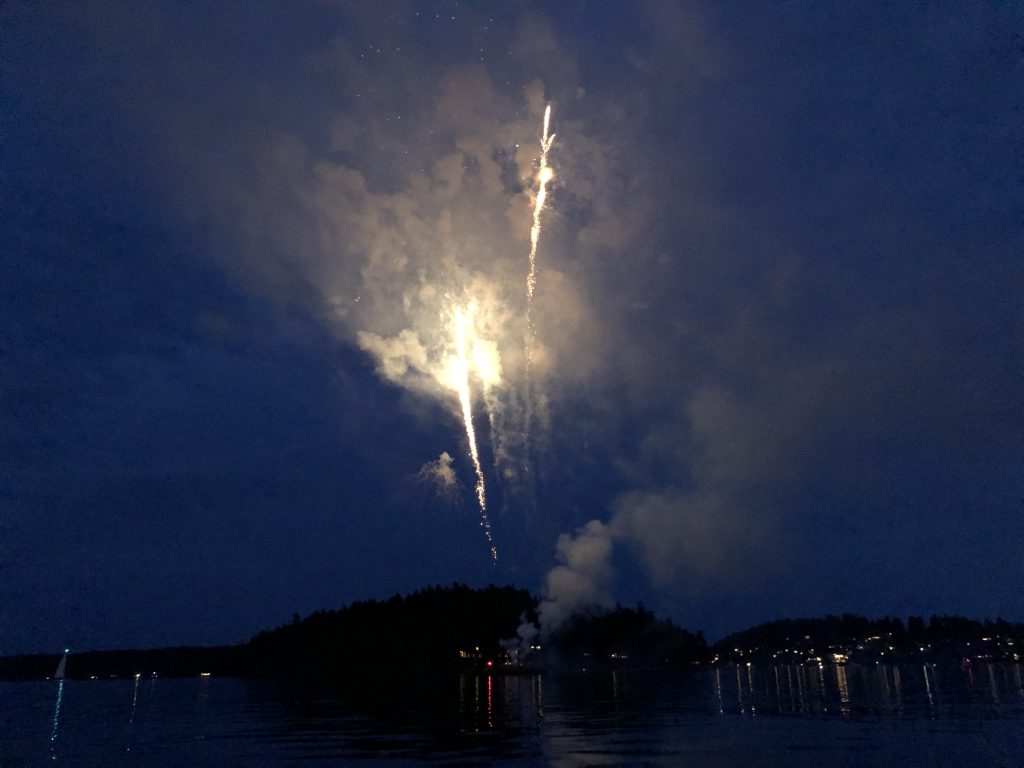
To continue, we drove to the University of Washington Friday Harbor Laboratories to get a front row seat for the fireworks. After some exploring at the UW library, we sat on the pier to watch the fireworks. The fireworks were unlike anything we had ever seen before. These flashed bright across the night sky, making a thunderous sound which reverberated for what seemed like miles. It was quite the experience.
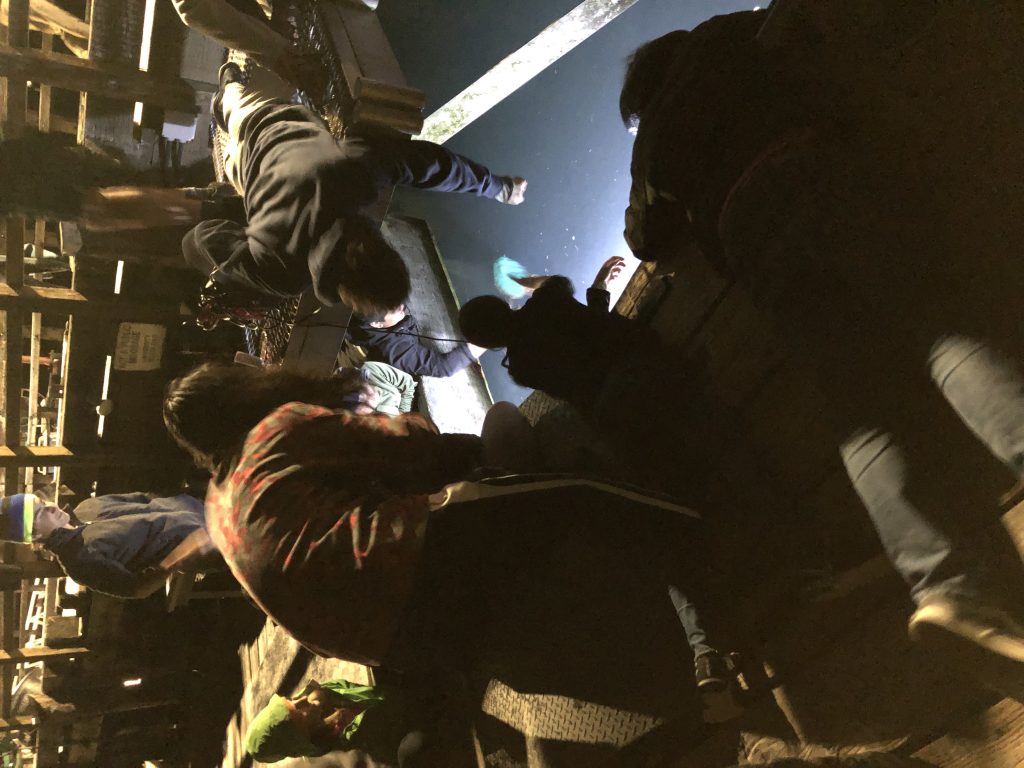
To finish off the night, we placed a light under the water near the dock. We watched with awe as animals swam curiously towards the light. We saw many fish, worms, and crab larva. On our way back up the dock, we saw large worms swimming in the water. Excitedly we placed the light near the worms and studied the interesting creature.
While Fourth of July is fun in our hometowns, experiencing the holiday on San Juan was unforgettable.
By Grace Davis, Faith Jayaram, Jeremy Davis, and Tony Yuan To
On a regular day, rain may be considered calming. On day two of our longboat trip, it was anything but. Awoken by a cold, downpour of rain, the people who stayed on shore overnight, found their sleeping bags drenched. While this had proven to be inconvenient, our “skip-and-dip” only made our situation soggier. This activity occurred at approximately 6:30 in the morning, when we all jumped into the ocean together. The feeling of the cold water was meant to prepare us for the possibility of falling overboard on our longboat. Personally, this allowed me to connect to the marine environment and the life surrounding Saddlebag Island.
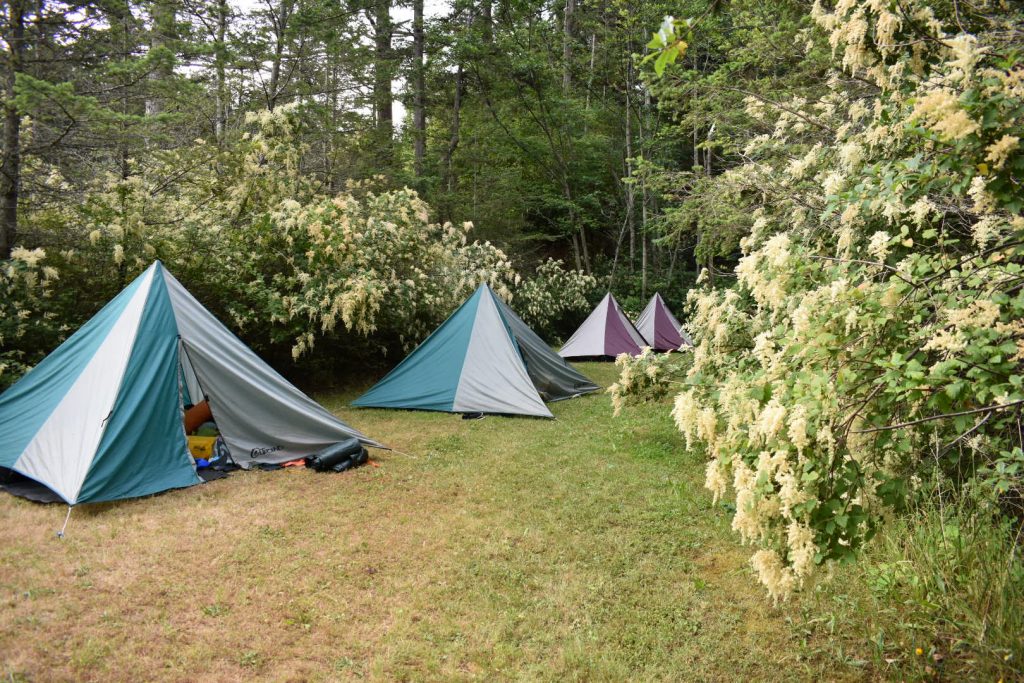
Tents used on the longboat trip, generally housing 3-4 people, taken by Grace Davis
While the rain continued to fall, attempts at getting dry after the skip-and-dip were forgotten. Our bright orange rain suits were quickly outfitted to protect us from becoming even more wet. Though our precipitation problems could have offset the mood of the day, we pushed through with surprising positivity. Hot drinks and a breakfast of yogurt with granola was happily eaten by both the Townshend and Bear boat crews.
Following breakfast, each crew went off to work on preparing to leave for the next island. The morale crew took down tents and helped with bilge diving– a term for putting items back onto the longboat. The cook crew cleaned up after breakfast and ensured that all items were in their proper dry bags. The boat crew, who had created the schedule for the day, watched as all jobs ran smoothly.
With everything ready for the day, an unfortunate twist of events occurred. One of our own, Zoey, became sick and was unable to continue on the trip. The original plan was to row to Lummi Island, roughly seven nautical miles from Saddlebag Island. Since Zoey needed to leave, we instead rowed to Vendovi Island where Caroline and Tom (Salish Sea Sciences Directors) could pick her up.
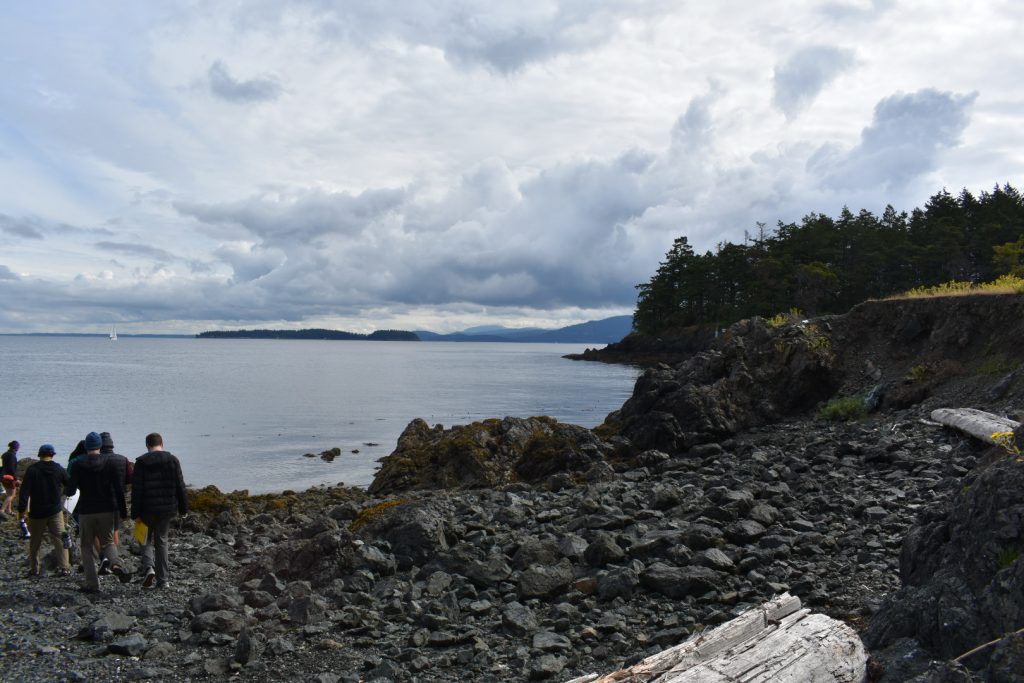
Vendovi Island, taken by Grace Davis
On the water, each boat rowed through the rain. Along the way, we spotted several seals pop their heads out to watch us. Additionally harbor porpoises were spotted off the starboard side of the longboats.
As we rowed towards Vendovi Island, the weather conditions improved, and the rain let up. Just a few hours after miserably rowing in the rain, we were able to sail, for the first time, the rest of the way to Vendovi Island.
Vendovi Island, taken by Grace Davis
Our new camp on Vendovi Island had much to offer us. We were greeted by the small Island’s caretakers, who graciously let us be the only overnight guests on the Island. Vendovi had many treasures, as it is a privately owned nature sanctuary. As the sun set, and we prepared for our stay on the island, we watched the island’s Pigeon Guillemots fly back to their nests, and settled in for the night as well, spirits high for our adventures on the island the next day.
By Grace Davis, Faith Jayaram, Jeremy Davis, and Tony Yuan
To kick off our third day in the Salish Sea Sciences program, we learned about underwater acoustics and the effect man-made noises may have on marine life. Although it was upsetting to hear recordings of boats drowning out the calls of our Southern Resident Killer Whales, the information and skills we acquired were valuable. Being aware of this issue is imperative for the environment of the San Juan Islands and, possibly, the environment of every ocean. Two of the wonderful people we met were Jason Wood and Jessie Turner. Jessie has an ongoing project that revolves around the audio impact sea planes have on marine mammals. As budding marine biologists and ocean enthusiasts, it was a lovely experience to learn about his craft.
Tomorrow we will be embarking on our five-day longboat journey. We are all excited and a tad bit nervous. We will report back on our expedition when we return to our home in Friday Harbor.
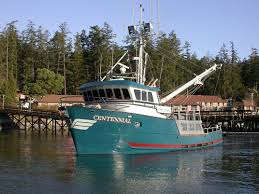
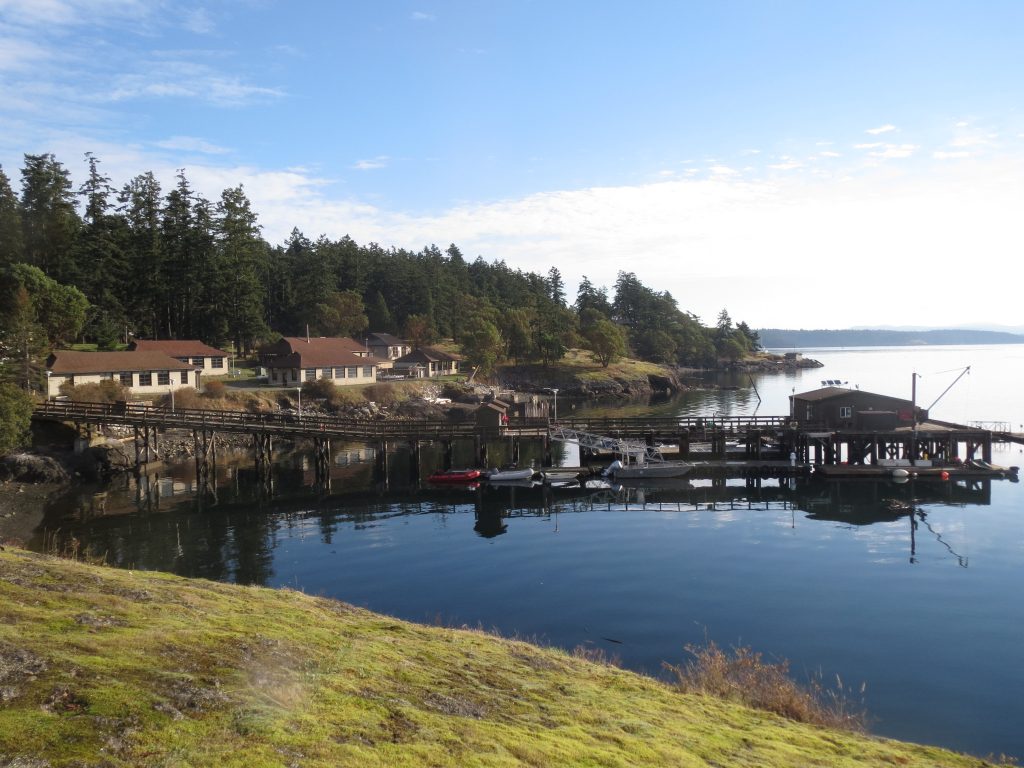
The Centennial, the vessel used by the Friday Harbor research team The University of Washington Friday Harbor Laboratories