Day 21: Work Time and Hiking

Project Work Time:

We began our morning by heading straight into project work time. Most of the group spent time analyzing their data and working on posters. Tatum woke up early this morning to hang out with her Pigeon Guillemot friends and had lovely conversations with Dr. Amy Cook. Many of us are heading into the project enzone as the camp is coming to a close.

Geological Hike with Park Ranger Jeff Hodge:

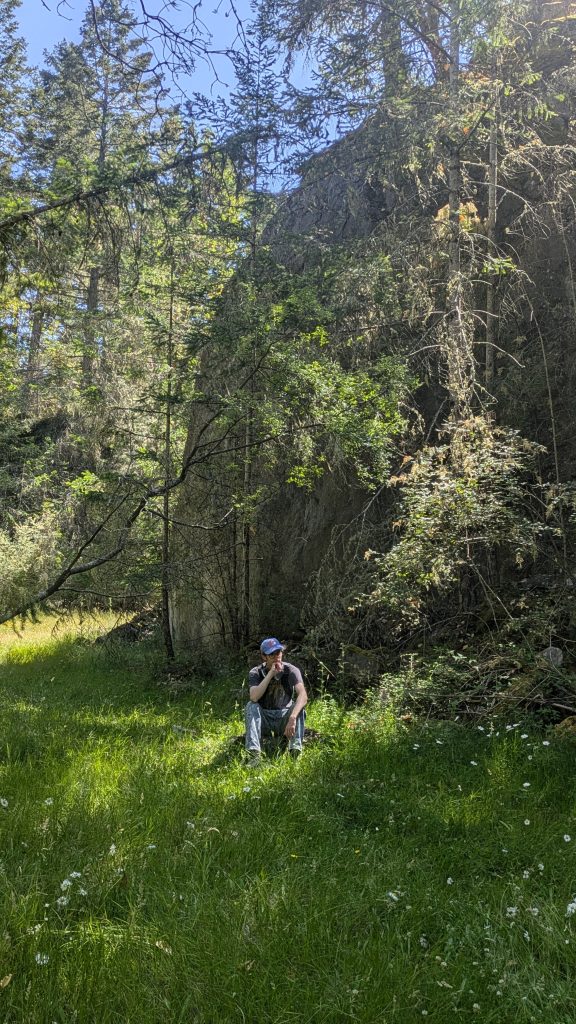
The group headed out on a tour of English Camp with Park Ranger Jeff, who gave us an in-depth look into the geology of the San Juan Islands, and the causes of development of the islands in the first place. We had a lovely hike up to the top of Young Mountain (Hill) with Ranger Jeff leading us to deeper thoughts about the geological creation of the islands. He mentioned to us how glaciers a mile high carved out the San Juan Islands. Thank you to Ranger Jeff Hodge for coming out and spending his time hiking and teaching us.
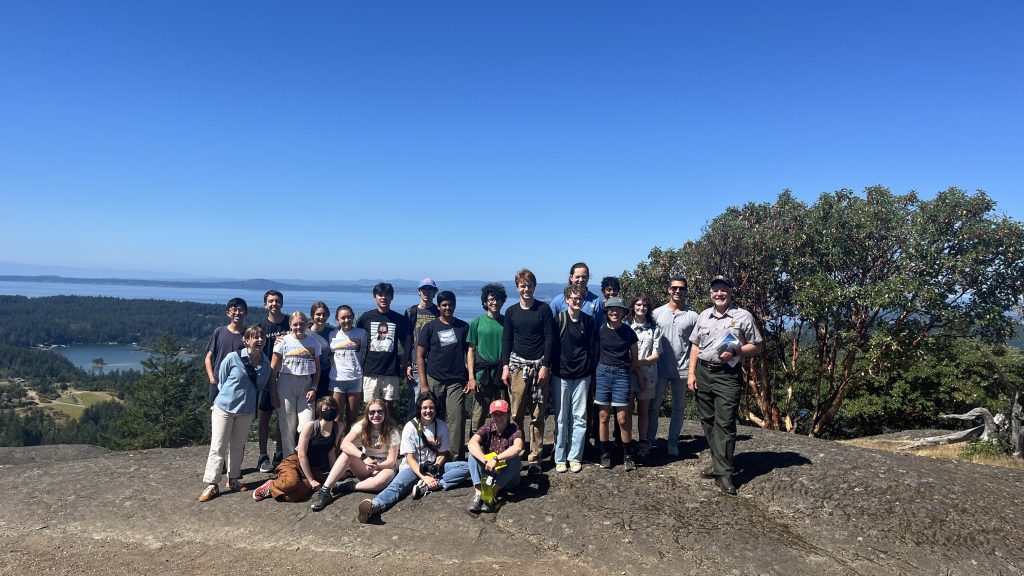
Photo credits to the nice lady also taking a hike

Friday Habor Labs:

After the hike up Young Mountain, Ansuya, Flora, Scarlett, Nina, Max, and Ian headed to FHL to continue their research projects. Ansuya and Flora frantically ran around the lab, rushing to get their research done in the short timeframe. Conversely, Max leisurely ran tests on his seastars, Scarlett and Nina walked around the lab to get their data together, and Ian sat around learning the R coding language. Overall, it was a very productive lab time as all parties made steady progress on their projects.

-Image of Ian’s coding

Lime Kiln with Shauna Barrows:

Later we went to Lime Kiln Preserve which is run by the San Juan Island Landbank. There we met with Shauna Barrows a Field Assistant for said landbank who took us on an interpretive hike. Along the hike, we learned about the limestone mines and their effects on the local environment. We talked about the changes to the changes to the soil, specifically how they are now more rocky and have a higher pH. We also were taught about how many trees have adapted to San Juan Island. These trees have typically become better at living with more rocky soil, salty air, and low humidity. Many people working in the forests of San Juan Island predict that just like how it was found that the coastal juniper is different from the rocky juniper, other trees might be genetically different enough from their closest relatives to be considered a new species. Some of these supposed new species include Madrona, Big Leaf Maple, Douglass Fir, and Western Red Cedar. 

Along the hike, we were shown an old quarry. Some of us wandered off from the group to explore the winding path through the quarry. Shauna Barrows afterward led us over to Carefree Lake where Northern Pike has been infiltrating the ecosystem, leaving devastating impacts on the ecosystem. We are exuberant for Shauna to join us at dinner tonight, to continue our conversations. If you want more information on the Land Bank head over to their website.
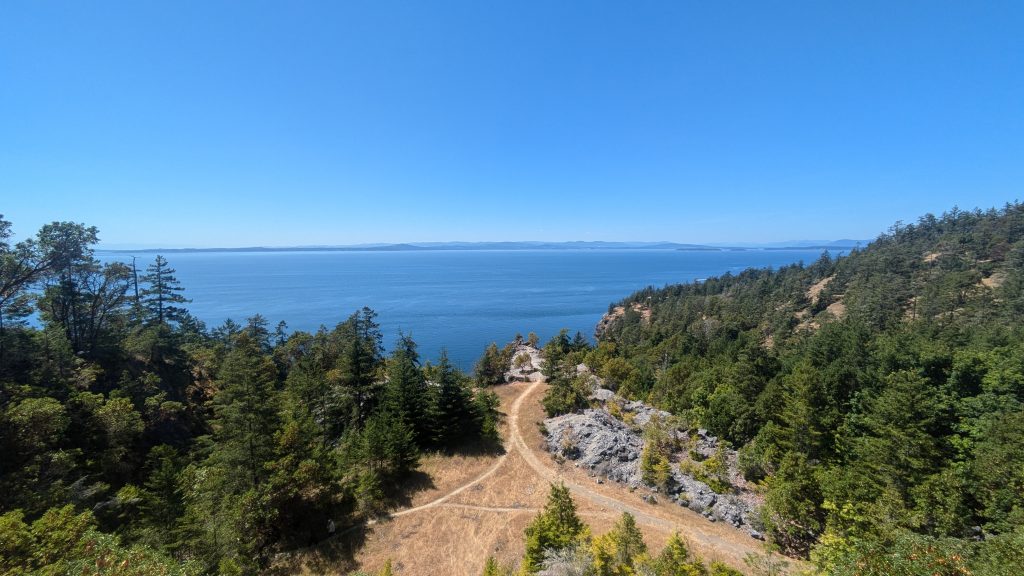
Photos taken by Caleb Zulauf

Day 16: Projects and Trivia

Westcott Bay Shellfish Company:

Those who didn’t need to start their research project piled into the vans for a trip to Westcott Bay Shellfish. As the name implies, they grow shellfish, mainly Pacific Oysters but also a few types of clams, mussels, and even Olympia Oysters. Today, we got a tour of the facility from Chaz who told us all about the history of the Westcott Bay Shellfish Company. We learned the company started farming oysters in the late 70s. Chaz also told us about how oyster farming isn’t the easiest as it involves a lot of strategic planning. Growing these oysters is very difficult due to the high mortality rate. To account for this, Chaz and his team change the “cages” of the oysters every six months, checking sizes and overall health. Chaz also discussed how harmful algal blooms (HABs) are monitored. Every week, the company sends in mussels for science to test for neurotoxins and bacteria. Luckily, the Westcott Bay Shellfish Company hasn’t had to shut down the company due to HABs, as the bay is pretty protected.  After the discussion, Chaz continued his tour and showed us the equipment that is used to collect and store the shellfish. At the end of the tour, we were able to check out the same and larger oysters that were gonna be shucked today! We are extremely grateful to the Westcott Bay Shellfish Company for allowing us to tour their establishment and telling us the intricacies of shellfish farming. 

Westcott Bay Shellfish Company: https://www.westcottbayshellfish.com/

-Photo credits to Soren

Cattle Point:

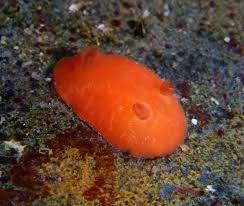
To complete their research projects, many people traveled to different parts of the island to collect data and specimens. Today, Sam and Gretchen needed their respective data from Cattle Point: Sam searched for red sponge nudibranchs, while Gretchen set out to complete a survey on mossy chitons and the algae surrounding them. Unfortunately, the trip was unsuccessful, as Sam only found 2 of his 8 needed nudibranchs. Thankfully, Gretchen made some ground on her research on mossy chitons as she managed to find 10 chitons in her survey of the intertidal zone.

Photo Credit to Gretchen, in the picture above there, are 4 Mossy Chitons
Red Dorid (Nudibranchs and Other Sea ...
https://www.inaturalist.org/guide_taxa/2821

Eagle Cove: 

Cassandra and Jeff drove the gang over to Eagle Cove, where we all bathed in the sun and played in the water. Matt and Sid cut up Bull Kelp to create horns and played notes together, and even attracted a couple of folks asking how to do it. Max, Nina, and Scarlett took a paddleboard out into the water and had some fun, and Sam, Katie, and Ansuya had a blast reading. When it was time to head out, everyone gathered their stuff and made it back up the big hill. Everyone was sad to leave their Bullhorns and reading perches, but we all piled back into the vans to meet Finlee, Caleb, and Gretchen back at home, as they had been hard at work at FHL.

-Photo credits to Morgan, in the middle is Cara, and off to the right is Soren jumping into the waves

-Photo credits to Morgan, in the picture is Cara playing in the sand

Trivia: 

The group ended the night with an exhilarating trivia game at JP’s. We had to split up into three teams because we were too big of a group: the Chill Pickles (Caleb, Nina, Soren, Ben, Katie, Gretchen, and Finlee), HABs (Scarlett, Sam, Ansuya, Max, Flora, and Tatum), and Brevetoxins (Sid, Ian, Matt, Tyler, Morgan, Claudia, Cassandra, and Cara) We even got our own category! The science directors, Adam, Emma, and Riley banded together to create a super-team, and in the end, Adam led his team to victory with a second-place tiebreaker, a quick bowling match. 

-Photo credits to Max, in the picture is Adam about to lead his team the Chase Fan Club to the victory of second place

Day 3: Friday Harbor Labs

Dr. Swallas Talk: 

The night before, the brilliant Dr. Billie Swalla, an evolution and development researcher and professor at the University of Washington, came for dinner and talked to us about her specialty, ascidians, and their genome. We also learned about chordates, and how evolution has changed their body shapes. She showed us a species chart that showed how most species had tails while there were only a couple of species with no tails. We got to walk through her lab the next day during our tour of Friday Harbor Labs. When we were walking through her students were adding their newest catches to the tanks. On our walk through we got to see crabs, barnacles, worms, and jellyfish. We are very grateful to Dr. Swalla for allowing us to peer into her lab and research. If you wish to find out more about her research you can access her website here: https://www.biology.washington.edu/people/profile/billie-j-swalla

Jackson Beach:

Last night, our group of upcoming scientists made a trip to Jackson Beach at night time. A couple of brave individuals entered the freezing ocean and jumped in for a while. Afterward, we all grabbed a volleyball and set up a court in the sand. Unfortunately, one team was severely outmatched skills-wise and began losing horrifically. Luckily, in a genius maneuver, the losing team performed a human pyramid to raise morale and demoralize the other team. The day ended with a clear victory as the comeback never materialized and a successful trip to Jackson’s Beach. HOWEVER, our journey wasn’t over yet as we began the next day exploring the expansive island.

Image taken by Cassandra

Research Project Talk:

To start the 3rd day of learning we got a lecture about our projects. Adam and Riley gave the time frame for how our projects are going to work in the next 4 weeks. The first week was mainly about getting out in the field and exploring. Then week 2 is about brainstorming and ideas for projects that can be used. Week 3 is about meeting with our mentors and getting data. Finally, week 4 is about getting more data and making our posters. They also told us how we could get our materials and how our projects would work. After their talk, Caroline came in to discuss charts and maps. We learned how people can rely on maps and figure out what’s happening with our planets.

Cattle Point with Dr. Dobkowski:

After the talk about our research projects, we headed out to Cattle Point located on the southern end of the island. We met up with Dr. Katie Dobkowski and her mentees: Lucy and Francisco, to provide help on their project. Dr. Dobkowski is a professor at Evergreen University in Olympia, Washington, and has done many research projects relating to seaweed in subtidal and intertidal communities on the West Coast. Their project was focused on crab molts and the different types of crabs around the beach. We mostly found Red Rock Crab molts on the first part of Cattle Points Beach, and around the corner of the beach, we found more Native Shore Crab molts. It was very tricky to find the actual molts, but it was tons of fun even with the sun and heat and the steep climb up to the vans. More about Dr. Dobkowski’s research here: Website

– Image taken by Morgan

Lab 1 with Dr. Hodin:

We headed to Lab 1, the Seastar lab, where we met Dr. Jason Hodin and his mentees: Venessa and Chloe. Dr. Hodin is a professor and a senior research scientist at the University of Washington. They explained their work with sunflower stars (Pycnopodia helianthoides) and wasting disease. Venessa and Chloe led us over to the seastar tanks, where they demonstrated how they feed the stars. They answered our many questions, especially about wasting disease and how it’s taking out sunflower star populations, along with their conservation efforts to save the stars. More on Dr. Jason Hodin here: Website

– Photo taken by Morgan

Exploring the rest of FHL (Friday Harbor Labs):

After exploring the Seastar Lab we were graciously led around the Friday Harbor Labs by  Dr. Michelle Herko, the program director at Friday Harbor Labs. She brought us through the main building and shared the history of the establishment and how she got into working at the Friday Harbor Labs. Then, she brought us around the lab and showed us the various equipment and organisms researched. In one of the sections, there was an area for numerous invertebrates of all sizes and ages, like a large, squishy sea anemone in the lab longer than Dr. Herko worked there! Overall, the FHL was fascinating and led by incredible scientists, and I would love to visit again. More Information on Dr. Michelle Herko here: Website

Blog was edited for clarity, to add more information, and adding new pictures on July 7th, 2024