Post Longboat R&R

By Rachel and Maya

Finally, some long-awaited rest!

More information about our six day longboat trip is coming soon- get ready for lots of exciting stories- but today’s blog post will focus on the group’s first 24 hours back on San Juan Island.

After traveling through the Eastern San Juans for a week, every member of the 2018 Salish Sea Sciences program was exhausted, sunburned, and ready for some serious rest and relaxation. Luckily, the Tims allowed us a full day of fun in the sun, beginning with a late wakeup at 8:30 AM and a breakfast of cereal and fresh berries. Thank goodness for something other than bagels, peanut butter, and jelly (our breakfast for the past six days)!

The rest of the day consisted of free time in town and at the dorm. A big group went on a field trip to Haley’s Bar and Grill to watch Croatia play England in the FIFA World Cup semi-finals over a huge plate of nachos. Croatia came out with the big win, but not before a suspenseful overtime.

Post-game, we visited the local bookstore to decompress from our sports-related stress, returning to the dorms later for snacks and lunch before heading out again on another adventure: an afternoon swim at Egg Lake.

For dinner, two acheologists working with the National Parks Service, Jeremy Ripin and Emilio Santiago, were our guests. Over a meal of cottage pie, They engaged us in conversations about carbon dating, local artifacts, concluding the night with an informative presentation on archeology. Jeremy and Emilio surprised us by laying out several artifacts from the local collection for observation, ranging from arrowheads to ceramic mugs.
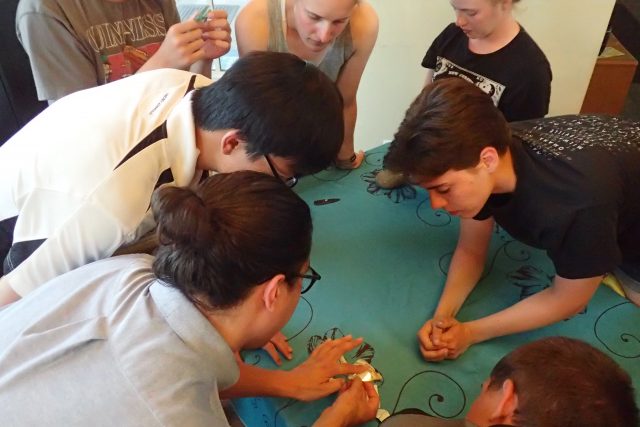
 

Observing bottle shards, arrowheads, and ceramic pieces

All in all, today was a chill, restful day. Check back tomorrow for an update on the longboat trip!
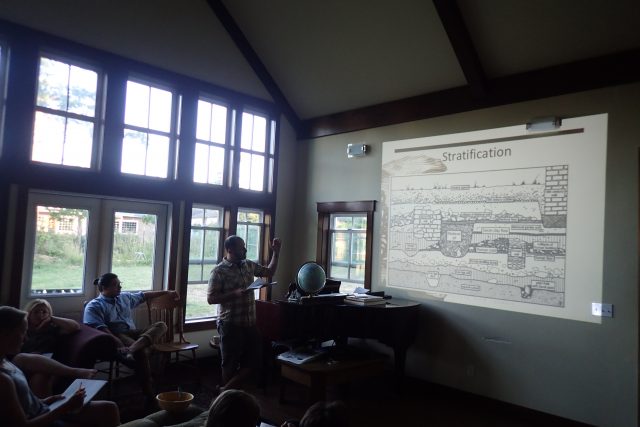
 

Our guests, Jeremy Ripin and Emilio Santiago, giving us a presentation on archeology
Fucus MUCUS!

Maya should not be a meteorologist.

Today’s early West Coast morning started as many others do: with a thick layer of gray clouds covering the sky. Though some of us- Maya, we’re looking at you- were optimistic during these early hours, insisting that the clouds would burn off to reveal golden sunlight, those positive but sorry souls could not have been more incorrect. Our trip to Cattle Point involved not sun but instead blustery wind and less than ideal temperatures. Despite Rugby Tim’s  constant reminders to “DRINK MORE WATER” and Professor Dobkowski’s insistent “100% NOT rain” weather forecasting, we were cold. Really cold. But what were we even doing out at Cattle Point, anyway?

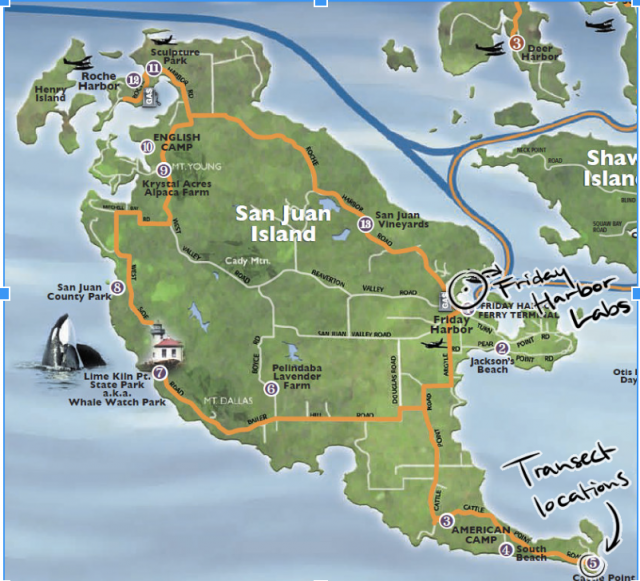
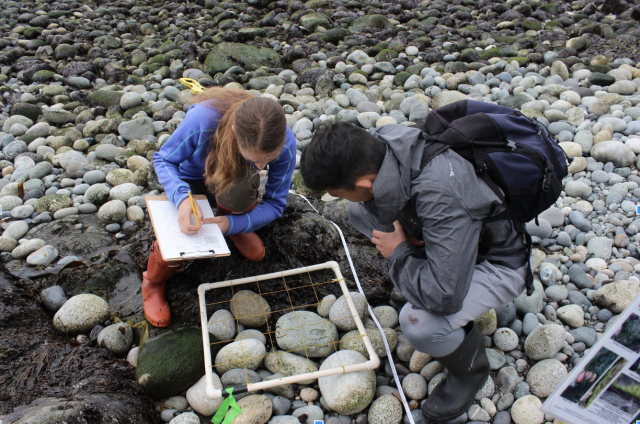
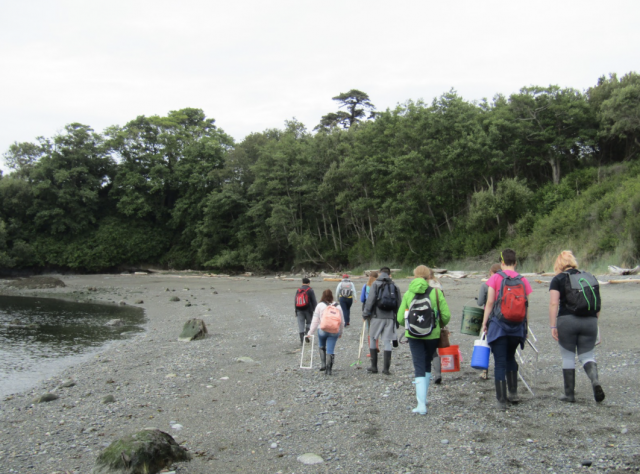
Last night, we were introduced to Professor Katie Dobkowski (by the way, congratulations on your new job at Bates, professor!) who gave us a first look at the study we would be participating in the following day. As mentioned in a previous blog, the study was started in the early 70s, basically making us official researchers in a project nearly three times our age! As far as tools of the trade go, quadrats (square arrangements of PVC pipes laced with string grids) and transect tapes (long mater tapes) were our essentials during this field study. Locations A, B, C, and D, located all along cattle point and encompassing many different substrates (surfaces where organisms can grow), were where we unrolled our transects and dove headfirst into algae data recording.

Scientist Ela and Kenneth hard at work collecting data with the help of a quadrat.

The weather and temperatures were rougher than Timmy’s puns, and the Fucus mucus made us severely question our foot-eye coordination, but we scientists are well known for our balance of fun and elbow grease. Several of us took breaks by playing with one genus of algae, Halosaccion, that squirts a thin stream of water when squeezed. Others found enormous rock crabs that were extremely interesting, as they were missing claws and legs, which gave us a look into the rough lifestyle of intertidal creatures.


Fucus Mucus

(https://depositphotos.com/21066093/stock-photo-fucus-vesiculosus.html)

After a quick lunch, Megan Cook came over to our dorm to teach us about scientific communication and how to connect with an audience. She taught us to write brilliant, emotional, and grammatically correct sentences like this: “First we woke up, the breakfast was awesome, I love cereal, the research was excellent, I love peanut butter and jelly sandwiches, that was my lunch, it was amazing”, et cetera. In all truth, her lesson was incredibly useful, and taught us a lot about writing compelling narratives. Afterwards, we journeyed to the mythical Friday Harbor Labs to assist Sasha Seroy in an experiment with Lacuna, or small intertidal snails, focusing on their teeth and food sources. Some of us got extremely lucky and observed some of these snails begin their feeding process by sticking their toothy radulas into kelp leaves.

Tonight we were lucky to have Beatrice Grauman-Boss and Lauren Lubeck as dinner guests. They are both undergraduates who are currently working on a project at the Friday Harbor Labs. Lauren and Beatrice taught us about sand dollar larvae cloning, which is epic! They taught us with an impassioned energy about budding, showed us pictures of the buds they had cultivated in their lab, and explained to us the process of cloning as a defense mechanism. It was truly inspiring. We can’t wait to hear more tomorrow when we visit them at the Friday Harbor Labs .