Today was a project day meaning we all went our separate ways to complete our various studies. Many of the Southern Resident Orcas came to the island and we got an opportunity to listen to their echolocation. The sculpins got their first concert of viola and clarinet in order to assess their reactions to the music while the bioluminescence team learned about the circadian rhythms of the Noctiluca Scintillans. More research was done into the sleep cycles of Nudibranchs. Saml did dock biodiversity surveys and underwater footage collection via a kayak and Gopro rig he’d built. We were also honored with a visit from the esteemed A. O. Dennis Willows, a UW professor Emeritus directed the incredible Friday Harbor Labs for over thirty years from 1972 to 2005, he taught us about what had made him and his colleagues successful and gave us advice for our futures in the sciences.
Whale hello there! Today, the Salish Sea Science students met pod T065A, a pod of 6 transient killer whales with 2 brothers from pod T077. Pictured is T077D, a male born in 2009. The Salish Sea crew was abruptly awoken at 8 a.m. by the sound of Alex yelling that there were orcas spotted at eagle bay. We all hustled into the van and drove to Land Bank and eagerly awaited the orcas. When they finally made their way to us, we all watched in awe as they swam by together as a pod. Once they were farther out, we hurried over to San Juan County Park and watched as they departed over to Canada. After this exciting event, students went back to the dorm and began working on project introductions. This included blacking out a room for some students, setting up tanks, and heading to a tide pool to collect data. We then planned our night walk to the Friday Harbor docks to look at the different abundance of life present at this time and bioluminescence.
This morning we created our project proposals based on the hypotheses each of us devised on Sunday. In addition to our original hypothesis and question we also added a materials list, a list of the locations each of us needed to visit for our projects, a procedure (how we’re doing our projects), an explanation of why our project mattered and how our project could be scaled and continued. After we each got our proposals checked off we ate lunch and figured out where we’d be going in the afternoon. After lunch, we packed our bags and ourselves into the van and headed off to Cattle Point on the south side of the island with Alex and Ayla. As we journeyed to the water’s edge we were amazed to see that it was crystal clear, this allowed us to see the shallows of the subtidal zone in addition to the intertidal which is generally what we see when tidepooling. We spent time scrambling the rocks and searching through the shallows for creatures. We found an abundance of animals including purple shore crabs crawling through cracks in the cliff side, aggregating anemones overflowing the tidepools and goose necked barnacles with their necks stretched up high. Some of us also saw people seining (running a small trawl along the seafloor for the purpose of research) and asked them about it. We also saw some spectacular bald eagles in addition to hearing the steller sea lion’s incredible call from a small island in the distance. When we got back to the dorms we were given some time to unwind and relax before evening chores began.
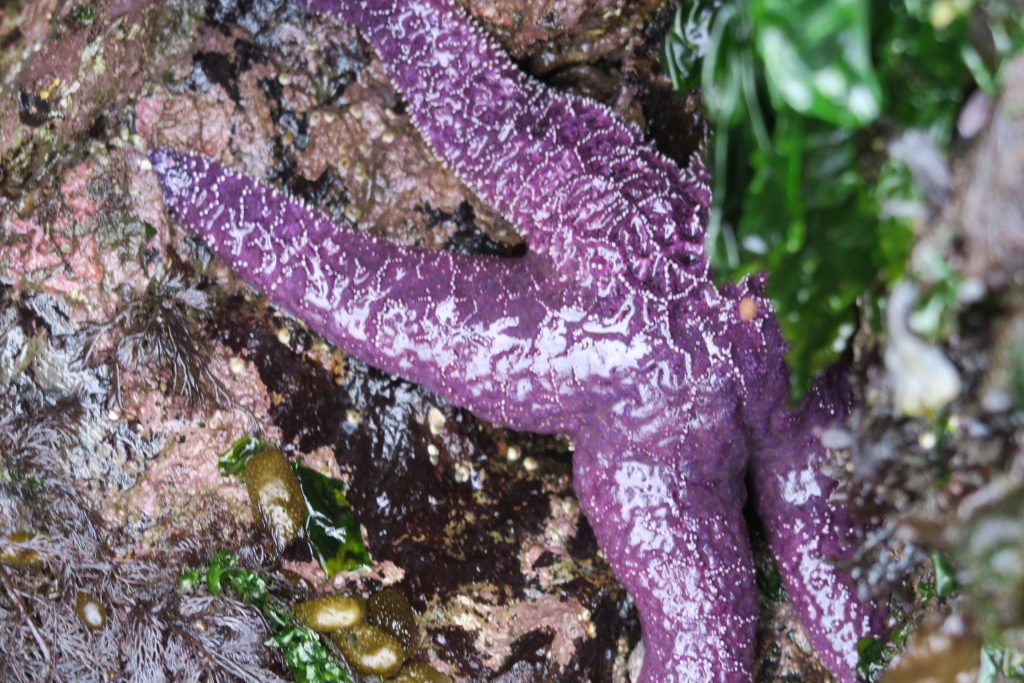
Today the Salish Sea Science crew took a boat trip on the Regina to Yellow Island. In order to help reduce the boat’s weight we voyaged to the island in two separate groups with the second group also getting the chance to explore the incredible biodiversity of life on Friday Harbor’s docks including towering tube worms and dazzling decorator crabs . When we arrived we were greeted by the Steward of the island Matt. He guided us to the tidepools we would later explore. Then after a brief break for lunch and a talk from Matt about the Coast-Salish people’s relationship with Yellow island, our group gathered and went to the tide pools. We spent time bounding across the stones in search of starfish. We found individuals of multiple species including Pisaster Ochraceus stars in both their juvenile and adult forms with almost all of them being of the purple color morph, and Dermasterias Imbricata stars. However, we only found about ten sea stars in the intertidal area we were tasked with searching, although the adventure was still fun. The trip back to San Juan Island was done with everyone in one group on the boat. Some of us were a little anxious about the boat’s stability with all of us on it at the same time. Luckly, it all turned out A-okay and we made it safely back to shore. We then ended the day with music from a rolling stones cover band and a pizza dinner.
Photo of a purple Pisaster Ochraceus sea star taken by Samuel Slutz
Is this the krusty krab? No, this is Patrick! Today, Salish Sea students were guided today by Alex McIntire, a college senior working his marine biology major degree along with a minor in chemistry at Oregon State University, who also happens to be a San Juan local. We loaded up in the van after a delicious pancake breakfast made for Sarah’s birthday courtesy of Henry. made our way to the rocky tidepools at Reuben Tarte. There, we searched for a variety of different sea star species. Their stleather, purple ochre, and blood sea stars scattered around the multiple tidepools. We then proceeded to tally up the sea stars we found and take photos of them, cataloging the species for future ID. Once we had a good l on the number of sea stars in the area, we tested the pH of the ocean and tidepools. We learned from Alex that the open ocean has an average pH of around 8.1 but here in the Salish sea our waters are more acidic with a pH of 7.8 since the Salish sea is more enclosed and thus experinces less water exchange which leads to higher pH. However, our pH test showed the water as extremely acidic with a pH of around 6.4 in the ocean and 6.2 in the tide pools! Luckly it was our pH test strips that were damaged not our ocean which just goes to show the importance of having the right tools for the job when it comes to science. Monitoring the sea star population is an important task as many star populations have been dramatically reduced by Sea star wasting disease has managed to drastically decrease our sea star population over the years, causing their tissue to decay until they eventually die. Currently, we know little about how sea stars contract, carry, and spread this disease so students had to be very vigilant about not touching any of the stars as to not transfer the illness from sick stars to healthy ones.
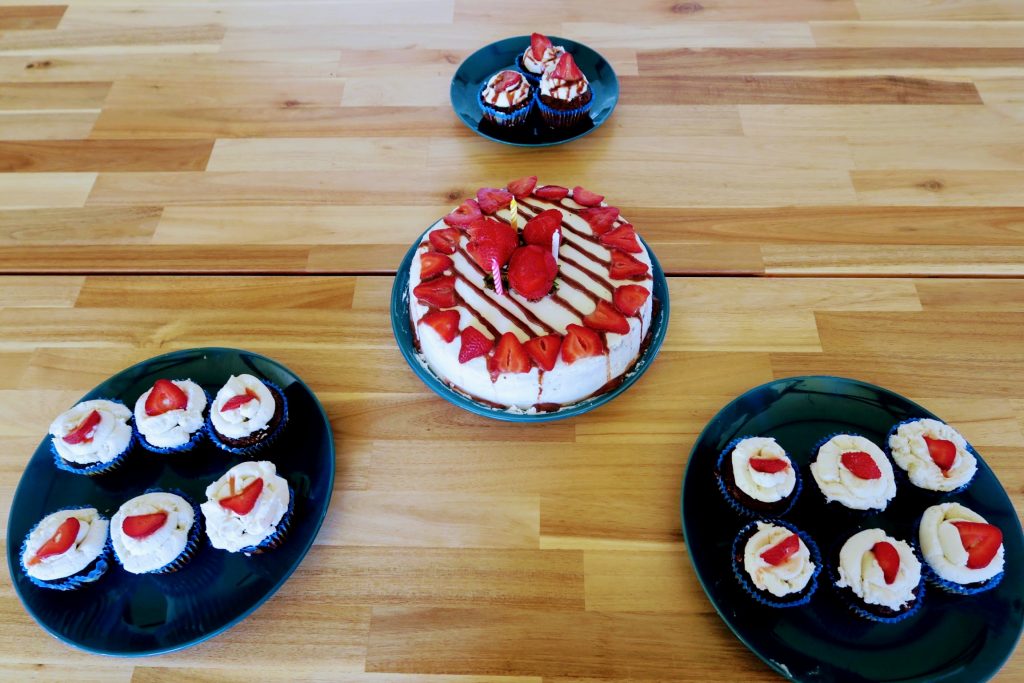
The cake and cupcakes made by Elsbeth and Sam picture by Samuel Slutz
After the tidepools we headed back to the dorms and pooled our data on water temperatures along with starfish populations. That evening Samuel and Elsbeth finished the Birthday cake and cupcakes which we had after our tostada diner.
Today we explored the sounds of the Salish Sea. During our second day at Salish Sea Sciences, students learned how to record acoustics using a new program called Audacity. We began by going around the dorm recording different sounds in order to get used to the software. After that we made our way over to Jason and Sam at the Sea Mammal Research Unit’s Engineering team where they explained their work which focuses on the development and deployment of hydrophone equipped buoys. The goal with these hydrophones(a kind of e special underwater microphone) is to see how different noise levels from boats affect the way marine mammals hear and communicate with each other. They then told us how the sound itself is measured, in a unit known as decibels. This is how they determine the volume of different sounds made by things such as marine mammals and boats. Then equipped with this new knowledge all of the students went out to different spots to see who could record a spot in town with the most noise. When we returned to the lab we all worked in groups to convert our data into decibels. From that we determined that the intersection at spring street and pine was the loudest spot during our minute long recording although it could have easily been the airport if a plane was landing during the time which just goes to show the variability in one area’s soundscape. After that we shared delicious meal of spanakopita and salad prepared by Elsbeth, Jonathan, William and, Denny and then listened to Ayla’s presentation about her experiences at Salish Sea Sciences and as a Stanford student.
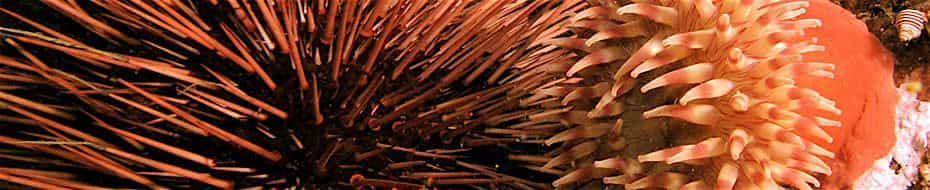


 Today the Salish Sea Science crew took a boat trip on the Regina to Yellow Island. In order to help reduce the boat’s weight we voyaged to the island in two separate groups with the second group also getting the chance to explore the incredible biodiversity of life on Friday Harbor’s docks including towering tube worms and dazzling decorator crabs . When we arrived we were greeted by the Steward of the island Matt. He guided us to the tidepools we would later explore. Then after a brief break for lunch and a talk from Matt about the Coast-Salish people’s relationship with Yellow island, our group gathered and went to the tide pools. We spent time bounding across the stones in search of starfish. We found individuals of multiple species including Pisaster Ochraceus stars in both their juvenile and adult forms with almost all of them being of the purple color morph, and Dermasterias Imbricata stars. However, we only found about ten sea stars in the intertidal area we were tasked with searching, although the adventure was still fun. The trip back to San Juan Island was done with everyone in one group on the boat. Some of us were a little anxious about the boat’s stability with all of us on it at the same time. Luckly, it all turned out A-okay and we made it safely back to shore. We then ended the day with music from a rolling stones cover band and a pizza dinner.