TRIGGER WARNING: Today’s blog post includes pictures of a porpoise necropsy. While the procedure was done respectfully and carefully, the images include blood and/or other exposed innards of the specimen. Thank you for reading!
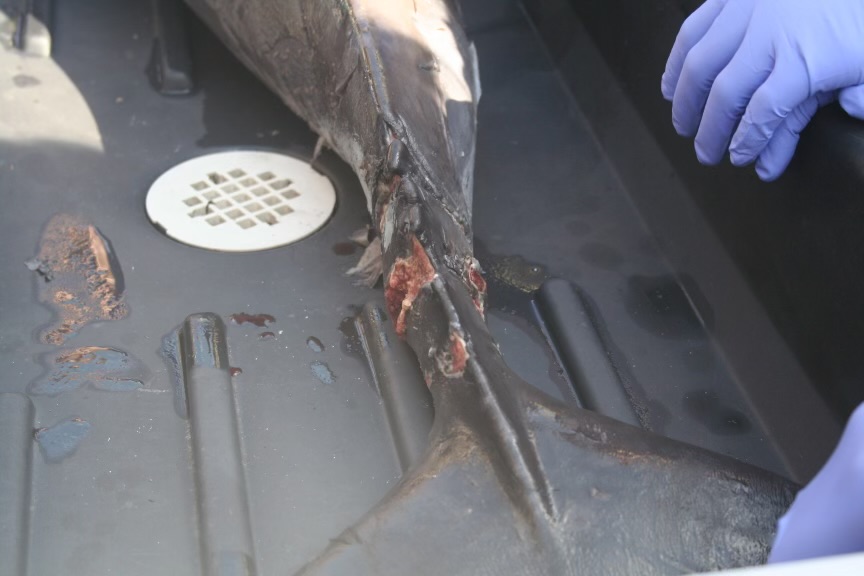
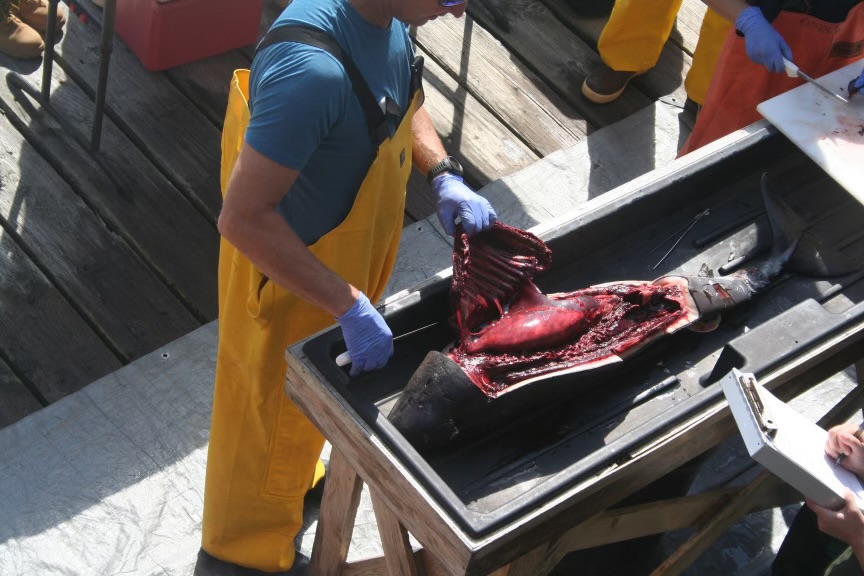
Today’s adventures were quite a treat. Recently, a Harbor Porpoise was found floating off of Lopez island, so Friday Harbor Lab’s necropsy of the week was examining this unique creature. It exhibited severe scavenger damage around it’s left eye, and large, evenly spaced lesions on it’s tail stock (the area that connects the body to the tail) likely caused by a boat strike. Without further microscopic investigation or testing, the most clear and probable cause of death was some kind of infection (meningitis or bacteremia of some sort) that entered through the cuts caused by a boat strike and travelled through the blood.
Lesions pictured above were presumed to be an inficted injury caused by a propeller, the infection spreading to the rest of the body (Picture Cred. Hannah)
Vetrinarian Dr. Joe Gaydos shows that the lungs of a 7 month old porpoise, an interesting part of the body to see!(Picture Cred. Hannah)
After we went back to the dorms for lunch, and some project developement time, we went with our science director Adam Rogowski to examine Fecal coliforms in the Friday Harbor Marina. This bacteria is found, as you might have guessed, in feces or other waste materials from all warm blooded animals, including humans. We came to start the procedure for measuring the concentration of this bacteria in different areas of the marina in order to understand the water’s safety to other animals, where it might be coming from in the case of a high concentration, and how it could affect the local ecosystem.
Todays guests are… US! Tonight Salish Sea Sciences is having Presentation Night. Half of our students will be giving a presentation about a topic of their choice. The other half of our students will be presenting next week, and this week, their job is to introduce a person that is presenting as if they were a scientist joining us for dinner. This will include a brief introduction, and a summary of that students studies.
Some highlights of the presentation included: How breeding 54,000 lobsters can make you a quadrillion dollars, what a sandwhich ACTUALLY is, and the rising of Mario and Luigi, telling us about how our society works in the rising age of the softboys.
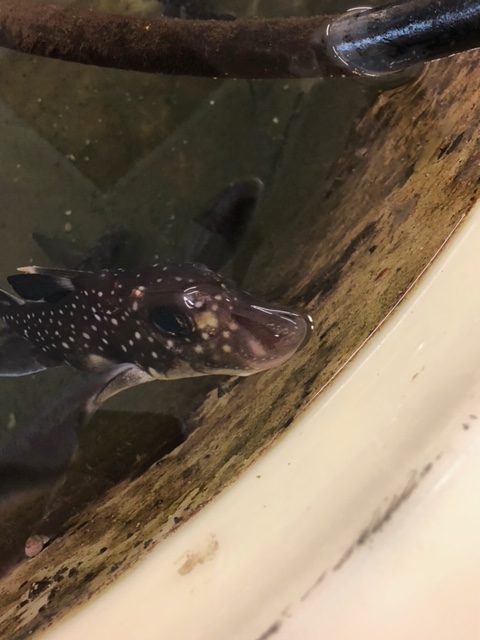
Hey blog! As we get back to our regular posts, we return to FHL for an in-depth tour of their fish labs, observing the many fascinating species held within. From the slippery prickleback , to the almost birdlike ratfish, there was a plethora of marine life being held in the labs for various research.
Pictured above is a ratfish from the tanks in the fish lab at FHL. This was taken by Ingrid.
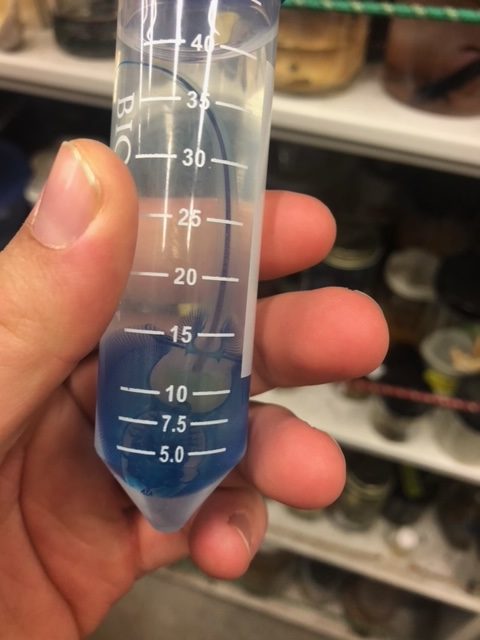
We received a tour of the preserved specimens, as well as a walkthrough of how the dyed specimens are stained and preserved in jars.
Pictured above is a dyed preserved skate specimen in a tube. The blue shows the cartilage, and the clear body is from enzymes that were injected to eat away the tissue to leave it clear to dissect. This was taken by Ingrid.
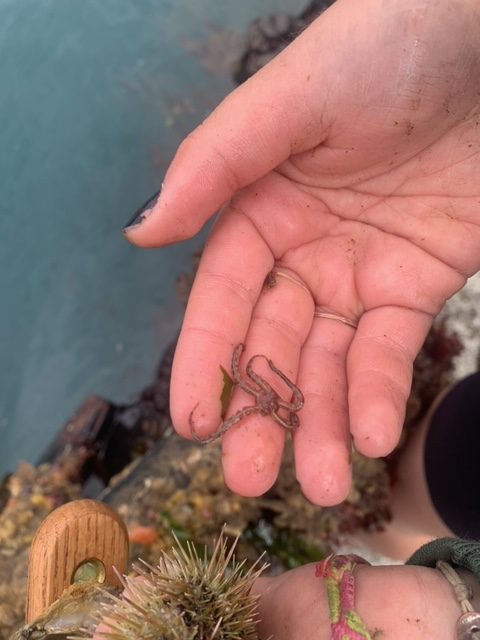
Our group continued the tour with a demonstration of the lab’s CT (computerized tomography) machine, often used in the medical field. This particular CT was being used to create high quality 3D scans of fish later used to created life-like models. Next, we listened to a lecture from two resident scientists studying baleen whales and the mechanics of how they feed. After that, Dr. Sebens (Professor in the Department of Biology at the University of Washington) whom we had over for dinner the previous night lead us down to the FHL docks to collect all sorts of marine organisms. To do so, we flipped over tires along the docks covered in all types of algae, sponges, crustacean, urchins, etc.
Pictured above is a brittle sea star that was found on one of the tires we flipped over. A green urchin is also shown, which we also put in the bucket. This was taken by Maddie.
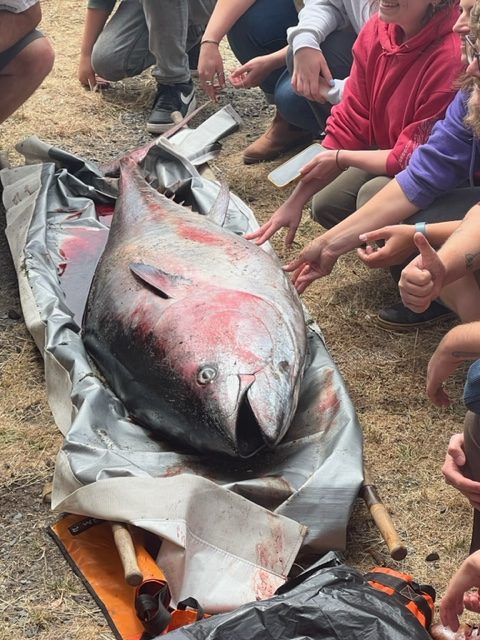
We put the organisms that we gathered in a bucket to be later taken to the labs for further inspection. As we were finishing up, a boat full of scientists came rushing back revealing a one of a kind discovery. A group of six of them carried a covered figure on a stretcher, later being told it was a giant blue fin tuna. What we didn’t realize is that we were about to witness history. Apparently, tunas are only found in warmer water which is why it was so strange to see a tuna so far up north.
Pictured above is the bluefin tuna that was found by the scientist on Orca Island. This was taken by Vedha.
Finally, it was time to head back the van to our next destination.
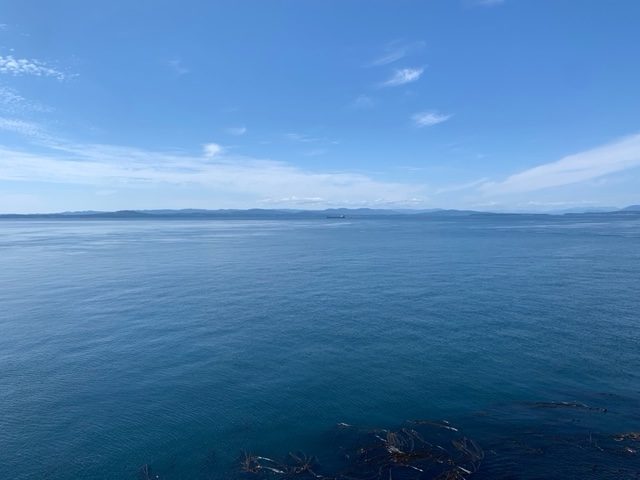
This destination was the Lime Kiln State Park also known as the “Whale Watch Park” due to it being known as one of the best places to whale watch in all of the San Juan Island. The park also has a rich history most commonly known for the beginning of lime kiln production. Caroline introduced us to Erin Corra who was a naturalist along with many past duties such as being the head director of Friends of Lime Kiln Society. As she took us through the park she quizzed us on many difference species of trees which Finlee answered all. Next, she took us to the watch point where there was many signs talking about the marine animals that passed through the Haro Strait. Many stops later we finally reached the main feature of the park, the lighthouse. Inside there were many displays of posters showcasing the vast history of the lighthouse and of marine life in the surrounding area. Unexpectedly, we were told that we could venture to the top of the building. We split in to groups for this due to the small staircase and size of the upstairs. From the top, we got a wider view of the area, being able to see much of Vancouver Island.
Pictured above is the panoramic view from the top of the lighthouse. Across the sea is Vancouver island. This was taken by Maddie.
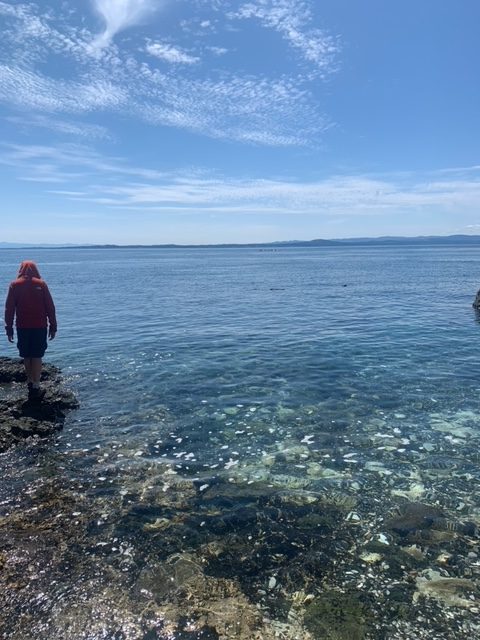
After all of the groups got back down we hiked over to the Lime Kiln where a small beach took our main focus. We explored the area by dipping our feet into the cold salty water along with climbing the nearby cliff.
Pictured above is the intertidal zone we could explore around in. There were many marine organisms that were found such as sea anemones, crustaceans, etc. This was taken by Maddie.
Finally, we made our way back to the van to return back to the school.
Overall, this was a very enjoyable experience where everyone learned something new that was so close to our school. We got see the daily life of marine biologist and what they do to help the science community out. That’s all for now. Signing off from the Salish Sailors! (Written by Tommy, Ingrid, and Maddie)