Day 16: Research, relaxation, and examination

By Olivia, Orly, Kalena, and Miles

“What are we doing today?”

“Is there a plan for after lunch?”

The morning began in a blur of uncertainty as no one had yet put the schedule on the board. In fact, it wasn’t until after breakfast when wake up time was written out. No matter, most students went up to bed for a quick nap before our first activity: Scientific sketching.
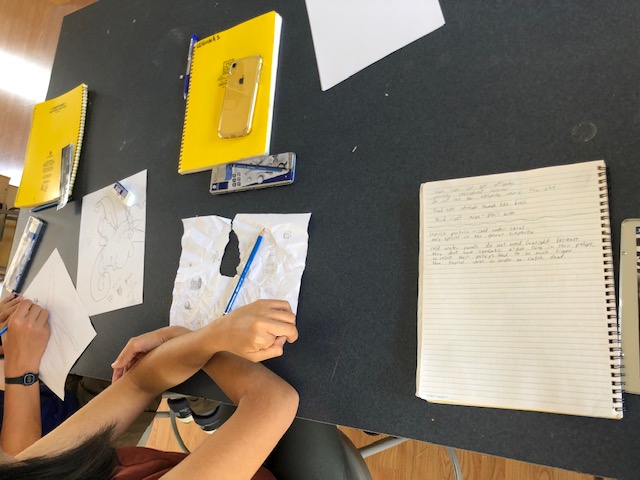
Taken by Olivia

The classroom was filled with self deprecating jokes and uncomfortable laughter as our inner critics came at us full force. Task one: Look at the animal in the picture and draw what you see without looking at what your pencil is doing. The exercise was intended to improve the way we look at detail, not hone our artistic talents. Nevertheless, it was the state of quality that made its way into side conversations. Task two: vectors. In order to draw scientifically, the measurements need to be correct enough in order to classify the organism. Artistic skill is unimportant as long as details and measurements are as exact as they can be. Our wonderful teacher Anna taught us about that.

Our morning sketch sesh eventually deteriorated a half hour before lunch, giving us time to work on personal research. Many students used their time wisely; studying in the common room or in their dorms. Others used this opportunity for self care: a quick nap, taking time to read their favorite book, and catch up with friends and family back home.
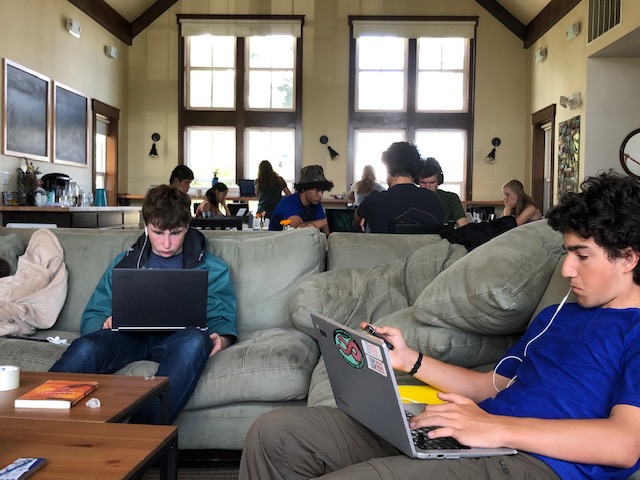
After weeks of go go go, many students here at Salish Seas needed a day to themselves. Therefore, after much confusion over plans, we broke up into groups: students who wanted to stay in the dorms/around town were permitted to, while others who wished to explore, experiment and/or record data for personal projects went with Derek to Deadman’s bay. (look up the meaning of the name if you dare, I personally don’t recommend it)

The few people the ended up going to Deadman’s bay did all kinds of different things. Some of us ran our experiments for our projects and others explored the tidepools. For their projects, Jeremy looked for oyster catchers and Camden and Ayla attempted to begin taking water samples. Sadly, the birds were nowhere to be found and the batteries to a YSI (a machine used to find dissolved oxygen, pH, etc.) didn’t work. Though our group faced a few shortcomings, we were still able to find interesting organisms. Harris caught a small sculpin on his fishing rod and while hiking, Leighna and Jeremy found a seal (it was sadly dead, but still interesting). We also found a sea lemon, which is a yellow nudibranch with spots. The eight of us were glad we could get out of Spring Street and enjoy the nice weather.

Everyone who stayed ‘home’ (in the dorms) got free range of the town if they chose to, and hours of time to relax however they needed to. I know of a few who took naps during this time (we’re all obviously very tired) and others who decided to go into town mostly gravitated to a coffee shop for a fresh studying environment.

Everyone regrouped before dinner to welcome our guest, Morgan Eisenlord, and her research helpers Maya and Liv. Eisenlord is currently focusing on wasting disease in eelgrass, and gave us a fascinating lecture afterwords on it. She explained that the Wasting Disease pathogen had an average of 80% prevalence between all 16 sites sampled. This particular pathogen eats the chloroplasts in eelgrass, making it hard for the eelgrass to photosynthesize properly. We are all very excited for our upcoming work in the field with Eisenlord!

It felt wonderful to crawl into our comfy beds after the first sunny day, all dreaming of our exciting research projects to come.
Day 6: Vendovi Adventures

By Orly, Olivia, and Ezra

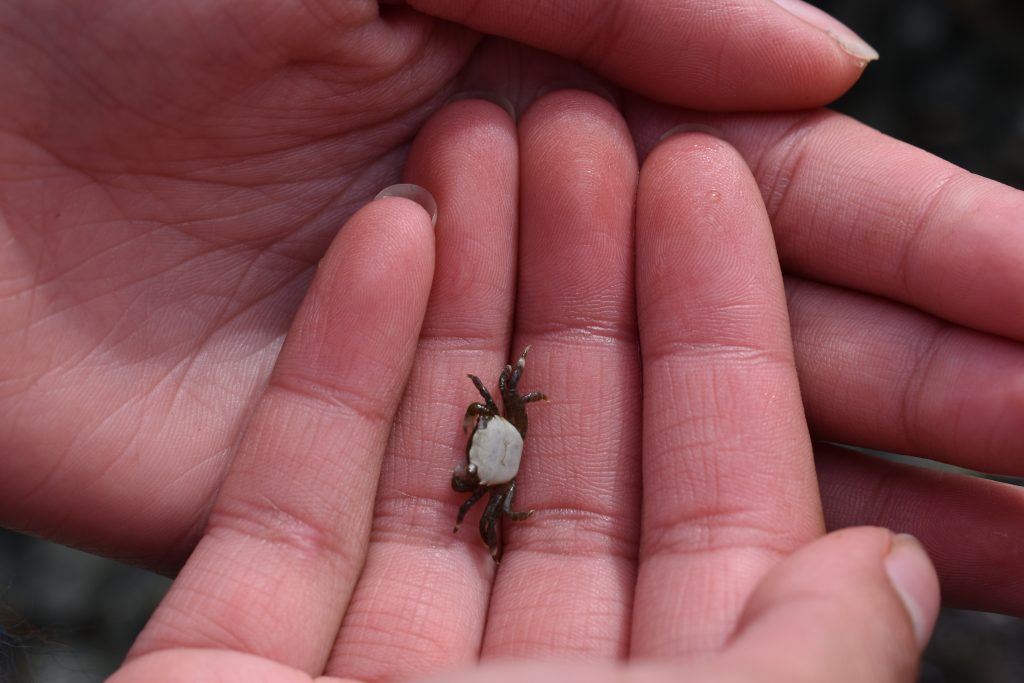
Yay! Tiniest crab contest first place winner goes to Miles, second place to Ezra, and third to Faith! Everyone congregated at the beach for some tide pool explorations first thing in the morning, and we all discovered some fascinating creatures, including an eel, sea slugs, and gigantic crabs.

Taken by Tony

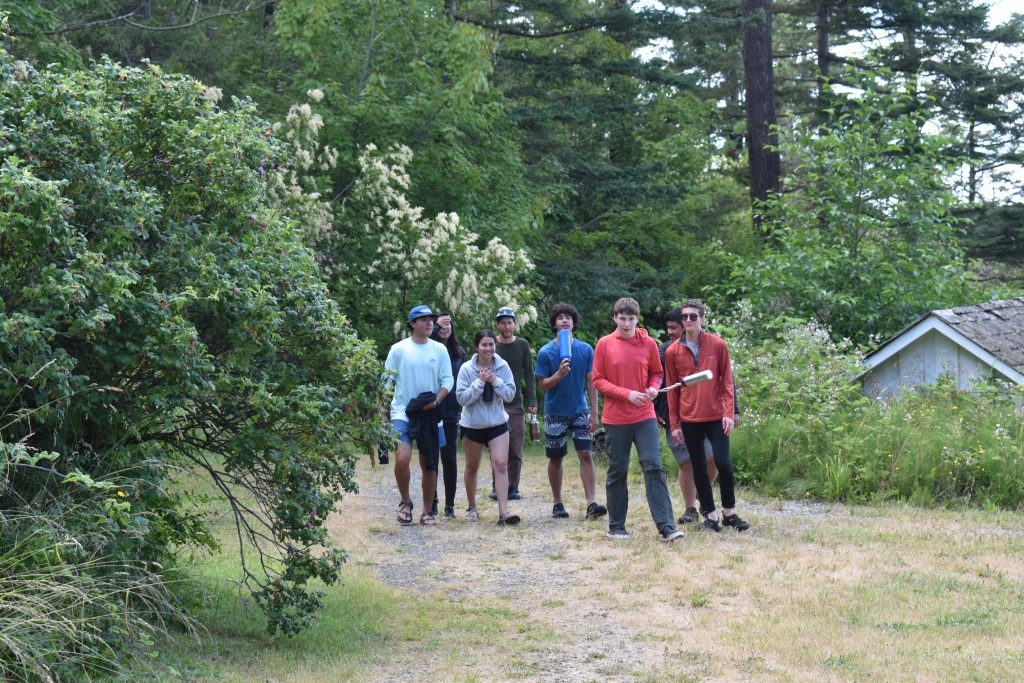
In compensation for our hosts’ hospitality, we continued the day with various service projects around the island. By splitting off into small groups, our team of 18 students and 6 adults we completed 4 various tasks around the island: Pulling thistles, morning glories, and ivy as well as collecting trash as we went. Our hosts, Elaina and Thyatira, welcomed us warmly with their kind personalities, despite the fact they do not usually allow visitors to stay the night on their island.

Taken by Tony

After our morning of service and fun, we treated ourselves to a quick lunch break before heading out into the water for a team on team race: Bears vs. Townshend. We rowed our hardest from Vendovi all the way to Vidi rocks, calling Power 10s, then Power 15s, then Power 20s. Bear ended up in the lead as we crossed the finish line, but Townshend too tried their hardest. After a pleasant row and many wildlife sightings around Vidi island, both boats headed back to Vendovi for some structured “free time”.

Our options for activities before dinner were: a nature hike with Sockeye and Shay, water coloring with Amanda, Science on the dock with Anna, and the option to chill in the tents. On the nature hike, Shay identified the plants as we went that made the experience both educational and fascinating. Fun fact: the state plant for Washington is the Oregon grape. Isn’t that ironic? Water coloring was very peaceful and included several interpretive painted blobs on postcards, but some people had sweet skills. Science on the dock was not well attended but included the victory of figuring out the faulty Niksen bottles!

The day ended with a lovely fire and faces covered in sticky s’mores, a fond reminder of the ones we had back at Spring Street! Thankfully we all stayed cozy and dry that night, leaving us well rested but sore from our violent battle to the Vidi rocks.

Day 2: Testing the waters of marine biology

By Olivia, Ezra, and Orly (with help from Toffee)

We voyaged out into the wide Salish Sea on the Centennial! It was a great introduction to how oceanographers collect scientific data. A plankton tow, which is used to collect plankton near the surface, was lowered into the ocean very slowly and glided along the surface for a couple of minutes. The results proved very fruitful – who knew there could be so many plankton in one petri dish? The microscope was the center of attention for quite a while – we all oohed and aaahed over plankton unseeable to the naked eye.

Not only did we discover plankton on that trip, our group of over 18 also learned how Nisken bottles operate. Nisken bottles collect water at different depths by remotely closing the containers at specific water levels. The water contained information on the salinity, ph, and temperature. This information unfortunately did not get used in a hands on experiment, but it was a fundamental and interesting introduction to the tool.

Taken by Harris

Luckily, we had other activities that were very hands on, literally. Using a box dredge, rarely seen ocean floor creatures were brought to the light and scrutinized by our curious eyes and hands. Bull kelp, sea cucumbers, and crabs were all combed through among a variety of other interesting animals. The excavation was peppered with shouts of “duck your head! There’s flying shrimp!” as we threw the live shrimp overboard. The benthos, or bottom dwelling creatures, were all kept alive during our thorough examination.

Taken by Tony

Out came the notebooks for our first scientific lecture. Our first guest of the trip, Dr. Megan Dethier, is a specialist on shoreline ecology and was recently appointed to be the director of Friday Harbor Laboratories. Dethier’s talk covered everything from armored sea walls to the impacts of climate change on shorelines. Both her information and speaking style created a presentation that even us amateurs could understand.

The main focus of Dr. Dethier’s talk was on the extremely fascinating topic of beach armoring. Beach armoring is the building of walls to prevent erosion of seafront properties. However, this practice is detrimental to the ecosystem because it limits the crucial deposition of sediments into the inter tidal zone. Wow! It’s surprisingly easy that even with good intentions one misguided action can ruin the health of a whole ecosystem.

Throughout the first full day of the program, we bonded as a group over gooey sea cucumbers, challenging new concepts, and our first of many scientific expeditions. We have spent the last 10 minutes trying to find a presentable concluding sentence, so this is it.