Dr. Swallas Talk:
The night before, the brilliant Dr. Billie Swalla, an evolution and development researcher and professor at the University of Washington, came for dinner and talked to us about her specialty, ascidians, and their genome. We also learned about chordates, and how evolution has changed their body shapes. She showed us a species chart that showed how most species had tails while there were only a couple of species with no tails. We got to walk through her lab the next day during our tour of Friday Harbor Labs. When we were walking through her students were adding their newest catches to the tanks. On our walk through we got to see crabs, barnacles, worms, and jellyfish. We are very grateful to Dr. Swalla for allowing us to peer into her lab and research. If you wish to find out more about her research you can access her website here: https://www.biology.washington.edu/people/profile/billie-j-swalla
Jackson Beach:
Last night, our group of upcoming scientists made a trip to Jackson Beach at night time. A couple of brave individuals entered the freezing ocean and jumped in for a while. Afterward, we all grabbed a volleyball and set up a court in the sand. Unfortunately, one team was severely outmatched skills-wise and began losing horrifically. Luckily, in a genius maneuver, the losing team performed a human pyramid to raise morale and demoralize the other team. The day ended with a clear victory as the comeback never materialized and a successful trip to Jackson’s Beach. HOWEVER, our journey wasn’t over yet as we began the next day exploring the expansive island.

Research Project Talk:
To start the 3rd day of learning we got a lecture about our projects. Adam and Riley gave the time frame for how our projects are going to work in the next 4 weeks. The first week was mainly about getting out in the field and exploring. Then week 2 is about brainstorming and ideas for projects that can be used. Week 3 is about meeting with our mentors and getting data. Finally, week 4 is about getting more data and making our posters. They also told us how we could get our materials and how our projects would work. After their talk, Caroline came in to discuss charts and maps. We learned how people can rely on maps and figure out what’s happening with our planets.
Cattle Point with Dr. Dobkowski:
After the talk about our research projects, we headed out to Cattle Point located on the southern end of the island. We met up with Dr. Katie Dobkowski and her mentees: Lucy and Francisco, to provide help on their project. Dr. Dobkowski is a professor at Evergreen University in Olympia, Washington, and has done many research projects relating to seaweed in subtidal and intertidal communities on the West Coast. Their project was focused on crab molts and the different types of crabs around the beach. We mostly found Red Rock Crab molts on the first part of Cattle Points Beach, and around the corner of the beach, we found more Native Shore Crab molts. It was very tricky to find the actual molts, but it was tons of fun even with the sun and heat and the steep climb up to the vans. More about Dr. Dobkowski’s research here: Website

– Image taken by Morgan
Lab 1 with Dr. Hodin:
We headed to Lab 1, the Seastar lab, where we met Dr. Jason Hodin and his mentees: Venessa and Chloe. Dr. Hodin is a professor and a senior research scientist at the University of Washington. They explained their work with sunflower stars (Pycnopodia helianthoides) and wasting disease. Venessa and Chloe led us over to the seastar tanks, where they demonstrated how they feed the stars. They answered our many questions, especially about wasting disease and how it’s taking out sunflower star populations, along with their conservation efforts to save the stars. More on Dr. Jason Hodin here: Website

– Photo taken by Morgan
Exploring the rest of FHL (Friday Harbor Labs):
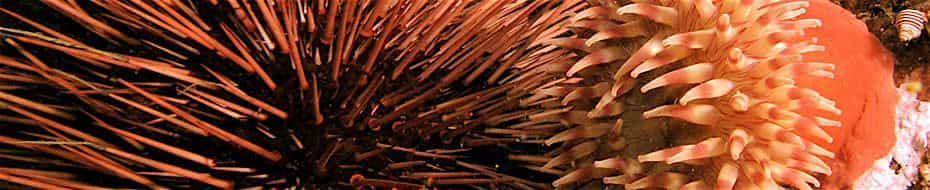
After exploring the Seastar Lab we were graciously led around the Friday Harbor Labs by Dr. Michelle Herko, the program director at Friday Harbor Labs. She brought us through the main building and shared the history of the establishment and how she got into working at the Friday Harbor Labs. Then, she brought us around the lab and showed us the various equipment and organisms researched. In one of the sections, there was an area for numerous invertebrates of all sizes and ages, like a large, squishy sea anemone in the lab longer than Dr. Herko worked there! Overall, the FHL was fascinating and led by incredible scientists, and I would love to visit again. More Information on Dr. Michelle Herko here: Website
Blog was edited for clarity, to add more information, and adding new pictures on July 7th, 2024