Discussion with Dr. Amy Cook:
Last night, Dr. Amy Cook graciously came over to join us for dinner and to give an informative lecture. In her lecture, she highlighted the importance of the scientific method and taught us how to apply strong inference or the hypothetico-deductive method. This method is a way to avoid falling into various biases in your scientific experiments like anchoring or IKEA bias. Despite the topic being less interesting than those on living organisms, the knowledge of applying strong inference is vital to successful research and will follow us for the remainder of our lives. She has a beautiful website that you can visit here: https://www.evergreen.edu/directory/amy-cook
Cattle Point with Dr. Amy Cook:
We started the day with a trip to Cattle Point where we met up with Dr. Amy Cook and took part in an exercise on pattern recognition and strong inference from our lecture with Dr. Cook the night before. Dr. Cook was very helpful and engaging with our ideas and encouraged further exploration of our interests. We all split into groups and made our way down to the beach, looking for ideas of patterns and relating hypotheses. Most of the groups wandered into the rocky intertidal zone and came up with very detailed hypotheses relating to the patterns they found. Caleb found a fully grown male red rock crab with a missing pincer in one of the deeper tide pools on the beach. We also ran into a family of five red foxes who made working around them very interesting.
The Foxes at Cattle Point:
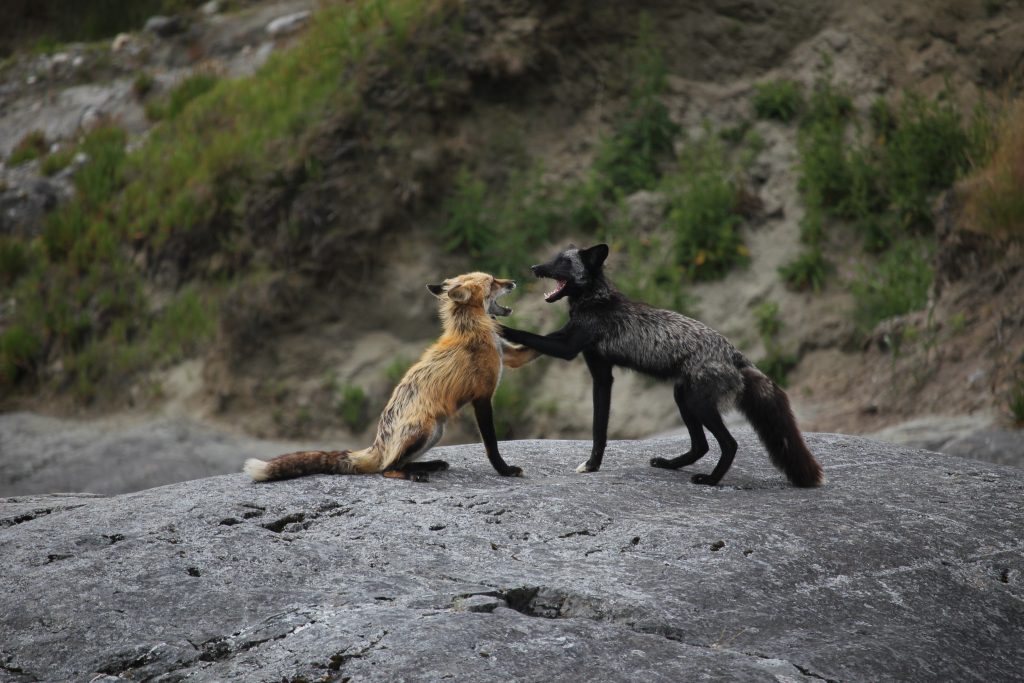
During our stay at Cattle Point, we were approached by a lone red fox along the coast. It seemed very comfortable around humans, likely due to associating humans with food, and got within a few feet of a couple of individuals. Suddenly, out of nowhere, another two red foxes descend gracefully from the cliffside, joining the lone fox. They run around the intertidal zone, playing and tackling each other until another pair of red foxes appear from the bushes, bringing the total count of foxes frolicking around to five. While watching the group of foxes, we wondered why a group of five foxes would travel together, as they are not known as pack animals. Our resident animal behavior specialist, Dr. Amy Cook, hypothesized that either it was a mating pair and their three pups or a mother-daughter pair co-raising their pups together. Alas, the truth will elude us as the red foxes escape back into the woods to live out their lives in peace.
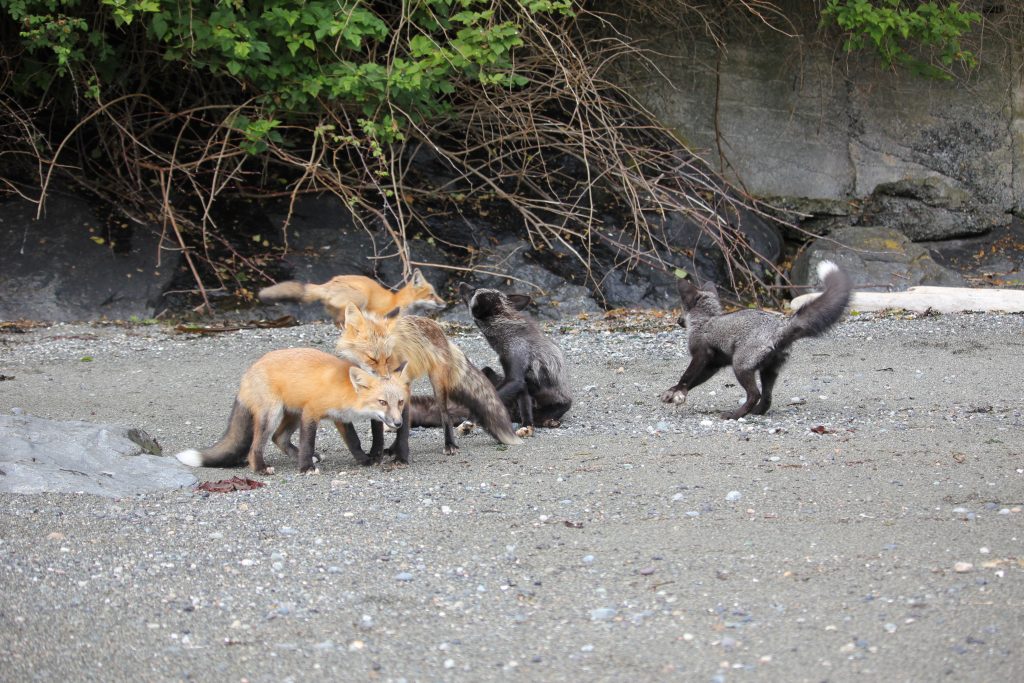
Photo taken by Katie.
Garry Oak Restoration:
After a quick lunch of sandwiches at the dorms, we headed out to the island’s northwest side to help restore Garry Oaks in a protected forest. Why do we need to help these trees, and why are they important, you ask? Garry Oaks are an integral part of the San Juan ecosystem. This is because many other types of creatures rely on them for different phases of their life, and if we get rid of Garry Oaks, we destroy the habitats of hundreds of creatures in those forests. We spent a couple of hours using chicken fence to create a cage for Garry Oaks that would help protect them from deer. Caleb and Sid spent time hammering in rebar to keep the cages in place, and the rest of our group was very helpful with identifying Garry Oak saplings, making the cages, and placing them on the rebar. We learned much about forest ecology from Ben Halloway, a San Juan Land Steward who oversaw our restoration work. He talked about the thinning and self-thinning of trees and how we must cut down trees to help others grow. Riley gave us a great analogy- if there are too many straws in one cup, none of them get enough water.
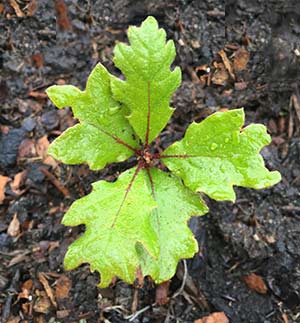
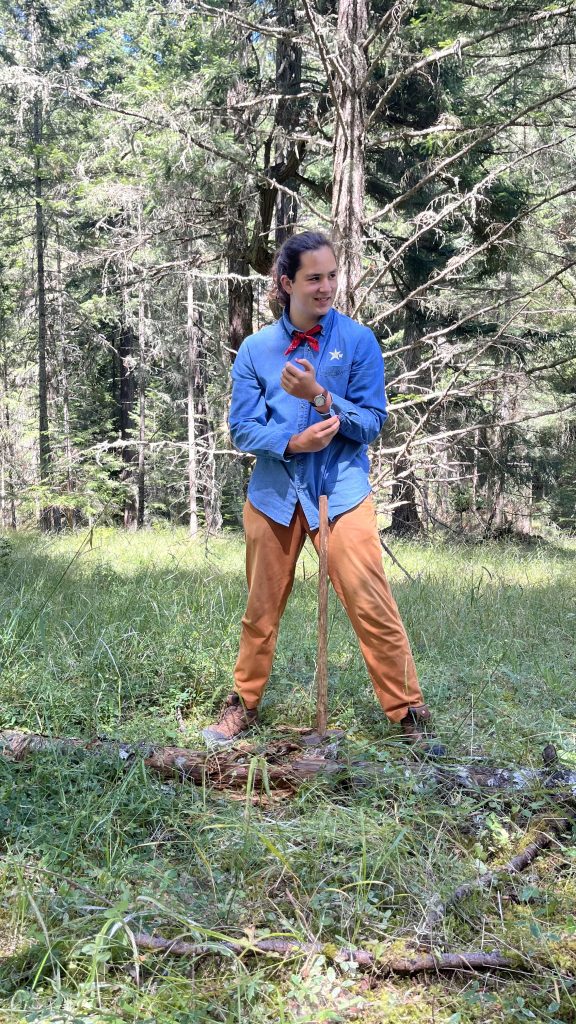
Photo taken by Morgan.
FHL Seminar:
For the final learning lesson of the night, we went to the Friday Harbor labs. There we sat in on a lecture about turbulence and how it affects microscopic organisms which was presented by Dr. Mimi Koehl. The whole presentation was about a type of sea slug and how they get to the right parts of the reef. The theory was focused on the odors that the corals produce that attract the sea slug larvae to swim out the sea current to get to the coral reefs. We learned that Dr. Koehl’s team discovered that sea slugs aren’t fully attracted to the reef by the odor of the corals but by the idea of environmental cues causing an on-off effect. You can vist Dr. Koehls website for more information on her research: https://ib.berkeley.edu/people/faculty/koehlm
Blog was re-written and added links to the mentioned scientists websites on July 7th, 2024