Day 4: Knot a Bad Start

I awoke to a clear, sunny morning on June twenty-sixth with one clear thought in my mind; that it was to be the last time in the next five days that I would feel clean and the slightest inkling of something like being rested. Hurriedly, all of us gathered our remaining things and ate breakfast. While every day at Salish Sea Sciences offers the promise of something intriguing, today was especially exciting. Finally the long anticipated start to our long boat trip had arrived. Five days and four nights of camping out, rowing, and cooking on some of the abundant islands of the Salish Sea. It did not take long for our group of eighteen to get ready, and before I realized it, we were on the ferry heading for Anacortes, a port city on Fidelio Island and the launching point for our long boats.

On the Ferry to Anacortes
Photo Credit: Tony

The sun pelted down on us as we walked towards our meeting spot at the marina where we were greeted with smiles and food by the instructors who would be guiding us on our journey. And while meeting our instructors and having lunch with our new found friends was exciting, it soon became apparent that was work and preparation to be done. To be honest I expected everything to be ready when I got there and that I would be able to sail off into the wind without having to do very much, but this was most definitely not the case. The prep work was not hard or strenuous, just long and boring. Primarily, most of the work had to do with preparing gear for ourselves. We had to be outfitted in rain gear and exposure suits, a type of full body life suit that can adequately deal with the cold waters of the Salish Sea if need be (I hoped I would not be needing either). We also received a twenty liter water proof “bag” to fit all of our stuff in. I say “bag” but it was more like a long sack that could be clipped at the top. Let’s just say trying to fit all of our stuff in was difficult for most and I knew I would not be getting anything from the bottom anytime soon. The thing was that the boats were only twenty feet long for twelve people and all their stuff so, as you can imagine, space was limited. Thus it made since we could only have a small amount of stuff. Even so, the packing the boats was like one giant puzzle. Finally we got under way after a large amount of people made one last trip to the restroom (the only form of a restroom on the boats was a bucket).

Sunset over Saddle Bay on Saddle Bag Island
Photo Credit: Tony

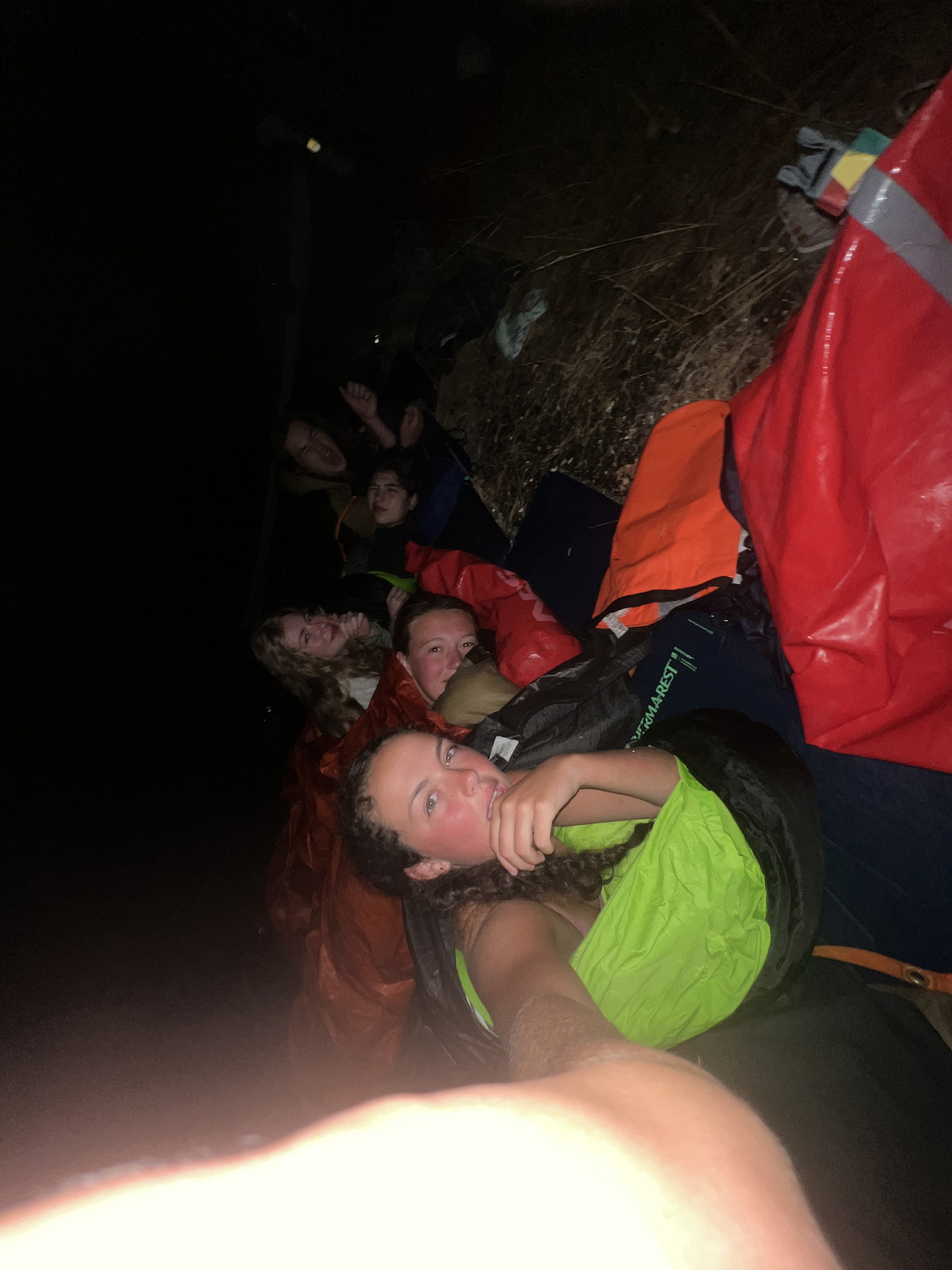
With eight people manning the oars, three navigating the boat, and a captain, our two boats slowly began moving towards Saddlebag Island, a small island off the much larger Guemes Island. It took much longer than I anticipated to reach Saddlebag, maybe three hours or so. I think this is primarily due to the fact that we were not exactly in sink when rowing. By the time we landed, we were all tired and hungry. We quickly separated into groups and made camp. We had a cooking group, a group that set up tents and a boat cover, and a group that made the rowing plan for the next day. I personal was on the cooking crew. Let’s just say it was quite hard. Between struggling to find all of our supplies and prepping a meal on a small picnic table, cooking for twenty-four people was defiantly an experience. Together, the cooking crew made a quinoa vegetable stir fry with peanut sauce which was pretty good. After washing dishes with sea water, bleach, and a bit of eel grass it became clear to me that this was not going to be the most sanitary trip. Soon we had all eaten and set up our sleeping arrangements. With our stomachs somewhat full, went to bed at around eleven o’clock, and I do not believe I have ever fallen asleep faster. And while the beginning of the trip was difficult, I still really enjoyed the experience.

Making Dinner on Saddle Bag
Photo Credit: Harris

Day 3: An Eventful Day

By Grace Davis, Faith Jayaram, Jeremy Davis, and Tony Yuan

To kick off our third day in the Salish Sea Sciences program, we learned about underwater acoustics and the effect man-made noises may have on marine life. Although it was upsetting to hear recordings of boats drowning out the calls of our Southern Resident Killer Whales, the information and skills we acquired were valuable. Being aware of this issue is imperative for the environment of the San Juan Islands and, possibly, the environment of every ocean. Two of the wonderful people we met were Jason Wood and Jessie Turner. Jessie has an ongoing project that revolves around the audio impact sea planes have on marine mammals. As budding marine biologists and ocean enthusiasts, it was a lovely experience to learn about his craft.

Tomorrow we will be embarking on our five-day longboat journey. We are all excited and a tad bit nervous. We will report back on our expedition when we return to our home in Friday Harbor.


The Centennial, the vessel used by the Friday Harbor research team
The University of Washington Friday Harbor Laboratories

Day 2: Testing the waters of marine biology

By Olivia, Ezra, and Orly (with help from Toffee)

We voyaged out into the wide Salish Sea on the Centennial! It was a great introduction to how oceanographers collect scientific data. A plankton tow, which is used to collect plankton near the surface, was lowered into the ocean very slowly and glided along the surface for a couple of minutes. The results proved very fruitful – who knew there could be so many plankton in one petri dish? The microscope was the center of attention for quite a while – we all oohed and aaahed over plankton unseeable to the naked eye.

Not only did we discover plankton on that trip, our group of over 18 also learned how Nisken bottles operate. Nisken bottles collect water at different depths by remotely closing the containers at specific water levels. The water contained information on the salinity, ph, and temperature. This information unfortunately did not get used in a hands on experiment, but it was a fundamental and interesting introduction to the tool.

Taken by Harris

Luckily, we had other activities that were very hands on, literally. Using a box dredge, rarely seen ocean floor creatures were brought to the light and scrutinized by our curious eyes and hands. Bull kelp, sea cucumbers, and crabs were all combed through among a variety of other interesting animals. The excavation was peppered with shouts of “duck your head! There’s flying shrimp!” as we threw the live shrimp overboard. The benthos, or bottom dwelling creatures, were all kept alive during our thorough examination.

Taken by Tony

Out came the notebooks for our first scientific lecture. Our first guest of the trip, Dr. Megan Dethier, is a specialist on shoreline ecology and was recently appointed to be the director of Friday Harbor Laboratories. Dethier’s talk covered everything from armored sea walls to the impacts of climate change on shorelines. Both her information and speaking style created a presentation that even us amateurs could understand.

The main focus of Dr. Dethier’s talk was on the extremely fascinating topic of beach armoring. Beach armoring is the building of walls to prevent erosion of seafront properties. However, this practice is detrimental to the ecosystem because it limits the crucial deposition of sediments into the inter tidal zone. Wow! It’s surprisingly easy that even with good intentions one misguided action can ruin the health of a whole ecosystem.

Throughout the first full day of the program, we bonded as a group over gooey sea cucumbers, challenging new concepts, and our first of many scientific expeditions. We have spent the last 10 minutes trying to find a presentable concluding sentence, so this is it.

King of Stats

By Evelyn Wyman, Brian Chu, and Gabrielle Cooper

Apologies for not making a blog post yesterday, we were out late on a wonderful canoe trip, courtesy of the Pacific Northwest Voyagers. The water was such a nice temperature many of us brave souls ended up swimming. Although swimming got us slightly behind schedule, the perfectly refreshing water and the gorgeous view of the sunset from the row back were completely worth it.  After the long night, most of us were pleasantly exhausted this morning, but we still had an exciting morning of science studying Eelgrass Wasting Disease with PhD candidate Morgan Eisenlord.

View from Kaigani

For the past few days we have been out in the field and in the lab with Morgan. A few days ago we went out to Fourth of July beach with her and collected samples to work with in the lab. Today we laid out more samples from different locations for scans and did some analysis to see the severity of the infection. After two days of entering eelgrass data into spreadsheets, we were lucky enough to have Will King, a graduate student, talk to us about statistics and how to transform data into visual information. He talked to us about proving significance in data, and also helped us individually determine what techniques we would use for our end of the program presentations, which are rapidly approaching!

Will King teaching us stats

Tim Dwyer also mentioned the significance of statistics, and how it separates the “I think” or “I feel like”, from the “I know”.

After a wonderful dinner cooked by chef Tim Brogdon, everyone gathered in the warm common room for Tim B.’s lecture on life skills. Wanna hear a construction joke? Sorry, still workin’ on it! He taught us the importance of being able to keep a positive attitude, how to be a successful leader, and how to be a wonderful human being. Being able to survive in society can be a rigorous adventure, but we are the ones who can make it fun and meaningful. Just as Avicii once sang, “He said, ‘One day, you’ll leave this world behind, so live a life you will remember.’

We Miss You Clarissa!

Blog for 7-16-18

By: Ela, Zoe

Today we woke up at the abnormally late time of 7:45 with little knowledge of the long day ahead.  After breakfast, Caroline came to talk to us about the longboat trip.  We reflected on some questions that she asked us for about thirty minutes. And even though the longboat trip was only six days ago, it feels like an eternity, because our days are so jam packed with science.

We went up to the lab to analyze the eelgrass scans we had made with Morgan the previous day.  It was tedious work, but very rewarding, we ended up with an extensive set of data.  With all fifteen of us, we made speedy work of measuring the eelgrass and finding the area of the diseased lesions.

Laying out eelgrass to scan

Lunch was a nice break from the eelgrass state of mind before going back up to the lab to make scans.  We worked on separating the leaves from the eelgrass plants and laying them out on transparency sheets. After three hours, we prepared an early pack- dinner for the evening canoe venture.


Unfortunately, before we left, we had to say goodbye to our lovely group member and friend, Clarissa. Clarissa left for a wedding in California and it already feels different without her. Saying goodbye to her was the most difficult part of the day. We hope that she has a great time in California and knows how much we miss her!

Clarissa the Softball master

We went to Westcott Bay to paddle and learn about the history of Native American and Hawaiian voyaging canoes. Being out on the water in the evening was a serene and peaceful experience. It was very quiet too, the only thing disrupting the silence was the sound of our voices singing to keep our paddling rhythm.  Once we reached our destination, we tied up to a dock, and some of us went swimming. It was refreshing and cold!

We came back exhausted at 9:30 after canoeing for two and a half hours. We were all ready for bed.

Eelgrass Expedition!

By Victoria, Zack, Maya, and Rachel


An epidemic sweeping the globe. Thousands, even millions, of individuals infected with the unforgiving pathogen Labyrinthula zosterae. Scientists desperately searching to find the source and cure of this crippling affliction, to save victims whose bodies are literally being eaten alive by this virulent parasite.


If this terrifying description made you shake in your boots, have no fear. Labyrinthula zosterae has no effect on humans- in fact, it is the pathogen responsible for eelgrass wasting disease, a plague affecting the leaves of Z. marina that spreads rapidly through contact with ocean water. Labyrinthula, or Labi, as it is called by some of the experts who study it, made its first major mark on the world in the 1930’s and has been spreading throughout the US ever since. Eelgrass on North American and European coasts even suffered from population decimations as high as 90%.

Afflicted Eelgrass (Zostera marina)

Today our program had a chance to interact with the disease at Fourth of July Beach, a research site and local eelgrass bed in Morgan Eisenlord’s current study. Morgan, along with several other scientists and interns, is currently conducting research on factors that affect Labi’s virulence, or it’s capability of causing disease, as well as how the pathogen is influencing eelgrass populations in the Salish Sea.


We helped contribute to her research by collecting around 200 samples of eelgrass leaves for later study that day, also measuring eelgrass population density with the help of our two most beloved field tools: quadrats and transect tapes. Post-collection, we took the aforementioned samples and scanned them, before running the photos through a program which we intend on using tomorrow to measure and log both the size of the eelgrass blades and their disease-induced lesions.

Zoe and Gabrielle sampling infected grass

Today was a beautiful, sunny day. Hopefully we continue to get lucky with such nice weather for the rest of our 5 days together!

Cannibalism!!!

By Clarissa, Eric, Magdalena, and Sabrina

Today was all about eating! And I don’t just mean the food that Tom works so hard to prepare. Sea stars and earwigs were the animals chomping away today.

We started off the day with some manipulated experiments in the Lab with the earwigs we collected the day before.  We experimented with different sized females, males, and their individual mate choices. Earwig competition may not sound very exciting or glamorous, but we were in for a surprising show! We were testing whether a small female or a large female would win in a fight for a shelter when one of our large females became vicious. She stabbed the smaller female with her pointed forceps and chewed off the smaller female’s forceps to prevent a counter-attack. With the small female weakened, there was no way for her to prevent the large female from slowly eating her over the course of ten minutes. Although that trial did not give us reliable data about which earwig would take the shelter, it helped us learn a harsh lesson about survival of the fittest in the natural world. We gave the dead earwig a brief send-off and returned to our work.

The set-up for our earwig experiments, featuring a just-molted earwig.

The next meal was a picnic at Friday Harbor Labs. While we ate, Tim Dwyer discussed our final projects. We all are coming up with scientific questions of our own to answer. By Thursday, we’ll have made posters with our findings!

Next on the menu: anemones! We set up an experiment about leather sea stars eating anemones with PhD candidate Chris Wells. For 2 hours, we meticulously observed our echinoderm and cnidarian friends to see who would win the fight. Anemones are surprisingly aggressive little buggers and none of our sea stars managed to subdue a snack.  The sea stars spent most of the time hiding in the corners of the tank while the anemones waved their stinging cells threateningly. Thanks to Chris for some fun hours in the sun!

One of our sea stars climbing the side of the tank to escape the terrifying anemones.

Cornflakes (Evy) and others set up the tanks for the animals.

For the final food of the day, we ate pizza prepared by the dinner prep team. Now, we’re about to chow down on popcorn while watching The Princess and the Frog. We’ll see you all on the other side!

Keep Your Friends Close and Your Anemones Closer

By Brian Chu, Evelyn Wyman, and Gabrielle Cooper

We woke up to a beautiful morning, and headed to the infamous False Bay, where we met up with Dr. Vik Iyengar to collect samples of marine earwigs.We had lots of fun flipping over logs and searching for the wriggly creatures underneath, which reminded Evy of every hike she has been on with her brother. We learned not only about earwig mating and fighting habits, but also about how Dr. Iyengar became interested in earwigs in the first place.One day while walking on the beach with his twins, he flipped over a log and was filled with wonder about why earwigs lived in this habitat. Many of us were intrigued by the different patterns of earwig behavior and are eager to learn more about them.

Relaxing on the beach in between runs to the lab

After our earwig adventures, we headed to Friday Harbor Labs and had the opportunity to participate in an ocean acidification experiment with Dr. Rebecca Guenther. Earlier in the program, Dr. Guenther visited us to talk about ocean acidification and algae identification. We were finally able to use the valuable information she taught us during the tide pool pH experiment at the Friday Harbor Labs tide pools. From 11:30 to 1:20 we ran up and down from the tide pool to the lab to measure the effects of light on photosynthesis and respiration occurring in the tide pools. In between the frantic runs to the lab, we enjoyed a sack lunch on the beach with a beautiful view.

Dr. Guenther talking to us about tide pool pH

After spending hours baking in the sun, we were all exhausted. After a few precious minutes of down time, we were whisked up to Spring Street lab to enter and analyze data. We also talked about the differences between mensurative and manipulative experiments in preparation for experiments we will be doing tomorrow with the earwigs we collected this morning.

We had a delicious dinner with Ph.D candidate Christopher David Wells who studies anemones. After dinner, while enjoying bowls of ice cream, he gave us a stunning presentation on the complexities of the interactions between sea anemones and sea stars. We can’t wait to observe and study these fascinating sea creatures with Chris tomorrow!

Digging into History

By Ela, Kaylee, Kenneth, and Zoe

Trying to get back into the swing of things, we woke up at 7:00, which is much too early for most of us. We started the day off by going to American Camp, on the South part of the island, where we learned about the archaeology that they are working on in preparation for the new buildings.

View from American Camp

While touring the camp, we got a history of the Pig War and how the uses for American camp changed over time. Around the time of the civil war, the British and the Americans were fighting over who owned San Juan Island, which was eventually granted to the Americans by the Kaiser Wilhelm of Germany. We got to see the process used in creating a time capsule of what American camp once looked like.  We explored American camp more, eventually making it to Granny’s Cove and looking at the beautiful view.

Granny’s Cove

We got very hot and tired spending three hours in the sweltering sun.  Lunch came just in time before we all collapsed.  With renewed energy, we went to work on the ongoing archaeologic dig. We split up into two groups, one group would map out an area in preparation for a dig and the other would go to the site that was already mapped out to dig holes.  After about three hours of digging, sifting the silt, and mapping we got in the van and went back to the dorm.

Mapping

Mapping

Digging

Getting back to the dorm and out of the sun was a nice break from the long day. We took naps, played foosball, and prepared for dinner.

We had four very interesting and engaging guests for dinner, two of them being Salish Sea alumni. Lisa Yuodelis, one of the alumni, gave us a presentation on the Soundwatch program she is interning with. This program helps educate boaters about whales and makes sure they stay at a safe distance from the whales. Noises from boats can affect foraging and mating patterns as well as hurt the ears, so the work that Lisa is doing is very important to maintain the endangered orcas. The other alumnus was Eric Sable who let us know about The Center For Whale Research and that it just opened a visitors center in Friday Harbor just above the ferry parking lot on front street.

Dr. Jason Wood, our next presenter, continued with a similar topic. His presentation was on his work with bioacoustics and marine mammals. He builds and adapts hydrophones to listen to orca calls at Lime Kiln, and he is working on a project with the Port of Vancouver to get cargo ships to drive slower through the San Juans to reduce noise pollution. Dr. Wood originally developed acoustic devices to monitor African elephant populations. His wife, Wendy, runs the Africa Foundation, an organization dedicated to conservation and empowering communities.

After a long day, we were ready to hit the hay.

Post Longboat R&R

By Rachel and Maya

Finally, some long-awaited rest!

More information about our six day longboat trip is coming soon- get ready for lots of exciting stories- but today’s blog post will focus on the group’s first 24 hours back on San Juan Island.

After traveling through the Eastern San Juans for a week, every member of the 2018 Salish Sea Sciences program was exhausted, sunburned, and ready for some serious rest and relaxation. Luckily, the Tims allowed us a full day of fun in the sun, beginning with a late wakeup at 8:30 AM and a breakfast of cereal and fresh berries. Thank goodness for something other than bagels, peanut butter, and jelly (our breakfast for the past six days)!

The rest of the day consisted of free time in town and at the dorm. A big group went on a field trip to Haley’s Bar and Grill to watch Croatia play England in the FIFA World Cup semi-finals over a huge plate of nachos. Croatia came out with the big win, but not before a suspenseful overtime.

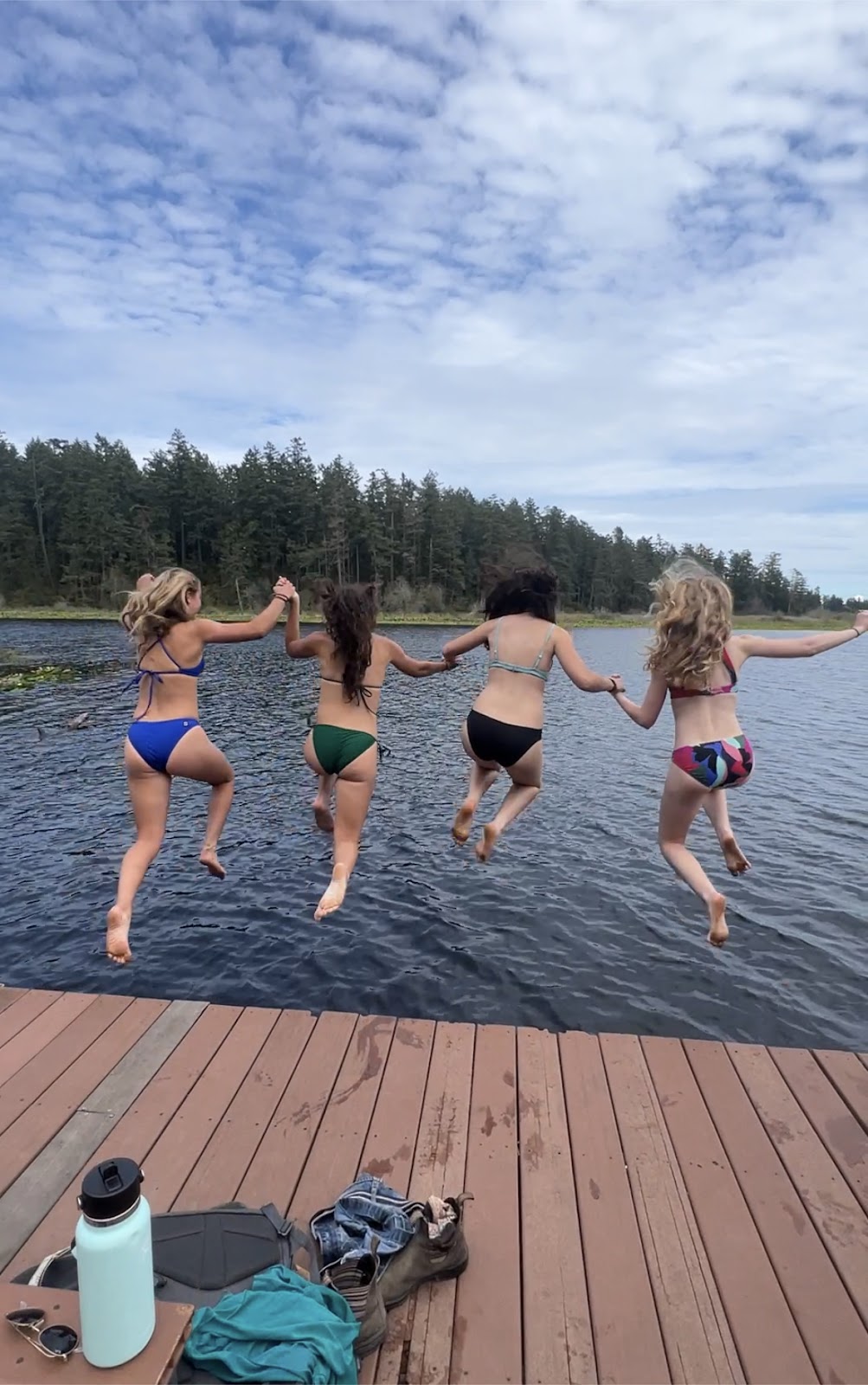
Post-game, we visited the local bookstore to decompress from our sports-related stress, returning to the dorms later for snacks and lunch before heading out again on another adventure: an afternoon swim at Egg Lake.

For dinner, two acheologists working with the National Parks Service, Jeremy Ripin and Emilio Santiago, were our guests. Over a meal of cottage pie, They engaged us in conversations about carbon dating, local artifacts, concluding the night with an informative presentation on archeology. Jeremy and Emilio surprised us by laying out several artifacts from the local collection for observation, ranging from arrowheads to ceramic mugs.


Observing bottle shards, arrowheads, and ceramic pieces

All in all, today was a chill, restful day. Check back tomorrow for an update on the longboat trip!


Our guests, Jeremy Ripin and Emilio Santiago, giving us a presentation on archeology