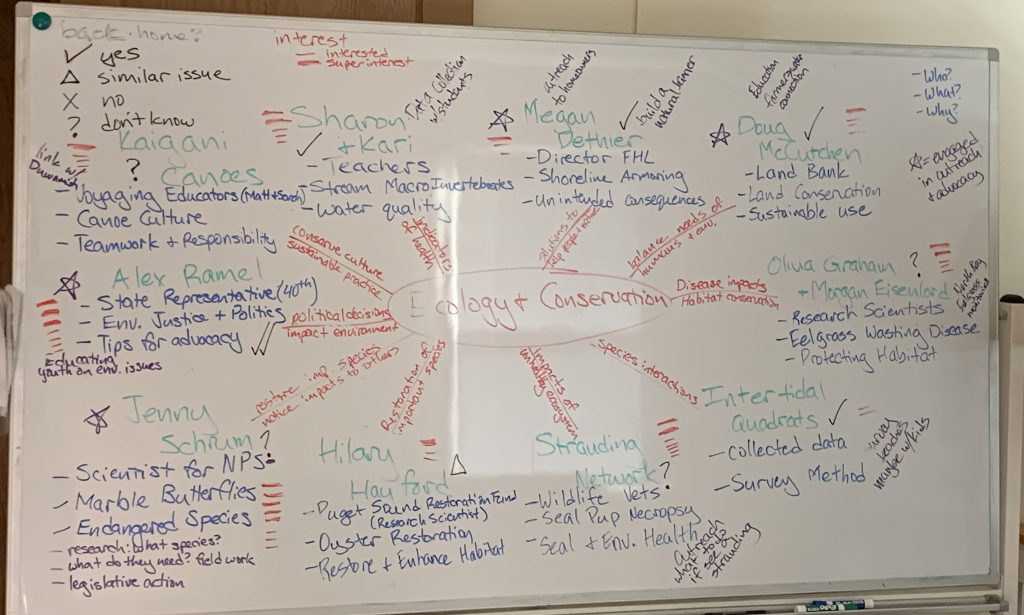
To start off the week, we made a web chart to connect everything that we learned from everyone we had met to ecology and conservation. Later on we came up with some project ideas based around each topic.
Katie Fleming (The Community Engagement Director for the Friends of the Salish Sea) met with us to and talked about who she is and what she does. We also discussed multiple issues revolving climate change.
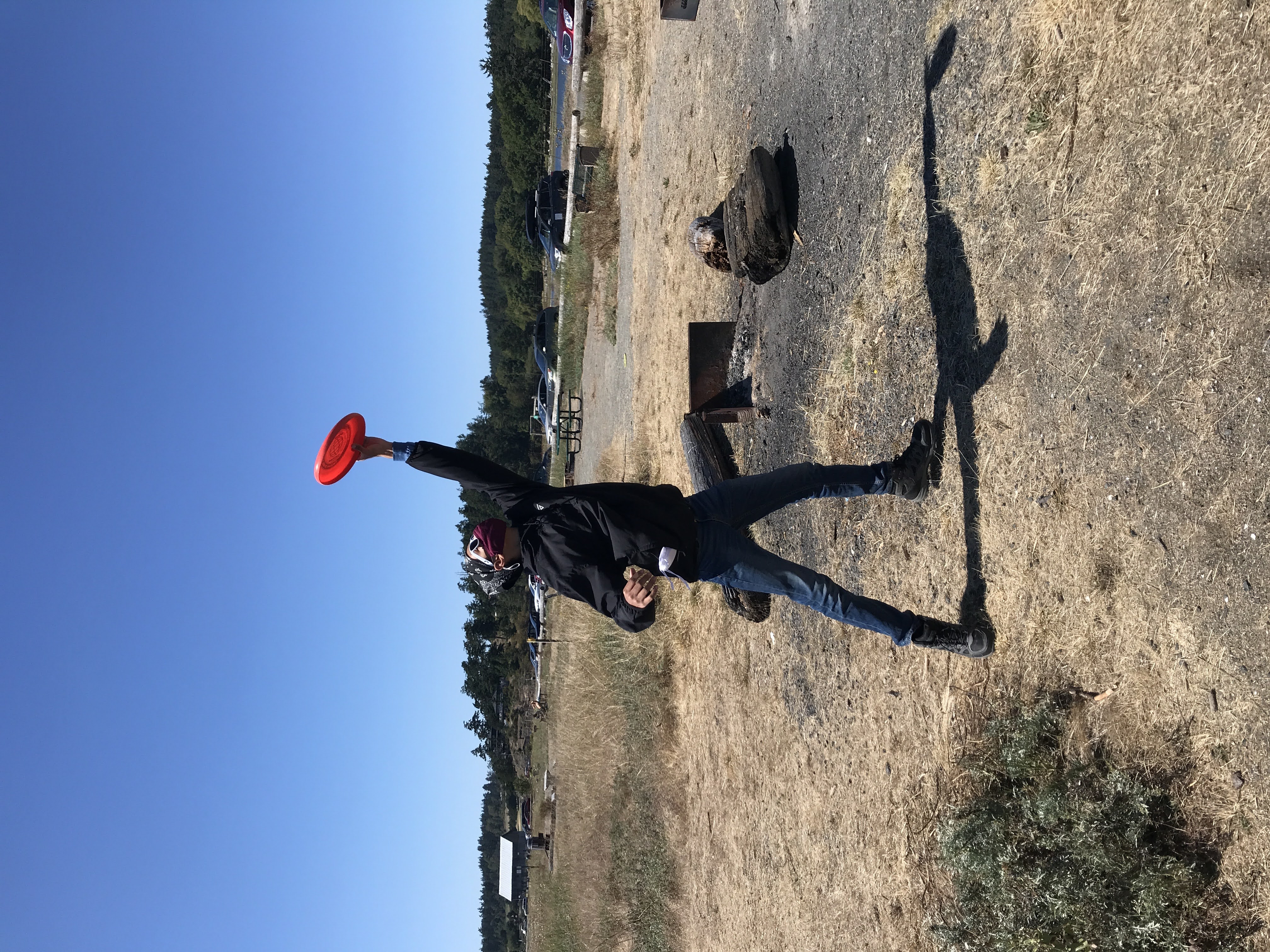
In our free time we took the opportunity to play some frisbee and soccer. I believe it is always good to take breaks, not only for reflecting on information, but also to stretch the body so it’s not stiff.
After that exhilarating brake, we talked with Mike Ramsey. He discussed some projects that are being worked on such as the one in Blind Bay, where some restoration on eelgrass is taking place.
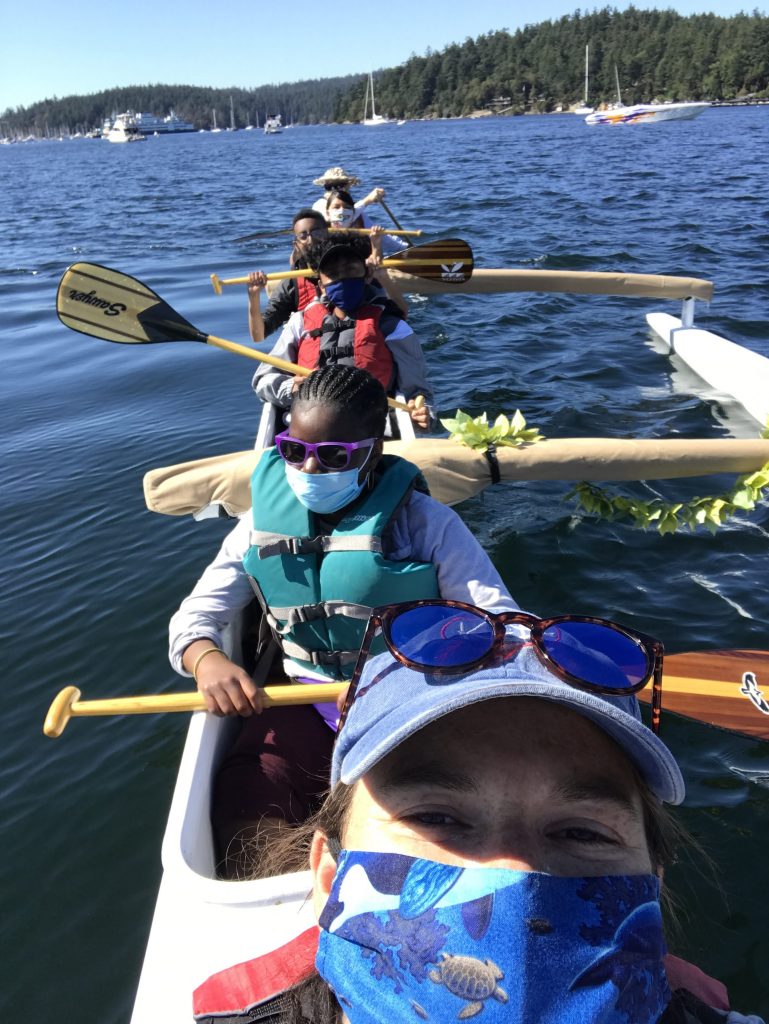
After a brief discussion with our guides Matt and Sarah from Kaigani Canoe Voyaging, we headed out to sea. We learned about the history of the canoe, we learned to use the canoe respectfully, and how to use the paddle most efficiently. We had some trouble moving with the waves but we were able to make it work. We made the best out of our trip and would like to go back on the water soon!
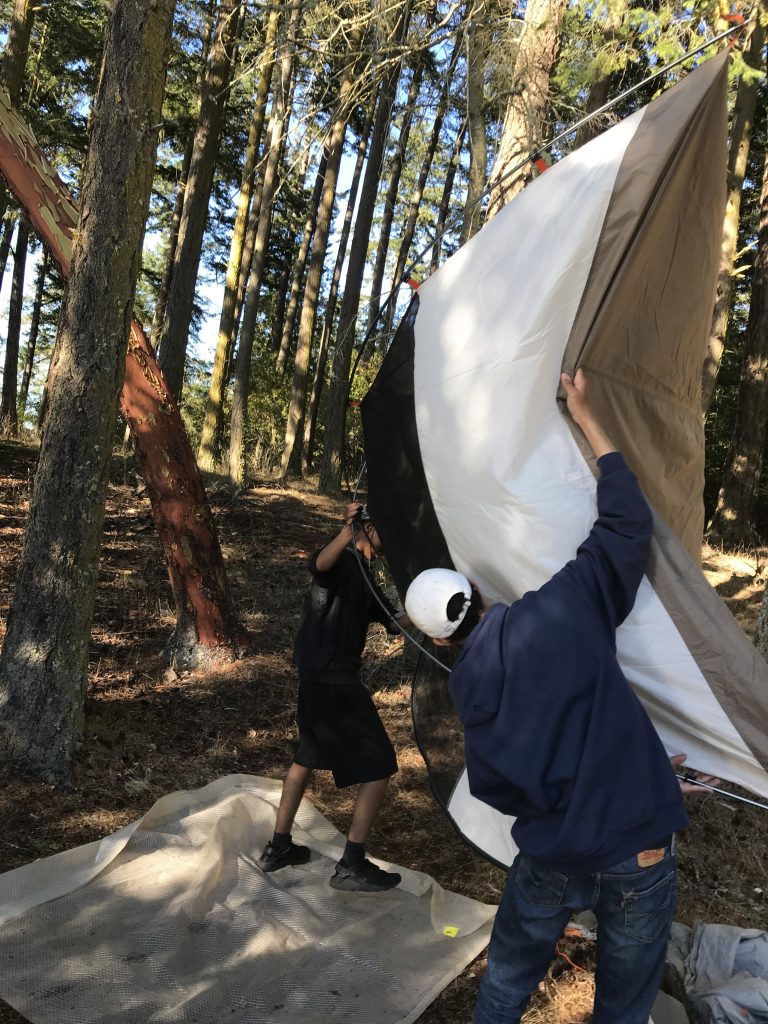
Once we arrived to Turn Island which would be our campsite for the night, we began to set up our tents. It was the first time camping for some of us so getting everything ready was a group effort. Some of our tents had a little dirt in them from their last use, so we picked it up and vigorously shook the dirt out of it.
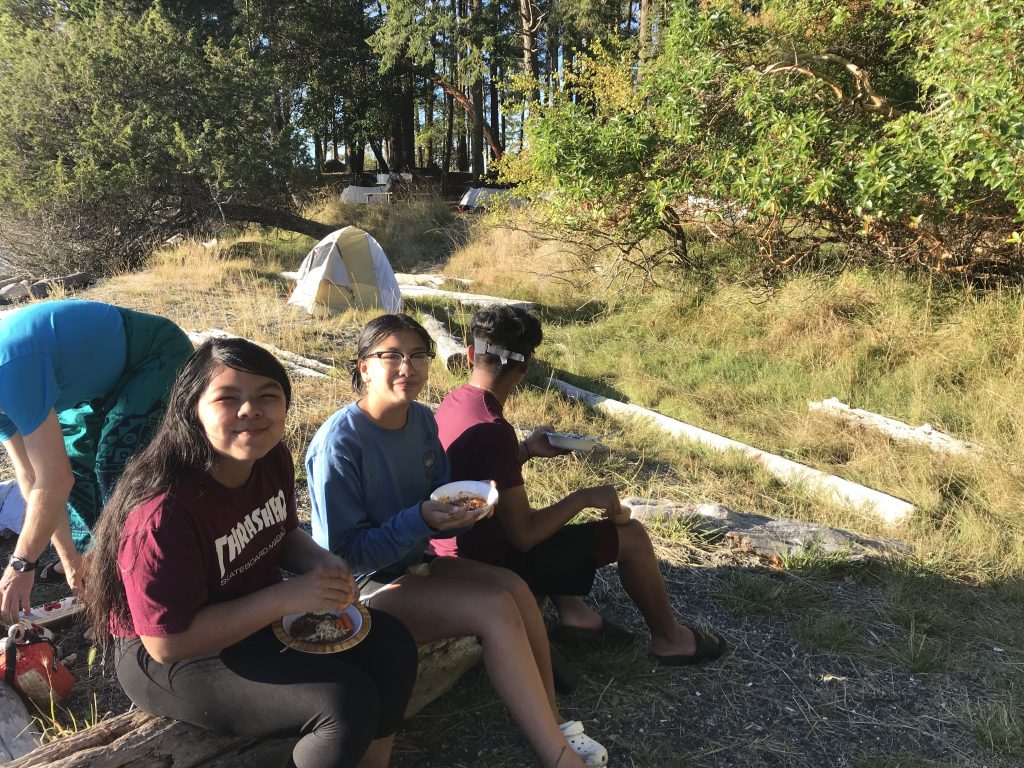
Shortly following setting up everything for the night, we took a break to enjoy our dinner and each other’s company. Some of us hopped into the water and it was freezing. After we got out of the water and finished eating, we set off for our silent reflection hike.
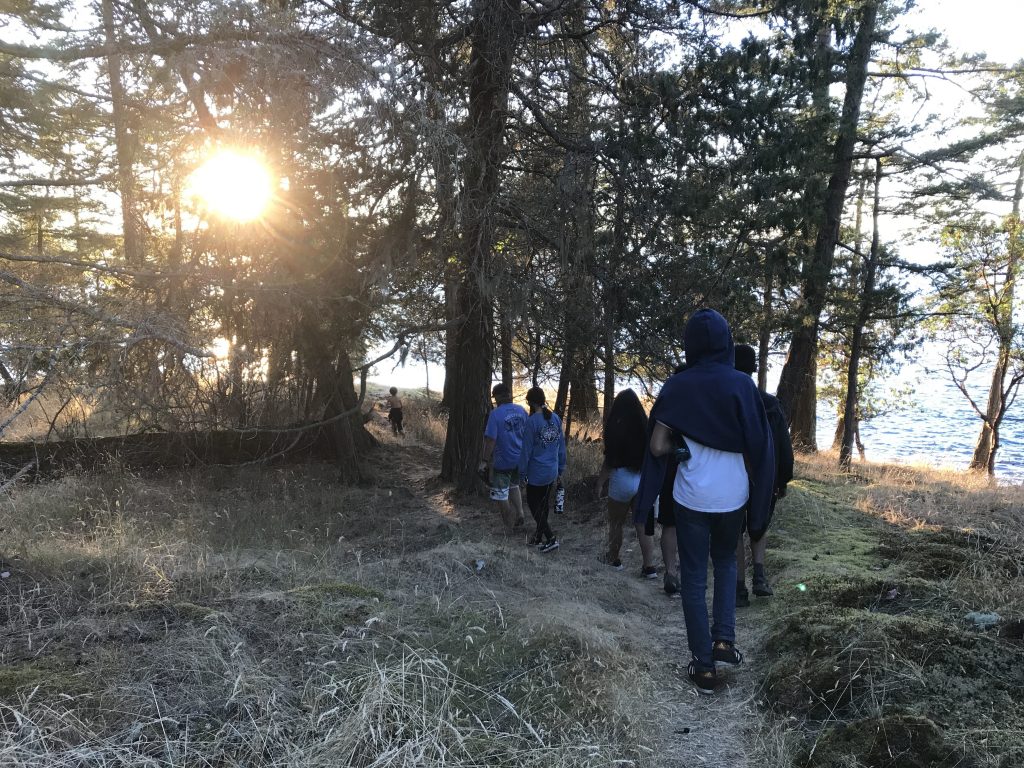
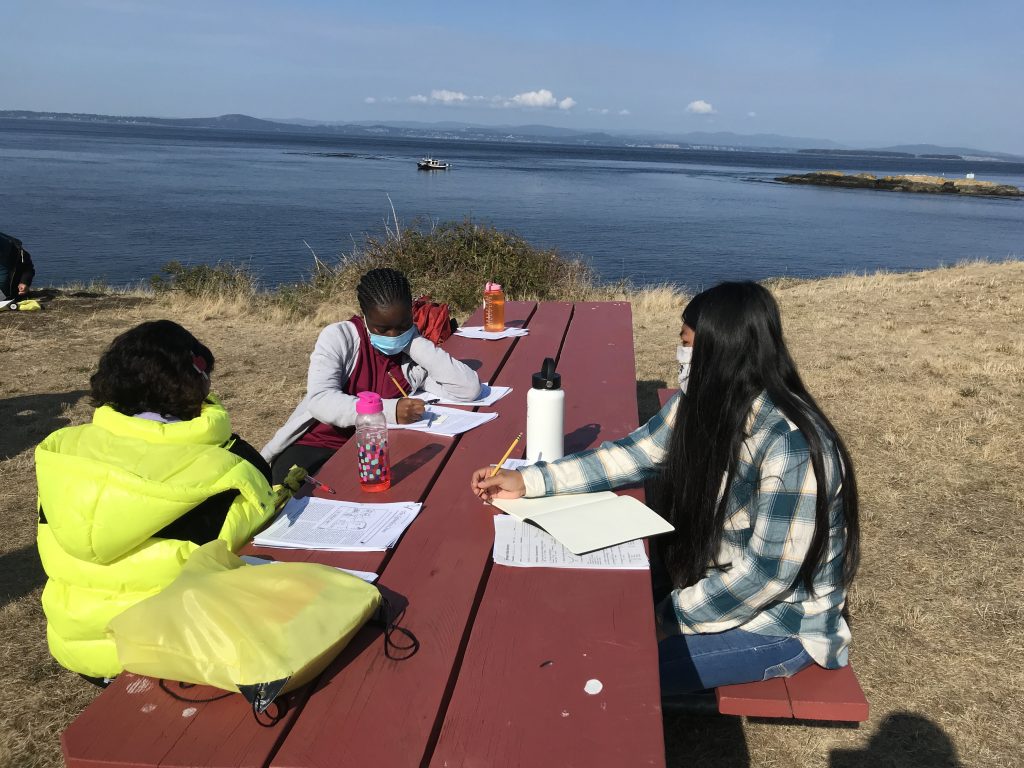
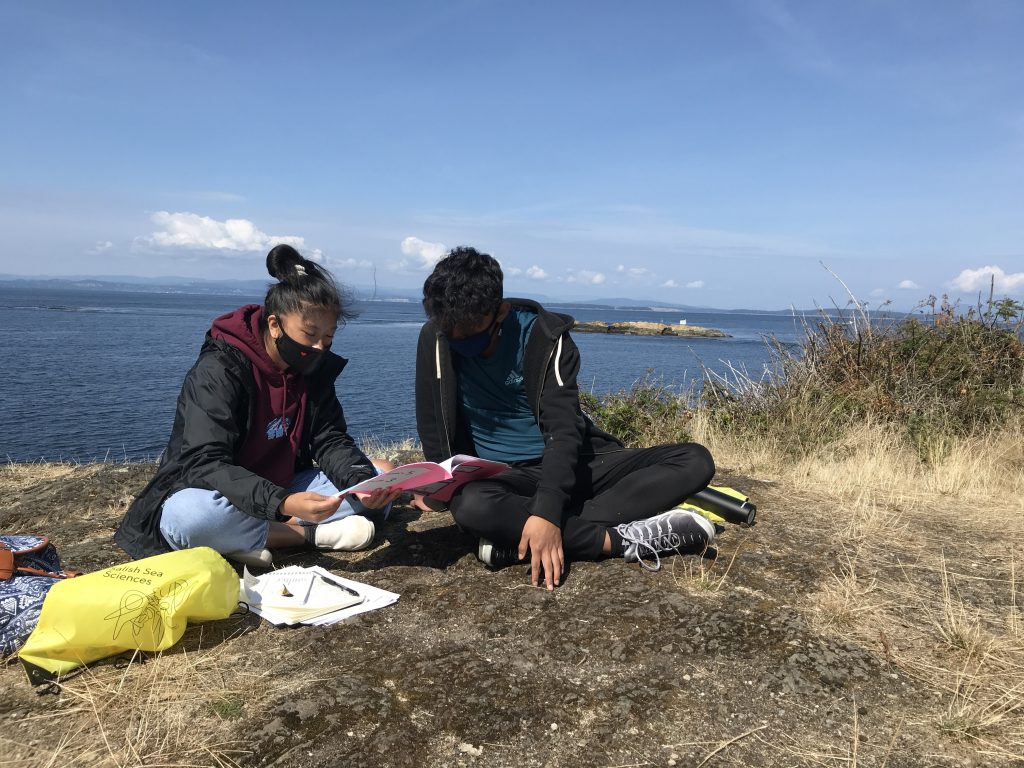
The silent hike was very peaceful and a good way to end our extensive journey to the island. We were able to think of all the things we have learned so far during this trip. On the hike itself, all of us were able to see a harbor seal that was just on the coast of the island. We sat down for 30 minutes and we watched the waves crash into the rocks as we wrote in our journals.
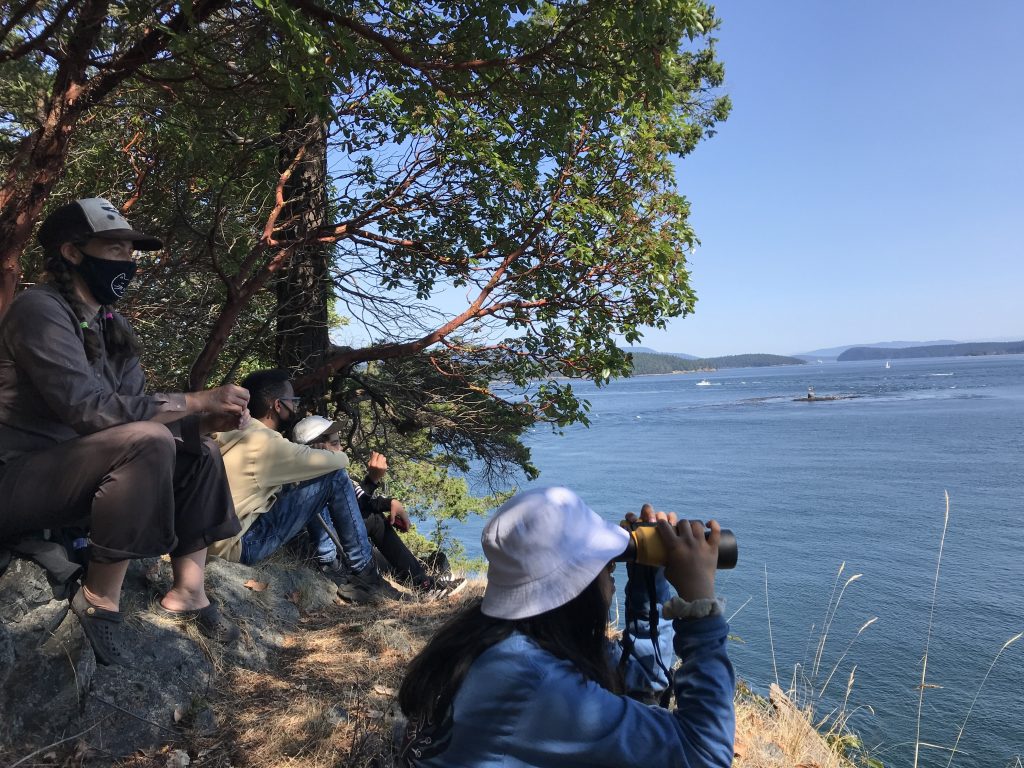
Before heading home, we saw a little glimpse of a whale coming up and using its blowhole. We quickly rushed to the other side of the island to see if we could catch any other sightings. Our chaperone Sockeye told us that it was a humpback whale. One of us was able to look through binoculars and see the back of the whale coming out of the water. After seeing this majestic species, we headed back to Friday Harbor Labs.
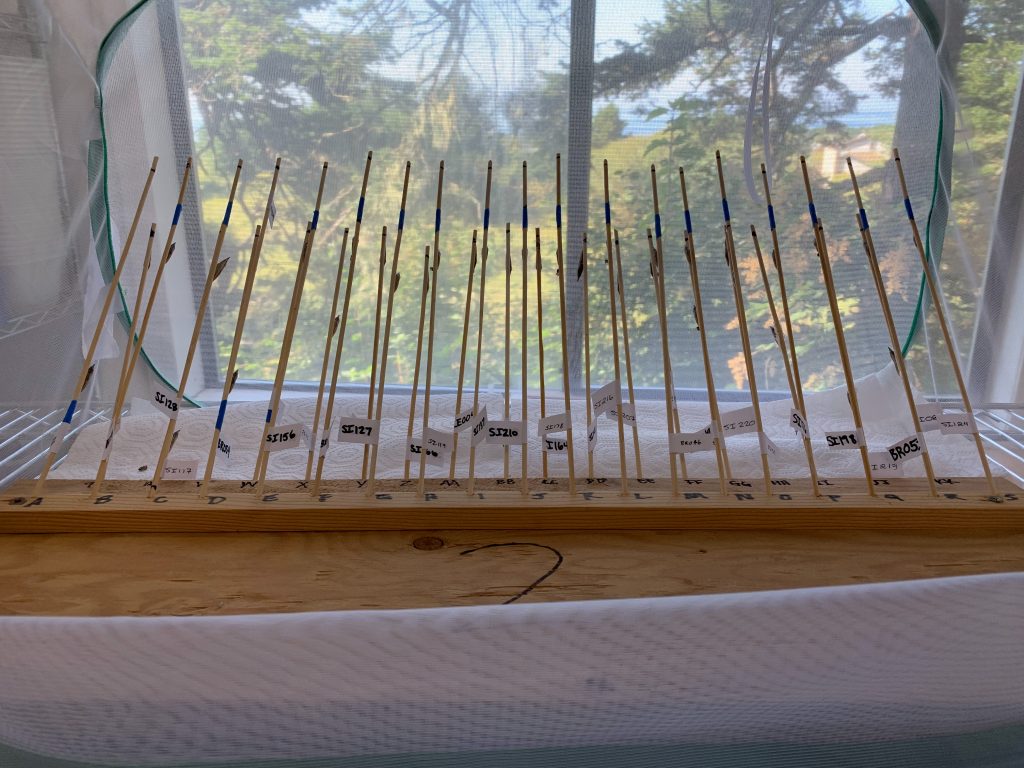
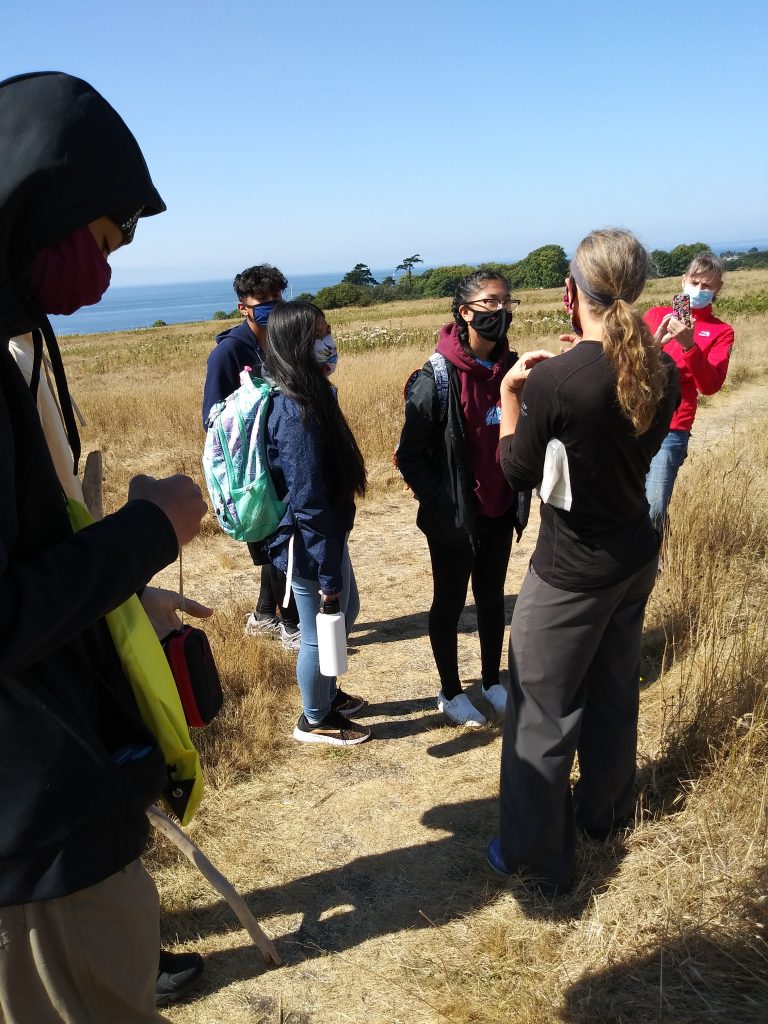
We drove to the American Camp to meet Jenny Shrum. While we were there, we learned about the endangered Island Marble Butterfly and what her lab is doing to learn more about the species and possibly help restore the species habitat. We went into the lab to see the chrysalis stage of the butterfly. Then, we went out to collect seeds of the butterfly’s host plant.
( This is us out gathering seeds )
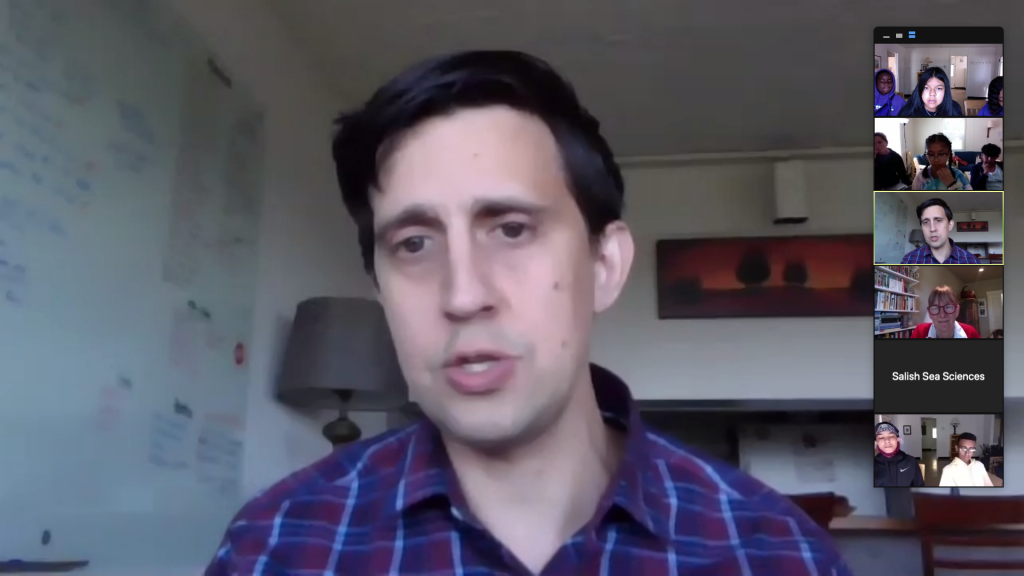
After we got back, we had a zoom call with the Washington State Representative Alex Ramel. He explained the process of a Bill being passed. He also talked about legislature and what he is doing for the environment. He also gave some advice on how to get involved with politics.
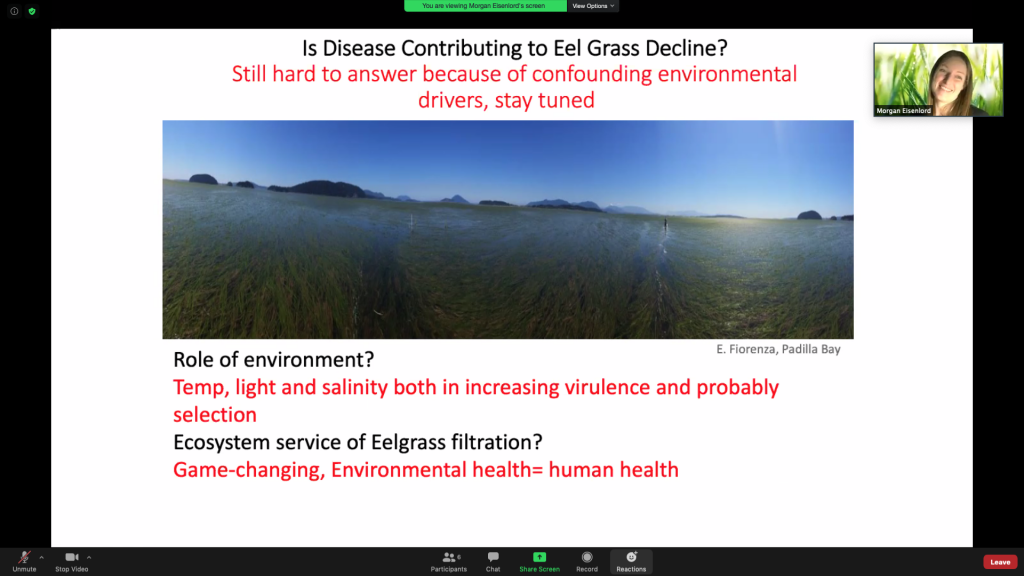
Shortly after the Zoom meeting with Alex Ramel, we had a meeting with Ms.Morgan Eisenlord a PHD candidate in the Harvell lab at Cornell University. Ms.Morgan spoke about the eelgrass wasting disease that doesn’t necessarily kill the host. She also talked about how there was a decline in eelgrass in the 1930’s to the 1980’s and it’s still currently happening today, but we are still unsure if the eelgrass wasting disease is the cause of the decline of eelgrass.
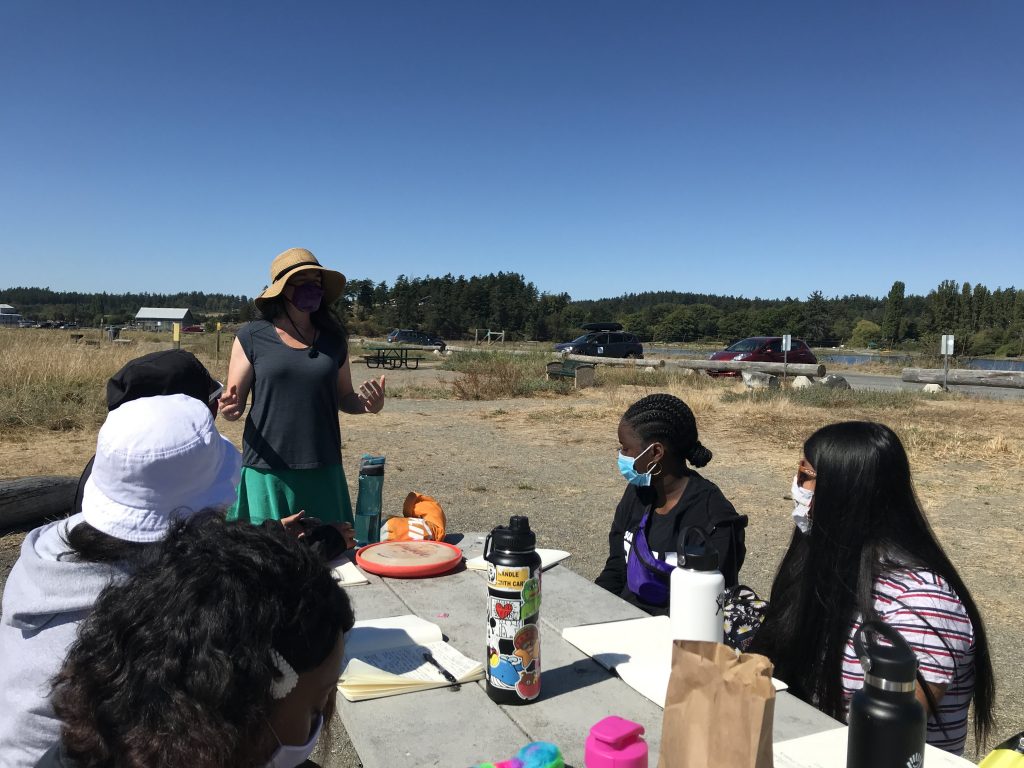
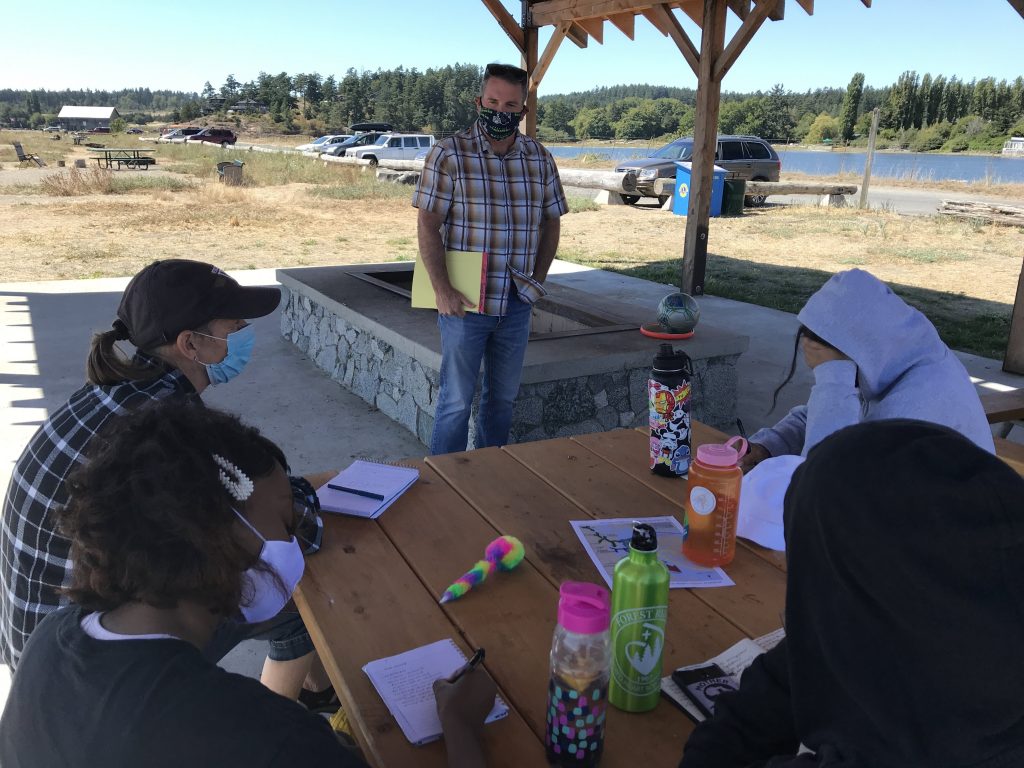
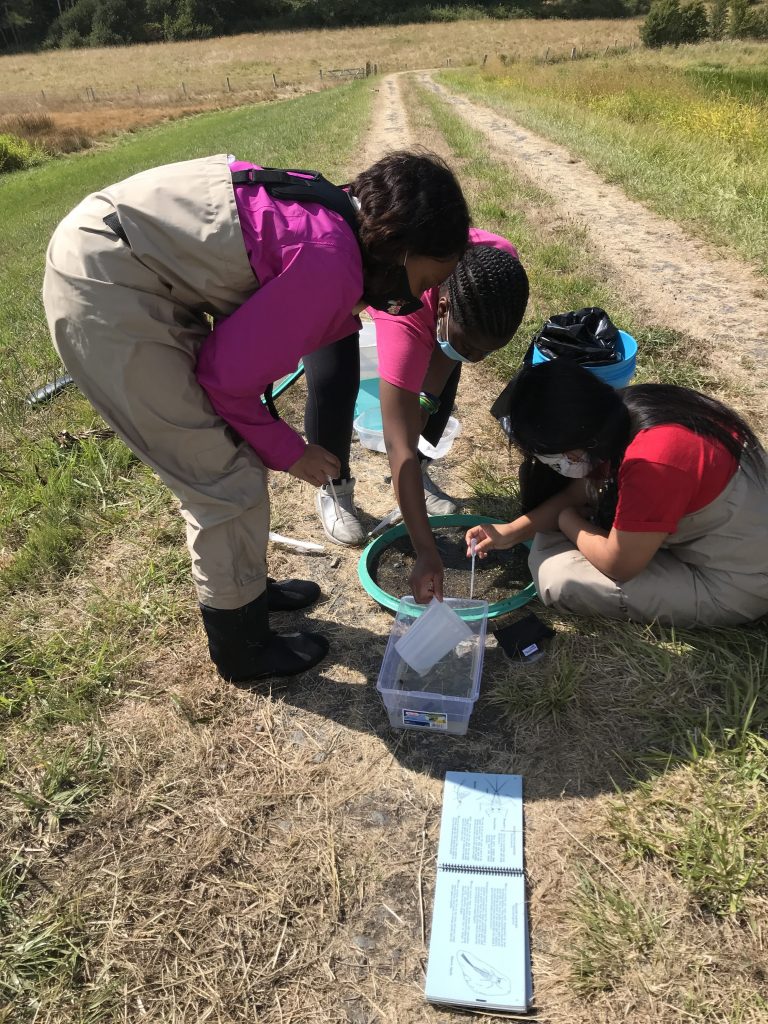
This morning we drove to San Juan County Park and discussed our findings on the BMIs (Benthic Macro Invertebrates) done on the 12th. We sat down near the shore with Kari Koski and Sharon Massey and took notes of the stream quality.
We sorted the invertebrates into groups based on tolerance to pollution. Turns out the creek had fair quality. We got into are groups and started to make questions about the BMIs.
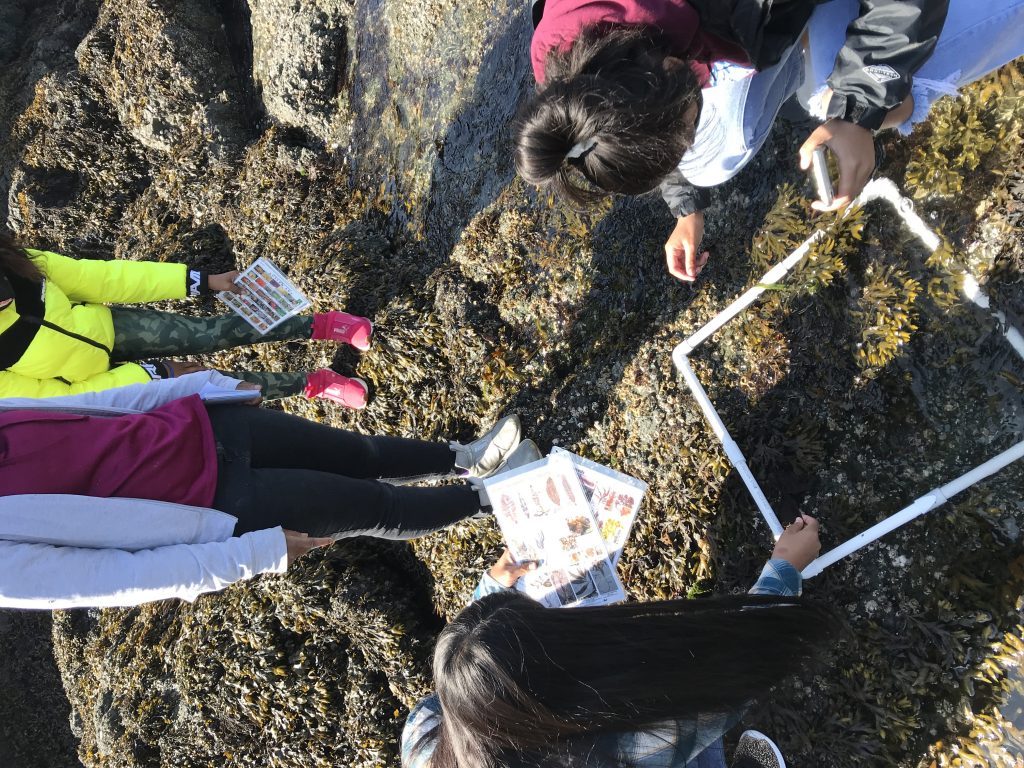
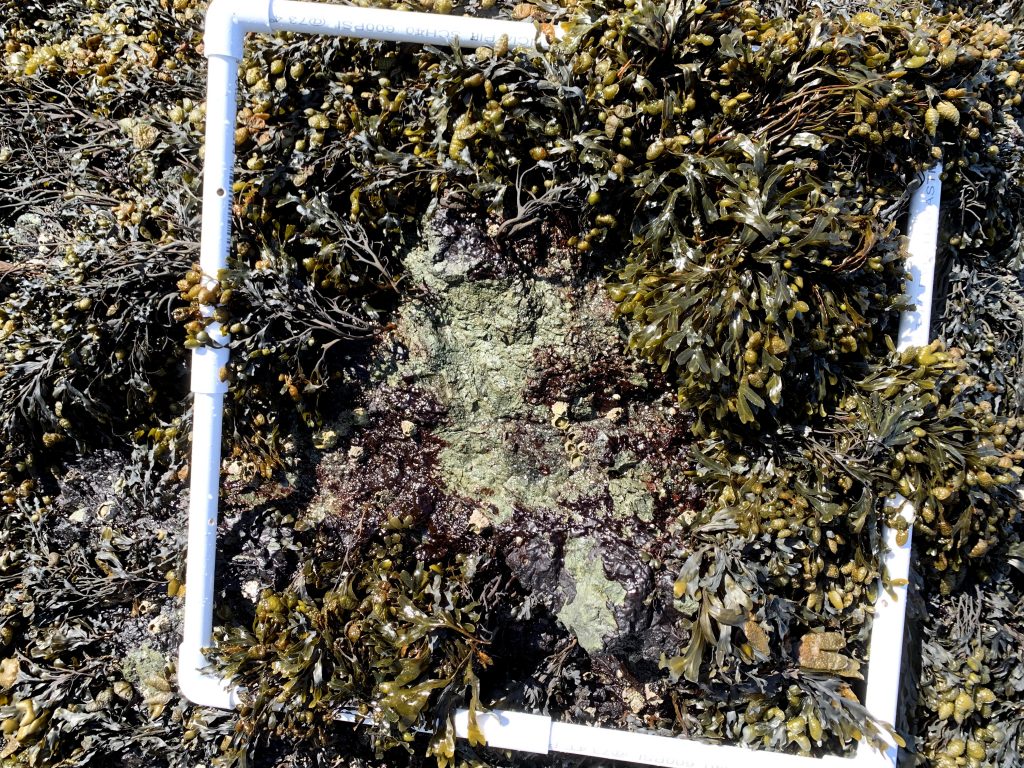
We walked a little farther and arrived at the intertidal zone. While there, we used a tool called a quadrat. You just throw it in a random place, and that’s your sampling site!
Different groups observed and wrote down all the critters and plant life within the quadrats. We mostly found barnacles, snails, and rock weed.
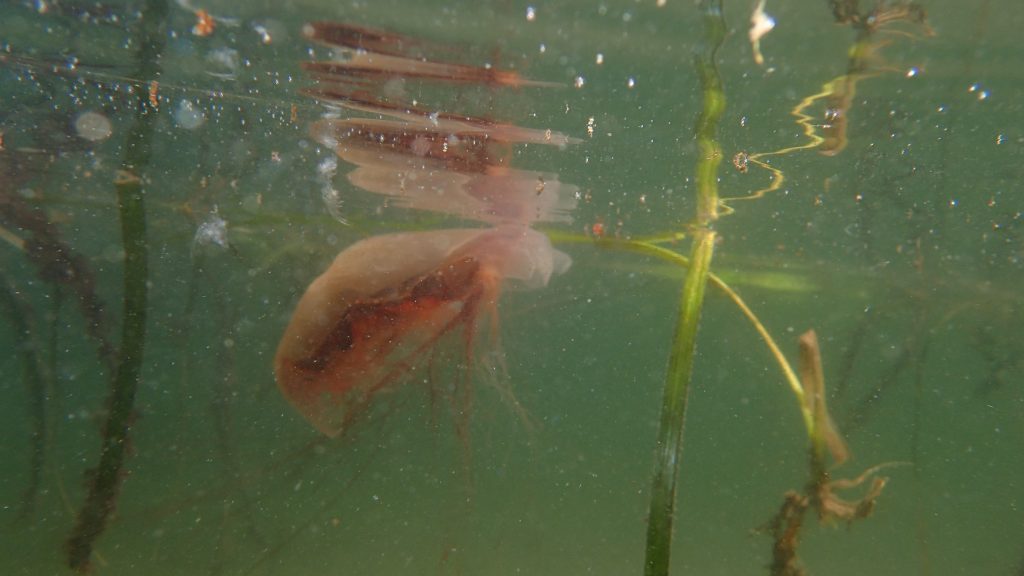
When leaving we almost missed this vibrant jellyfish along the shore. Yafet Amine stepped into the cold water and blindly took this photograph.
We also had a live demonstration of a necropsy of a dead baby seal. We had a interesting presentation with Hilary Hayford, PhD about oysters restoration.
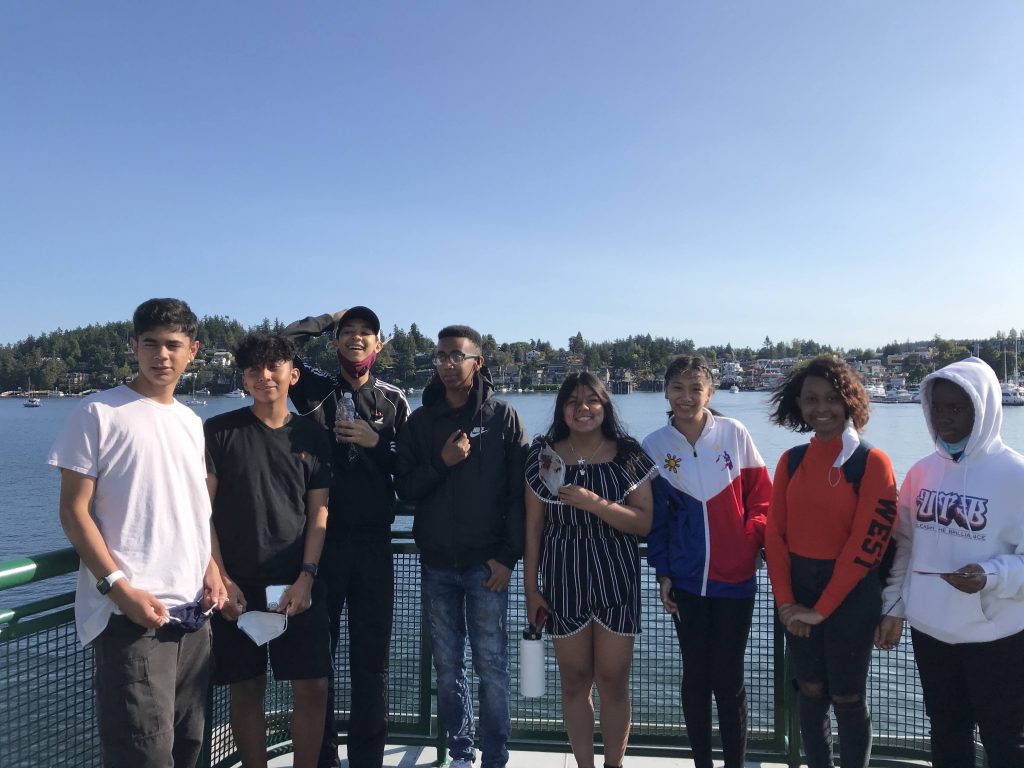
1) Youth from Unleash the Brilliance start off their trip by going on the ferry starting at Anacortes and ending up in Friday Harbor. It was many of the youth leaders’ first time on the ferry and one of the youth said it was a very scenic ride and an enjoyable leg of the journey. The image is of all eight of the youth before arriving at the Friday Harbor Port.
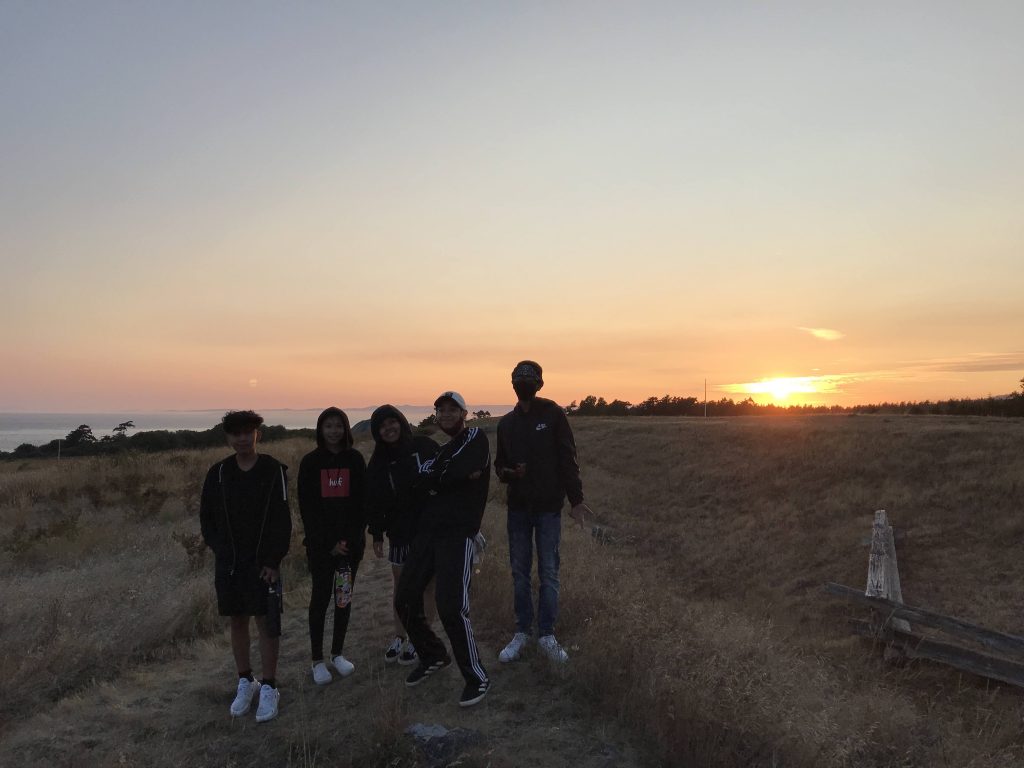
2) The group ended up at South Beach where they started to wind down for the evening after a long day of travel. They took a hike up the trail to enjoy a beautiful sunset and while they hiked, they realized that the island is home to various animals due to their encounter with deer and photographers aiming to capture a glimpse of foxes. It was definitely a relaxing view from the hilltop of South Beach.
Tuesday
3) We all met up at Jackson’s Beach the following morning and learned about maps and charting. As we looked at the waterways, we were fascinated by the fact that the fresh water going out into the Salish Sea and through the Strait of Juan de Fuca into the Pacific Ocean had an effect on the speed and direction of the current. We enjoyed a breezy morning on the San Juan Islands while we picked up plastic found on the beach and observed wildlife.
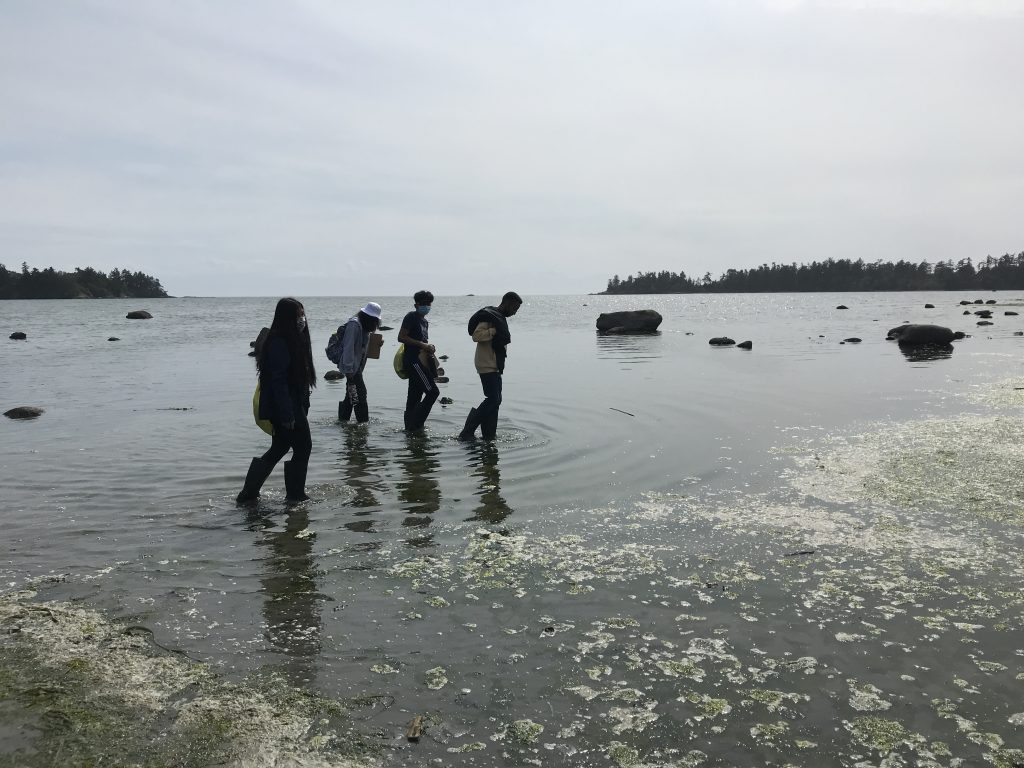
4) We met with Sharon Massey and Kari Koski, two naturalists and senior science educators who have a passion for the water quality on the island. We checked out a local creek with them and surveyed the physical characteristics of the creek. We then headed out to False Bay where the creek flows out into the Salish Sea. We enjoyed wading in the water with our rubber boots on but not very fond of the smell of the decaying algae.
Wednesday
5) Waders are like overalls that go down over your feet and keep you dry while you’re in the water. We were all excited to get into our waders and get our hands dirty!
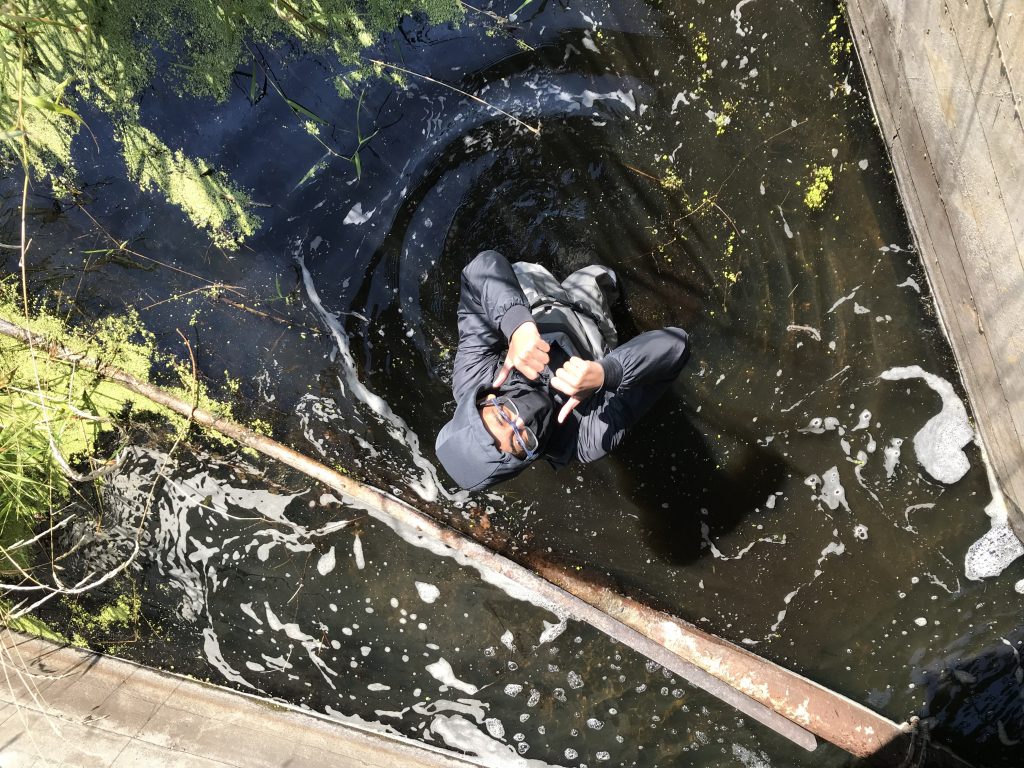
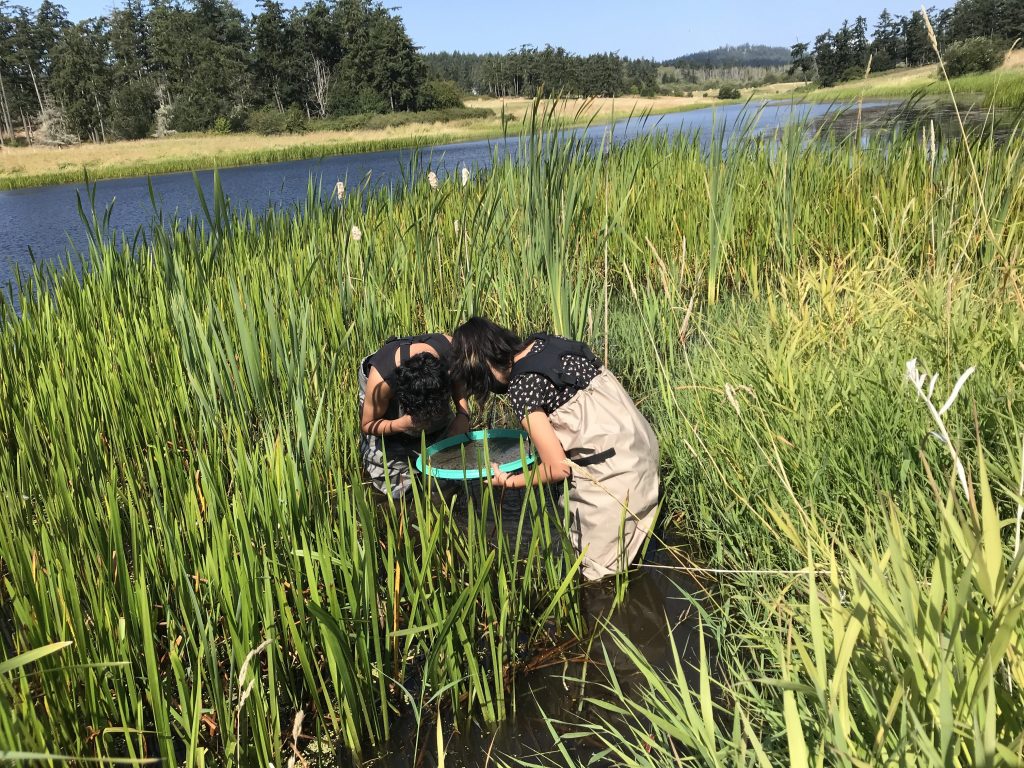
6) We quickly made our way into the water where we collected samples. We collected the substrate in the water and tried to pick up as many critters as we could find. These critters are also known as macroinvertebrates that live in these ecosystems.
7) We thoroughly investigated our samples in the nets we caught them in and we used magnifying glasses to identify the different species in the pond. We found a number of macroinvertebrates along with spiders, mini snails, and a tadpole. We returned the samples to their natural habitat and then went off to lunch.
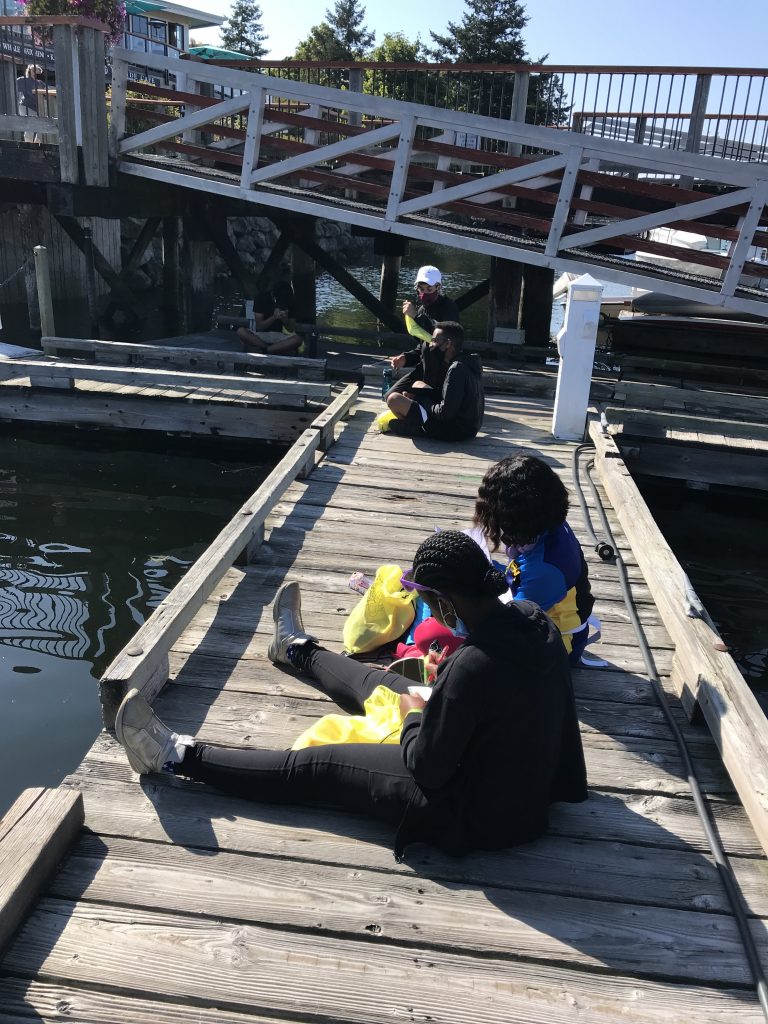
8) After lunch, we took a 45 minute walk down to the harbor where we looked at the shoreline armoring. We had learned about shoreline armoring from Dr. Megan Dethier, the Director of UW Friday Harbor Laboratories. Shoreline armoring is a wall made to protect the shoreline from eroding too quickly but it also has a negative effect on the beaches. It acts like a dam and holds in the sediment which causes beaches to wash away. On the dock, we were able to see two different shoreline armoring techniques which includes rocks and a concrete wall.
The sunrise signals the start of a new day and a new beginning. We started off our last day by watching the sunrise in everyone’s hometowns. Nothing can bond a group like waking up at 4:45 to watch a sunrise.
Like the sunrise, we learned that while today might be the last day of the program, it’s certainly not the end of the book. Instead, today was the beginning of the next chapter.
The friendships we have made and the lessons we have learned throughout this program will continue to follow us throughout our time. We can’t wait to see what the six of us accomplish.
Colette’s Colorado Sunrise
Salish Seas Sunrise
Seattle Sunrise
SoCal Sunrise
Feedback Frenzy
It’s impossible to wrap up an experience like this. Fortunately, Foundry10 lent us a hand in simplifying things.
We shared our feedback, positive and negative, about the program. Using those thoughts, we time-traveled to the year 2025 where we simulated a zoom reunion…
Our imaginations brought us across the galaxy. One of us was busy researching cancer on Mars, another had created a multi-million dollar flipper company, Julia was busy unearthing Spanish medallions in thousand-year-old shipwrecks, and a few were lucky enough to become roommates at the University of British Columbia…
We all shared a good laugh discussing our aspirations.
Lovely, Long, Legendary, Lengthy, Lavish, Lush, Lasting List
Lunch led us to lists. Reminiscing on our four-week experience, we created a lovely, long, legendary, lengthy, lavish, lush, lasting list of guest speakers, topics, skills, and knots.
This seemingly meaningless list indicates so much more than one would think. Each event listed shows our growth and development along the way.
Gracious Growth
Throughout the program, we’ve been ever so grateful for the multitude of guest lecturers; however, none of this would have been possible without the support of the Salish Sea Sciences team.
Derek, thank you for keeping the Zoom calls light and fun and directing this program! You have always made sure to keep us engaged. Our off-track conversations have taken us across the world and to the ninth planet. Thank you for your constant encouragement. Many of the things we go on to do following the program, wouldn’t have been possible without you. So we encourage you to continue to change the world.
Kay, thank you for helping us along the way and teaching us about the wonderful butterflyfish! Your enthusiasm brought the program to a whole new level. You’ve supported us throughout our whole journey, and we can’t thank you enough for helping us grow as a whole. You are an amazing role model and we can’t wait to see you again!
Bea, thank you for showing us we can. Your journey to get where you are now followed so many twists and turns, but you got there. We admire your RESILIENCE and vigor to get where you want to go. We’re all hoping that starting today, we can recreate that in our own lives. Also, thank you for helping us with our independent projects, you helped guide us through our challenges.
Tom, thank you for always being there for us and listening to our suggestions for Salish Sea Sciences. You’re always open to hear our opinions on improvement and trust our judgment. You make us feel like true adults who can do anything we put our minds to. We admire your dedication to helping Morgan Eisenlord with your new program and we thank you for being just as dedicated to us in this program.
Last but most certainly not least, Caroline. Thank you for bringing us all together. You and Tom have created such an amazing, impactful program, and have changed so many lives for the better. Your constant support, advice, and mentorship throughout this program have been incredible and we can not thank you enough.
Thank you.
This is the Makos and Bottlenose Dolphins, signing off… But not really. 😉
As incredibly exciting and fulfilling as today was, it was equally exhausting. For the sake of our sleep schedules and easy readability, we’ll keep this quick.
The Return of the Pauly
While being online for the duration of this program has had its lows, to an extent it’s been a blessing in disguise. Being online has allowed us to connect with incredible people we would have otherwise never met, including the likes of Daniel Pauly.
In his second appearance with us, Dr. Pauly shared one of his more recent studies. His research suggests that as our oceans warm, the fish that inhabit them will become increasingly small due to a lack of oxygen. We are honored to be one of the first student groups he has shared this lesson with and we hope to help spread his crucial message worldwide.
Mo Sea Stars!
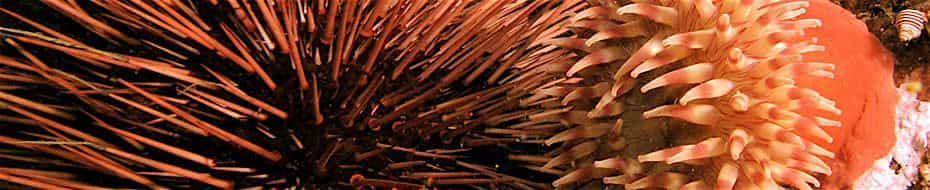
In between scrambles to complete posters, Mo Turner joined us to talk sea stars. We’ve met many remarkable scientists during our time at Salish, so this being the second to last day, it was enjoyable to circle back around. It was definitely a more casual conversation; filled with random star-y questions. We even got a chance to view many of the specimens from one of FHL’s sea star galleries. The Vermillion Sea Star (pictured below) garnered many oohs and ahhs.
We spent countless hours today finalizing our posters and preparing to present our research. As nerve-wracking as it was, our discussions went surprisingly well. We each got to speak with an abundance of people ranging from family members to scientists we’ve never met before. It was nice to finally be able to wrap up our past few weeks of doing research and collecting data.
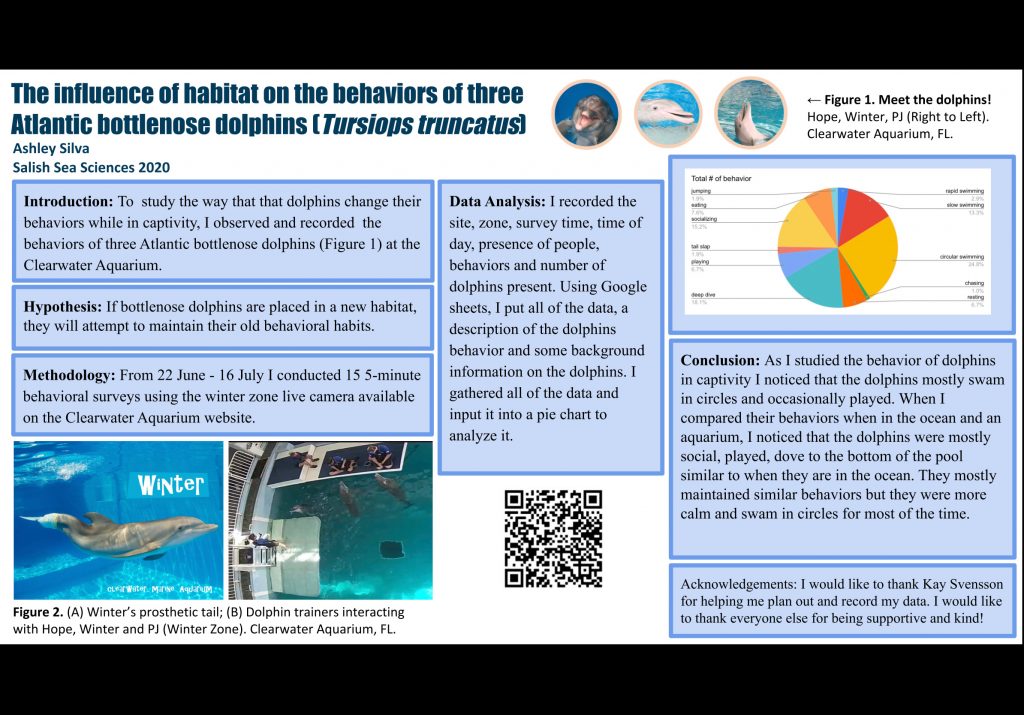
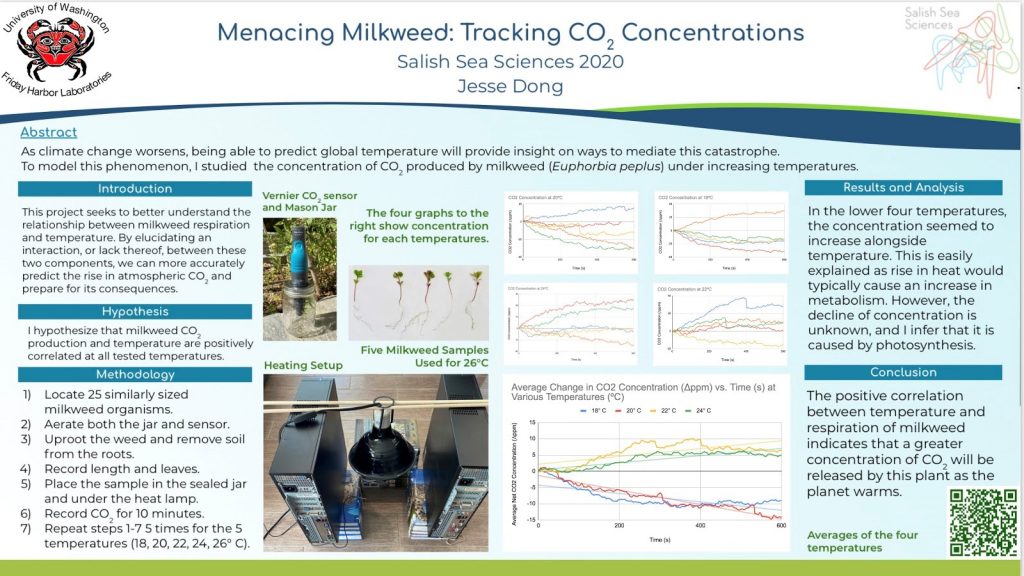
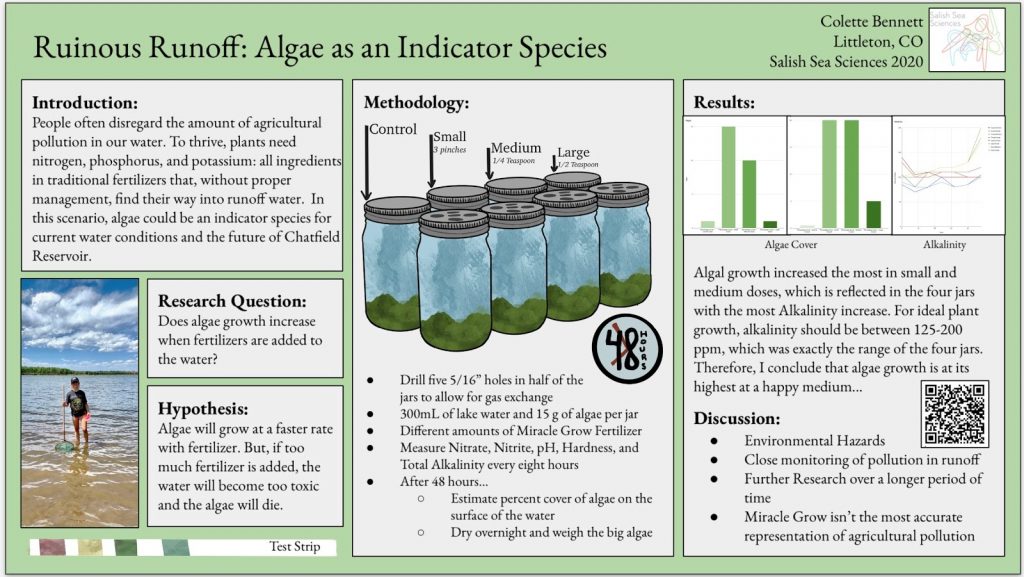
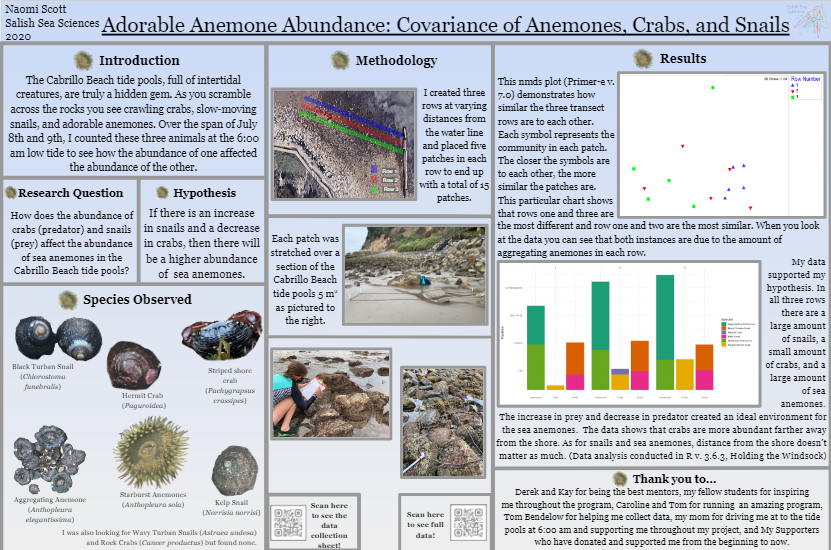
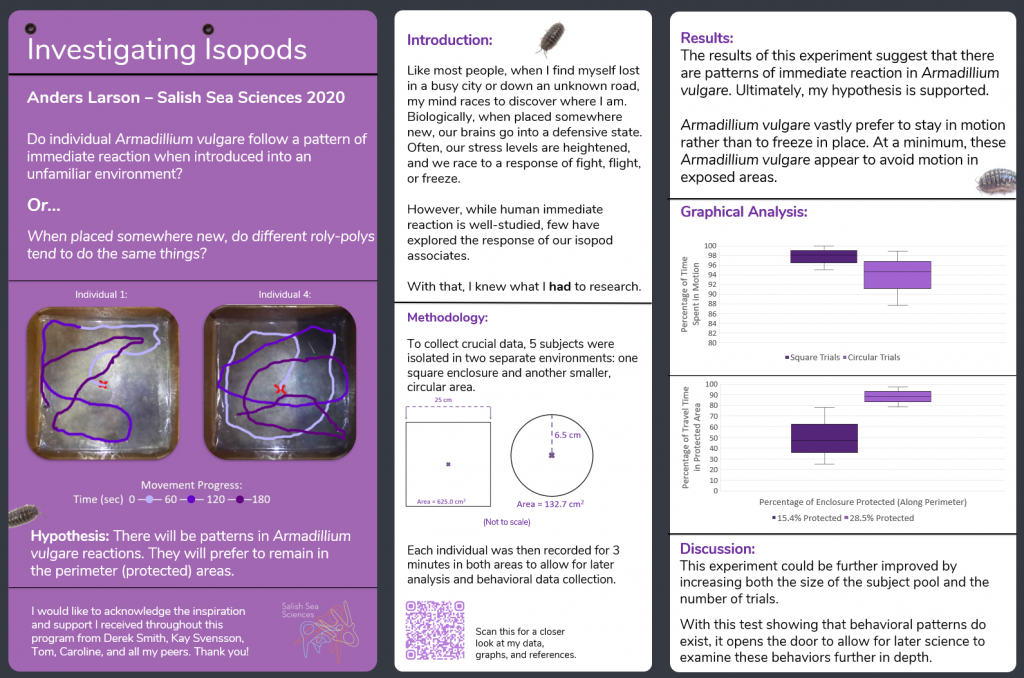
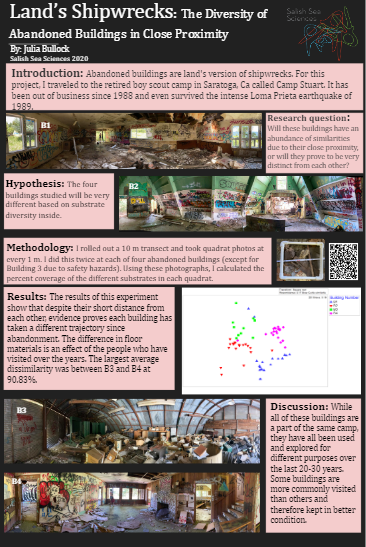
The Salish 2020 Posters
Getting Sleepy
It’s astonishing how fast time truly flies when you’re engaged, supported, and constantly amazed. This program has been a once in a lifetime experience for all of us. Despite our small group size of 6, we’ve accomplished more than we ever thought possible.
These past weeks have pushed us to improve our speaking, listening, and learning. In this time, we’ve connected with artists, activists, humorists, and scientists; many of which we could have only dreamed of meeting beforehand.
We have to thank those that have been essential in molding this time into an unforgettable period.
Derek, thank you for your constant enthusiasm and endless ideas. Kay, without your experience and guidance we’d surely be lost. Caroline, thank you for always helping us to improve. Tom, your technical savvy and inspiring ideas have saved the day more than once. Bea, thank you for your crucial project help. And, for all the inspiring guest speakers we’ve had, thank you for making time in your busy schedule to meet with us. It means the world.
To be completely honest, we could talk endlessly about all of the incredible experiences we’ve had with this program.
However, as we keep writing this, we’re beginning to get tired and we think we better call it a nigh…
We’ve had plenty of lectures throughout the program. But none quite like this.
Today’s lecture was more of a discussion. The conversation members? Ray Troll, an astounding marine artist, Dr. Kirk Johnson, the director of THE Smithsonian’s Museum of Natural History, Dr. Milton Love, an inspiring ichthyologist, and the Salish Sea Sciences team.
After asking a few questions, we found that it was much more fun to sit back and listen to the three talk and catch up. As the buddies filled each other in, they provided us insight on various topics, from the malacosteus niger’s dislocated jaw to empty pandemic museum exhibits.
Ray Troll vs. Anders
At one point, an artifact battle took place as each scientist tried to show us an even more impressive replica or skull! We have to say, Anders might have won the whole thing with his paper mache walrus head.
Watching the three scientific celebrities discourse this way is not something you get to be a part of every day. This is just one of the many amazing opportunities we have experienced over the past four weeks.
Deep Down Discoveries
As our conversation with the three titans came to a close, Megan Cook, a Manager of Education Partnerships and Programs at OET, joined our Zoom call.
Megan mesmerized us with her octopus-covered whale skeleton and colorful underwater mapping diagrams. After explaining the motivation behind marine discoveries, Megan discussed all the different ways that OET uses underwater ROVs to explore and discover on the ocean floor.
Mapping the Ocean Floor
Not only can the giant ROVs collect samples of different underwater organisms, but every expedition is live-streamed on Nautilus Live’s website!
Inside look at OET’s ROV
Matching one of the program’s main themes of discovering the many marine biology paths, Megan showed us the variety of people involved in making these expeditions possible. When these positions are combined, they make one big dream team that can accomplish amazing things!
ROV captures octopus brood around a whale carcass
Plentiful Poster Planning
In between the wonderful conversations we had with these knowledgeable guests, we were constantly working on our individual projects, specifically, our posters! With the majority of our research done and the poster session occurring tomorrow night, it was time to work on the public engagement step and share our results. It was crunch time!
Although this task may seem deceptively simple, the formatting and organizing practically fried our brains. We were able to collect loads of data, but if we didn’t present it in a clear manner, then hours of grueling research and analysis would go to waste. The task of trying to fit a research paper’s worth of information onto a single Google slide might have been the biggest challenge of the whole program. 😉
Despite the obstacles that we faced, the Salish team was able to pull through and design aesthetically pleasing posters. Tomorrow at 5:00 pm will be the true test as we will finally share our projects with the public. We can’t wait to see what our guests have to say!
In all likelihood, most reading this blog aren’t exceptionally well versed in the radical world of rockfish. Oftentimes, when faced with unfamiliar science, it can be extremely difficult to work past the inexpressive style and surmount the barrier of confusing jargon.
While some scientists (like Sasha Seroy) choose to combat this issue with art, others choose a more comedic path…
This morning, we had the pleasure of meeting and talking with Dr. Milton Love, a scientist and humorist working at UC Santa Barbara. While he has experience in a broad range of fields, our discussion today mostly concerned the ecological value of offshore oil rigs. Dr. Love shared with us both scientific and personal wisdom. His approachable demeanor had us asking constant questions, whether they be about science or personal. All puns aside, it was lovely to speak with him today.
Captain’s Orders
There are always multiple stages of every issue. In science, while a critical aspect is research and documentation, equally important is actually taking action on that work.
Today we spoke with world-famous ocean conservationist, Paul Watson.
Captain Paul Watson has been a lifelong steward and advocate for our planet. At only age 11 he spent his summers releasing beavers from hunting traps. Later in his journey, he co-founded Greenpeace, directed Sierra Club, and began the Sea Shepherd Conservation Society; one of the world’s leading marine conservation groups.
While to some Captain Watson is an inspiration and a hero, others purport he’s an eco-terrorist and extremist. He philosophizes: “it doesn’t matter how thin the line is if you don’t cross it”.
From what we gathered, Watson believes that if critical action is being taken and still we receive backlash from governments and corporations, then something is wrong. “The earth has been around for 4.5 billion years, yet we still think it was made for us”.
It was so kind that Captain Watson was willing to take the time out of his busy day to speak with us. He left us feeling inspired, (full of quotes), and ready to save the world.
Exploring Octopodes
For the second time this week, we dove into octopuses and their many talents.
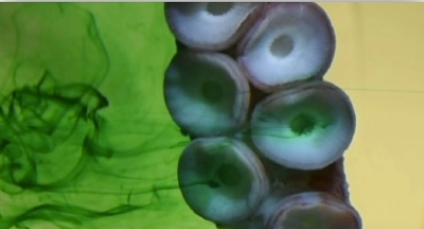
Octopus scent is relatively unexplored, hopefully Willem can find some interesting answers. (Photo Credit to the Gire Lab)
University of Washington graduate Willem Weertman gave us a detailed explanation of his graduate school thesis exploring octopuses’ ability to track odor plumes (, odor released and carried by some sort of current). Recently, he’s been busy building a flume at Friday Harbor Laboratories for use in his future studies.
Those Who Came Before Us
As an excellent end to the busy day, we got to speak with a former Salish Sea Sciences member, Ayla Ridwan. She is currently a senior at Friday Harbor High School and is an intern at FHL where she is looking at fish and soon, sharks.
It’s awesome to see how her experience with Salish Sea Sciences opened such an incredible door of opportunity, we hope to be just as fortunate. Just as Captain Paul Watson suggested today, “What you do in the present will define what the future will be”.
Today, we spoke with Dr. Emily Carrington, a biology professor at the University of Washington who studies mussels and the ecophysiology of wave-exposed organisms. Dr. Carrington explained the many behaviors of mussels and their impact on the environment (aside from the amazing food).
Dr. Carrington studies how the mussels attach, what causes these attachments to weaken, and how global warming impacts the mussels. The focus of Dr. Carrington’s lecture was the glue and byssus that mussels use to attach to rocks. These materials help the mussels stick to wet, salty surfaces, and keep them grounded when exposed to the elements.
Are Dr. Carrington and her team on to a new type of super glue?
Comic of the waves’ impact on mussels.
And Snails!
Next up, Dr. Hilary Hayford, a coastal marine geologist who tracks the effects of climate change on nearshore species. She spoke to us about Dogwinkle (Nucella lapillus) snails and how the tides affect their feeding patterns.
Her numerous experiments demonstrated when and how the snails forage. A snail’s journey to their prey – mussels – is long and dangerous as they are slow-moving and vulnerable to heat. The snails must time their trips wisely.
The Dogwinkle snails are unable to survive heat over 34º Celsius. They must forage during the two high-low tide cycles when the lowest tide occurs at night. This way, the outside temperatures will be cool enough for the snails to stay hydrated.
Dr. Hayford made it clear that the window of time to help these creatures survive the effects of global warming is small. Soon it will become too warm for the snails to make the long journey up to their food. However, climate change’s ticking time bomb doesn’t just impact the intertidal zones: practically every environmental ecosystem will be adversely influenced. We must act quickly!
Mussels in areas with high and low temperatures
And Octopuses!
Yep. You heard us right, octopuses! Dominic Sivitilli, a Ph.D. student in behavioral neuroscience and astrobiology, confirms that the plural of octopus is in fact “octopuses”.
The final hours of the day flew by as Dominic hypnotized us with videos of wandering octopus legs and suckers. These benthic beings are some of the most ecologically unique in the ocean. With camouflaging powers, soft bodies, and decentralized nervous systems, octopuses are quite an unusual intelligent being.
Dominic’s work mainly focuses on the nervous system of this intricate invertebrate. Thousands of suckers line the eight flexible arms of the octopus, each equipped with chemical and mechanical receptors. Each individual sucker is hundreds of times more sensitive than the human fingertip!
Armed with its own computational system, each sucker is constantly scouring the surrounding objects in order to decipher between food and foe. When one sucker finds something intriguing, it recruits its buddies in hopes of possessing the object.
An octopus examines its surroundings
Although the octopus is colorblind, it is mysteriously capable of amazing camouflage.
Oh My!
In between the constant, captivating lectures, we have been continuing to conduct our own research in hopes of making our own great scientific contributions.