Day 5: Constitution Conundrum

By Kika Dunayevich, and Gray Rager

 This morning, we woke up bright and early in preparation to leave for Orcas island. Everyone was thrilled at the opportunity to explore more of the Salish Sea archipelago, but our departure was hectic as we scrambled to eat breakfast and pack for the day. Last night’s volleyball game had left some among our group a little weary and worn-out, resulting in our sluggish start to the day. We meandered into town and boarded the ferry, arriving in the bohemian port town perched upon Orcas Island. We needed to wait for the low tide so to bide time we toured the surrounding area. Exploring a grocery co-op, a quaint bookstore populated with gentle village seniors, a local print shop, and an Italian-style bakery serving freshly baked loaves of bread and an assortment of pastries.

From the Darvill’s bookstore we headed to Crescent Beach to start our sea star survey. We moved along the beach together looking for sea stars, measuring all Pisasters we could find. After about an hour of measuring sea stars we started our walk back and met a man working an oyster farm. We had a lengthy conversation about oyster farming, and the heat wave and its effects on the oyster crop. We headed back to the van knowing a little more about oysters (try Judd Cove oysters).

A Pisaster sea star at Crescent beach (photo by Maddy Glaser).

Before departing for Mount Constitution, we had a lovely discussion with Dr. Joe Gaydos, the author of The Salish Sea: Jewel of the Pacific Northwest and a Senior Wildlife Veterinarian and the Science Director of the Seadoc society. He explained the importance of outreach, activism, and communication in the field of ecology and conservation, and prompted us to think critically about our strategies for influencing politicians and corporate leaders to protect this critical ecosystem. He proceeded to sign our copies of his book, and we thanked him for his contribution to the Salish Sea ecosystem and its diverse and magnificent flora and fauna.

Kika and Jacob explore a squid egg sack on the beach (photo by Sara Sarmiento Ruiz).

We proceeded to hike up Mount Constitution, trekking around the aquamarine mountain lake glimmering with sunbeams and teeming with toddlers. We marched up the dust-strewn trail, wandering into the dense woods populated with young Douglas fir and nitrogen-fixing blankets of moss. Brimming with energy and naïve self-confidence, we hiked for a total of two hours and ascended over 2,000 feet of craggy mountain trails, gradually wearing out our strained muscles. We rapidly became separated, panting heavily and coated with sweat – Gray, Joey, and Jacob had the GALL to race up the mountaintop, leaving the stragglers in the dust. Thankfully, after the many winding detours of the trail, we crested the mountain and were rewarded with a staggering view of the San Juan Islands. Crystal clear waters stretched out for kilometers in all directions, emerald forested islands perched on the plane of azure like the toes of an immense giant. 

Jacob and Joey in the old wood box at the top of mount Constitution (photo by Gray Rager).

We returned, exhausted and sweaty, to the dorm room after a brief respite from activity following lunch. We relaxed in our dorms and concluded the day with a meal of tex-mex tacos, guacamole (salad?), salsa, and assorted toppings.

That concludes our fifth day in the Salish Sea Sciences program!
Day 4: Searching for Sea Stars

Today’s blog by Joey and Maddy 🙂

Today’s search for Sea stars at Lonesome Cove was a huge and exciting success! Today tide times were much more agreeable with our sleep schedules, and we were able to start the day a bit later than usual. Some of us used the extra time to go get breakfast and coffee in town at the Bean, a local coffee shop. Those that went agreed that the poppyseed muffin was average, but said that the ham and cheese breakfast sandwich was very good. 

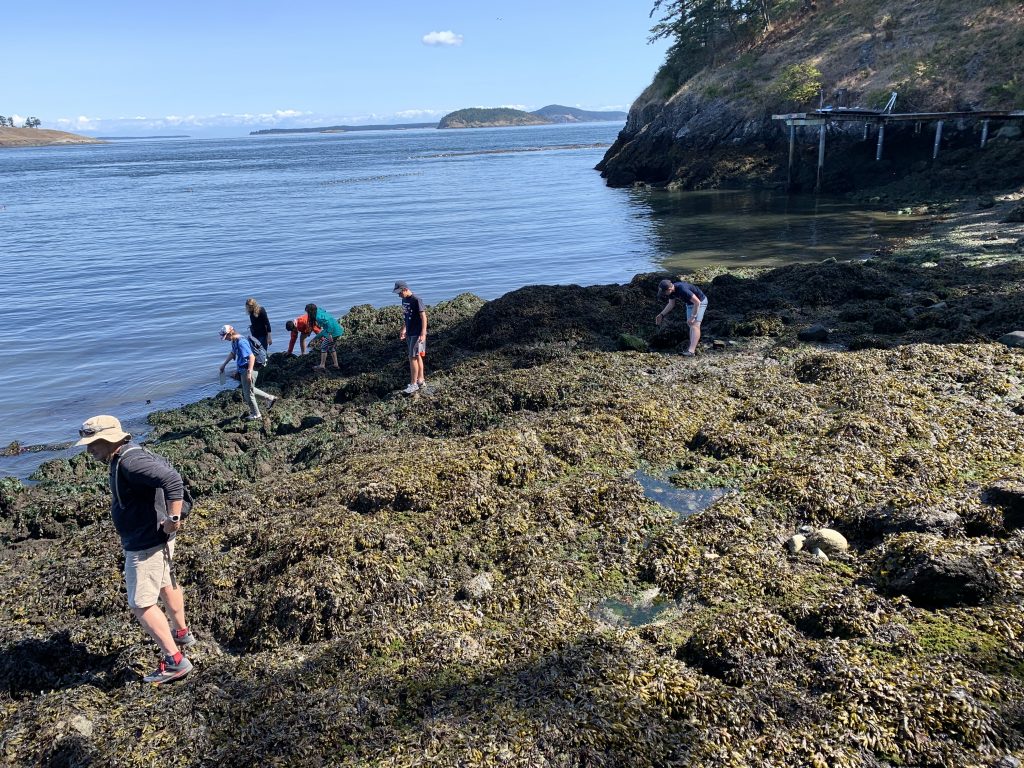
Once everyone had eaten and packed lunch, we headed straight to Lonesome Cove. In the intertidal zone, we were greeted with the salty smell of the sea and many seaweed covered rocks. After quickly changing into our water shoes, Miranda, who studies Sea Star Wasting Disease (SSWD) as a science co-instructor at SSS, showed us how to conduct a sea star survey. For the next two hours, we scoured the rocks for hidden creatures, carefully traversing the slippery seaweed patches and trying to avoid cutting ourselves on the sharp barnacles.

Everybody working together to spot stars on the beach! (Photo: Derek Smith)

We were amazed by the many bright red sea cucumbers and slimy anemones, but the most stunning animals were the bright purple Ochre sea stars. Unfortunately, due to SSWD, the population of sea stars of all species are greatly reduced; according to Miranda there used to be hundreds of orange and purple stars lining the rocks. But even despite the large declines, we were able to find 56 total stars, 22 of which were Ochre stars! Hopefully this data will help scientists around the world further understand SSWD and save the sea stars!

Kika and a sea star that she found! (Photo: Derek Smith)

When we were done, we had lunch on the beach; all of us enjoyed the perfect view of the ocean, with Canada in the distance. After a little down time at the dorms, (during which Joey beat Gray in a game of Xiangqi) Morgan gave a presentation about eelgrass wasting disease (EGWD) and explained how it related to our survey excursion. In her presentation, she honed in on different experiments that people have conducted to understand how EGWD spreads. Specifically, she told us about an experiment she ran to test whether EGWD transfers through the water column. Her team placed healthy eelgrass samples around different distances from a natural bed of eelgrass. Two weeks later they retrieved the eelgrass and tested it for EGWD. Her results showed that EGWD can spread through the water column, and that a concentration of only 6 cells/mL of the pathogen is needed to infect eelgrass. This presentation was extremely interesting and helped us gain an insight into how a real scientific experiment is run.

After that, Derek gave us an excellent and engaging presentation, full of colorful photos of various marine organisms. For his Ph.D, Derek studied marine ecology in various parts of the world, and the goal of his presentation was to help us understand what it’s like to work in his field. After pulling us in with beautiful data displays and interesting facts, he gave us an activity that would allow us to truly understand what it feels like to be a marine biologist.

For dinner we had vegan patties or chicken with delicious turmeric rice with a side of Israeli salad, prepared by Tom (Caroline’s Husband and excellent chef), Jacob, and Madelyn. We thoroughly enjoyed our dinner as we joked and conversed about the events of the day, happy with our sea star searching success.

We challenge you to figure out how to solve his puzzle – it’s not that hard and we put the puzzle and the answer below.

Derek’s Puzzle

Derek has analyzed tens of thousands of photos of different parts of the Salish Sea seafloor. With his accumulated wisdom, he has come up with three simple rules to determine the characteristics of where a certain photo was taken.

  1. Pink is shallow
  2. Orange is deep.
  3. Horizontal areas have less organisms than vertical areas. 

Using the rules, determine which characteristics each of the following 6 photos have. One has each combination (i.e. only one photo is deep and vertical). (Making a table is a useful thought organizer). Good luck! The answers are below the photos.

Image 1:

Image 2:

Image 3:Image 4:Image 5:

Image 6:

(Photos by Dr. Derek Smith)

ANSWER BELOW. SCROLL AT YOUR OWN RISK.

Answer: Soooo…. We don’t know the answers either. Now you know what it feels like to be a marine ecologist!! (This is what Derek did to us, unfortunately)