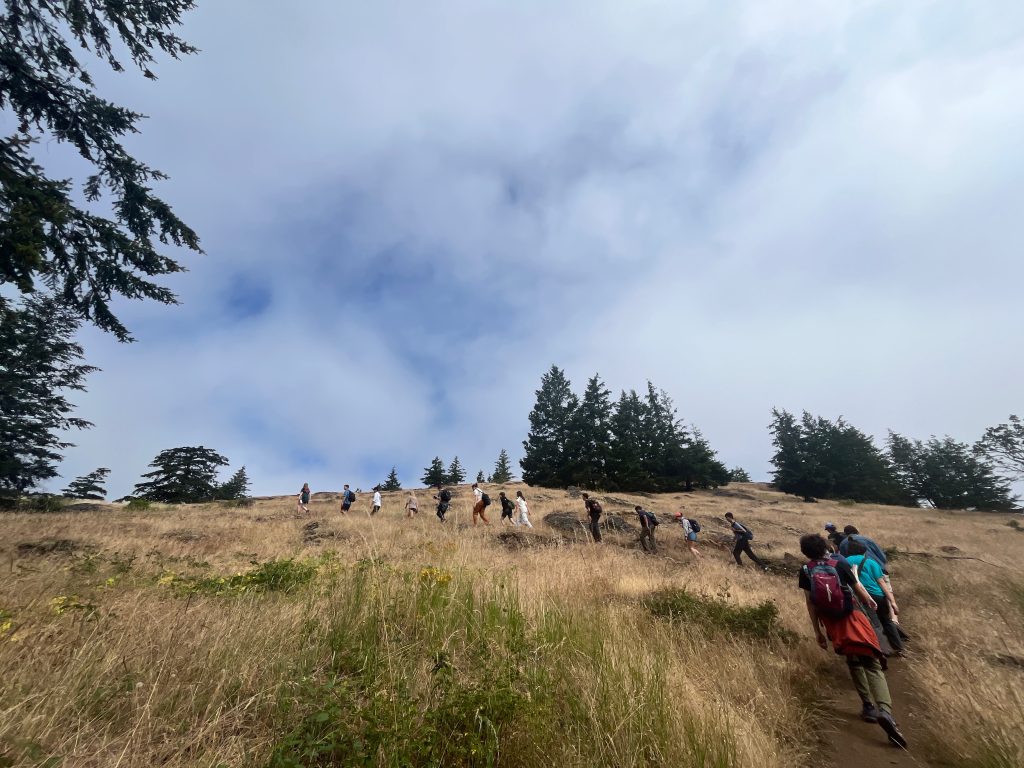
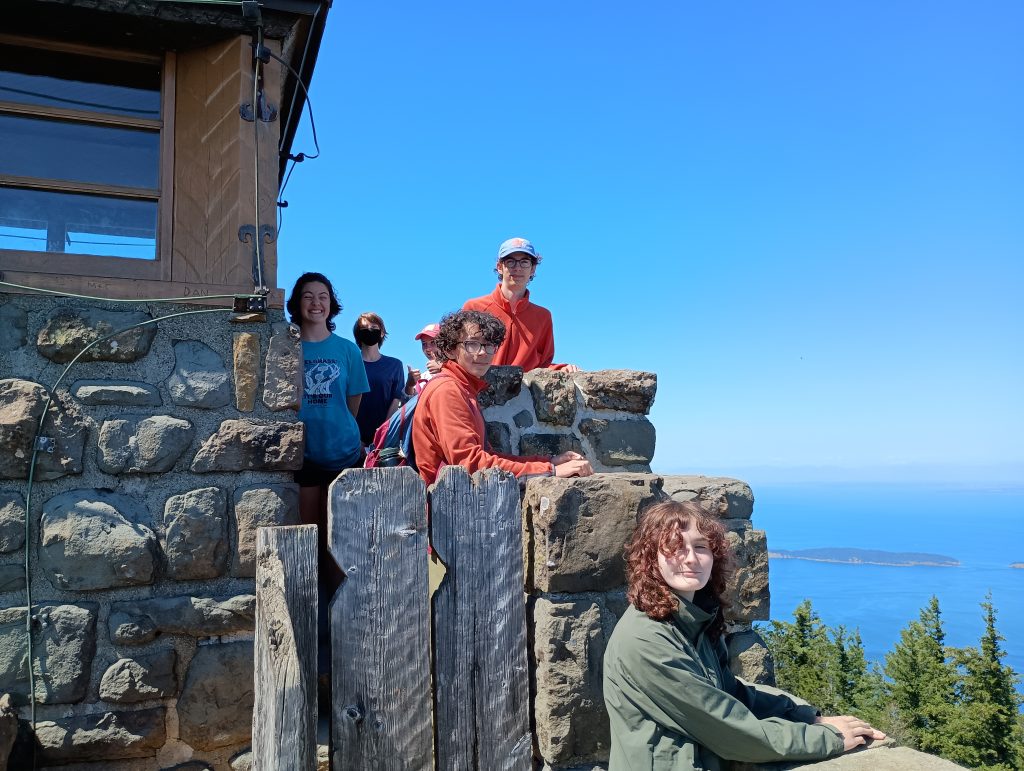
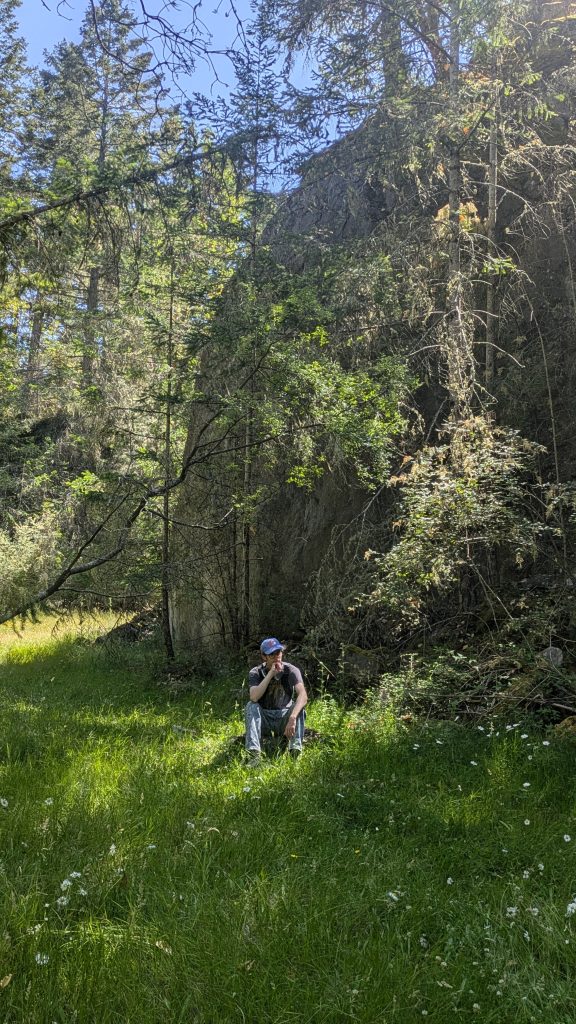
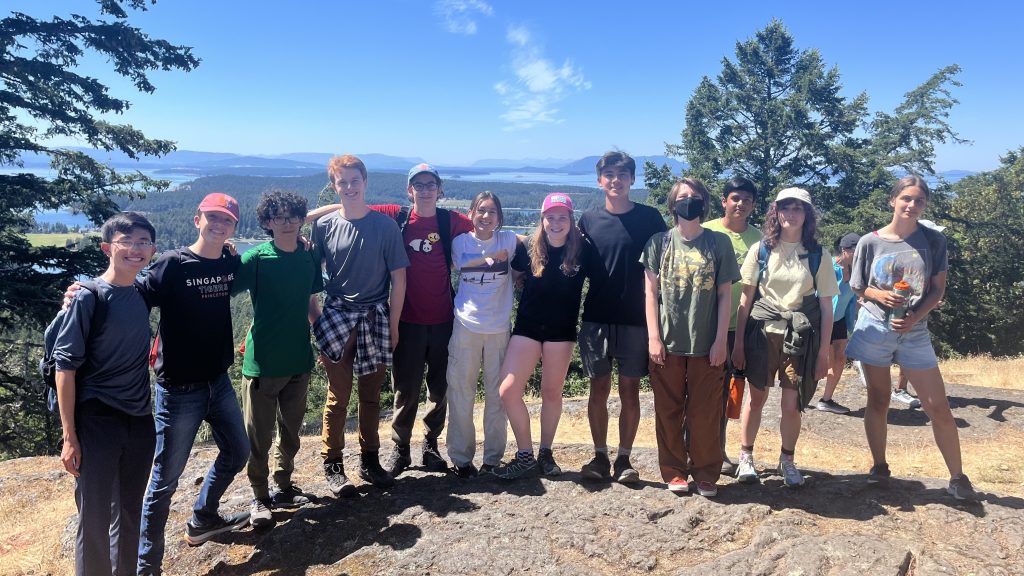
Today the group took a day off and headed to Orcas Island! After a short ferry ride over, we drove to Turtleback Mountain. As we hiked up, Riley, one of our science directors, gave us some background on the importance of preserving native plants in the Pacific Northwest. Specifically, he described his work with the Land Bank on Orcas Island. As we strolled, we noted the diversity of the plants, as well as the presence of native trees such as Garry Oaks, which land stewards and conservationists have been working hard to protect.
The group hiking up Turtleback Mountain to a scenic lunch spot (Taken by Katie Chin)
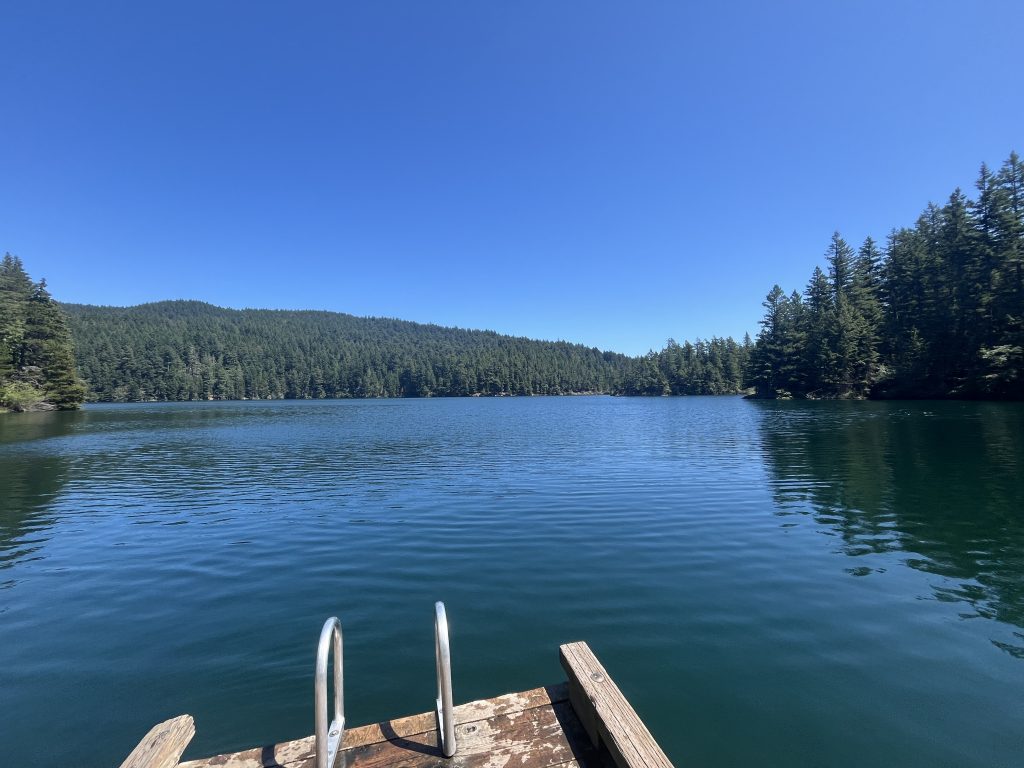
After Turtleback Mountain, we drove to Cascade Lake. Although the morning had been cloudy, the sun was shining when we arrived. We spent several hours swimming, paddle-boarding, and enjoying a change of scenery. Some people explored the lake on paddle boards and rafts, while others opted to sit on the dock, read, or fish. The water was warm, and everyone enjoyed a day off in the sun!
A view of Cascade Lake (Taken by Katie Chin)
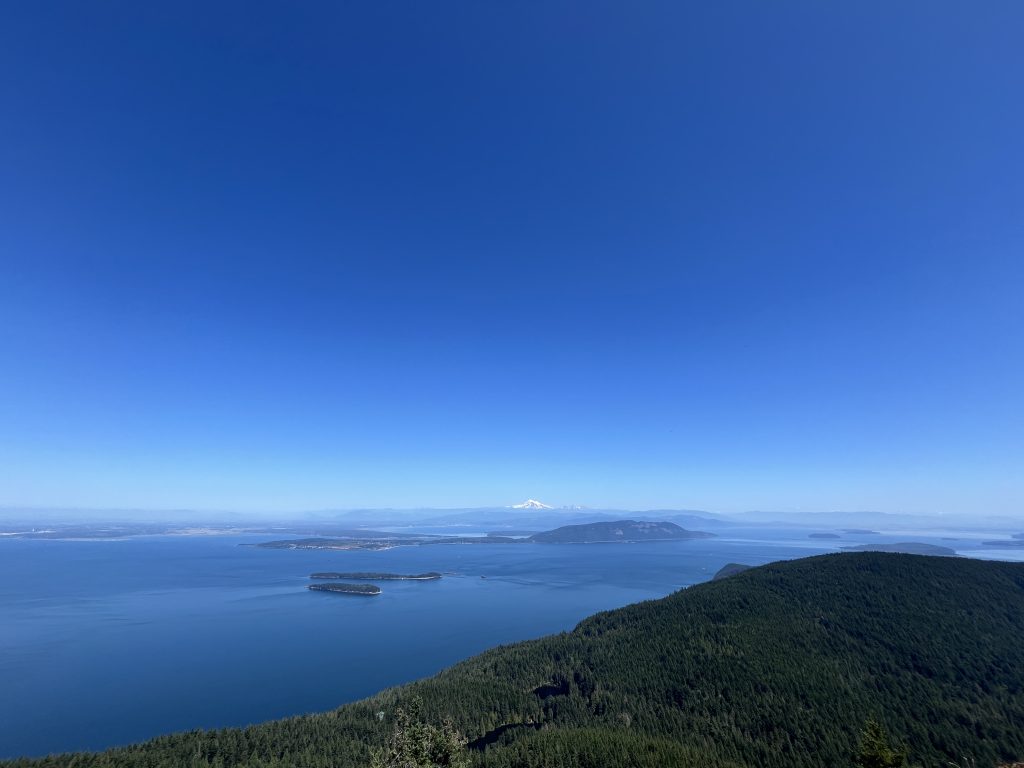
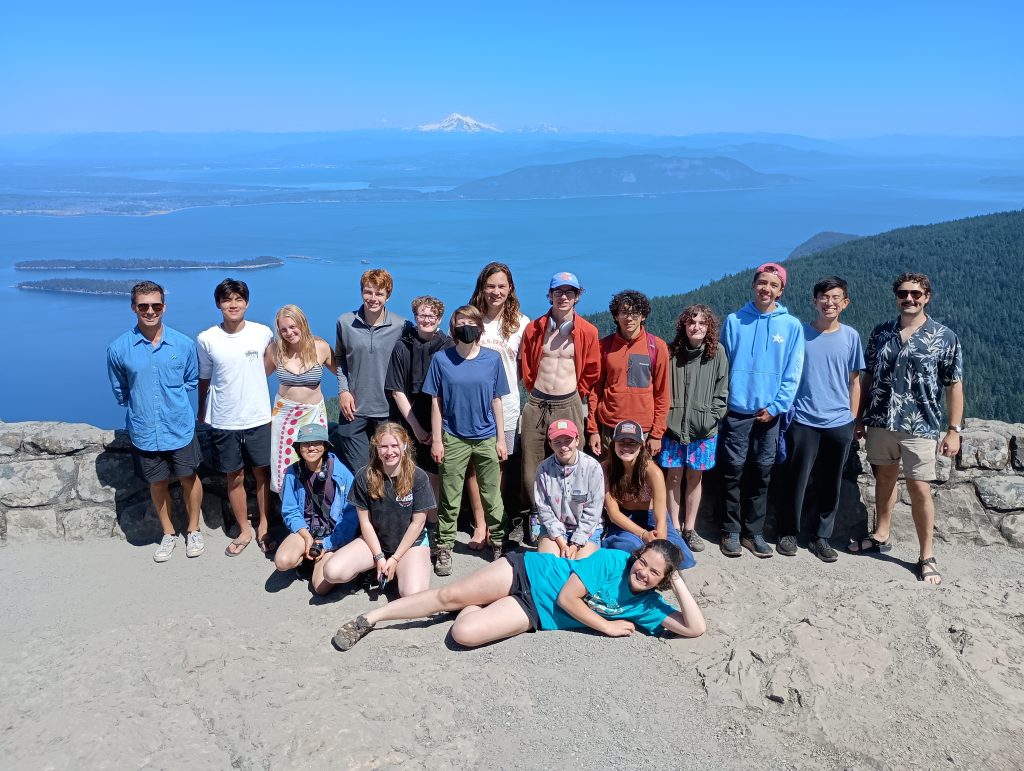
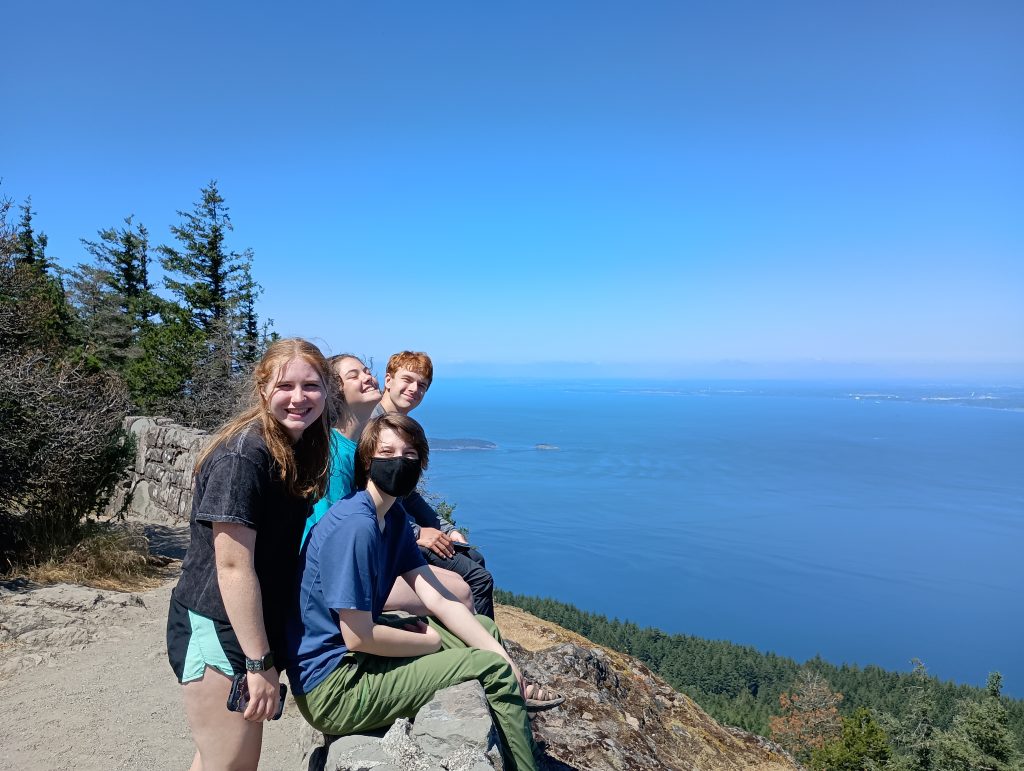
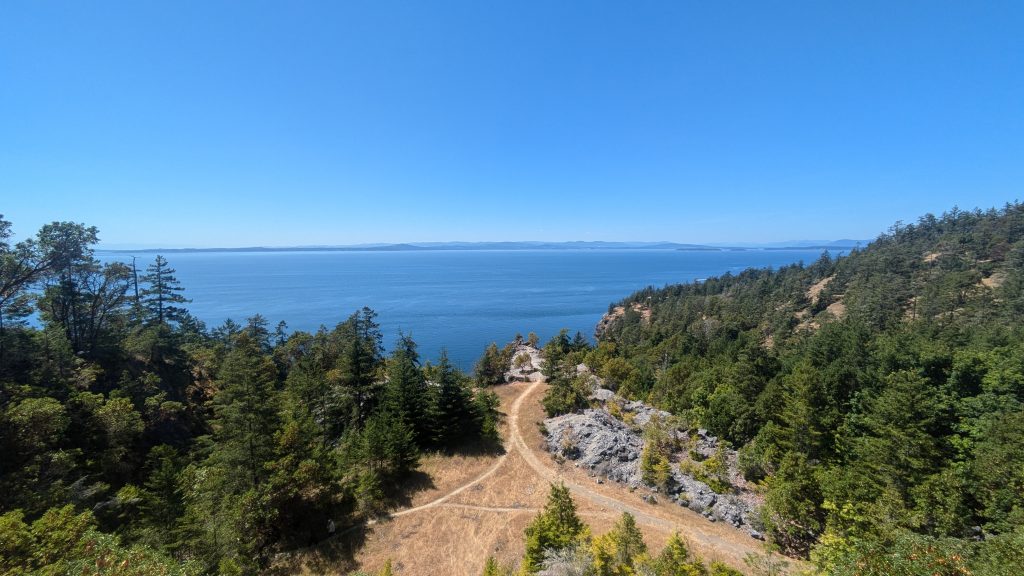
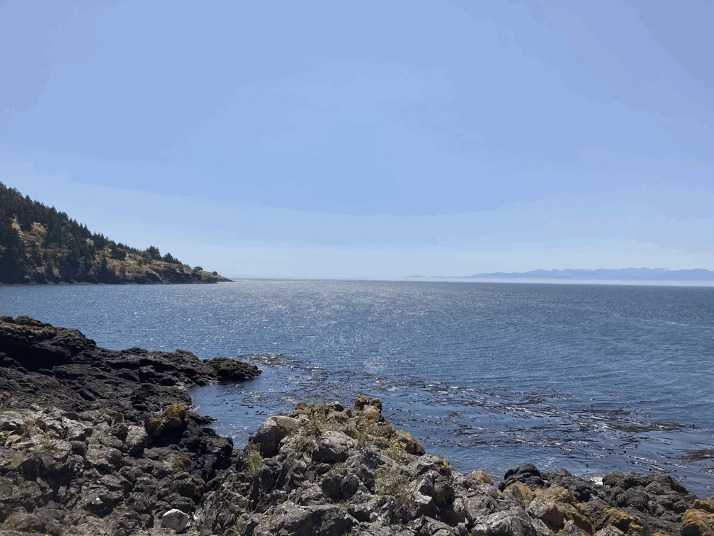
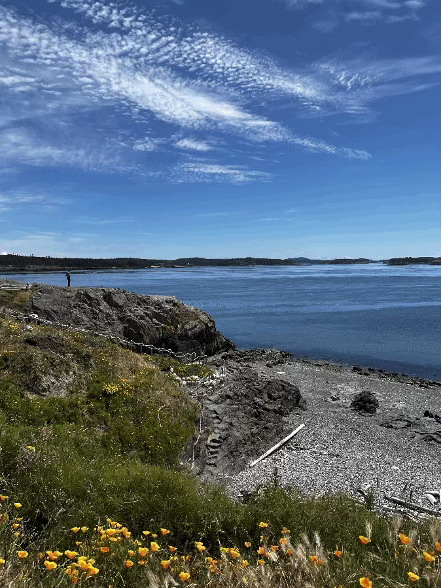
We then drove up Constitution Mountain for another scenic viewpoint. The beautiful weather allowed us to see the islands in the area, as well as catch a glimpse of Mt. Baker in the distance.
The view from the summit of Constitution Mountain (Taken by Katie Chin) Finlee, Soren, Tatum, Ian, Sam, and Claudia at Constitution Mountain (Sourced from Adam Rogowski) The group at Constitution Mountain (Sourced from Adam Rogowski) Morgan, Soren, Finlee, and Ben (Sourced from Adam Rogowski)
We then took the ferry back to San Juan Island. Once back at the dorms, the group reunited with Flora and Ansuya who had opted to stay back at Friday Harbor Labs for the day and work on their projects. Although we missed them at Orcas Island, we were happy to hear they had had a successful day of work. After a quick dinner, some people headed off to JP’s for trivia night and then caught the sunset with a view off the Friday Harbor docks.
We began our morning by heading straight into project work time. Most of the group spent time analyzing their data and working on posters. Tatum woke up early this morning to hang out with her Pigeon Guillemot friends and had lovely conversations with Dr. Amy Cook. Many of us are heading into the project enzone as the camp is coming to a close.
Geological Hike with Park Ranger Jeff Hodge:
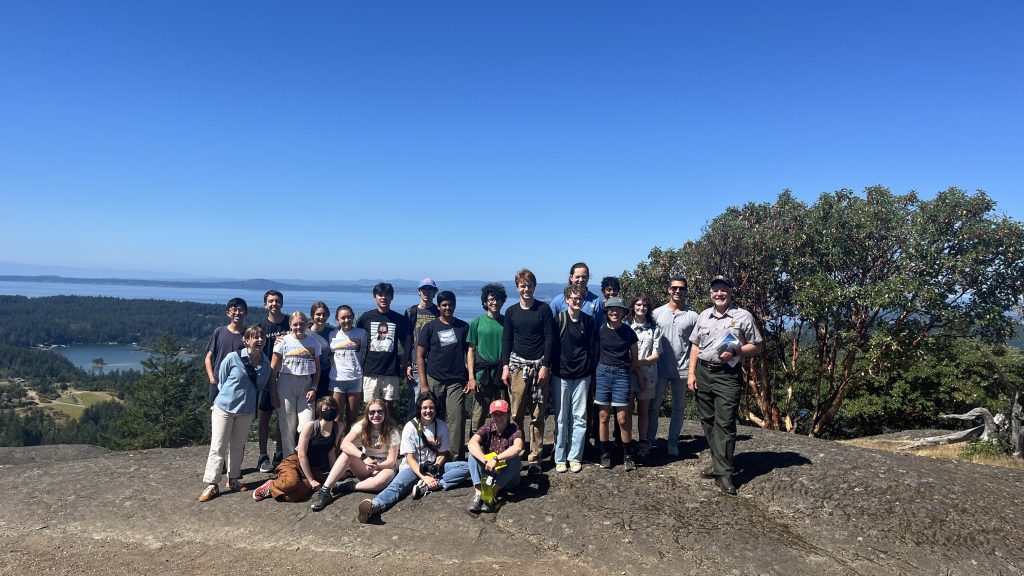
The group headed out on a tour of English Camp with Park Ranger Jeff, who gave us an in-depth look into the geology of the San Juan Islands, and the causes of development of the islands in the first place. We had a lovely hike up to the top of Young Mountain (Hill) with Ranger Jeff leading us to deeper thoughts about the geological creation of the islands. He mentioned to us how glaciers a mile high carved out the San Juan Islands. Thank you to Ranger Jeff Hodge for coming out and spending his time hiking and teaching us.
Photo credits to the nice lady also taking a hike
Friday Habor Labs:
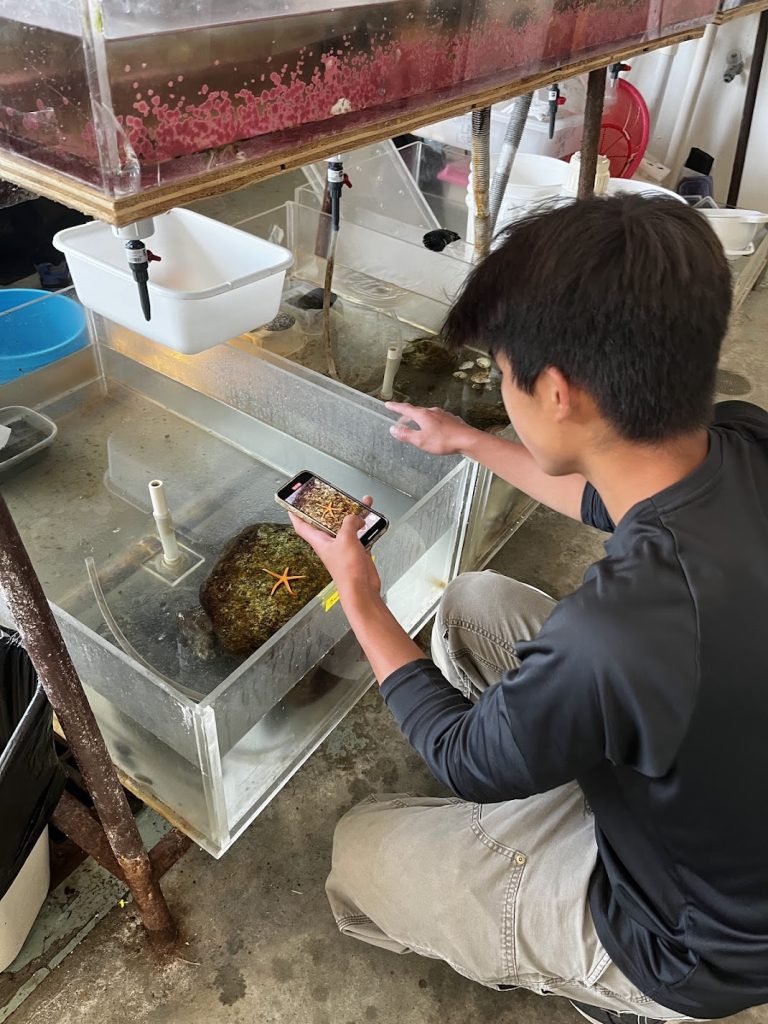
After the hike up Young Mountain, Ansuya, Flora, Scarlett, Nina, Max, and Ian headed to FHL to continue their research projects. Ansuya and Flora frantically ran around the lab, rushing to get their research done in the short timeframe. Conversely, Max leisurely ran tests on his seastars, Scarlett and Nina walked around the lab to get their data together, and Ian sat around learning the R coding language. Overall, it was a very productive lab time as all parties made steady progress on their projects.
-Image of Ian’s coding
Lime Kiln with Shauna Barrows:
Later we went to Lime Kiln Preserve which is run by the San Juan Island Landbank. There we met with Shauna Barrows a Field Assistant for said landbank who took us on an interpretive hike. Along the hike, we learned about the limestone mines and their effects on the local environment. We talked about the changes to the changes to the soil, specifically how they are now more rocky and have a higher pH. We also were taught about how many trees have adapted to San Juan Island. These trees have typically become better at living with more rocky soil, salty air, and low humidity. Many people working in the forests of San Juan Island predict that just like how it was found that the coastal juniper is different from the rocky juniper, other trees might be genetically different enough from their closest relatives to be considered a new species. Some of these supposed new species include Madrona, Big Leaf Maple, Douglass Fir, and Western Red Cedar.
Along the hike, we were shown an old quarry. Some of us wandered off from the group to explore the winding path through the quarry. Shauna Barrows afterward led us over to Carefree Lake where Northern Pike has been infiltrating the ecosystem, leaving devastating impacts on the ecosystem. We are exuberant for Shauna to join us at dinner tonight, to continue our conversations. If you want more information on the Land Bank head over to their website.
We started our day at the modest time of 8:00, waking up to prepare for our statistics workshop with the wonderful Dr. Cassandra Donatelli. We downloaded the necessary software, R, to get ready. After that, our paths divulged, with some staying at the dorms and some going to Friday Harbor Labs with our favorite Riley.
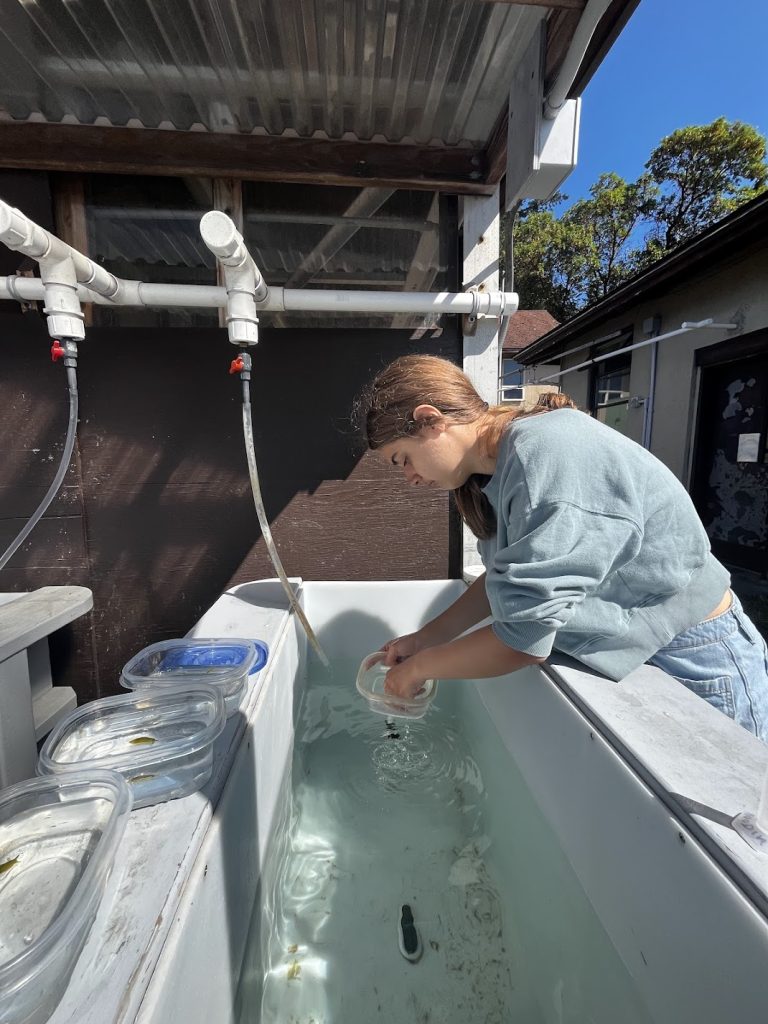
At the labs, many of us were continuing data collection, either in Dr. Billie Swalla’s lab space or down at Dr. Sandy’s tanks. It was a beautiful day on the island.
Salish Sea from FHL Taken by Scarlett
Flora and Ansuya were working on sea hare behavior, while Ian and Max were in the lab observing their behavior under certain stresses.
Flora working with the sea hares Taken by ScarlettMax observing a blood star Taken by Scarlett
Supervised by the wonderful Emma, the rest of the students plugged away on their individual projects: designing posters, analyzing data, and compiling all the information we’ve gathered over the past three weeks. It was more productive for some than others, but with the program coming to a close, all the students are locking in to get their projects done.
After an intense work period, everyone needed a well-earned break. Emma and Riley took us all to Community Treasures, an eccentric and abundant collection of knick-knacks, doo-dads, and proverbial diamonds. We wandered around the complex, exploring antiques, cassettes, and fascinating fits put together from the various oddities.
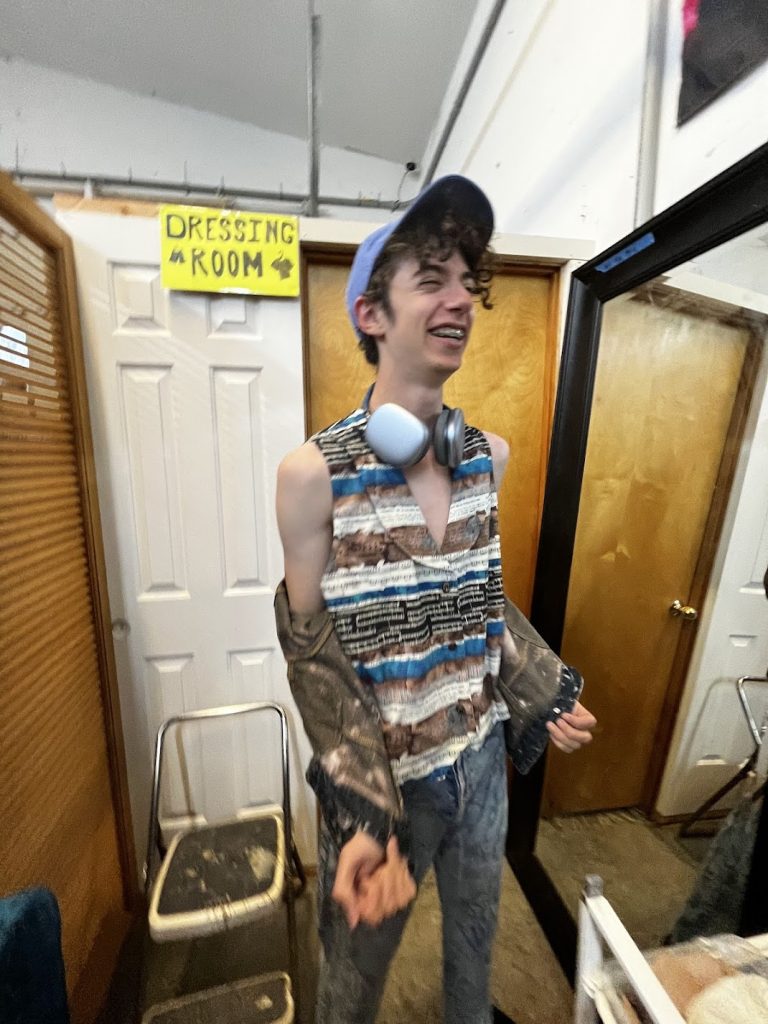
Sam in all his glory Taken by Scarlett
After our terrific thrift trip, we returned to the dorms for our statistics workshop! For a second pleasant time, we had the honor of hosting Dr. Donatelli to teach us about the R program. We learned how to do many things with our data, including creating plots, graphs, and making calculations. This was incredibly helpful and provided a strong backbone for our data analysis work.
Kindly recounted by Caleb Zulauf, Finlee Rice, and Tatum Bunting
After two days of running all over the island for various project needs, the students at Salish Sea Sciences were in need of a late start. Ever the generous leaders, our co-science directors Adam Rogowski, Emma Ledin, and Riley Conley granted us a 9:00 wake-up and a delicious hot breakfast this morning. Cassandra was kind enough to prepare waffles, sausage, bacon, and eggs for a lovely start to the day. Though most took advantage of the late start, a few students were eager to get on top of things and began work on projects (mostly eelgrass related) at FHL.
Once we had all regrouped, we continued our streak of untimeliness by barely getting out of the door at 10:20 to venture off to Friday Harbor High School.
Under the guidance and help of Sam Garson, we conducted a PCR (Polymerase Chain Reaction) to identify the species of various mussels we collected at Cattle Point. Frustratingly, the invasive mediterranean mussel is nearly impossible to distinguish from the native pacific mussel based on appearance alone. Because of this, DNA analysis is essential to gauging the presence of this intruder in the Salish Sea and beyond.
Mr. Garson, beyond guiding a very interesting lab, is an incredibly accomplished educator, communicator, and scientist who has worked on everything from deep sea exploration with the Nautilus to infectious disease at Children’s Hospital in Seattle. He is now utilizing his skills to encourage and inspire the next generation as a high school educator on San Juan Island. These authors would highly recommend reading about his unbelievable accomplishments in everything from managing ferocious army ants in the Amazon Basin to dominating spelling bees at the Kremlin. Or to learn more about his eventful past few weeks in Brazil, click here.
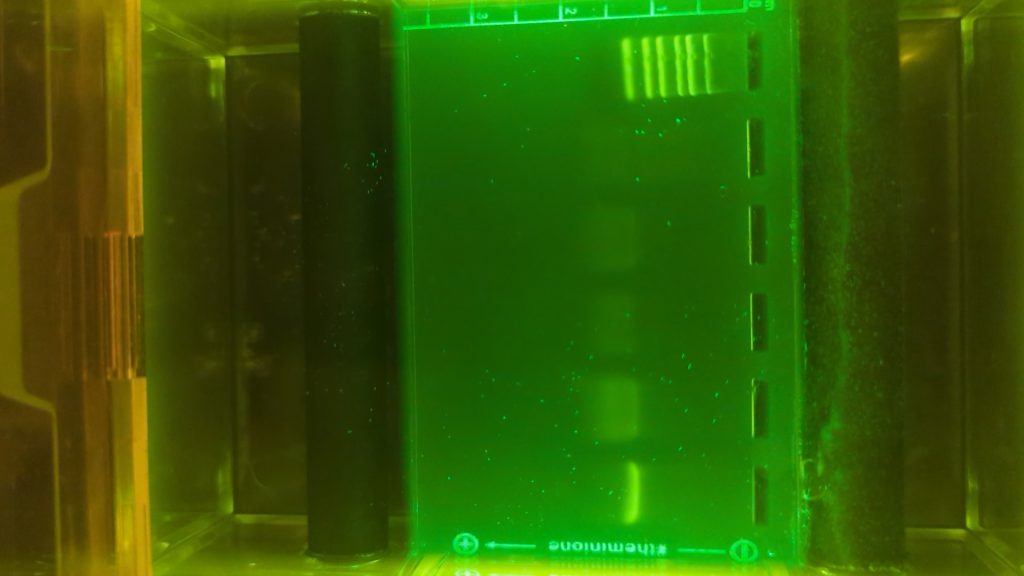
One of our less than ideal PCR results (photo credit to Caleb).
Utilizing a new type of TAQ polymerase, we were able to condense a multi day process into just a few hours. After crushing and extracting tissue from our mussels (some more gently than others), we created our PCR cocktail and eagerly awaited our gels to phoresis. After a few hours of careful micropipette work, deliberate mussel crushing, and many conversations about our deepest fears to fill the time, we saw… *drumroll please*… few legitimate results (likely due to the Jenga tower that is global shipping). Despite finding few results from our PCR tests, we did learn a lot about micropipetting, PCR (polymerase chain reaction), and invasive mediterranean mussels.
After saying goodbye to the icon that is Mr. Garson, we were scheduled to go on a hike with Shauna Barrows of the San Juan Island Land Bank at the Zylstra lake land preserve. Unfortunately it didn’t work out, and instead we had more project work time. A lot of us spent our time at the dorms compiling and analyzing data, learning how to use certain scientific tools (specifically dissolved oxygen meters), and observing wildlife. Another small group ventured back to the labs to monitor and work on their projects.
Tonight we are going to be dining on Tom and the kitchen crew’s finest (rumor has it spanakopita might be involved).
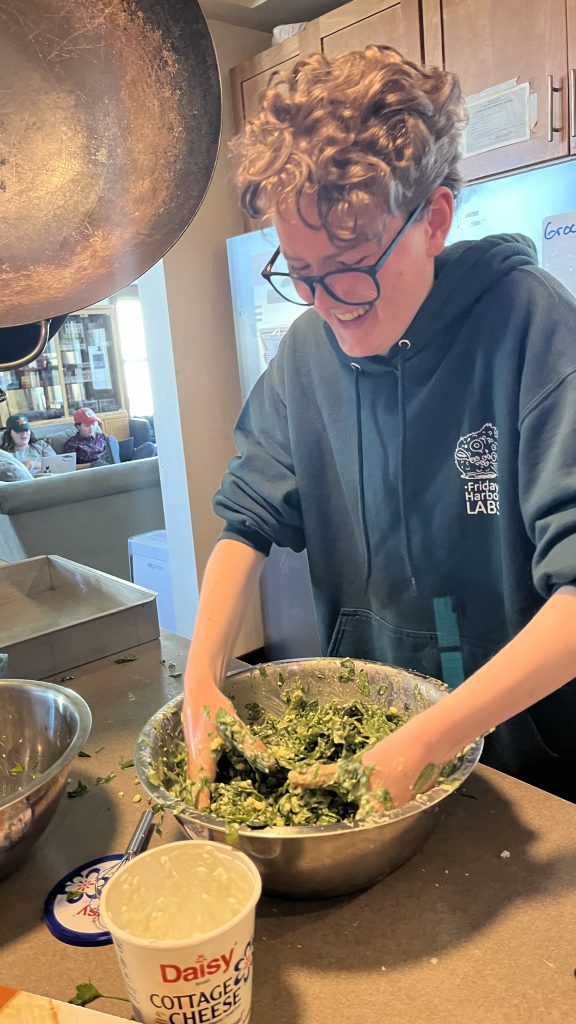
Gretchen thoroughly enjoying mixing the Spanakopita filling we look forward to enjoying (photo credit to Morgan)
We will be joined by Jess Farrer who is the Research Director at The Whale Museum and previously served as the San Juan County Marine Mammal Stranding Network Coordinator and Data Specialist. Currently, she is also working with SR3 (SeaLife Response, Rehabilitation, and Research) as a researcher studying Killer, Minke, and Humpback Whale populations in Antartica. She has extensive experience on this remote continent, having worked with the United States Antarctic Program studying Weddell seals at a small camp near McMurdo station and as a naturalist for National Geographic expeditions.
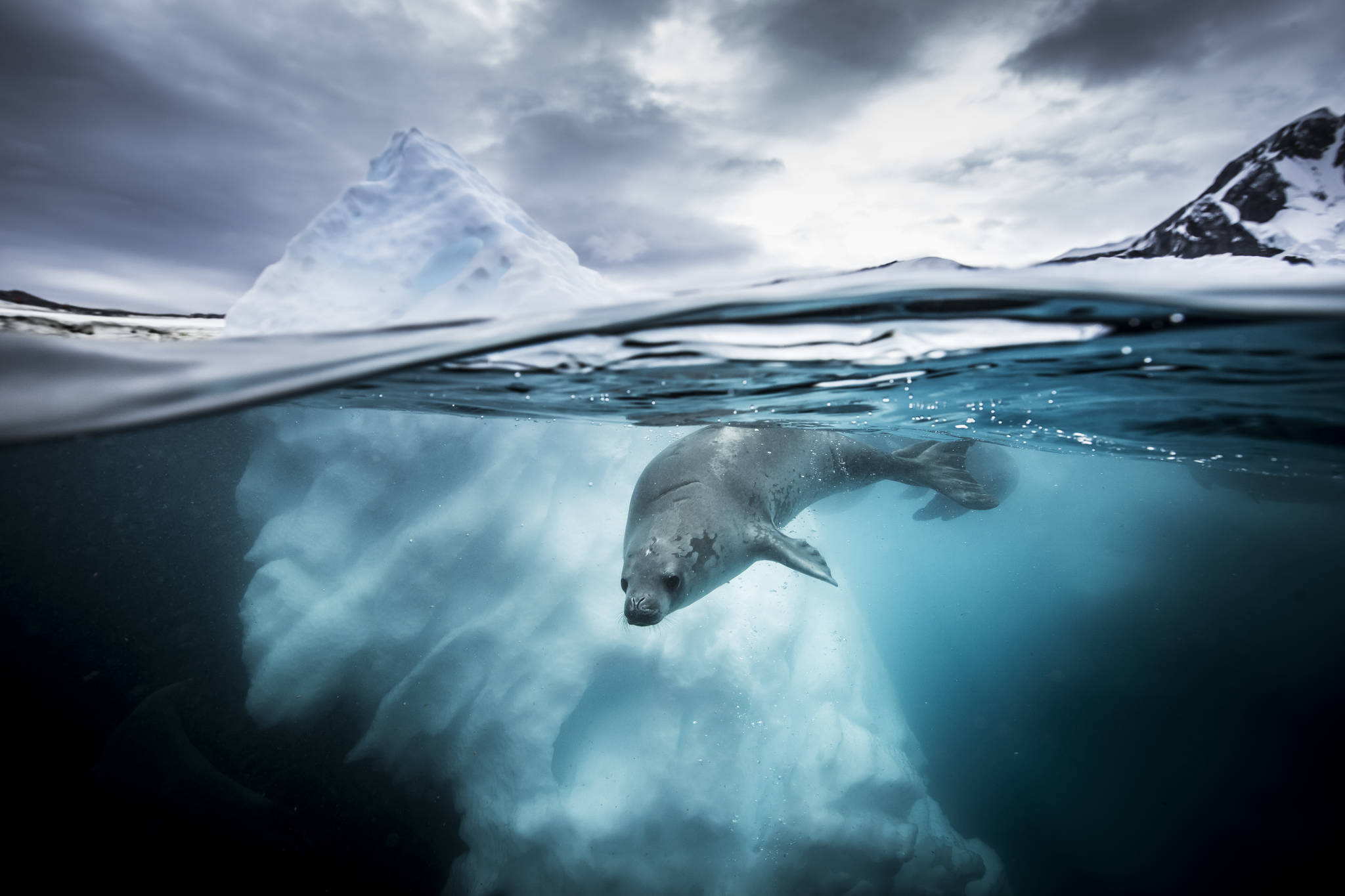
While working in Antartica, Farrer started utilizing photography and videography to document and share this incredible region. In 2019, the photo, “Curious Crabeater”, earned her runner up in The Underwater Photographer of the Year Competition in the wide-angle category. This award was founded in 1965 by British diver and magazine editor Bernard Eaton and it receives around 5000 entries every year.
On the videography side of things, (besides filming one of the most influential cinematic masterpieces of the 21st century, “Crybaby Learns to Swim”) Farrer has also worked with the BBC as a contributor to Frozen Planet.
Also, check out “Crybaby learns to Swim”, a video recorded by our esteemed guest, Jessica Farrer.
To explore more of her wildlife photography, find her on instagram @jessica_farrer.
We woke up earlier than normal to go to a harbor seal necropsy at FHL. Before we headed out, we spent half an hour cleaning the dorms, splitting up tasks so everyone could partake in the process. Upon arriving, we walked down the pier, only to discover the necropsy was not happening. This cancellation was due to no megafauna ex. seals, sea lions, or orcas dying and being collected to be examined. While a disappointment we were glad nothing had died.
Cattle Point
Picture by Nina Johnson
Caroline graciously drove Ben, Morgan, Finlee, and Nina to Cattle Point at 11:30 AM. Nina was in pursuit of mussels to use for her project and a group activity tomorrow. With Ben’s help, she collected over twenty. Morgan was also looking for organisms to support her project. Ben assisted Morgan in finding two crabs, a disappointing number compared to the success they had had the day before with a collection of over one hundred crabs. Finlee collected surf grass for her project as well. After a successful day at Cattle Point, Ben impressively carried a heavy bucket of seawater up the steep trail back to the lighthouse.
Friday Harbor Labs:
Sam, Ian, Flora, Ansuya, Scarlett, and Max went to FHL in the afternoon. Each person began working on their individual projects. This included Ian and Soren working with worms from Frankie Hedge’s Lab. Max started his data collection with blood stars. Ian began to ID polychaete worms collected from the night-lighting last night. Unfortunately, Sam lost one of his nudibranchs, meaning that he will need to transition to another project. Ansuya, Flora, and Scarlett met with Dr. Sandy Wyllie Echeverria to continue working on their projects relating to eelgrass and sea hares.
Harrowing hand happenstance
Picture by Nina Johnson
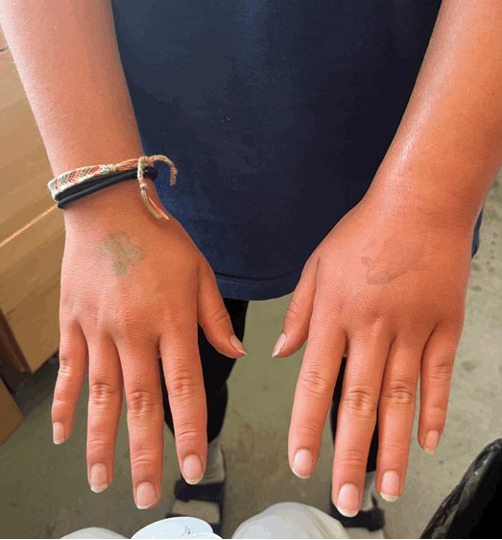
The day did not come without injury, however. Scarlet’s left hand, stung by a wasp yesterday, began to swell like a balloon. Caroline stepped in and assisted in a journey to Urgent Care. Luckily, it was not a severe injury.
Other Sites:
While most of the group was at FHL, a small portion split off to work in the field. Gretchen and Katie headed to Argyle Lagoon to survey chitons, Sid headed to Eagle cove to record aggregating anemones, and Claudia headed to 4th of July Beach to collect eelgrass samples.
LimeKiln State Park:
photo by Claudia
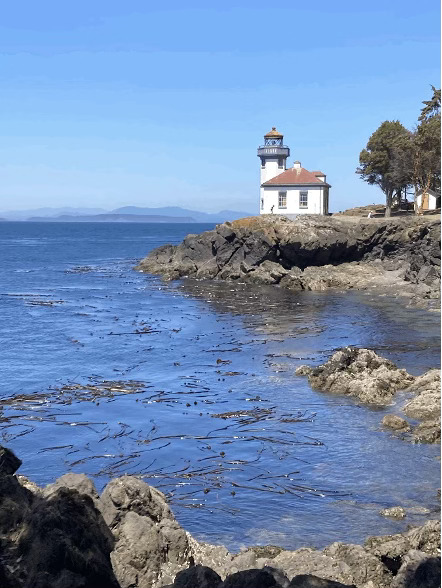
Meanwhile, the rest of us headed over to Lime Kiln State Park where we were given a tour by Erin Corra, the founder of FOLKS, a nonprofit that works to provide education about Lime Kiln State Park. We learned about the park’s history as well as its environment, all the while admiring the wonderful view of the lighthouse. We ended off our tour with a visit to the hydrophone, where we learned about the importance of using research methods that do not impact our environment.
Photo by Adam Rogowski
Seminar:
In the evening, we went to a seminar on diversity, equity, and inclusion by Helen Yip. She addressed the importance of scientific perspectives from marginalized people, as well as promoting women in STEM. Her fascinating lecture incorporated a lot of audience participation, and we learned a lot!
Note: This post was originally interactive, but WordPress does not allow hyperlinking within a document, so now you just have to scroll.
Good morning! After a restful night’s sleep, the world seems ripe with possibilities. How will you start your day?
Go to Friday Harbor Labs
Collect data at the beach
Work in the Spring Street Lab
Watch the pigeon guillemots at the docks
Welcome to Friday Harbor Labs! By appointment you can…
Meet with Dr. Sandy
Go to the fish lab
Eelgrass symposium: Flora, Ansuya, and Scarlett
You meet Dr. Sandy in his office. In a packed 45 minutes, he reviews your procedure, gives you valuable input, and imparts a few life lessons. You learn the importance of precise language and providing scientific reasoning behind the choices in your procedure. You now have several other trials that you need to perform in preparation for your experiment including observation to determine how long it takes for a sea hare to get hungry and a test run of scraping the epiphytes off an eelgrass leaf to determine how much the sea hare eats. In preparation for the germination of the eelgrass seeds, two of Dr. Sandy’s tanks must be cleaned and filled. You embark on a quest to gather the variety of pipes Dr. Sandy directed you to, during which you run into Adam and Soren. CONTINUE TO ORIGAMI BITES BACK.
Formalin Fish Fun- Soren (and Adam)
“I want to live here one day.” – Soren
You accompany Soren and Adam to the fish lab. Future Dr. Meg gives you a tour of the wet specimens.
Surprise: You found a diaphonized frog specimen!
Diaphonized specimens are made by using a chemical solution to clear the organism. Then dyes are added, the pink dye is attracted to the collagen rich bone and the blue to the cartilage.
Soren is doing his project on the preservation of wet specimens. Wet specimen refers to an organism that has been preserved in liquid. The organism is first placed in a fixative liquid (usually a formalin solution) this will halt any decomposition and the organism will stiffen into the position it is placed in. After around 24 hours the organism will be removed from the solution, rinsed in water, then go through a dehydration series. Placed first in 25% ethanol alcohol gradually it will be moved through higher concentrations of alcohol until it will be indefinitely preserved in 70% ethanol alcohol.
Hooray! Future Dr. Meg agreed to help Soren with his project. With her help, Soren will test how well different species hold up to preservation.
You have extra time before lunch, you help Adam sanitize sea water for Claudia’s experiment. On the way back to his office, you run into Flora, Ansuya, and Scarlett. CONTINUE TO ORIGAMI BITES BACK.
You and five others head down to the tanks in order to clean them. As you begin to wash the tanks, Scarlett yelps. Something has bit her! Upon further investigation, you discover a wasp nest on one of the tanks. These are paper wasps, distinguished by their tendency to bite rather than sting. As Caroline informs you later, their hive essentially functions as a condo where females lay eggs and feed their own young without forming close connections with the other wasps.
Adam, allergic to wasps and notorious for not carrying his epi-pen, informs Dr. Sandy of the hive. The daring Dr. Sandy assures you he will take care of it. Thwarted once again by circumstance, you return to the dorms for lunch.
Choose to
Return to the dorm
Follow Dr. Sandy’s sidequest
Ahoy! Welcome to the docks…
Pursuing Pigeons- Tatum
You and Tatam head down to the docks to observe the pigeon guillemots. Tatum finds a way to survey the birds that will allow her to establish a baseline of their behaviors. Watching the birds is a meditative experience, though the ferries were extremely disruptive. Interrupting both the vibe and the view. After a successful day of collecting preliminary data you and Tatam head back to the dorms. CONTINUE TO DORM.
Welcome to the Spring Street Lab! Though she be little, she is fierce.
Sand Dollar Shenanigans- Caleb, Finlee, and Claudia
“I’m out of my depth, I’m just an average Joe!”- Caleb Zulauf
Yesterday, Caleb acquired sand dollars from FHL. Today, you help him extract gametes by injecting potassium chloride into the center of the five septa for his experiment which will test how pH affects sand dollar development. Perched on a beaker, the cilia of the sand dollars wave in hypnotizing patterns. Cooped up in the lab all day, surrounded by super-sanitized glassware and a strangely UFO-shaped centrifuge, you feel like you’re boiling alive. You struggle to keep all your water cool. In the end, it’s all worth it, as you fertilize the eggs. Tomorrow, you will have larvae.
You’re collecting Data at the beach!
You’re headed to the field, but what beach do you choose?
Cattle Point Beach
Deadman’s Bay
Go to Cattle Point Beach
Focus on:
Mussels
Nudibranchs
Muscles and Mussels- Nina & co.
You accompany Nina on a perilous quest to collect mussels from the rocks for her project. She will observe the effects of temperature on the strength of mussels’ byssal threads. In her intrepid attempts to pry the bivalves from their substrate, Nina bangs her head on a log and injures her knee. Luckily, others are nearby, and she promptly receives help.
Oh no! You forgot the knife and spatula used to scrape up the mussels at the beach. Head back to the beach to collect the abandoned items then go back to the dorms. CONTINUE TO DORMS
The Elusive Red Sponge Nudibranch- Sam & co.
“There was more Ulva than seawater” – Sam Feit (frustrated)
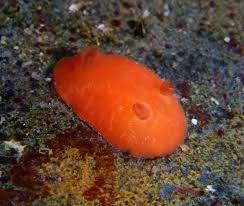
At cattle point, you assist Sam, Max, Nina, and Ian in their pursuit of red sponge nudibranchs for Sam’s project which involves observation of their egg-laying behaviors. Max spies and collects one in the first ten minutes, but you spend the next hour up to your thighs in seawater. Due to the high density of sea lettuce, your visibility of everything below the surface is extremely obscured, and you do not find any more. Sam nearly loses a finger to a red rock crab and your boots are now full of water. You drop the one nudibranch off at the labs then head defeated back to the dorms CONTINUE TO DORMS
Congratulations! You have chosen to go to Deadman’s Bay!
You now have another choice ahead of you.
You can focus on:
Chitons
Limpets
Crabs
Anemones
Coasting with Chitons- Katie and Gretchen
You and a friend start a survey looking at the mossy chiton. Starting from the rocks then heading deeper into the intertidal zone. Your mission is successful! You find many mossy chitons! Afterwards you head back to the dorms. CONTINUE TO DORMS
Out of the Tide Pool, into the Bucket- Matt
You notice that he has a heavy heart due to some unforeseen circumstances regarding his project and some recent changes. You also realize that he is armed with a scraper and a spatula, which vastly increases his chances of collecting more mossy chitons at the beach. However, all hope is not lost. You and him work together to collect a whopping 6 mossy chitons at the beach, heading back to the dorms on a high note. CONTINUE TO DORMS
Looking for Limpets – Tyler
You get out to the beach after a short drive with 6 others. With your quadrant and transect in your hands, you pick a good spot and start taking some measurements. Your data sheet in hand, you start noting down how many limpets are in the transect. Finger, shield and mask limpets are dotted throughout the rocky intertidal area as your paper slowly starts to fill up with numbers. You head back to the dorms with a sense of accomplishment knowing that all your data is now collected. CONTINUE TO DORMS
Sticky Pincers- Morgan and Ben
With a couple good buddies on the journey, you are glad that you are able to get outside to look at some crabs to help with Morgan’s project. You find an assortment of crabs hidden underneath the wide variety of rocks found at Deadman’s Bay. You also eat a delicious sandwich lunch while you are there. With full stomachs and crab buckets, you head back to the dorm. CONTINUE TO DORMS
Image by Morgan Aman
Sea Anemone Roundup – Sid
You set out to collect data on Sea anemones, using a transect. You are fairly successful, ending up with 20 data entries by the end of the expedition. The anemones seem to grow better in the sun, but still the data is inconclusive and more information is needed. You head back to the dorms. CONTINUE TO DORMS.
It’s lunchtime! Thanks for collecting data with us. You return to the dorms for a quick bite to eat. Meanwhile…
Fighting Fire with Oil- Dr. Sandy Wyllie-Echeverria
When Dr. Sandy receives Adam’s message about the wasps, he fearlessly takes it upon himself to clear the creatures. He strategically selects his weapon- a can of WD-40. After dousing the nest, he rolls coolly up to maintenance to inform them of the situation. Wasps begone!
We have a few more decisions for you to make…
You can either:
Relax at the dorms
Accompany students to Friday Harbor Labs
Sea Hare Fliplimpics- Flora and Ansuya
Image taken by Flora Vaught
After a brief detour (due to wasps) during which you run into Future Dr. Frankie and Future Dr. Yohan, you head back to the labs to finish your preparations. As the hose method of washing the tanks is not working, you resort to bailing it out with a sponge. You are concerned when you begin filling the tank and the water appears dirty, but soon remember that is normal, as it is seawater. You proceed to gather two sea hares from Dr. Sandy’s tanks and accompany Ansuya and Flora to the lab space Dr. Swalla has so kindly allowed you to share. The test you perform will determine how long it takes for a sea hare to get hungry, a crucial detail in Flora and Ansuya’s projects. This is determined through the amount of time it takes for the sea hare to right itself after being flipped over, as this can only be performed when all of the sea hare’s biological processes are occurring properly. After acquiring the data you need, you return the sea hares to their tanks. Finally, you enlist Adam to assist you in examining the eelgrass Scarlett courageously dived blind to collect at 4th of July beach. You are looking for signs of eelgrass wasting disease which is caused by a protist that enters the plant through lesions. This is related to Ansuya’s experiment which will compare sea hare’s grazing habits on healthy and diseased eelgrass. CONTINUE TO DORMS.
You’ve almost made it through the day! You only have one more decision to make!
Head to the beach
Relax in the dorms
Sunbathing at South Beach- The Pebble Pitchers
“So what are we supposed to do now?”- Ian Gafford
Although you probably thought you were going on a hike, you are pleased to be redirected to a north-facing beach for some brief fun in the sun. As Tatum emphasizes, this beach has it all: a gorgeous mountain view, a comfy pebble beach, and a variety of colorful stones. Snacking on grapes, you enjoy the plunk of the pebbles in the calm waves.
Detour! On your way back from the beach, you head to Cattle Point to retrieve Nina’s abandoned implements. CONTINUE TO DINNER
Decompress at the Dorm- The Tired Troupers
You’ve probably been wondering what Salish Sea Science students get up to in their scant free time. Some choose to hang out in the common area working on their posters, or getting some leisure time. Some people go for a walk around the town. Some people even take a nap! Really, it’s just relaxing and recharging after a long day. CONTINUE TO DINNER
Hungry? Good thing it’s time for dinner!
Infiltration- The Mussel Maniacs
Image taken by Flora Vaught
We all come together at the end of the day to eat dinner. You and all the others are happy to welcome our guest speaker Dr. Mike Nishizaki. After dinner we all circle up to listen to Dr. Nishizaki talk about 3 of his ongoing projects including investigations of the effects of temperature fluctuation and water flow on mussels. He also mentioned one of his creations. Robo-mussels! Robo-mussels are engineered to mimic real muscles in order to gain accurate temperature readings. He leaves us with beautiful stickers designed by one of his students, Raquel Santamaria Germani, that contain a QR code which leads to an in-progress poster of the muscle bed ecosystem.
It’s finally dark… Get your headlamp on, we’re going nightlighting.
Fear is the Mind Killer- The Polychaete Pursuers
Image taken by Katie
After dinner you and the rest of the students wait for darkness to fall. Then everyone heads out to the docks at the Friday Harbor Labs. At the docks a light probe is lowered into the water and you watch in amazement as it illuminates the water allowing you to see a myriad of organisms. Ian and some other students are there to collect polychaete worms for their projects. With his delicate hand and dubious British accent, Adam summons the worms from the depths, along with a few “propa fish”. Caleb is a menace with the net, snatching up unsuspecting worms left and right, even braving a bite from the biggest. Ian, the worm whisperer, is thrilled to collect more than enough worms for his experiment.
Suddenly, Katie gasps in shock. There’s a harbor seal! You watch as the seal circles around the light, dipping in and out of visibility. When the seal disappears you gaze up at the starry night sky with Sam until it’s time to head back to the dorms. Once you get back you can feel your eyes telling you it’s time to fall asleep. You get ready then fall into bed. As you close your eyes you look back at everything you did today. So much was going on, no one person could experience all of it. Perhaps you should ask others about their days, listen to their stories and see what choices you could have made.
Congratulations! You’ve made it to the end of the day. Crawl into bed for your beauty sleep before the next packed day tomorrow.
Those who didn’t need to start their research project piled into the vans for a trip to Westcott Bay Shellfish. As the name implies, they grow shellfish, mainly Pacific Oysters but also a few types of clams, mussels, and even Olympia Oysters. Today, we got a tour of the facility from Chaz who told us all about the history of the Westcott Bay Shellfish Company. We learned the company started farming oysters in the late 70s. Chaz also told us about how oyster farming isn’t the easiest as it involves a lot of strategic planning. Growing these oysters is very difficult due to the high mortality rate. To account for this, Chaz and his team change the “cages” of the oysters every six months, checking sizes and overall health. Chaz also discussed how harmful algal blooms (HABs) are monitored. Every week, the company sends in mussels for science to test for neurotoxins and bacteria. Luckily, the Westcott Bay Shellfish Company hasn’t had to shut down the company due to HABs, as the bay is pretty protected. After the discussion, Chaz continued his tour and showed us the equipment that is used to collect and store the shellfish. At the end of the tour, we were able to check out the same and larger oysters that were gonna be shucked today! We are extremely grateful to the Westcott Bay Shellfish Company for allowing us to tour their establishment and telling us the intricacies of shellfish farming.
To complete their research projects, many people traveled to different parts of the island to collect data and specimens. Today, Sam and Gretchen needed their respective data from Cattle Point: Sam searched for red sponge nudibranchs, while Gretchen set out to complete a survey on mossy chitons and the algae surrounding them. Unfortunately, the trip was unsuccessful, as Sam only found 2 of his 8 needed nudibranchs. Thankfully, Gretchen made some ground on her research on mossy chitons as she managed to find 10 chitons in her survey of the intertidal zone.
Photo Credit to Gretchen, in the picture above there, are 4 Mossy Chitonshttps://www.inaturalist.org/guide_taxa/2821
Eagle Cove:
Cassandra and Jeff drove the gang over to Eagle Cove, where we all bathed in the sun and played in the water. Matt and Sid cut up Bull Kelp to create horns and played notes together, and even attracted a couple of folks asking how to do it. Max, Nina, and Scarlett took a paddleboard out into the water and had some fun, and Sam, Katie, and Ansuya had a blast reading. When it was time to head out, everyone gathered their stuff and made it back up the big hill. Everyone was sad to leave their Bullhorns and reading perches, but we all piled back into the vans to meet Finlee, Caleb, and Gretchen back at home, as they had been hard at work at FHL.
-Photo credits to Morgan, in the middle is Cara, and off to the right is Soren jumping into the waves
-Photo credits to Morgan, in the picture is Cara playing in the sand
Trivia:
The group ended the night with an exhilarating trivia game at JP’s. We had to split up into three teams because we were too big of a group: the Chill Pickles (Caleb, Nina, Soren, Ben, Katie, Gretchen, and Finlee), HABs (Scarlett, Sam, Ansuya, Max, Flora, and Tatum), and Brevetoxins (Sid, Ian, Matt, Tyler, Morgan, Claudia, Cassandra, and Cara) We even got our own category! The science directors, Adam, Emma, and Riley banded together to create a super-team, and in the end, Adam led his team to victory with a second-place tiebreaker, a quick bowling match.
-Photo credits to Max, in the picture is Adam about to lead his team the Chase Fan Club to the victory of second place
^ A conglomerate of eager researchers. Photo by Katie.
By Katie Chin, Sam Feit, Max Liu, Scarlett Thornton
The day began with a pleasantly late start and a quiet (although rejuvenating) breakfast, allowing us to slumber through the long night, and recover after yesterday’s laborious schedule.
After filling our bellies with food, we set off to 4th of July Beach to observe the diverse and magnificent intertidal seagrass habitat. With our captains Riley and Emma at the wheel, we arrived at our destination with due diligence and pace.
^ Students on their way down to the beach. Photo by Scarlett.
We met Dr. Olivia Graham, an eelgrass extraordinaire who has been researching the vital organism for years. Accompanying her was Michiko the dog, her loyal companion and an invaluable assistant in our ventures. Our time with Dr. Graham began with reading up on different aspects of eelgrass, such as biology, importance, and need for conservation.
^ Esteemed Shih Tzu researcher Michiko. Photo by Katie.
After our reading and subsequent group discussion, we headed down to the beach to explore the low tide, and the newly exposed eelgrass meadow. Dr. Graham explained that once, the meadow was so dense you could barely take a step without landing on some eelgrass. But now, it was easy to see the swaths of eelgrass that had been wiped out by the seagrass wasting disease–which forms the basis for many of Dr. Graham’s studies.
Following twenty minutes of exploration, we were joined by Dr. Becca Maher–a postdoctoral fellow at Friday Harbor Labs–and Angie, an undergraduate spending her summer at the labs. They enlisted our aid in collecting eelgrass specimens for Angie’s project, which involved comparing the various microbiomes found on healthy eelgrass. While the eelgrass itself was fairly abundant, finding healthy, hearty leaves was difficult: we were limited only to selecting the second rank leaf of the entire plant, and the vast majority of them were stricken by various ailments, ranging from heat damage to wasting disease. But despite our struggles, we ended up collecting 30 samples with the help of Dr. Graham, Dr. Maher, Angie, Emma, Riley, and most importantly, Michiko.
^ Students hard at work gathering eelgrass samples. Photo by Katie.
After bidding our farewells to the FHL researchers, we headed back to the dorms for lunch and some work time for our research projects. Some members of our cohort split off: Sam and Tyler collected samples at Cattle Point; Ansuya, Ben, Max, Gretchen, and Caleb visited the Friday Harbor Labs to meet with scientists and collect data. Everyone else remained at the dorm, some in the lab beginning preliminary work, and others back in the common space, diligently plugging away at their research.
And soon this evening, we’ll have the pleasure of dining with Shauna Barrows, a field steward with the San Juan County Conservation Land Bank! We look forward to hearing her story on how she got involved with the San Juans, and her approach to conservation, forestry, restoration, and the Salish Sea as a whole.
Kindly recounted by: Finlee Rice, Tatum Bunting, and Caleb Zulauf
This morning, Co-Science Director Adam Rogowski gifted us with a much-needed late start. After relishing in a chance to sleep in, we enjoyed a hot breakfast of waffles, eggs, sausage, bacon, and fruit.
Soon, the chaos of getting ready for the day ahead interrupted our slow morning as people slathered on sunscreen and pulled on boots.
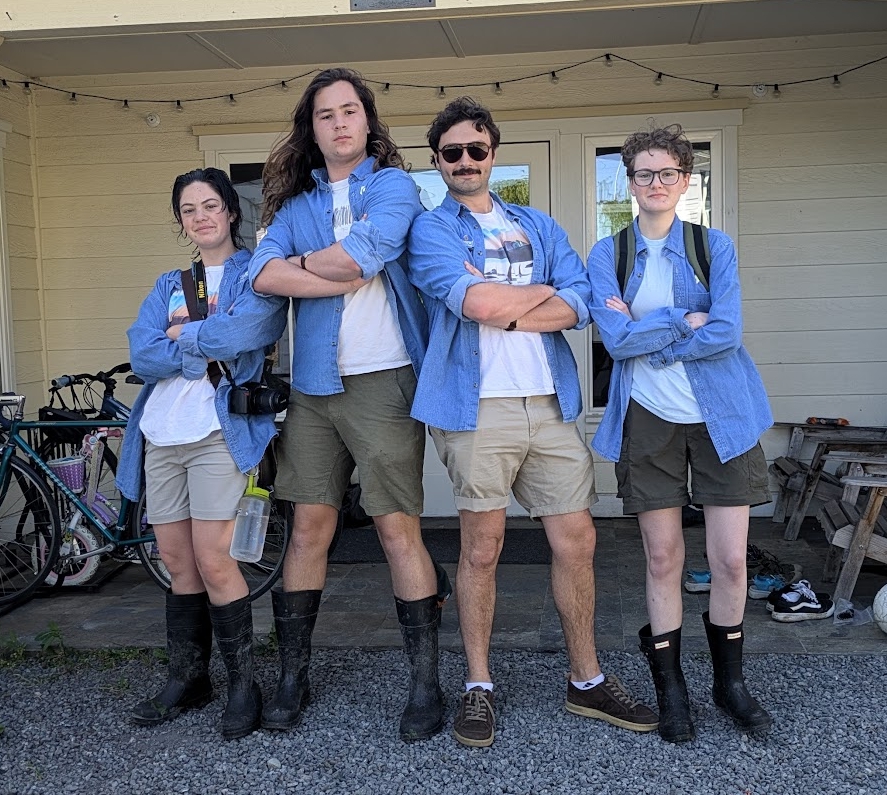
From left to right: Finlee, Caleb, Adam, and Gretchen, taken by Co-Science Director Emma Ledin
Adam arrived early this morning, and upon seeing his outfit, Caleb, Finlee, and Gretchen decided that in honor of all that Adam has done for us, the only logical way to share our appreciation would be to dress exactly like him.
Once everyone was adequately prepared, we ventured off to Argyle Lagoon for a clam survey.
Adam and Co-Science Director Riley Conley talking to the group about Argyle Lagoon, taken by Finlee
After Adam humbled us all by handing out survey worksheets for third graders, we quickly proved our maturity by getting thoroughly stuck in the loose silty mud. We may have been handed an elementary school worksheet, but Adam and Emma worked to create a college-level discussion about the role of invasive species in the ecosystem, exploring how the data we collected will add to a decades-long survey of clams in Argyle lagoon. By the end of the morning, we even left with a Tupperware full of invasive varnish clams!
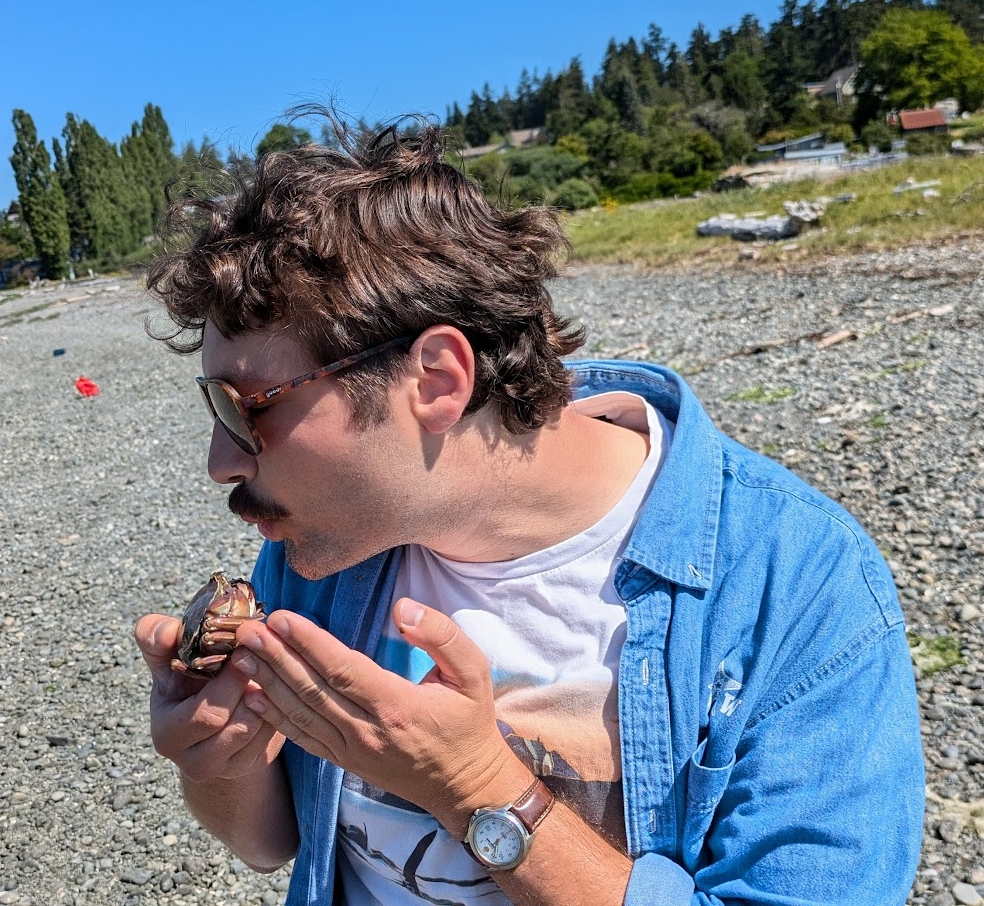
A Graceful Crab being kissed by Adam, Photo by Caleb
The rest of the day was mostly quiet. We all worked through our projects, asking Adam and Emma for help and encouragement. Over the past two days of more devoted project work time, more and more people are beginning to settle into and develop their ideas. So far, we have projects focusing on everything from limpets and lugworms to sea hares and sand dollar larvae.
Soft shelled clams on a sieve taken by a thoroughly stuck Caleb
After picking Adam and Emma’s brain for any and all information we could get out of them, Adam took a few of us program members to FHL to look at some of the resources available to us. We took a look at the tide tables being provided to us by Dr. Billie Swalla, and talked to Michelle Herko about CRISPR. Unfortunately, some of the scientists we were hoping to run into were not available because they were preparing costumes for the “Invertebrate Ball”, a prestigious gala that happens once a year where all of the UW FHL students dress up as invertebrates for a night of fun. However, Adam decided that due to the fact that the ball serves alcohol, it would be inappropriate for 19 highschoolers to be present (some of us might just sit outside and look sad until someone lets us in though).
Tonight, we are lucky enough to be joined by Dr. Olivia Graham, an accomplished marine disease ecologist, Postdoctoral Research Associate at Cornell University, and a fellow at Friday Harbor this summer. We will look forward to discussing her current work on seagrass wasting disease. To learn more about her past work at FHL, check out this Tide Bite.
We left the dorms at 8:00 AM and soon arrived at False Bay to meet and aid three graduate students from Dr. Emily Carrington’s Ecological Biomechanics class: Alyssa Giedd, Jenny Duncan, and Frankie Hedge.
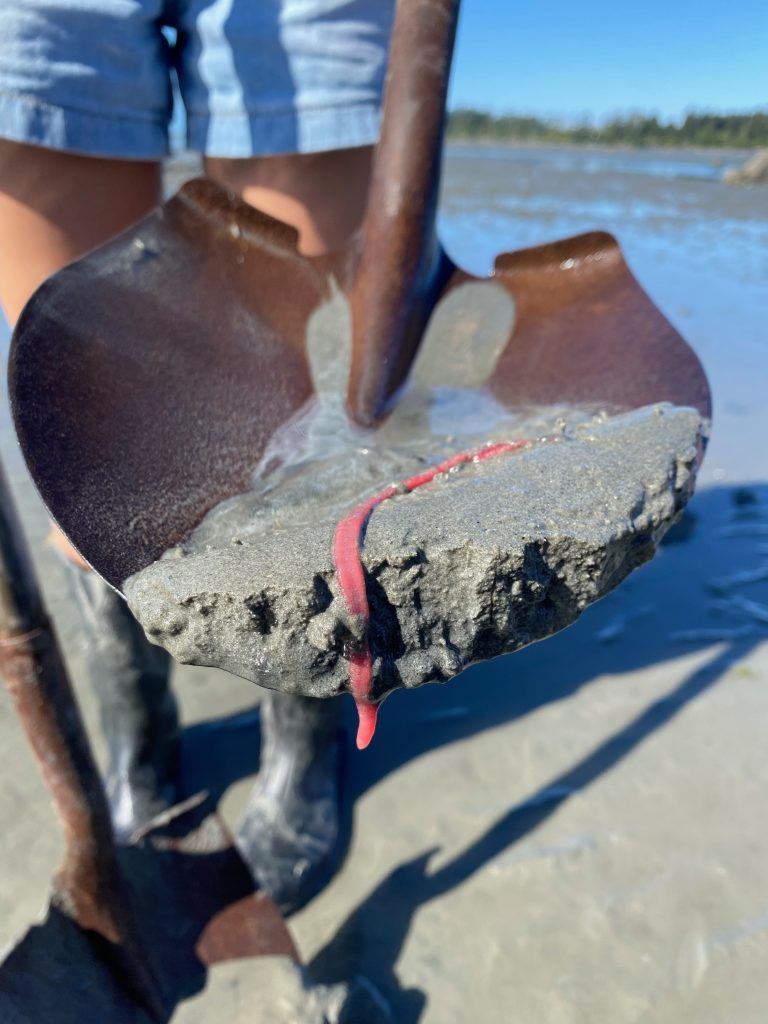
Each of these researchers focused on different topics. Alyssa Giedd, a talented mechanical engineer, was looking at the fascinating legs of polychaete worms in the design of worm-shaped robots. Jenny Duncan was our only non-Annelid researcher focusing on ghost, and mud shrimp and how they interacted with the sediment of their habitat. Frankie Hedge had us collect bloodworms. She was planning to test how worms affect the sediment that passes through their digestive tract. Working with these researchers was an incredible experience.
The blood worms have a bite that is comparable to a bee sting, so we had to be especially careful when identifying them and holding them in our hands before dropping them in the holding containers. Thankfully, no one was bitten, and after around two hours of looking for invertebrates, we found enough worms for Frankie to run two more trials and enough polychaete worms so that Alyssa could study their movements. Following our time digging at False Bay, we returned to the dorms for lunch.
After lunch, a few students headed off to the Friday Harbor Labs to meet with scientists and hone their project ideas. Caleb, Finlee, Ansuya, and Gretchen assisted Frankie Hedge in identifying the worms collected in the morning. Although Frankie was focusing on blood worms, polychaete worms, lug worms, and various other species were also identified. Ansuya and Flora met with Dr. Sandy Wyllie-Echeverria, a specialist in seagrass conservation, to brainstorm ideas for their projects.
Nina accompanied Dr. Mike Nishizaki, a professor at Carleton College who specializes in research on intertidal organisms, and a Research Experience for Undergraduates (REU) student, Sophie Elam, to Cattle Point to assist with data collection of mussels. They recorded the temperature of the mussels from the low, mid, and high tide lines, observing the percentage of mussels that were open. The data will contribute to a project that is examining the effects of temperature on mussels and the mechanisms the mussels use to regulate their temperature at different tides and times of day.
Other students branched off to help Dr. Amy Cook with her project on Pidgeon Guillemots. A specialist in animal behavior, Dr. Cook is observing Pigeon Guillemot nesting habits due to urbanization. Katie and Tatum learned about Dr. Cook’s process in analyzing animal behavior and spent time observing a local nest.
photo by Claudia
Hike:
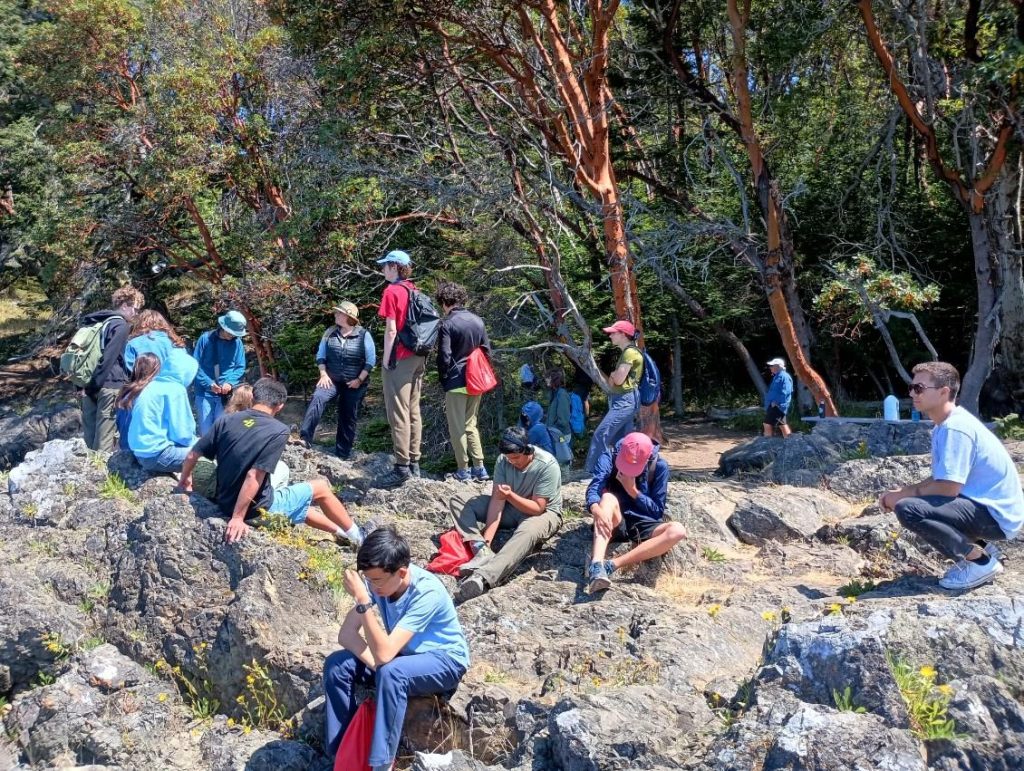
The rest of us stayed back and did some brainstorming on our projects, followed by a hike up Young Hill. Riley compared the hill’s ecosystem to that of others we have seen throughout the island; admirably, the hill was covered in oaks, native to the San Juans. We learned about how spacing between trees keeps the forest healthy by leaving room for growth and shrubbery. When we reached the top, we were greeted by a charming view and a flock of turkey vultures.
Photo by Riley
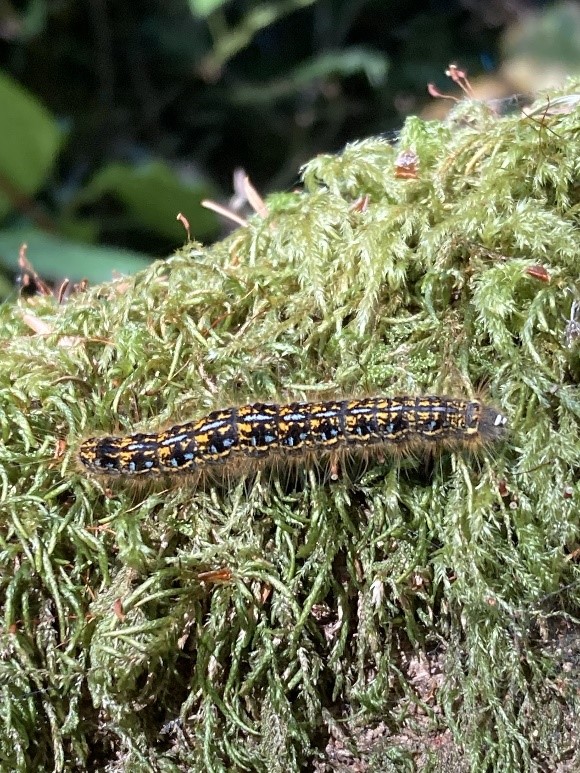
Caterpillar! (Photo by Claudia)
Dinner:
We dined with Olivia Carpenter and Olivia Trahan from Soundwatch, an organization dedicated to reducing vessel disturbance of marine wildlife. Founded by the San Juan Whale Museum in 1993, Soundwatch collects data on marine vessels that frequent the Salish Sea and their effects on local marine wildlife, especially Southern Resident Killer Whales.
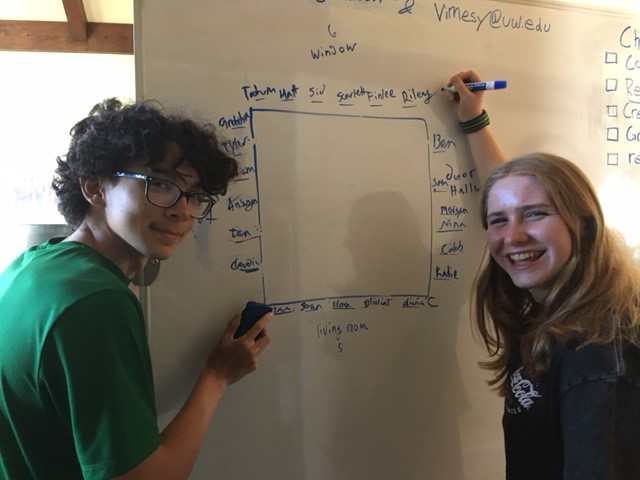
The welcome team prepared for dinner by researching Soundwatch and their work and setting the table. They tackled the challenge of deciding where everyone will sit by drawing a diagram on the whiteboard.
Morgan and Ian draw the layout of the table. (Photo by Caroline)