The first thing we did today was to begin looking at the final result of our research projects. We examined many posters from past years and evaluated their strengths and weaknesses. We ended up making a list of all of the things that we had to avoid as well as parts that we did want to include.
Today was the 4th of July so we were privileged to watch the parade. It was a great experience to learn about all the organizations active on the island like the Suroptomists, Wolf Hollow Wildlife Rehabilitation Center, and the Lions Club. There were also many fun floats that were assembled by determined community members.
After the parade, we all went to the pig war picnic. The Pig War is a historical event that occurred on San Juan Island in the late 1850s where tensions between settlers due to a border dispute culminated in an American settler shooting a British settler’s pig. As the situation continued to escalate the British and American armies were called to the island where they set up camp on different sides of the island. However, due to negotiations, no blood was ever spilled, and the only casualty of the pig war was the initial pig.
Next, we headed down to Jackson Beach for some fun in the sun. We lounged around the beach, took a few freezing dips in the water, and played volleyball in the blazingly hot sand pit.
Photo by Nina
Finally, we went down to the docks to watch the fireworks. Although we discussed the negative environmental effects of such a display (air and noise pollution), we all agreed it was a fabulous show.
Last night, Dr. Amy Cook graciously came over to join us for dinner and to give an informative lecture. In her lecture, she highlighted the importance of the scientific method and taught us how to apply strong inference or the hypothetico-deductive method. This method is a way to avoid falling into various biases in your scientific experiments like anchoring or IKEA bias. Despite the topic being less interesting than those on living organisms, the knowledge of applying strong inference is vital to successful research and will follow us for the remainder of our lives. She has a beautiful website that you can visit here: https://www.evergreen.edu/directory/amy-cook
Cattle Point with Dr. Amy Cook:
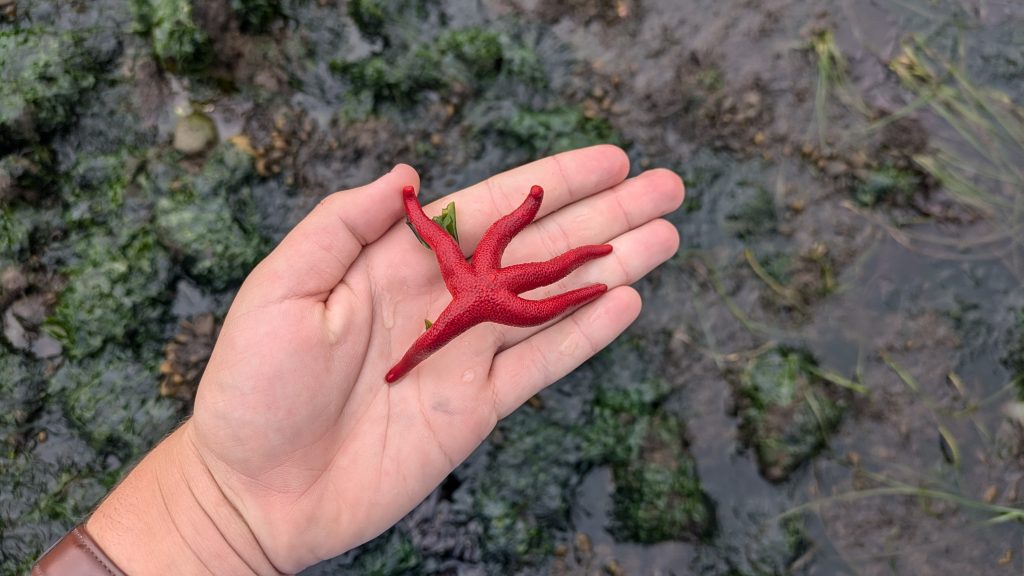
We started the day with a trip to Cattle Point where we met up with Dr. Amy Cook and took part in an exercise on pattern recognition and strong inference from our lecture with Dr. Cook the night before. Dr. Cook was very helpful and engaging with our ideas and encouraged further exploration of our interests. We all split into groups and made our way down to the beach, looking for ideas of patterns and relating hypotheses. Most of the groups wandered into the rocky intertidal zone and came up with very detailed hypotheses relating to the patterns they found. Caleb found a fully grown male red rock crab with a missing pincer in one of the deeper tide pools on the beach. We also ran into a family of five red foxes who made working around them very interesting.
This Henricia Leviusica (Blood Star) was picked up and checked out by Caleb, who also took this photo.
The Foxes at Cattle Point:
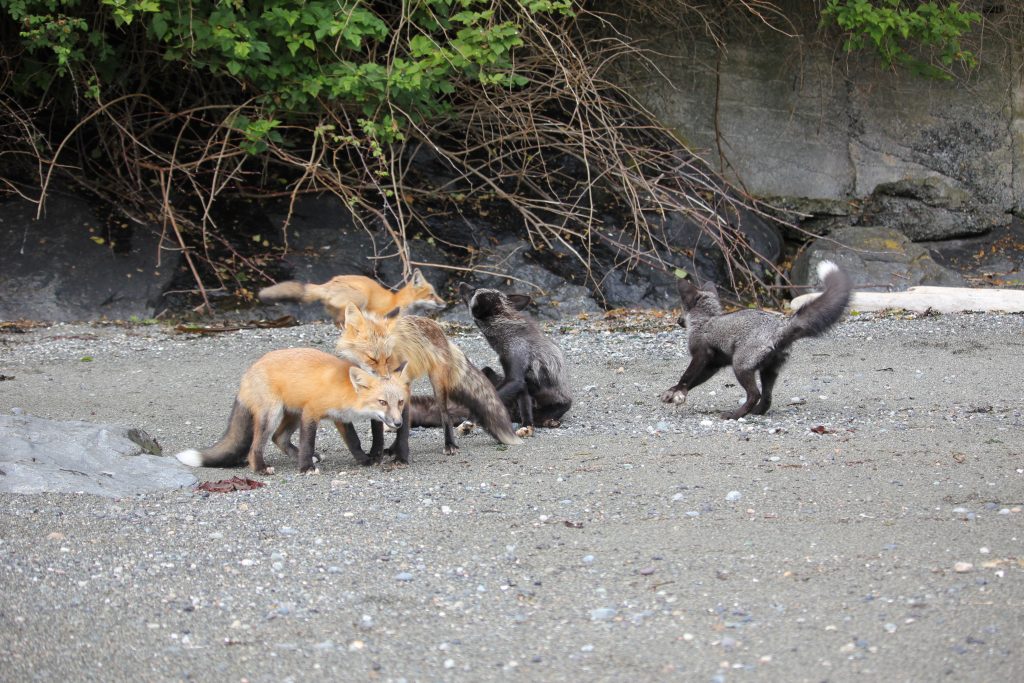
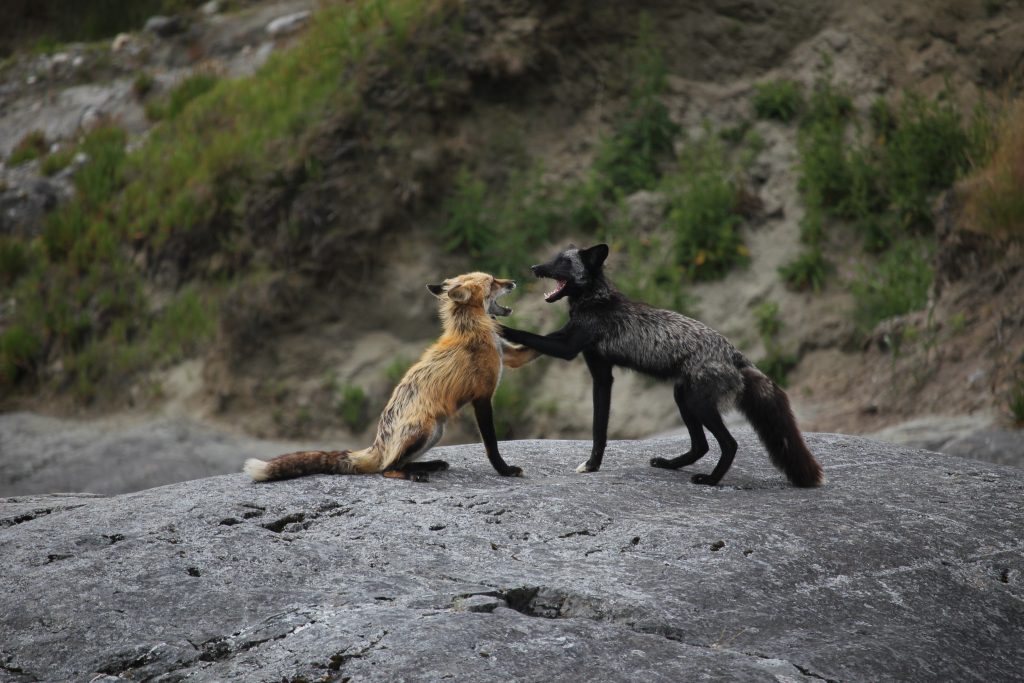
During our stay at Cattle Point, we were approached by a lone red fox along the coast. It seemed very comfortable around humans, likely due to associating humans with food, and got within a few feet of a couple of individuals. Suddenly, out of nowhere, another two red foxes descend gracefully from the cliffside, joining the lone fox. They run around the intertidal zone, playing and tackling each other until another pair of red foxes appear from the bushes, bringing the total count of foxes frolicking around to five. While watching the group of foxes, we wondered why a group of five foxes would travel together, as they are not known as pack animals. Our resident animal behavior specialist, Dr. Amy Cook, hypothesized that either it was a mating pair and their three pups or a mother-daughter pair co-raising their pups together. Alas, the truth will elude us as the red foxes escape back into the woods to live out their lives in peace.
The Fox family is up to no good. While the littlest kit one gets a bath from one of the adults. The other two kits start a game of tag. While the other adult pays no attention. Photo taken by Katie. The adults have a little chat in the fox world. Photo taken by Katie
Garry Oak Restoration:
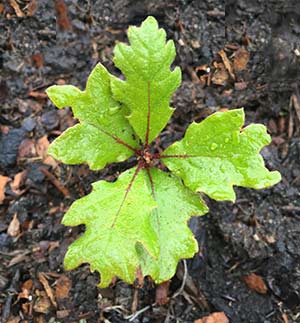
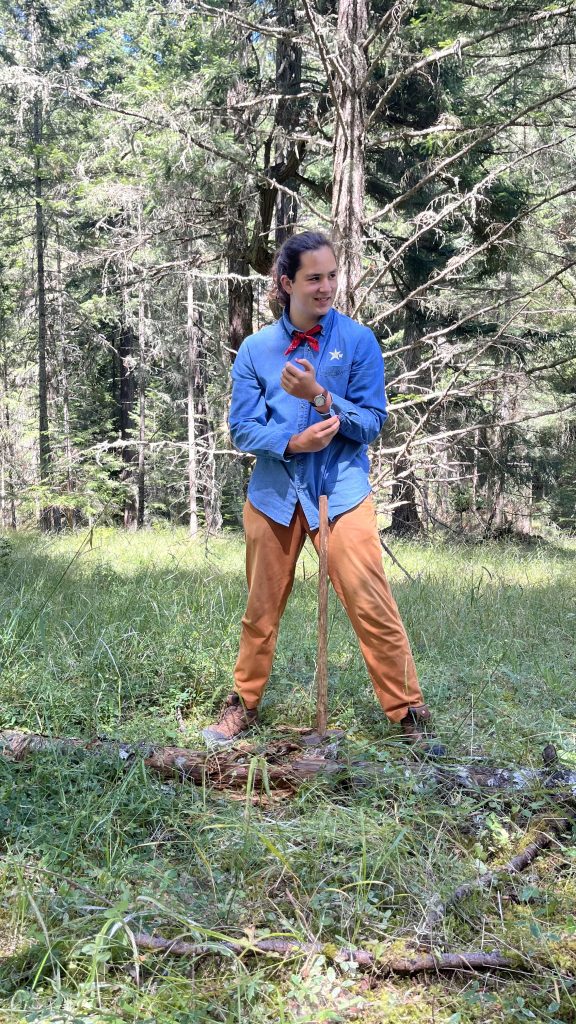
After a quick lunch of sandwiches at the dorms, we headed out to the island’s northwest side to help restore Garry Oaks in a protected forest. Why do we need to help these trees, and why are they important, you ask? Garry Oaks are an integral part of the San Juan ecosystem. This is because many other types of creatures rely on them for different phases of their life, and if we get rid of Garry Oaks, we destroy the habitats of hundreds of creatures in those forests. We spent a couple of hours using chicken fence to create a cage for Garry Oaks that would help protect them from deer. Caleb and Sid spent time hammering in rebar to keep the cages in place, and the rest of our group was very helpful with identifying Garry Oak saplings, making the cages, and placing them on the rebar. We learned much about forest ecology from Ben Halloway, a San Juan Land Steward who oversaw our restoration work. He talked about the thinning and self-thinning of trees and how we must cut down trees to help others grow. Riley gave us a great analogy- if there are too many straws in one cup, none of them get enough water.
Photo from https://ohgarryoaksociety.org/garry-oaks-seedlings/Caleb took a quick break from destroying a fallen tree with a hammer. Photo taken by Morgan.
FHL Seminar:
For the final learning lesson of the night, we went to the Friday Harbor labs. There we sat in on a lecture about turbulence and how it affects microscopic organisms which was presented by Dr. Mimi Koehl. The whole presentation was about a type of sea slug and how they get to the right parts of the reef. The theory was focused on the odors that the corals produce that attract the sea slug larvae to swim out the sea current to get to the coral reefs. We learned that Dr. Koehl’s team discovered that sea slugs aren’t fully attracted to the reef by the odor of the corals but by the idea of environmental cues causing an on-off effect. You can vist Dr. Koehls website for more information on her research: https://ib.berkeley.edu/people/faculty/koehlm
Blog was re-written and added links to the mentioned scientists websites on July 7th, 2024
Written by Katie Chin, Sam Feit, Max Liu, Scarlett Thornton
False Bay, SJI (Taken by Scarlett Thornton)
We started off the day with an early morning to False Bay to catch the low tide. Despite the perilous sinking sands, we managed to traverse the soft sediment environment. With the guidance of our courageous scientific director Adam, we set off to find lugworms, important detritivores who digest sand, ridding it of bacteria and other organic matter. In order to find these worms, we searched for their spiral-shaped fecal casings and dug underneath. Using quadrats, we determined the density of the worms and their casings.
We met future doctor Frankie Hedge, who is surveying sediment density to inform her study on blood worm density and preferred conditions.
From left to right: Gretchen, Caleb, Scarlett (Taken by Nina Johnson)Adam!! (Taken by Scarlett Thornton)
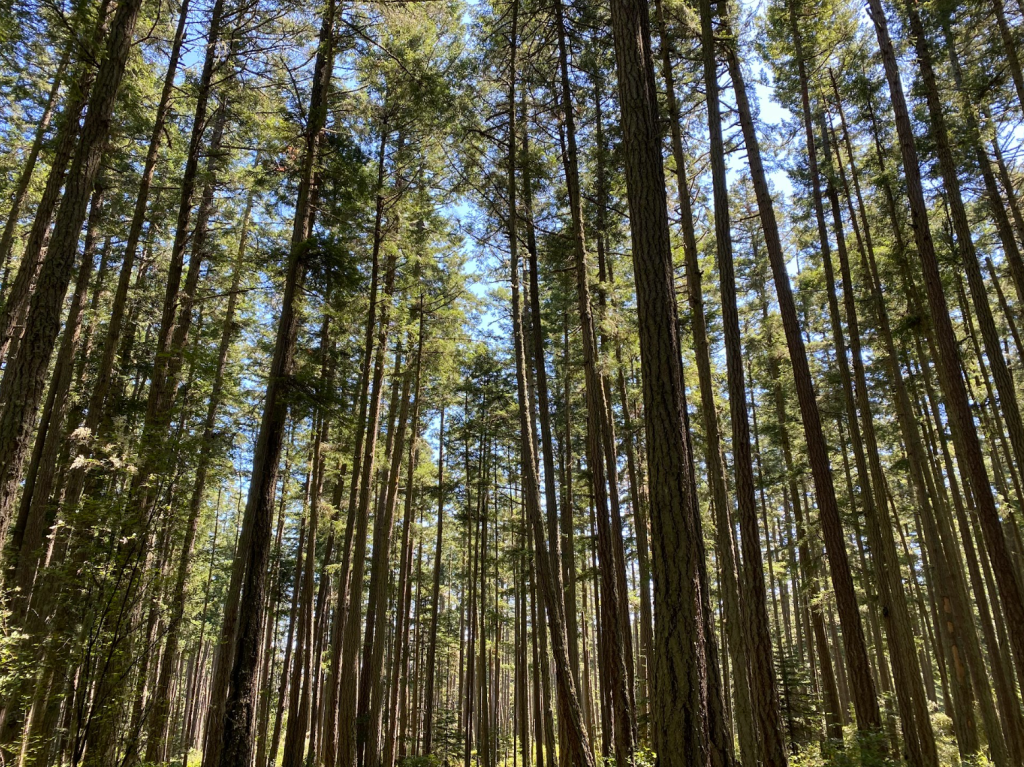
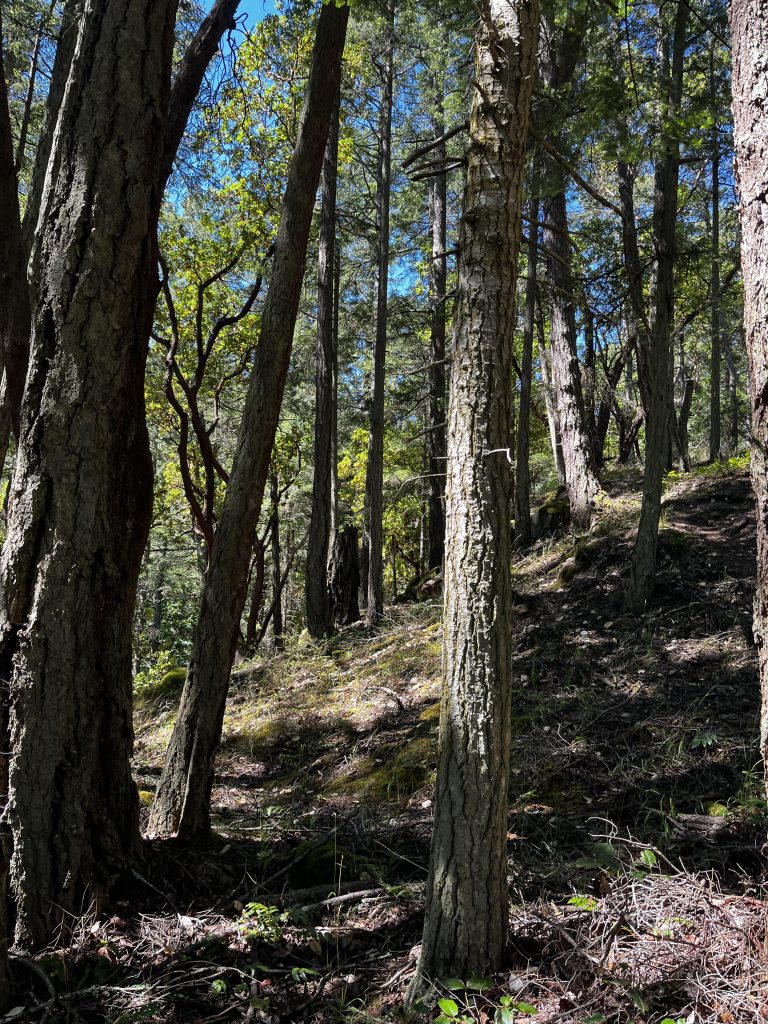
The next part of our day, after a sandwich lunch, was the Friday Harbor Lab Preserve tour. Guided by the most knowledgeable Justin Santiago, we took a fascinating nature hike through the preserve, learning about the incredible Douglas Firs and snacking on some salmonberries. As we walked, the incessant but interesting sounds of different birds filled the soundscape, many of which were identified by bird expert Justin. We learned about interesting indigenous practices for maintaining a healthy forest, as well as the scientists’ goals for the forest in the future. The hike was a rare terrestrial exploration for us marine folk, but both terrestrial and aquatic environments affect each other.
Friday Harbor Lab (Taken by Sam Feit)
Lastly, we visited the Friday Harbor Labs to purchase some FHL merchandise.
From left to right: Max, Caleb, and Katie at the bottom (Taken by Sam Feit)
This evening we are looking forward to welcoming Dr. Amy Cook for dinner and a presentation. She studies animal behavior and conservation biology, among other things.
Kindly recounted by: Finlee Rice, Tatum Bunting, and Caleb Zulauf
We all rolled out of bed this morning, feeling refreshed from the night of rest following our kayaking trip. SOME ate breakfast while others slept in as we waited for the first post-sea-kayaking meeting with a scientist. Dr. Becca Guenther an accomplished scientist, professor, artist, and overqualified hot tub fixer upper with a Ph.D in Coraline Algae, gave an insightful lecture touching on the life cycles of algae, their uses, what qualifies an algae, and the polyphyletic nature of algae. She also made it amply clear that algae is already plural, and that “algaes” is grammatically incorrect.
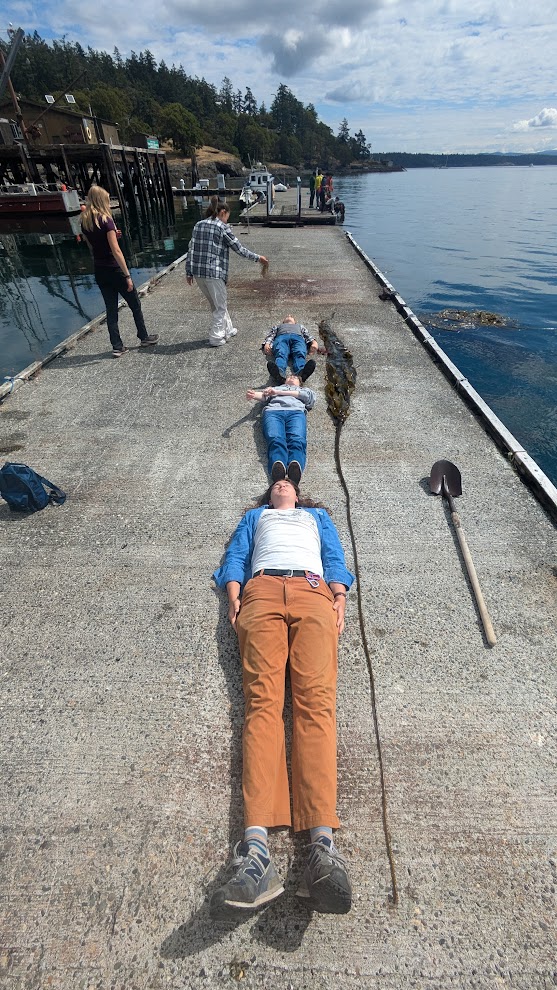
From closest to farthest, Caleb, Gretchen, and Ben lay down and measure up against a collected bull kelp on the Friday Harbor Labs docks, as Nina (far left) walks by with Scarlett (to Ninas right) who feeds ben some seaweed. (photo credits go to Tyler)
Once our interest in seaweeds and algae was appropriately piqued, we ventured back to the increasingly familiar Friday Harbor Labs. Armed with buckets and shovels, we spread out along the docks to collect algae and seaweed samples for pressings. Tires, leveraged onto the dock with the ends of shovels, proved treasure troves for interesting specimens of seaweed (and a few well-dressed kelp crabs, sea squirts, and sponges). After a few water fights with rockweed vesicles and a bull kelp horn solo (courtesy of Sid), we lugged our overflowing buckets back to Spring Street.
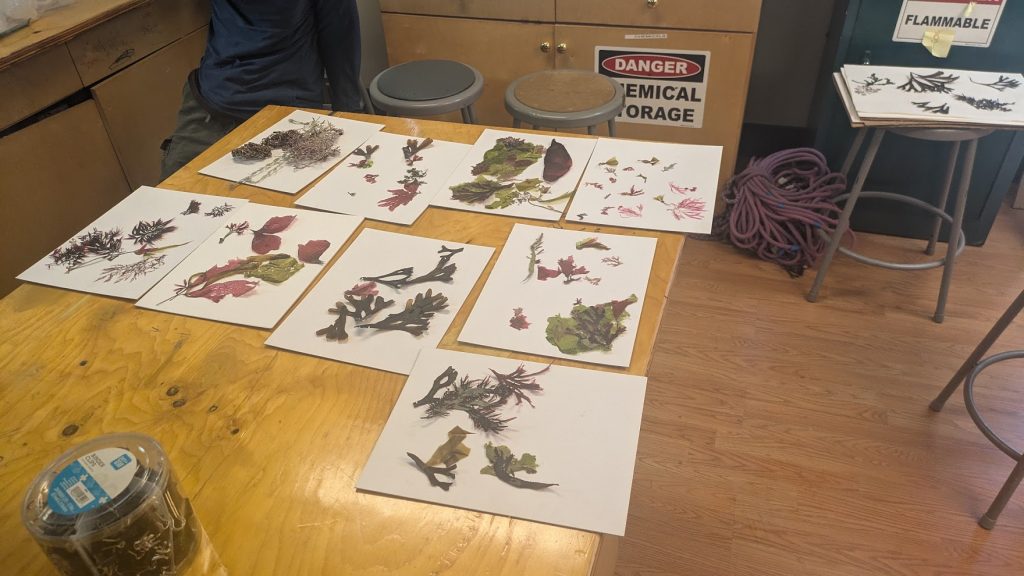
Dried and flattened seaweed, collected by Dr. Guenther (All further photos by Caleb)
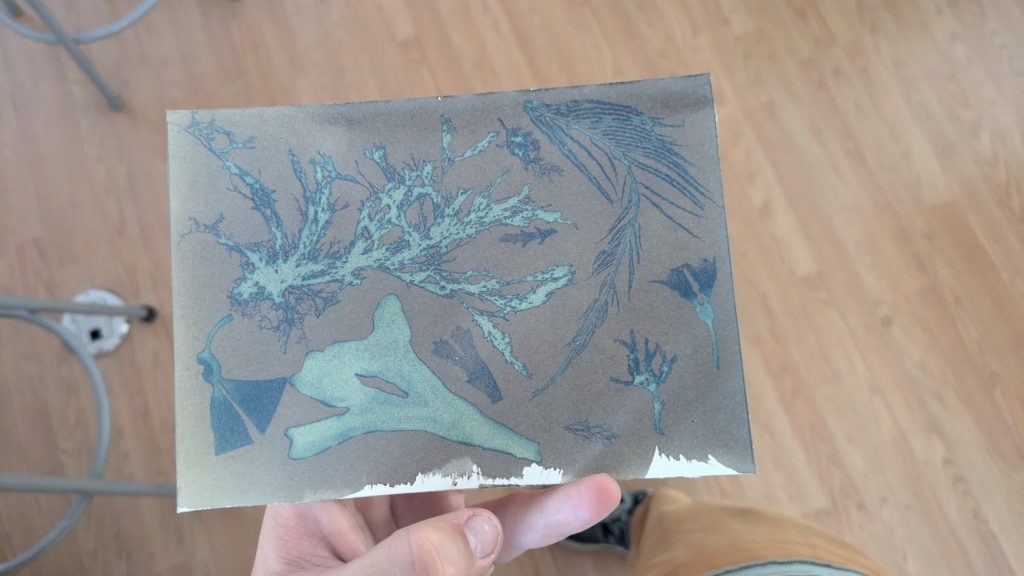
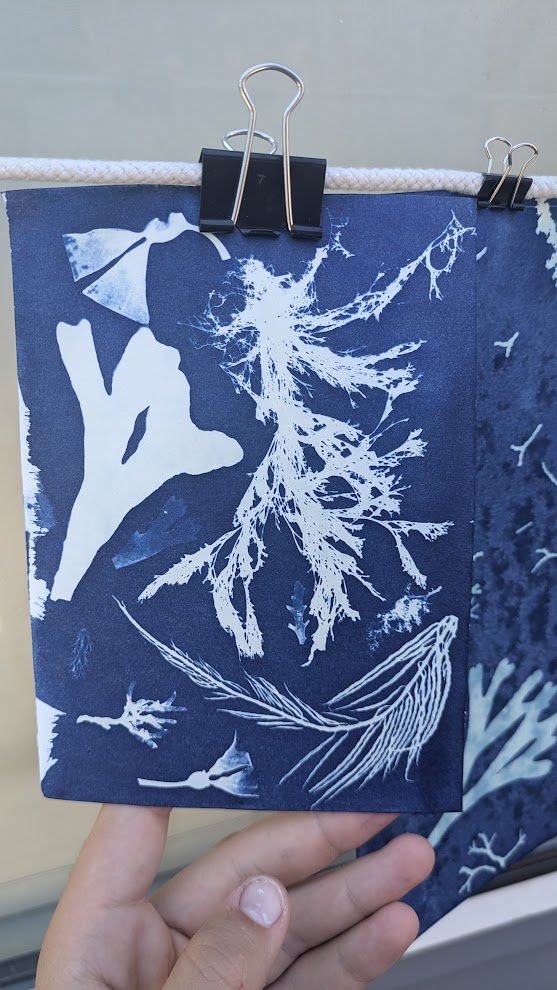
Once back at the science rooms, we started by setting up our seaweed presses in which we carefully arranged different seaweeds. Some of us made pictures while others simply arranged them in a pattern. From there we layered them between cardboard and blotting paper and placed them in a press. In a few days we are going to remove our pieces of art and observe how they have changed with time and pressure. After clamping our press down we got going on making cyanotypes. We took previously pressed and dried algae and placed them on photoreactive pieces of paper, left them in the sun to photoreact, and finally washed them in water and a diluted H₂O₂ solution and let them dry. All this work resulted in vibrant blue backgrounds with the white negative space of algal specimens.
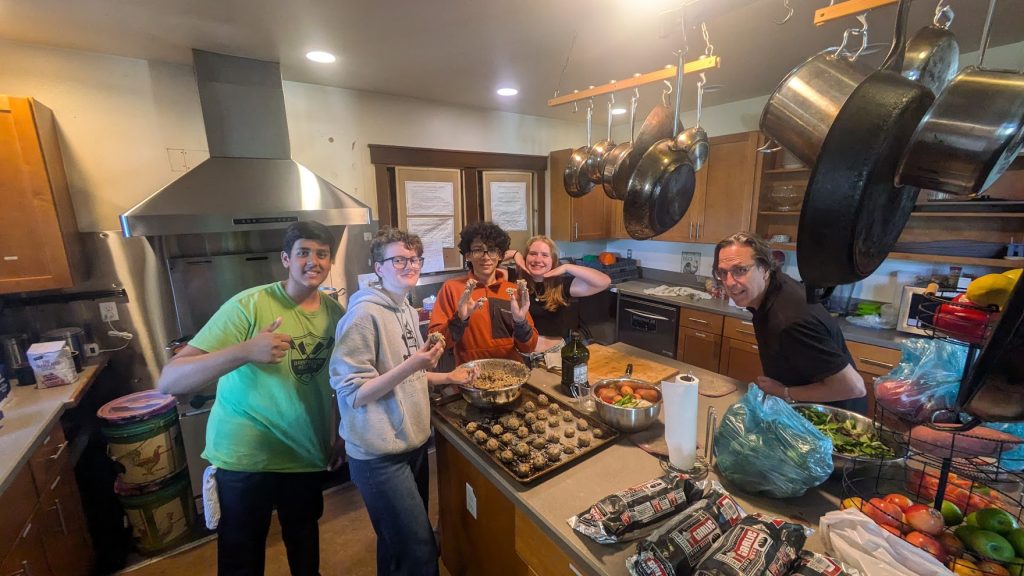
Cyanotype after being exposed to the sun but before being washed.Cyanotype post wash.Dinner crew requested to be put in the blog during its making, so here they are making vegetarian meatballs for our guest (Dr. Sandy Wyllie Echeverria (check out some of his incredible work about eelgrass here)) as well as all the students and staff. Listed left to right is Sid, Gretchen, Ian, Morgan, and Tom.
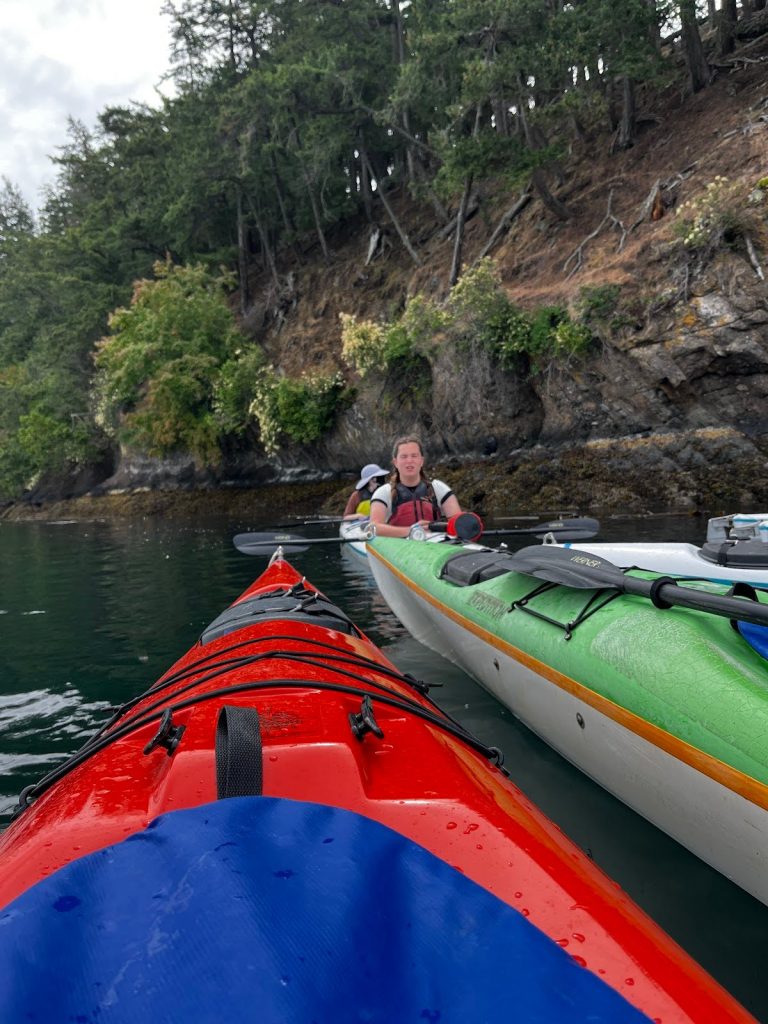
We paddled out to Stuart Island for a four day camping trip.
Taken by Scarlett Thornton
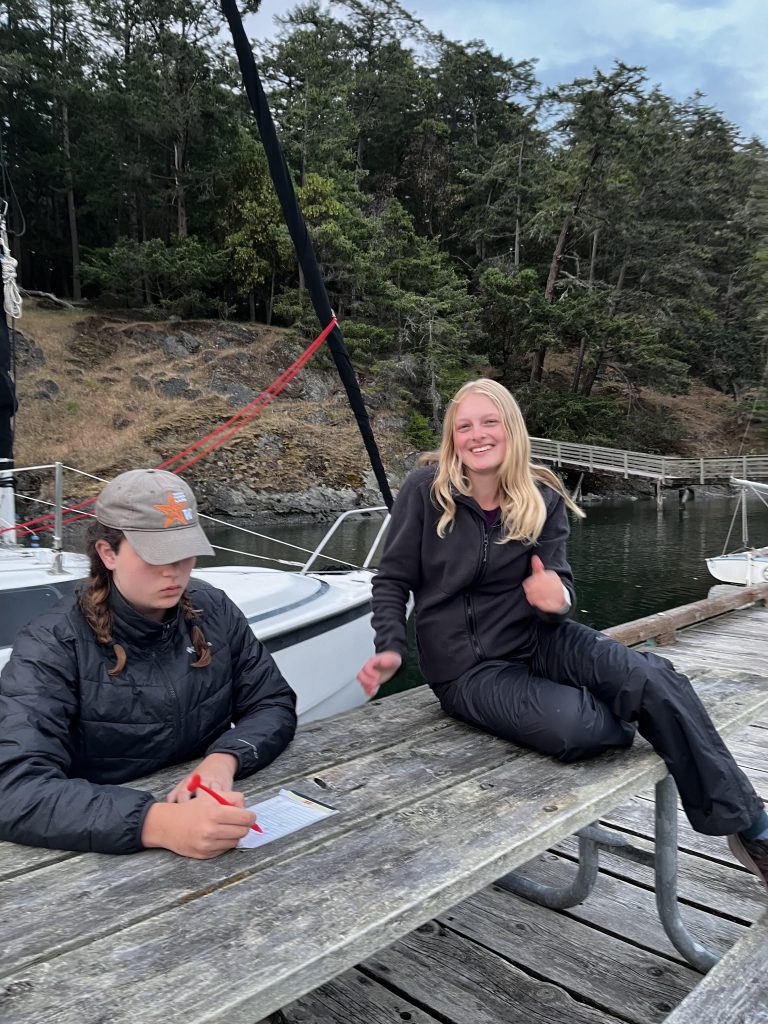
Caleb and Nina on the dock at Stuart Island.
06/28: Hike to Turn Point
Taken by Scarlett Thornton
— Taken by Guide Gretchen
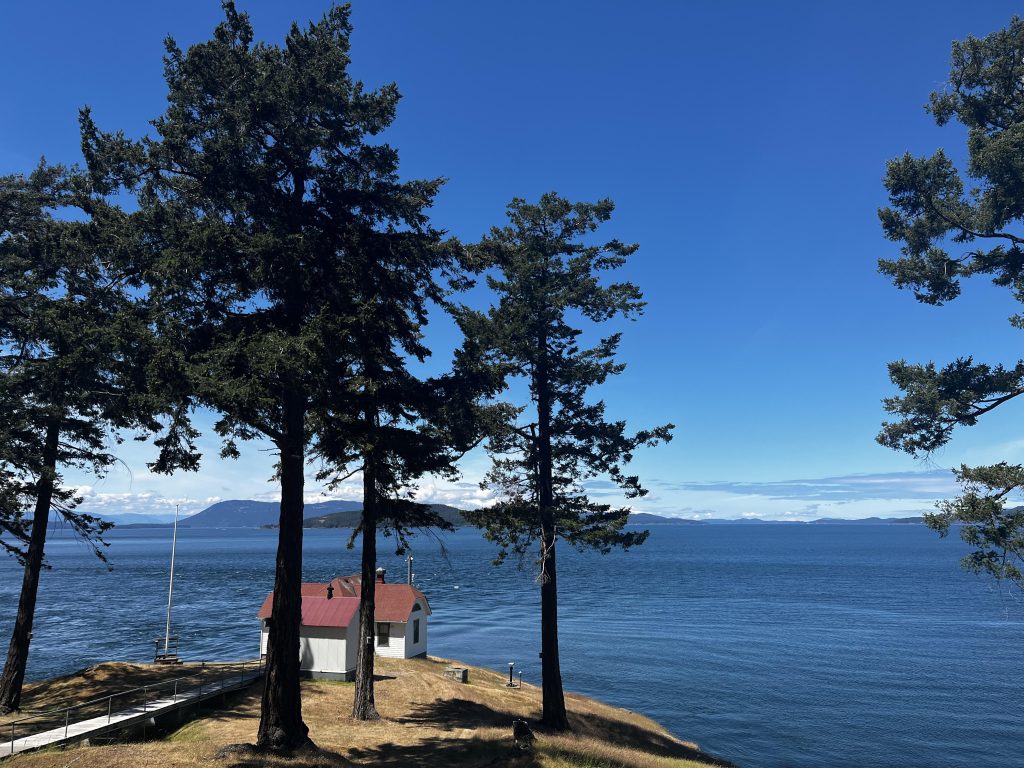
Group hike up to Turn Point Lighthouse on Stuart Island
Taken by Scarlett Thornton
Lunch at Turn Point Lighthouse
06/29: Day kayak trip or hike
— Taken by Soren Hecimovich
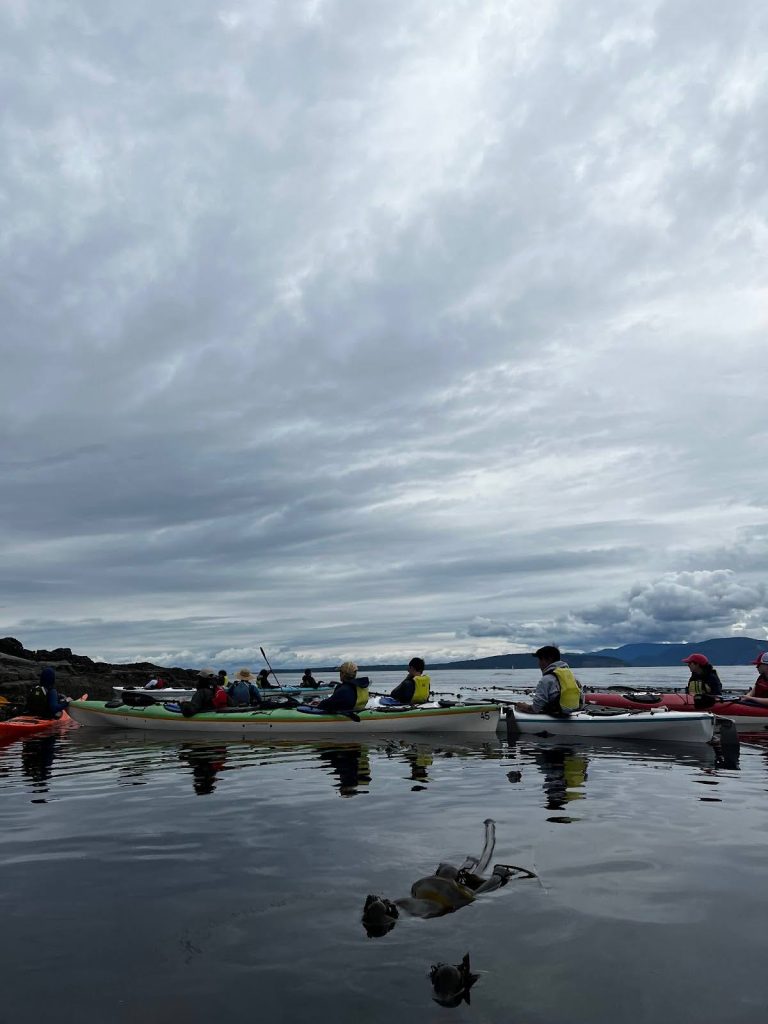
Some of the group took a day paddle along Stuart Island to explore the waters and marine life including Porifera and harbor seals.
06/30: Kayaking back
The group kayaked across the channel between Stuart Island and San Juan Island early to avoid bad winds coming in. We left at 8:30 and arrived at Friday Harbor around 11:30. Afterwards, the group crashed out at the dorms and watched “The Boys in the Boat” and various other television programs.