Day 4: Shark Attack!!!

Salish Sea Sciences trip to The University of Washington’s Friday Harbor Labs (FHL). Wednesday, July 2nd, 2025. By: Lars, Miles, and Leah

We were graced with a half half hour later start for breakfast – but! We also had to pack our lunches whilst making our breakfast to prepare for a full day on the University of Washington’s Friday Harbor Lab (FHL) campus. The drive over to the labs was breathtaking, each window we looked out of had the shore right in front of us. Everyone was definitely antsy to get out and meet the scientists awaiting our arrival.

First, we met Michelle Herko, the program director of the FHL Science Outreach Program. She was very excited to tell us all about the history of the campus, and the work done at the lab on green florescent proteins. While showing us around the physyology labs, she explained how the bioluminescent reaction became widely used marker for studying gene expression and protein localization in living cells. https://pubmed.ncbi.nlm.nih.gov/31342754/#:~:text=Abstract,transgenic%20animals%20in%20biomedical%20research One aspect of the labs I found the most fascinating was its flow through water system. The system rapidly circulates water in and out, allowing scientists to observe the creatures in a natural aquatic environment. This is one of the many great features of these labs that attract world renowned scientists!

Walking through kelp lab! Photo credit to Lars Hill

Our tour continued, as Michelle offered us the opportunity to look at some awesome high powered microscopes. We could only have about 6 students at a time through those labs, so we split up. Those who were first to see the microscopes also discovered another cool project happening in the room next store. A scientist excitedly popped in, interrupting Michelle with the opportunity to see her spawning sea cucumbers! Of course we took her up on the rare opportunity, especially sense the sea cucumber spawning is not a simple process. Their study included injecting peptides to stimulate spawning, very neat! While the others waited, the stumbled upon a tank of dog fish! A sneak peak for a future tour! They were very friendly, and our young scientists quickly chose names corresponding with their spot patterns. As the groups switched off, some groups began opening their lunch boxes and digging in!

Adam adoring the snout of a dog fish. Photo credits to Lars Hill

After a decently satisfying lunch, our tours prevailed. We met Cassandra Donatelli, an assistant professor at UW’s School of Engineering and Technology. Donatellii got her doctorate in 2019 in biology from Tufts University in Medford, Massachusetts. Again, our group split up. Half of us continued with Dr. Donatelli, who, along with several other undergraduate researchers, guided us through the lab and introduced their individual projects. A highlight for many students was listening to an undergrad from The University of Massachusetts Amherst explain his project. He used CT scans to study the animals physical structures through their skeleton. Another researcher was 3D printing different crushing structures to study when fish bones may buckle and how to avoid that. Each of these researchers were surrounded by a supportive team from the University getting personalized feedback on each decision. The majority of these researchers were also from universities outside of the Seattle or Friday Harbor areas. Continuing the trend, a group of mostly undergraduate researchers studying aerodynamics showed us around their lab to better understand how to incorporate the swimming habits of Dog Fish into engineering. This tour also included a portion of the tour returning to our beloved dog fish in the pool, where we learned the researchers had also given them name based on their spot patterns! Clearly scientists think alike!

At this point in the day, attention spans were getting smaller, legs were beginning to hurt, and eyes were getting heavy. Yet we prevailed into our final set of tours! Our last introduction of the day was to the lovely Becca Guenther (who wrote this amazing newsletter on her ocean acidification lab, which we also toured!) She is currently the lab manager for FHL’s Sea Star center. (but may also be or have previously held the role as the lab manager for the ocean acidification lab?) The Sea Star lab was very visually satisfying! Many little oysters, clams, sea urchin and sea stars sat in tanks of varying size and length! Their biggest Sea Star was 7 years old, and a whopping 60 pounds! Becca detailed the danger she puts her and the organism in when she attempts to move him during routine tank cleanings. When he began to understood that he was being moved from his comfy spot, he would latch his suction feet on even stronger to the sides. This lab was established during the rise of Sea Star Wasting Disease, which has nearly wiped out any wild population of the Pacific Sunflower Stars. The researchers’ dedication to supporting these species—through feeding, tank maintenance, and ongoing study—is truly inspiring and deserves to be shared with a wider audience. If your interested in learning more, we recommended reading this fascinating article by Jason Hodin. https://depts.washington.edu/fhl/tidebites/Vol93/index.html

Size comparison of a tank with 2 year old Sunflower Sea Stars and 3 year old Sunflower Sea Stars. Photo taken by Hitomi

The final rotation of the day trip involved searching for a variety of marine phyla by pulling up the tires hanging off the side of the boat dock. The first group’s favorite find was a nudibranch, while the second group discovered a crab. It was fascinating to see the wide range of life—sponges, kelp, algae, and more—thriving on these tires, originally placed as buffers for the boats. I also noticed how much clearer the water was around this dock compared to the murkier water downtown, likely due to less boat traffic and runoff. This difference in water quality may very well explain the greater diversity of marine life we observed. Overall, it was a memorable way to end the day—full of discovery and a deeper appreciation for the subtle factors that shape marine ecosystems.

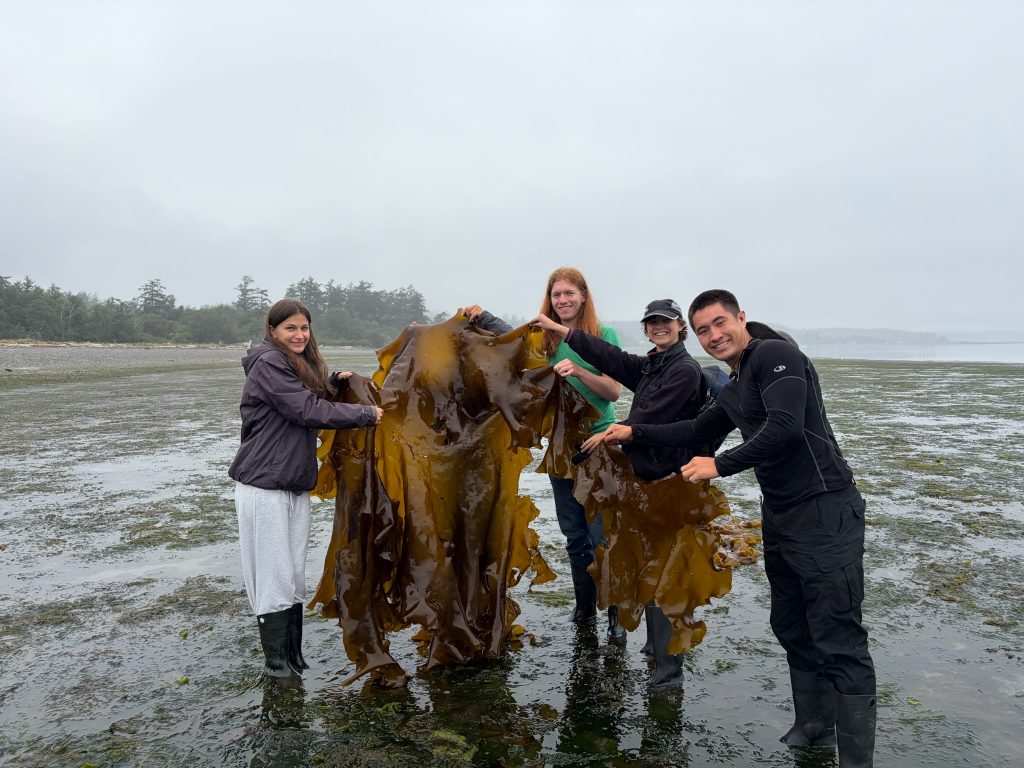
Pulling the tires up to the docks. So much giant kelp! Photo taken by Lars Hill

We left the labs ten times more tired than when we arrived. After a well-earned and satisfying dinner, we decided to skip the evening lecture in favor of some much-needed rest and preparation for the day ahead. Most of us spent the evening unwinding—watching TV, playing games with friends, or relaxing at the beach. The downtime was just what we needed to recharge and return even more excited for another science-filled day tomorrow!

Day 3: Adam has Crabs!?!

By: Hitomi, Eden, Trevor, and Harper

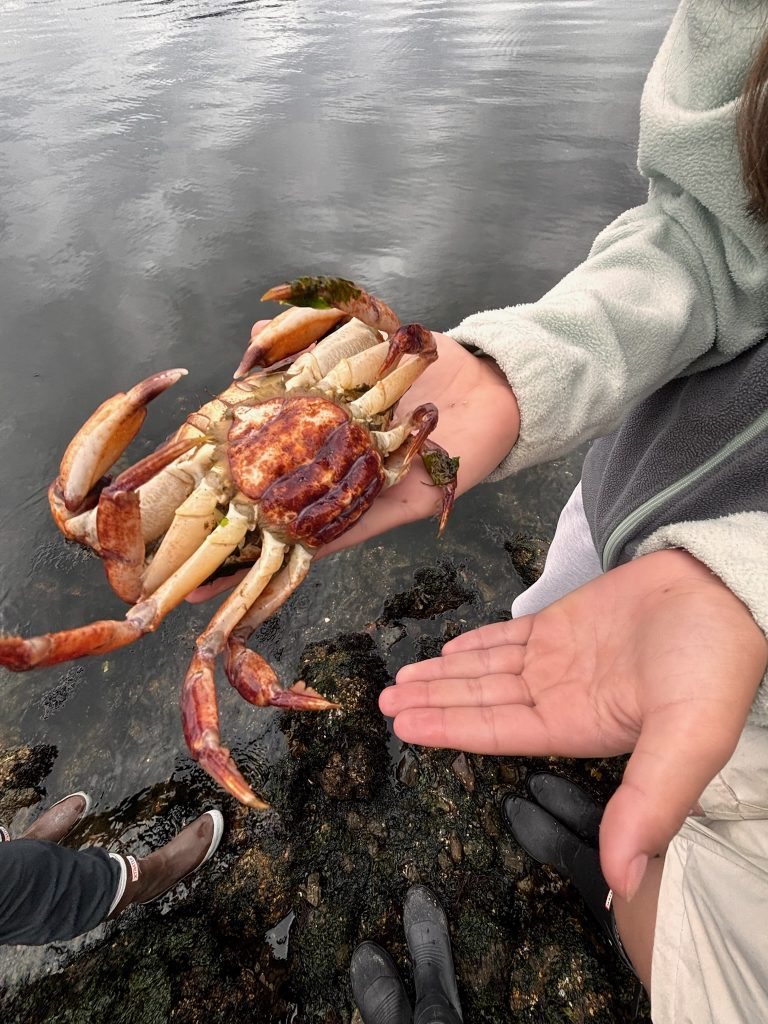
Adam holding crabs at tide pools (photo by Eden)

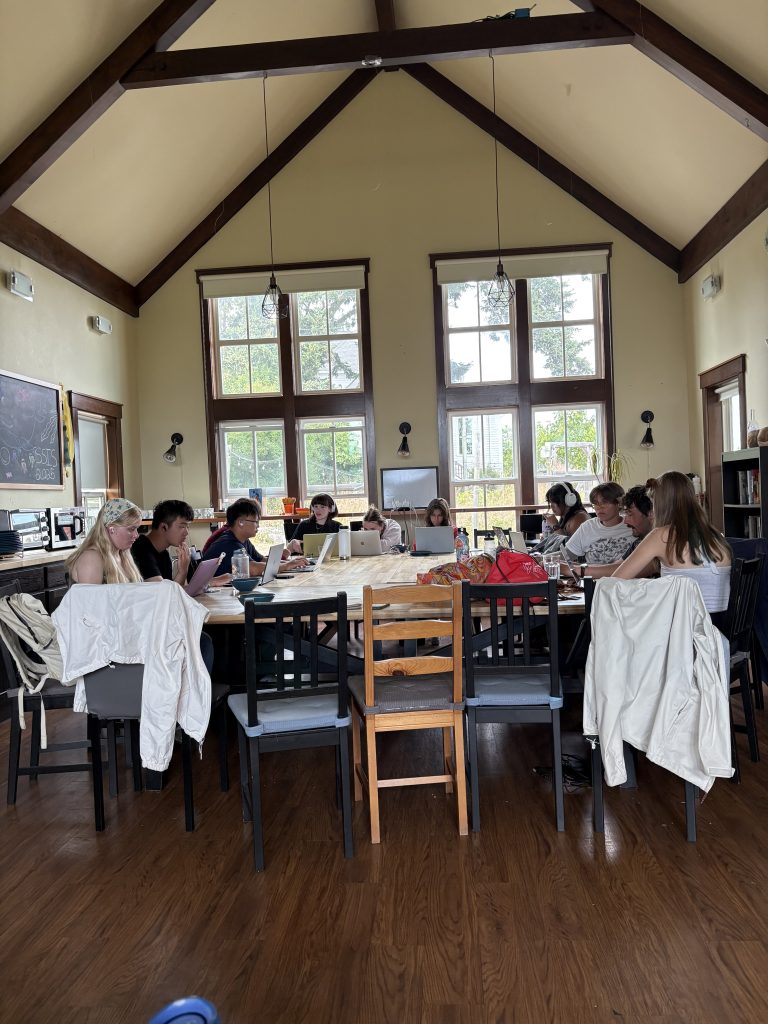
The dorm woke up to beautiful sunny weather and the breakfast crew’s spread of scrumptious cereals, yogurt, granola, bread, and fresh berries. Some eager folks went out for a quick morning workout, while others helped themselves to coffee in the area. First, we were introduced to the structure of our Pilot Project and shown examples from past years projects. Maya and Riley led a tour of our on-campus lab, which will act as a workspace for some over the next 4 weeks, and shortly after, we were delighted by Adam’s “Phyla of the Salish Sea” presentation. We gained base-level knowledge of local marine organisms, which was later used to explore the tide pools at Deadman’s Cove.

After Adam’s phylum presentation, we strolled into town to put our knowledge to use at the marina. Our main focus there was the fouling communities, which are congregations of animals found on man-made objects. We spent about an hour exploring over, under, and around the docks, searching for any organism we could find. While we were there, we had to apply our newly acquired knowledge of species and phyla to identify patterns in organism density, dispersion, and relationship to other organisms. In our full-group meetup afterwards, we all agreed that there was more seaweed on the upper section of the pilings (due to photosynthesis) and that there was a higher concentration of organisms, specifically plumose anemone, in the gaps between the dock (because of current and nutrient flow). Notably, we also saw plumose anemones, a red rock crab, and a few massive egg yolk jellyfish. Afterwards, we enjoyed a short hike back up through town and settled in for lunch.

Fouling anemones (photo by Hitomi)
Egg yolk jellyfish (photo by Trevor)
Ella holding Bull Kelp (photo by Hitomi)

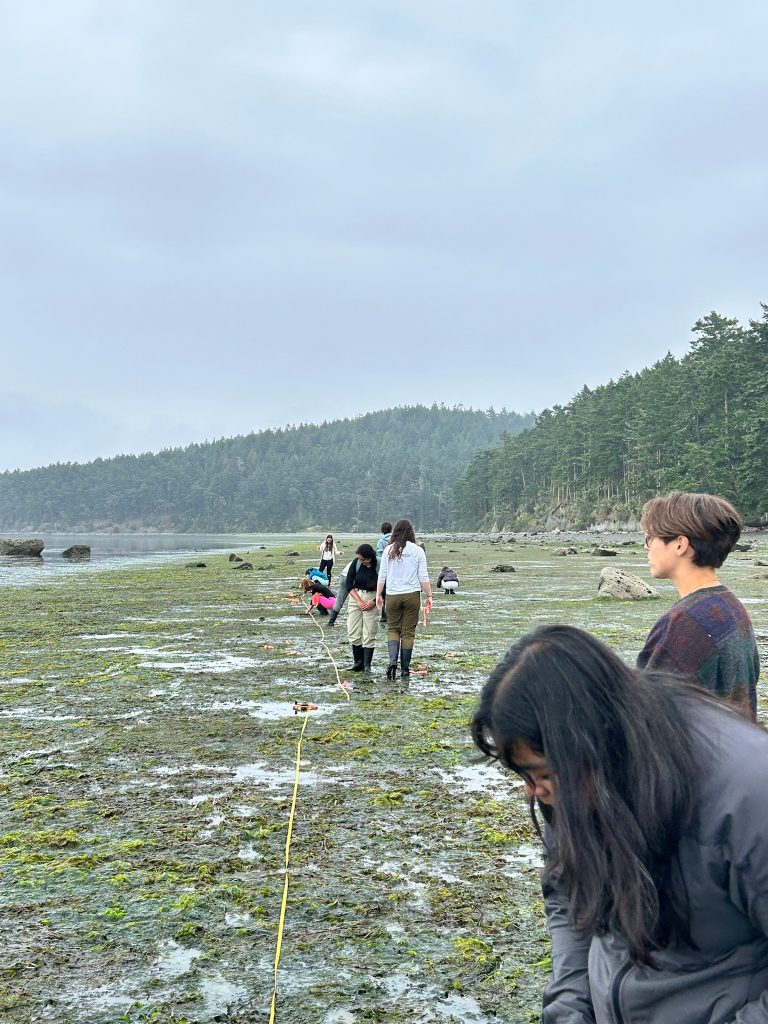
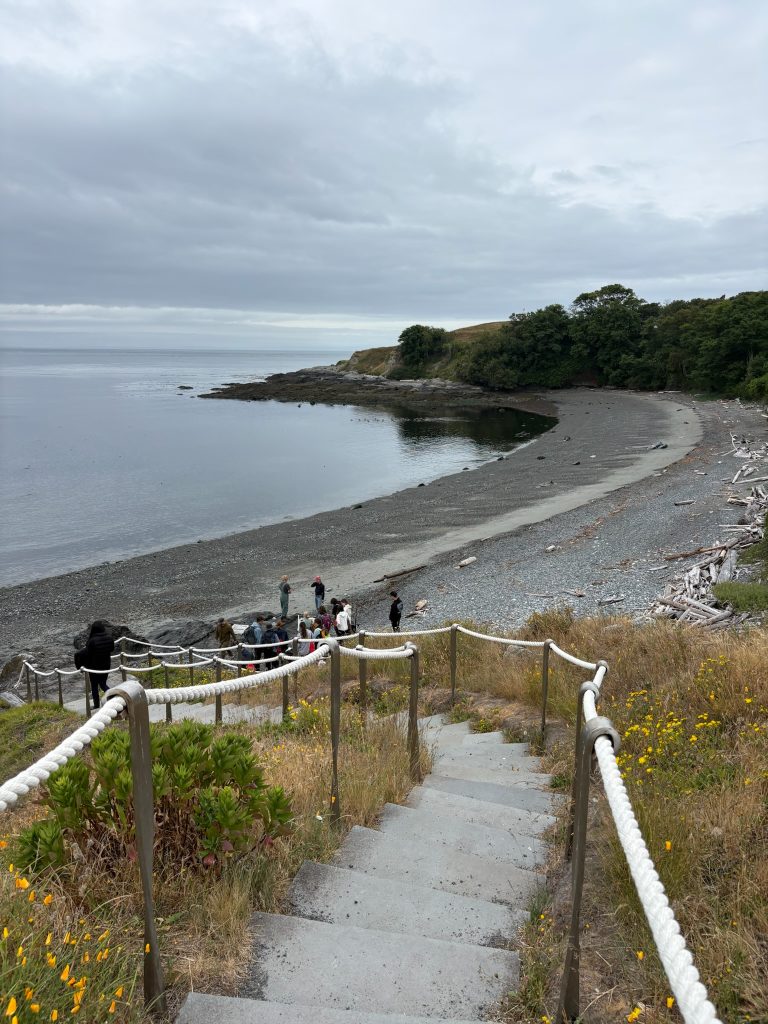
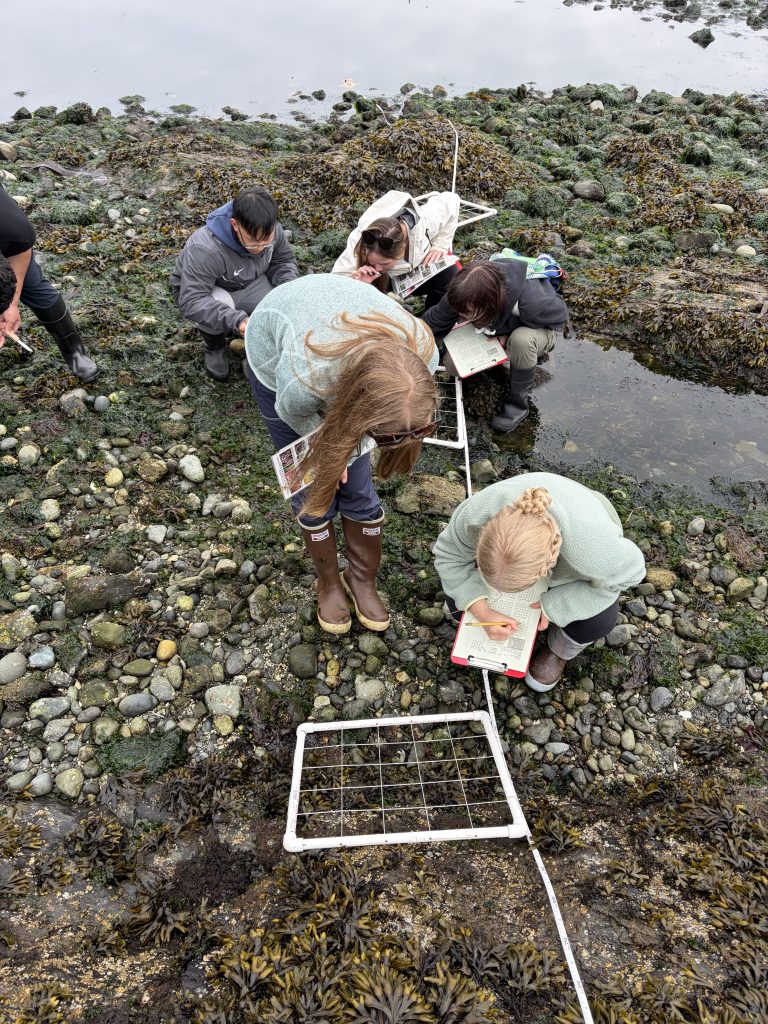
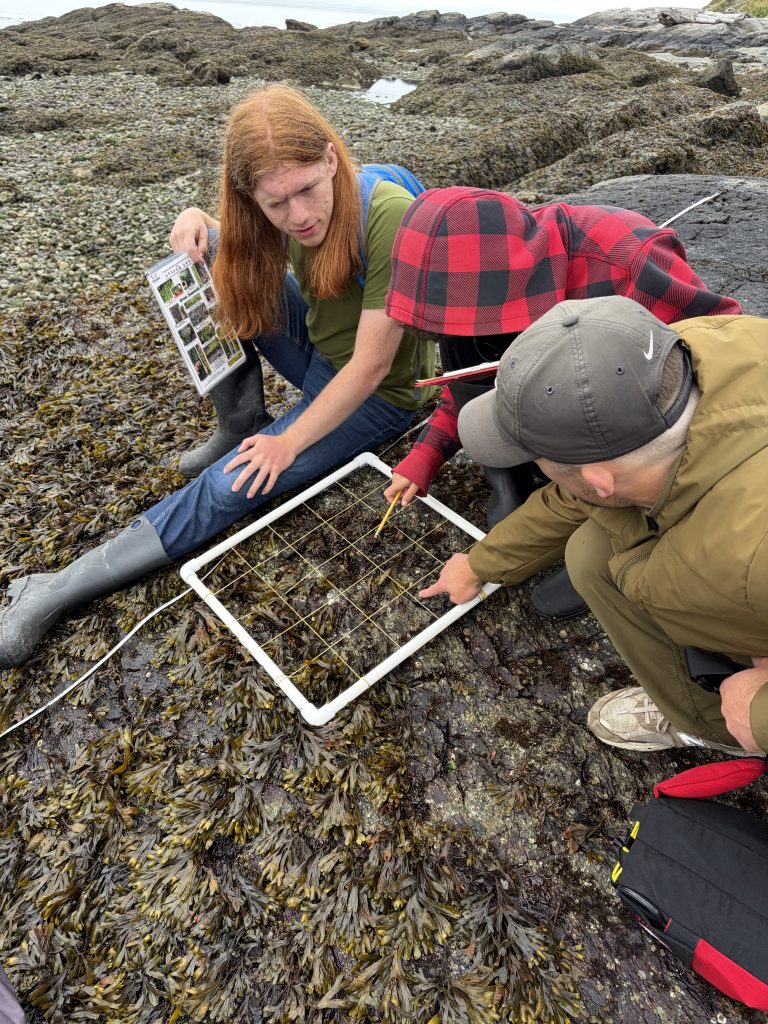
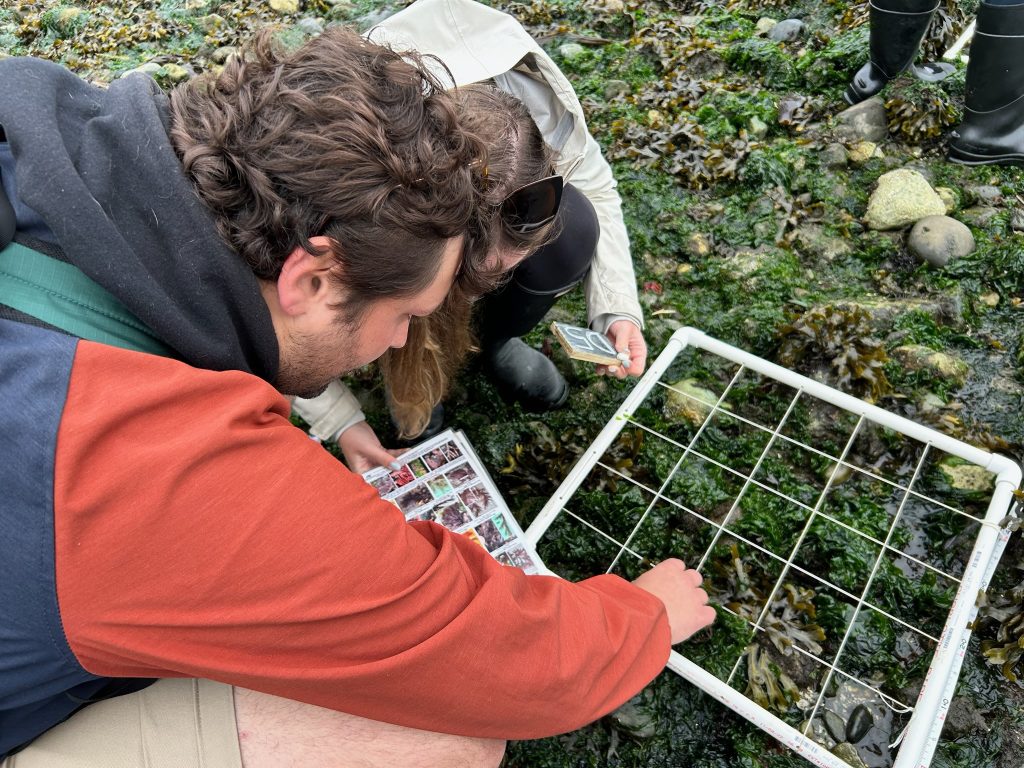
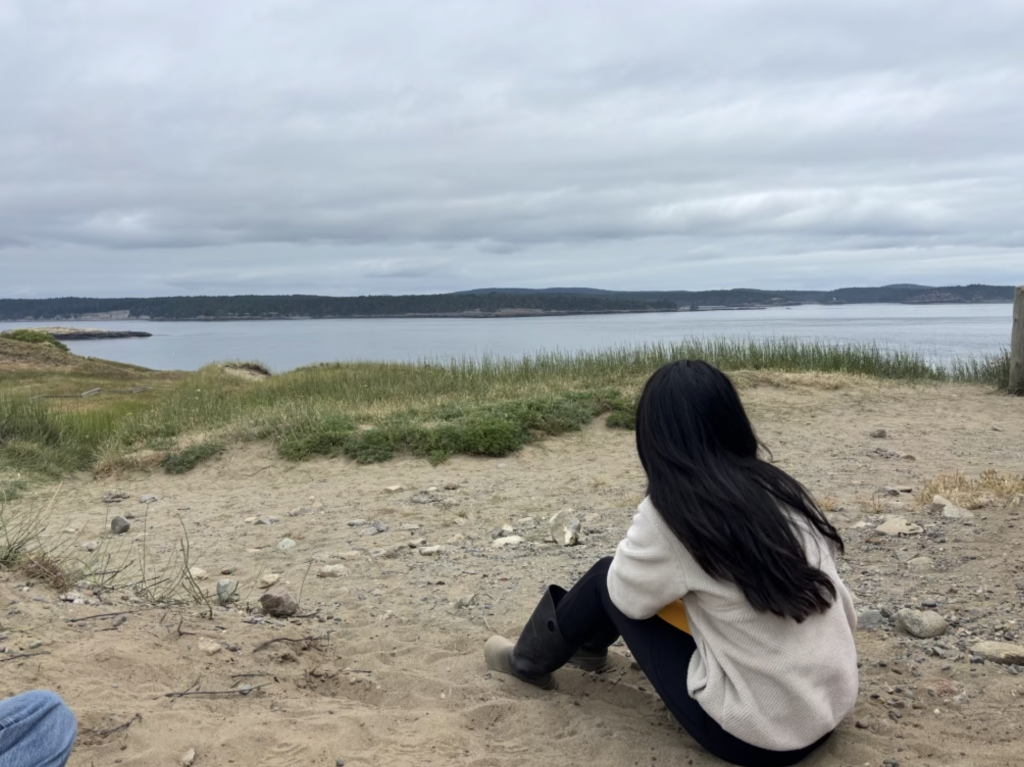
Following a lunch of sandwiches and fruit, we packed up our supplies and piled into the van as we set out for our last event of the day: studying tidepools at the ominously-named “Deadman’s Bay”. After a winding drive which took us west along the slopes of a cliffside forest, we parked beside the road and made our way down a steep trail to the shoreline. From the pebble-laden beachfront, the distant figure of Canada’s Vancouver Island sat in the shadow of the Olympic Mountains, which stood as a row of massive dark teeth against the blue sky. Once settled, our directors asked us to reflect on the potential biotic and abiotic factors around us. After this, we were handed “Tidepool Bingo” sheets and instructed to find the organisms on the sheet among the tidepools off to our right. Among the tidepools, we found rock crabs, barnacles, snails, algae, anemones, the occasional tidepool sculpin, and even a few sea stars. Unfortunately, we had to leave after a few hours due to the rising tide, though one of our directors was lucky enough to find the carcass of a sea urchin on her way back to the group. After our adventure at Deadman’s Bay, we drove back to the dorms and settled down for a snack while our dinner crew prepared for the arrival of our evening’s guest: Dr. Olivia Graham.

Starfish in the tide pool (photo by Hitomi)
Deadman’s cove (photo by Eden)

After a short break following tide pooling, a special guest Dr. Olivia Graham joined our dinner table! She is a marine disease ecologist and research associate at Cornell University. At dinner, Dr. Graham will present and discuss her research on the effect of seagrass wasting disease on eelgrass beds throughout the Northeast Pacific. We will be able to dine with her and ask her questions about her research and scientific goals, creating a comfortable space to talk scientist-to-scientist. Following dinner, we will have some free time to chill before heading to bed, ready for our next long day.

Days 1 & 2: Travelling the Country and Eelgrass Exploration with Dr. Olivia Graham

Blog by Orrin Spiess, Anisa Singh, Isabelle van Thiel, and Violet Marshall

After months of anticipation, we finally all arrived here on San Juan Island, one way or another. Some of us drove directly to campus, others flew in from across the nation to be picked up at the airport or along the way by our wonderful directors, Caroline Grauman-Boss and Tom Grauman. The commute to our dorms took us across the Puget Sound on a scenic ferry ride and a short walk through the charming town of Friday Harbor. We got to know our roommates and peers for the coming month over a pizza dinner and some recreational time walking around town.

After a somewhat tumultuous but restful night of sleep, we woke up to a blinding sunrise at 5:30am and our first day of life at camp. After everyone ate breakfast and reaquainted themselves with each other, we made our way to the common area for an informative orientation with Ms. Caroline. Having much more knowledge inside our heads, we got into our groups and began exploring the harbor with a scavenger hunt in hand. Winning with 420 points, Team Sunny Calirado ended up crushing all of us; although one team was late while allegedly helping an old man across the the street.

Entering mid-day, we packed our lunch and were off to at South Beach for a sandy and hot lunch of PB and J’s–though to be fair, the view was amazing. Later, we made our way to meet up with Dr. Olivia Graham, Postdoctoral Research Associate at Cornell University. She introduced us to the importance of eelgrass through a hands-on data collection and presentation experience. We then spent around 2 hours out on the 4th of July Beach collecting data on eelgrass populations: seedings, flowering, and alike! We also met her gorgeous dog, Michi, and Vidita surviving an attack from a fox (Adam chased it away). Having had a great time, our quest was sadly terminated as we left to go back to the dorms. Some time spent toiling away in the kitchen, we were able to enjoy exactly 21 baked pototoes with a glorious, amazing, beautiful, spectacular, jaw-dropping, mouth-watering, and scrumptious bean sauce with cheese.

Soon after our feast, we headed to the annual Illg lecture by Dr. Leslie Babonis, an assistant professor at Cornell who got her Ph. D at the University of Florida. We learned why particular sea anemone cells don’t sting and the future possibilities regarding RNA, CRISPR, and how modifying genes can change whole organisms’ biology and/or morphology. Following a quick walk back to the dorms, we arrived at the dorms to be met with some free time to eat some ice cream; soon, we were in bed and dreaming of the next day.

Day 13: Presentation Day

By: Wats, Leanne, Mia

This morning we woke up to the pleasant surprise of a cleaning job sign up. We spent the morning hard at work cleaning every part of the dorms from top to bottom. We had to leave the dorms better than we found them, as the Spring Street students will be returning soon.

The Job Board (Photo by Mia Widrow)

Once again, there was bagels and cereal on the menu for breakfast. We went through all the cream cheese (shocker!) it is a hot commodity.

Next we sat down to write many thank you cards to show our appreciation for the many people who were with us on this journey. It was an insightful reflection on all of our guests and the people we have met on this trip.

Sophia hard at work on a thank you card (Photo by Leanne Zhang)

After working so hard on thank you cards, we replenished our energy with a final lunch. Many people chose to eat the leftover pasta salad. We then departed for a fun afternoon at San Juan County Park Beach, to loosen up for our presentation later in the afternoon. It was too cold to swim, so many of us chose to relax on the rocky bluff. When we were descending the rocky bluff, one of us tripped over a short king.

Salish Sea Sciences students decompressing on a rocky outcropping at San Juan County Park Beach. (Photo by Leanne Zhang)
A relaxing cove at the beach. (Phot0 by Leanne Zhang)
Some Salish Sea wildlife! (Photo by Mia Widrow)

We then returned from the beach to collect our algae pressing that we made earlier in the week with Dr. Guenther. Unfortunately some of our pressings were moldy, but for the most part we were happy to see how they turned out!

Then we settled down for the final push on our projects, which we will be presenting at 5:00pm today to an audience of our cohort, families, and other guests we met during the camp. After that, we will be having a barbecue and then head to the beach for a final sunset together. There, we will sit by the fire, and roast marshmallows.

Thank you to Emma, Adam, Caroline, Tom, Cassandra, Riley, Cara and Misty. Thank you to all of our amazing guests who have taught us so much, and thank you to our fellow campers. We will all miss you so much and we hope you have a great rest of your summer!

Peace Out! (Photo by Erin Corra)

Day 12 (08/01/24): Beach day!

By Sasha, Alaina, Josephine, Sid

We spent the morning testing kelp and seaweeds with Lucy Hensley, an undergrad student at Bates College. We cut out standardized shapes of bull kelp (and other seaweeds) and used their MTS machine to pull the seaweed apart to test the strain and stress. Seeing and participating in the data collection at Friday Harbor Labs was super interesting.

Credit: Alaina Cutting Seaweed

There were lots of cool ratfish in the labs!

Credit: Alaina Ratfish!

Later in the afternoon, we headed to Eagle Cove for a fun beach day, where we had sandwiches and graham crackers for lunch. The water was super cold, but we braved it anyway.

Credit: Susanna
Credit: Maddie

We took advantage of the low tide to draw a big fish on the sand. Super fun!

Credit: Adam

We went back home the long way to see Mount Baker from the coast; it was finally a clear day! Seeing the mountain even from so far away was breathtaking.

Credit: Wats Mount Baker!

For dinner, we ate fried rice with the amazing Aisha Rashid, who works for Wild Orca. The day was super fun, and the good weather put us all in a great mood. We are going night-lighting later tonight back at Friday Harbor Labs, super exciting!

07.31.2024: Day 11, A Whale-y Awesome Time

Blog by Akemi, Evan, Maddie, and Ella

If the title wasn’t fin-tastic enough to catch your eye, maybe this hook’ll reel you in as a tail end to the month of July…

To start off the morning… we SLEPT IN! Yippee! We left for Lime Kiln State Park at 11:45am and met up with Erin Corra, a tour guide at Lime Kiln state park, who enthusiastically showed us around the park. Erin Corra has been an interpretive specialist since 2007 and then became the founder and program director of the Friends of Lime Kiln Society (FOLKS) for short, where she continued to educate the public on Southern Resident Killer Whales. She is genuinely excited to share the wonders of orcas with the public, and has been a driving force in educating people about their habitat and how to protect them. She gave us a better insight of the inner workings at Lime Kiln State Park! Additionally, Erin walked us around the trail towards the lighthouse, educating us on trees such as Madronas, Douglas Firs, and Big Leaf Maples. We also observed about three whales in the distance, coming to the surface for air, and even breaching a couple times! After watching the whales for a while (definitely humpbacks, according to Adam and Emma) we went further, to the actual lighthouse! Erin introduced us to the hydrophone, a non-invasive way to observe whale echolocation, where we can listen on land. Afterwards, we sat on rocks outside the lighthouse, eating lunch, while Erin took six of us up to the top of the lighthouse at a time! It was a beautiful view.

A view of the Lime Kiln shoreline and lighthouse. Credits to Akemi.

After a very interesting walk around Lime Kiln and a great whale spotting, we headed to Snug Harbor Resorts, the home of Soundwatch, an all-female group of researchers who monitor orcas and help educate boaters about viewing rules. Soundwatch is a derivative of the Whale Museum, and goes out on the water every day to help maintain guidelines on watching the orcas and report boaters who violate the laws. They also conduct their own research on the orcas that help to provide information for the Whale Museum and NOAA. While we were there, we learned about rangefinders, the devices used for tracking the distance between boats and the whales they’re watching. These are used to determine whether or not boats are violating the 400 yd bubble around the orcas, which is used to protect the animals from boat harm. We also learned about the boat they use to conduct their research and stop boaters from getting too close to the whales. Lastly, we got more of an insight as to how they help whales who have been entangled. Overall, it was a very enjoyable experience and we all learned a lot about orca research and conservation!

A photo of the harbor at the Snug Harbor Resort, where Soundwatch is located. Credits to Maddie.

After meeting with the crew from Soundwatch, our fearless leaders Adam and Emma took us to get ice cream in Roche Harbor! Many of us had not yet been to Roche Harbor so it was great to see one of the other established towns on the island. It had a very different feel than Friday Harbor, it had a few small shops and was overall a lot smaller than Friday Harbor. It was a fun change and a fun surprise that we got to stop for ice cream! Thanks Adam and Emma! It was a cool treat, and very delightful.

A view of Roche Harbor, photo credits to Maddie.

Day 10: American Camp and Hard at Work on Projects!

Blog by: Greta, Trevor, Pax, and Susanna

Today we woke up at 7:30 am and were greeted by a nice fog cover over the island. It was not raining however so we were looking forward to our exploration of American Camp around 9:00.

We loaded up the vans and were met by Emilio Santiago, a park expert who gave us a personalized tour of the visitors center. There, we learned about the histories of the Coast Salish people who have lived on the land around us since time immemorial. After the visitor’s center, we embarked on an interpretive walking tour of the American Camp park. We saw the quarters of some of the soldiers and learned about the history of occupation in the area.

PC: Greta- American Camp Plaza
PC: Greta- American Camp Buildings

We have been working hard on our projects, and with lots of time to review today we are getting closer to our final goals. With help from Adam and Emma, we are moving toward the best pitches for our conservation hopes. we are looking forward to presenting our ideas to all of you after our revisions and research. We had two sessions of project time today!

PC: Susanna- Project Work Time

At 1:00, we went to see scientific study presentations from UW undergrad students. We learned about many cool things, ranging from sea star larvae to eelgrass disease. The presentations were short, but we managed to keep captivated due to the energy the students exerted while presenting. They had been working on their studies for several weeks and it was evident that they had put in much work to make their research matter. Many thanks to Friday Harbor Labs for providing us with this excellent learning opportunity!

Tonight we will have spinach pie with Dr. Ken Sebens who focuses his studies on benthic and coral reef ecology.

Day 9: Poop water!

Blog by Maxene, Sophia, Morgan, and Carlos

Today we woke up at 8 am. Cloudy skies and rain welcomed us to start the day. We soon had breakfast at 8:15 am. We ran out of everything bagels, which as of today we now know is everyone’s favorite breakfast item! So sad, everyone started crying. (It’s chill though ‘cuz we had plenty of oatmeal and other things) 🙂

PC: Maxene – Iced caramel oat milk latte !! (not poop water..)

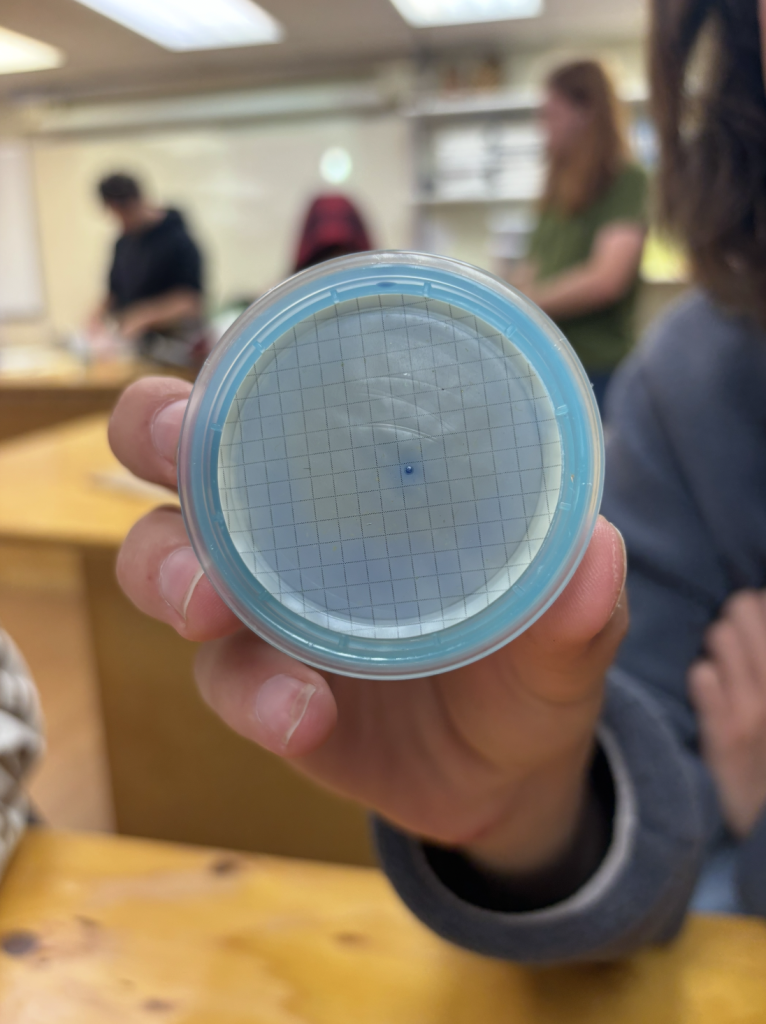
For today’s main activity, we surveyed the water by the marina! the survey intends to measure the fecal coliform in the water. It’s super important work, as no one else is measuring the fecal coliform but us!! (Actually, it’s a longitudinal study for the Port of Friday Harbor, but cool that we’re the one’s who took on this round!)

PC: Maxene – Leanne expertly measuring water quality at Friday Harbor
PC: Sophia – Watts catching fish on the dock
PC: Sophia – Grabbing more water samples at the dock

After an hour or so of measuring salinity and temperature and carefully collecting water samples at different test sites around the marina, we brought our samples home to be tested in the Spring Street School’s science lab. We ended the activity with 20 samples of bacteria that are sitting in the incubator as we patiently wait for them to be ready to be tested on.

PC: Maxene – Adam demonstrating how to test the samples
PC: Sophia – Testing water samples

After lunch, Dr. Jess Lundquist, Associate Professor of Civl & Environmental Engineering at the University of Washington, joined us at our residence to give us a lecture on her work. Dr. Lundquist’s research focuses on “spatial patterns of snow and weather in the mountains and how those patterns are likely to affect streamflow and water resources in a changing climate.” She shared with us her recent research related to the hydrodynamics of fog and how it informs our understanding of how the heat waves in June of 2021 killed a lot of intertidal organisms. This was very fascinating and sparked some ideas for our Conservation Projects.

Afterward, we worked on our projects for an hour. Many of us were locked in and smashed away at our keyboards in utter silence and focus.

PC: Maxene – Working on our projects

Dinner Crew cooked up some good chili and cornbread. We were glad dinner crew found the honey. Because who has cornbread without honey and butter? Tonight we look forward to challenging Emma and Adam’s team to some trivia at JP’s. Bowling and other fun activities will end our wonderful rainy day.

Day 8: Algae Art with Dr. Guenther

By: Leanne, Mia, Wats

After three fantastic days of kayaking with the Crystal Seas Kayaking Guides, it was a relief to be waking up in a nice comfortable bed. We sat down to breakfast as usual and kicked off our projects. It was time to brainstorm because the project deadline is rapidly approaching!

Maxene absolutely destroying her keyboard, diligently working away (Photo by Mia Widrow)

Then, we hopped into the vans to begin our voyage to the Friday Harbor Labs (FHL). There, we met up with Dr. Rebecca Guenther, who is a renowned algae specialist and long time resident at FHL. First, Dr. Guenther gave us a briefing about the day, which included algae collection at the docks of FHL, followed by a lecture and then some algae pressing and cyanotype print making.

First, we headed down to the dock at FHL. We split into small groups, and fished up tires which lined the sides of the dock. On the tires, there were many types of algae growing, as well as many other marine organisms. The dock was shaky and we were fearful of falling in. However, no one did! We all remained dry.

Everyone off to the docks (Photo by Mia Widrow)
Leanne observing some funky marine organism (photo by Mia Widrow)

After collecting sufficient samples we returned to Spring Street with hungry bellies. Some of us went into downtown Friday Harbor and got seafood at The Bait Shop, while others stayed at the dorms and ate spaghetti.

After lunch, Dr. Guenther joined us at Spring Street to begin an informative lecture about algae. We learned all about the many different types of algae, as well as how to identify them. We also learned about dichotomous keys, life cycles, and harmful algal blooms. Now that we know so much more about algae, we were ready to continue our deep dive into the world of algae through some artistic exploration!

We did two different kinds of art using the algae we collected earlier in the day at the docks. First, we made some algae prints using a wooden press similar to flower pressing for all botanists out there. We made some gorgeous art pieces by laying algae onto paper, then covering it with fabric and sandwiching it between cardboard and blotter paper. We loaded all of our pressings into a wooden presser and they will be done by the end of the week. We are excited to see how they turn out!

Red, brown and green algae, already pressed into beautiful creations. (Photo by Mia Widrow)
Everyone unlocking their inner artist through the medium of slimy algae. (Photo by Wats Littman)

The next medium we explored was cyanotype printing. This works by exposing a paper coated in a special chemical to the sunlight, and then dunking it into a hydrogen peroxide solution. Dr. Guenther prepared pressed algae for us to use, and then we artfully arranged them on sheets of paper. The algae arrangements block the sun from reaching certain points on the paper, which creates wonderful silhouettes of the algae on the paper.

The algal arrangements baking out in the sun. (Photo by Leanne Zhang)
Everyone’s finished artwork, drying in the Salish breeze. (Photo by Leanne Zhang)

We are all hungry and excited for a nice dinner tonight prepared by some of our fellow students. After dinner, we will be watching a performance of A Midsummer Night’s Dream courtesy of Shakespeare Under the Stars. It has been a great first day back from the kayaking trip and we are ready for the week ahead.

Day 7: Return to Friday Harbor!

By: Leanne, Wats, Mia

Our final day was our earliest by far. We woke up at the lovely hour of 5:30 am to have an amazing breakfast of oatmeal and fresh fruit at 6:15 am courtesy of Clark, Dylan, and Charlie. We broke camp, packed the kayaks, and began the voyage back to Jackson Beach. With two long days of paddling behind us, we were slow and tired, which yielded many breaks along the way. We briefly stopped at a small cove to rest and eat some snacks.

The beautiful Salish Sunrise on Jones Island. (Photo by Mia Widrow)

Our next stop was at the same island we stopped at for lunch on the first day, Turn Island. The rocks on the beach were incredibly sharp and painful, but somehow our three guides were able to walk on it barefoot. Thanks to Charlie, Clark, and Dylan, we were able to enjoy a delicious meal of pasta salad, along with some juicy apple slices and cookies. The recipe they used was Charlie’s personal family recipe. It was so delicious!

The lunch at Turn Island, courtesy of our guides. (Photo by Mia Widrow)

After having lunch, we jumped back in the boat. A second wind swept over us all and a final push to Jackson Beach felt like nothing relative to the rest of out paddeling. With the beach in sight, we raced the last bit and joyfully jumped out of our kayaks. We unpacked all of our gear from the kayaks and rode back to the dorms.

When we returned to the dorms, the wonderful people of Crystal Seas Kayaking gifted us each with a shirt! We showered and washed all our grimy clothes in the laundry machines. After that, we were gifted with free time, which many people used to get some meaningful rest. Some people chose to use this opportunity to explore downtown Friday Harbor, and run some errands.

The afternoon sun of Friday Harbor. (Photo by Mia Widrow)
Funk and Junk, a lovely thrift store downtown. (Photo by Mia Widrow)

After returning to the dorms, we ate a filling dinner and met Cassandra, the new dorm parent. We also met her daughter, Cara, and her cute dog. They will be with us for the duration of the program. We were sad to hear that Riley was leaving, but we were grateful for the time he spent with us. He also gave us some cakes courtesy of San Juan Bakery which were absolutely delicious!

A red velvet cake, courtesy of Riley and San Juan Bakery (Photo by Sophia Wolf)

After doing so much kayaking, we were glad to be back and getting some much needed rest. This experience was incredibly valuable, and we are grateful for the memories we made. Overall, the kayaking trip had moments of difficulty, but we all had so much fun!