Day 6: Happy America Day!

Friday, July 4th, 2025. By: Tori, Wyatt, Annika, and Ella.

Today our cohort woke up at 8am awaiting the Friday Harbor fourth of July parade. Our breakfast consisted of the regular cereal, sandwiches, fruit, and boiled eggs, which were quickly eaten! Before our cohort went out to find our seats for the parade, Caroline held a Map Talk, where our group got the opportunity to understand our surroundings and their history. After the “Map Talk”, our cohort took our seats on the side of Spring Street where we waited for the parade to begin (which took almost an hour). The parade was full of joy, with the vibrant culture of Friday Harbor on full display. From being pelted by candy to cheering on the UW marching band, the parade was a great way to start off our fourth of July.

– Picture of 4th of July parade (taken by Annika)

Following the parade, we put the chairs back to their original spot and then returned to the dorms for a meeting with Caroline. After she addressed the chores for later, she kindly gave us each a 20 dollar bill to buy lunch and released us for 2 hours of free time. The majority of the group went to the pig war picnic where there were many fun activities, and food options. Most people first looked at the various food options which included pulled pork sandwiches, mac n cheese, sushi, pizza, and tacos. After getting food there were several activities such as a cake walk where some people actually won a cake! At 2:30 everyone returned back to the dorm room to pack for the kayaking trip. 

– Picture of the Pig War Picnic at the fairgrounds (taken by Annika)

After lunch, fairgrounds, and exploring town, we took a group vote to go to the beach with Riley. Everyone reapplied sunscreen, some brought games or volleyballs, and a few brave souls grabbed swimwear. We were off. One 20-minute walk past ongoing festivities later, we were greeted with ocean air and stunning views across the archipelago at Jackson’s Beach. Despite the chilled wind, beach volleyball was played, forts were reinforced, swimming was swam, beachcombing combed; it is safe to say much relaxing was done, and fun was had. We, windswept, cold, and many damp, walked back to Spring Street and enjoyed a classic Fourth of July dinner of hamburgers, corn on the cob, and watermelon.

– Picture of Jackson Beach (taken by Annika)

After dinner, everyone walked down to the end of the docks to hang out and enjoy the fireworks. We spread out along a section of the docks and waited listening to music for the fireworks to begin. Once the fireworks started, it was hard to look away from them, and fireworks from other islands could be seen in the distance. When the fireworks were over a couple hours later, our cohort returned to Spring Street for some well needed shut-eye before the next day’s trip. However, some people decided to stay up later than everyone else and have ice cream and chat.

– Picture of fireworks (taken by Annika)
Day 5: OMG!! No Whales Were Spotted.

Salish Sea Sciences trip to The Whale Museum and Lime Kiln Point State Park. Thursday, July 3rd, 2025. By: Asher, Mira, Noam, and Vidita

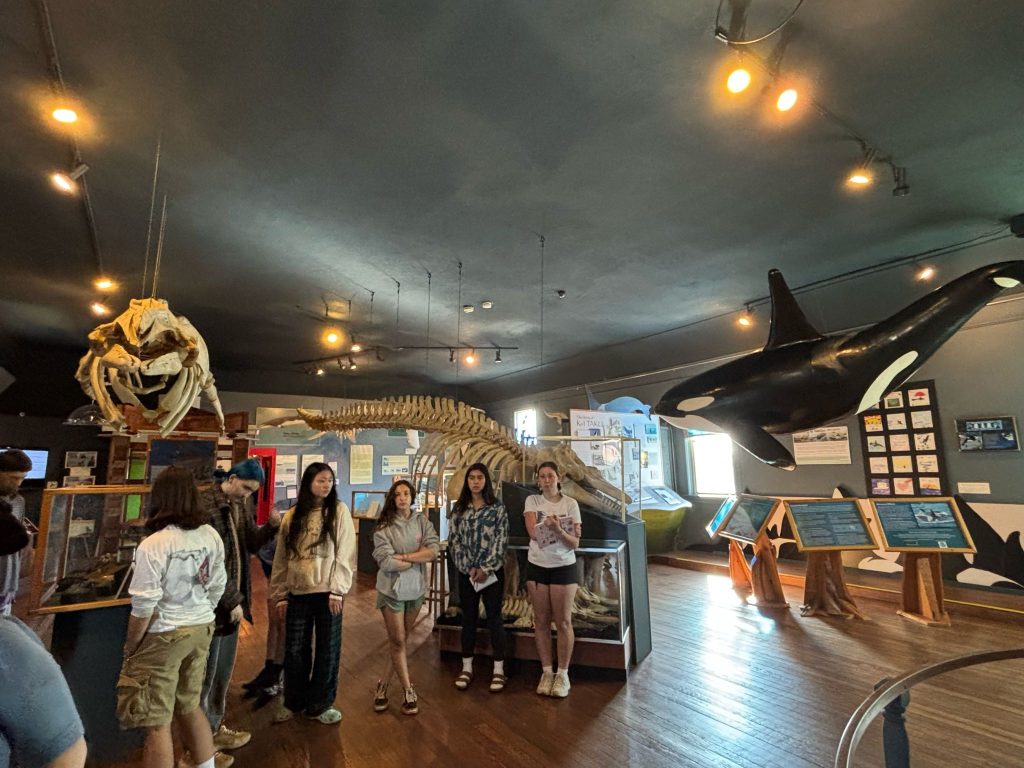
The group in the Whale Museum(Photo by Mira)

The Salish Sea cohort woke up to a clear-skied, warm morning in the dorms. After eating breakfast together–cereal, fruits, and other such things–we head out into town to find The Whale Museum, which, surprisingly, is a museum about whales.

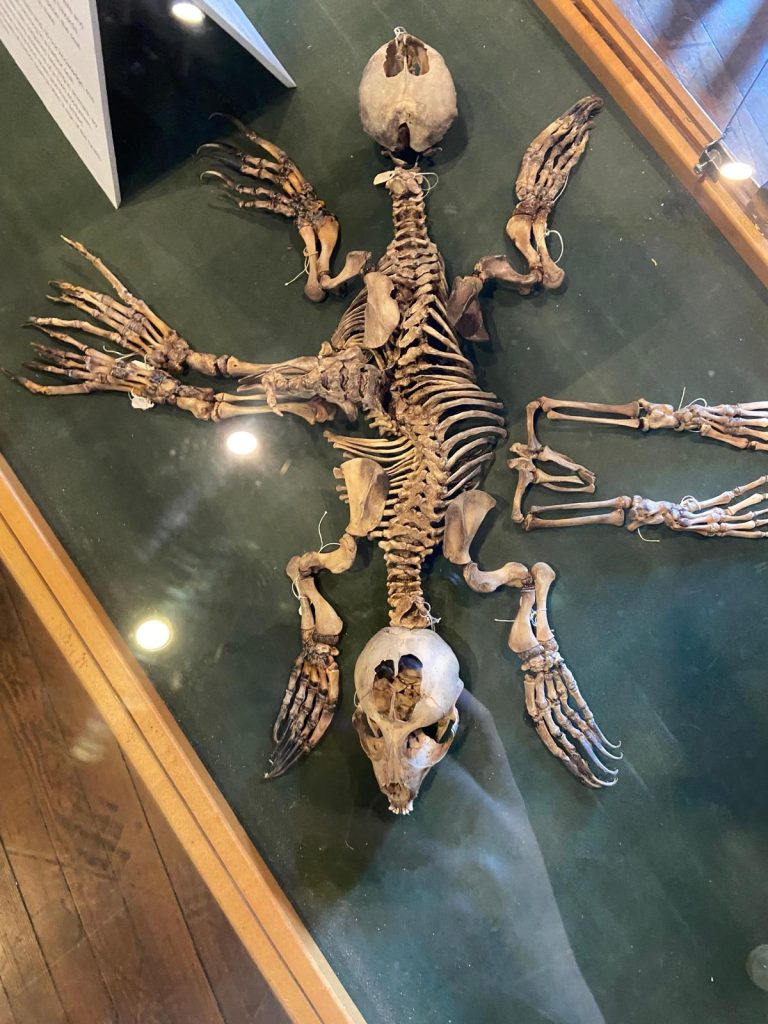
Once arriving, we were kindly greeted by Tracie Merrill, who had thoughtfully allowed our group to enter the museum before opening hours. Tracie led us through the exhibits, which covered different topics such as morphological variations between species, Coast Salish cultural stories, and the demise of conjoined twin seals. The group was quizzed on various topics about whales, such as the difference between baleen and toothed whales–which we aced. She also opened a touch-table, where the cohort was allowed to feel the skulls and furs of various marine animals. 

Upon being freed to explore the museum alone, the majority of the group trailed towards a movie that explained sound pollution and its effect on whales. It explored equitable ways to reduce noise in our precious waters–including slower cargo ships and efficient propellers. Others wandered into a red, vintage booth that allowed one to ‘call’ different species such as humpback whales and otters and listen to their noises. Certain whales were so quiet one had to strain to hear their screeches, but others were so loud one could hear it from a few feet away.  Some students colored shrimp, seals, and whales in whimsical colors in the children’s section.

All in all, it’s not difficult to conclude that our cohort thoroughly enjoyed learning about different species of whales and sustainability. We left the museum feeling fulfilled in our experience and excited to spend the rest of the day outdoors.

Conjoined Harbor Seal twins from 2010, the only specimen of its kind(Photo by Asher)

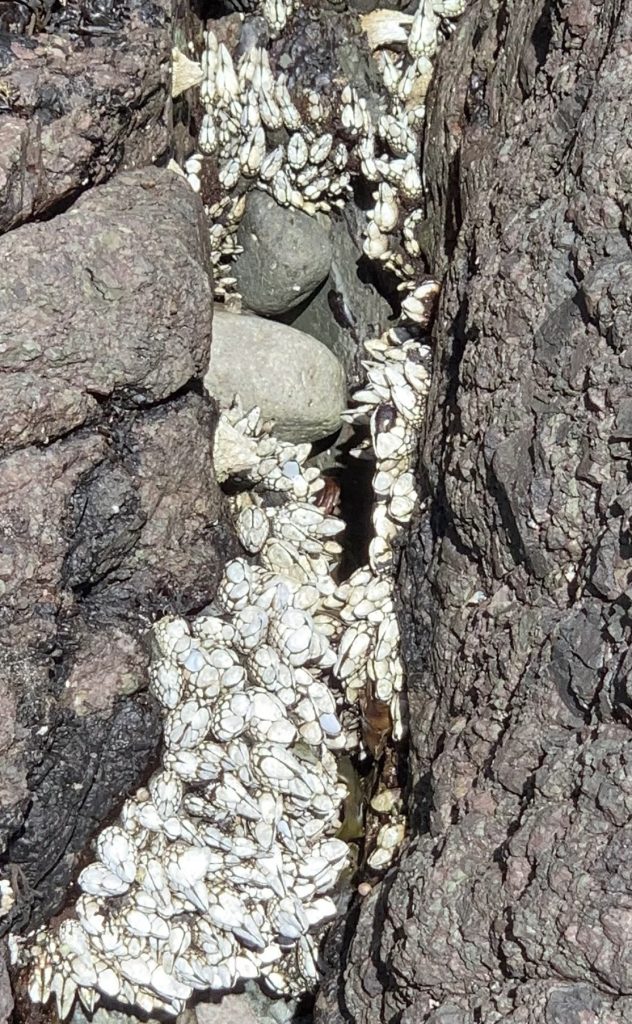
After our time at the museum, we returned to our dorm to pack lunch, which was sandwiches, fruit, and various trail snacks, to take to Lime Kiln State Park. We spent an hour there, eating, and going down to the water to stand on the pillow basalt, which, as we learned later, is cooled at a different rate, allowing it to take on a more ‘pillowy’ shape. We enjoyed our time at a new inter-tidal zone, with acorn and gooseneck  barnacles, egg yolk, and moon jellies, one of whom had six gonads(the four clover rings) instead of the regular four. The jellies seemed to enjoy a mass of fallen leaves, sticks, and kelp that was floating by the shore. We certainly had fun peering at anemones after eating a fulfilling meal, and were ready to head into our next adventure.

Some gooseneck barnacles on the rock reefs at Lime Kiln State Park(Photo by Noam)

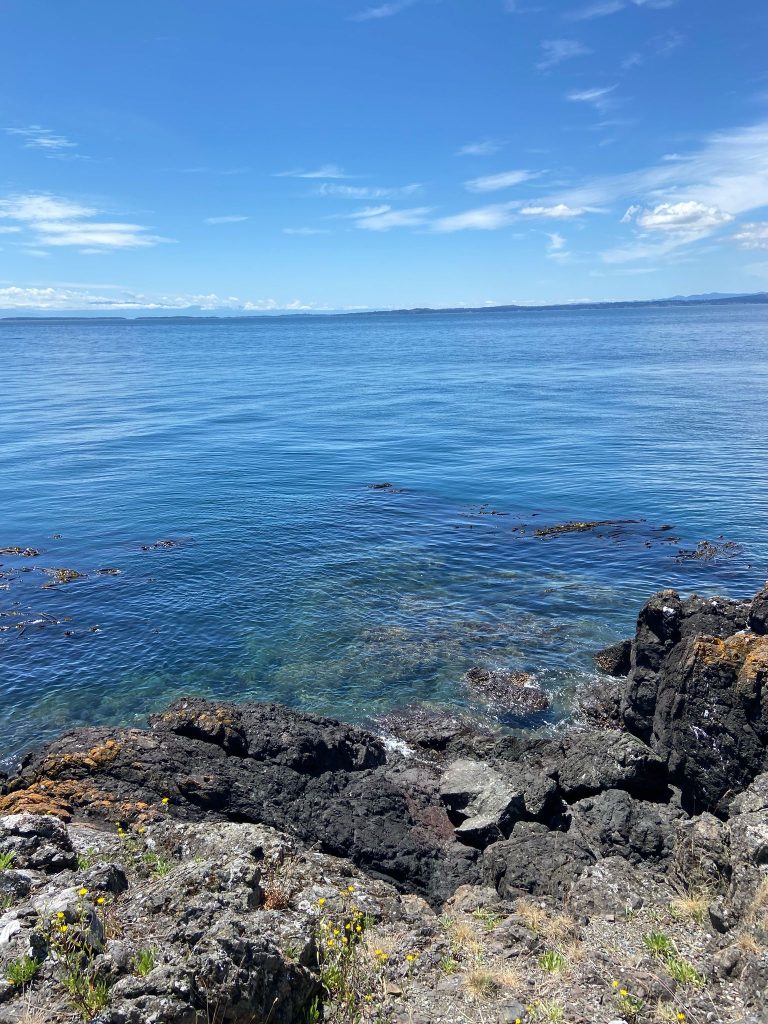
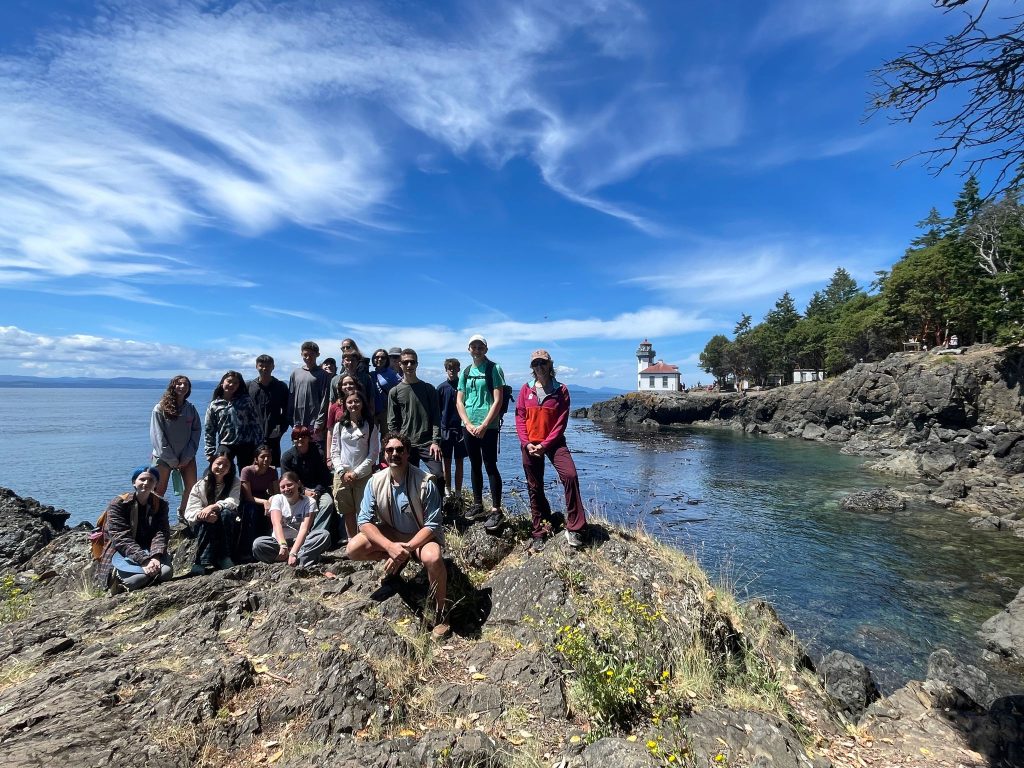
Next, we were lucky enough to get a tour of part of Lime Kiln State Park by Erin Corra, who is the founder and program director of Friends of Lime Kiln Society (Folks). We saw many types of beautiful trees including Douglas firs and Mandronas. One tree that stood out in particular was “Old Man Doug:” a 250 year old Douglas Fir! Additionally, we passed several divers from the Friday Harbor Laboratories (where we visited yesterday) wearing gear that they said weighed over 100 pounds. We then watched as they embarked on their journey of measuring sea urchins. Our final destination was the lighthouse, where we made our way to the top and gazed out over the gorgeous Salish Sea. Some of us even spotted the beloved harbor seal, Snowball! Visible from the lighthouse was Vancouver Island and the Olympic Peninsula, providing a breathtaking view that we were all too engrossed in, ending up arriving back at the dorms late.

The view from the cliffs in Lime Kiln Point Park(Photo by Asher)
The group in front of the lighthouse in Lime Kiln Point Park(Photo by Erin Corra)

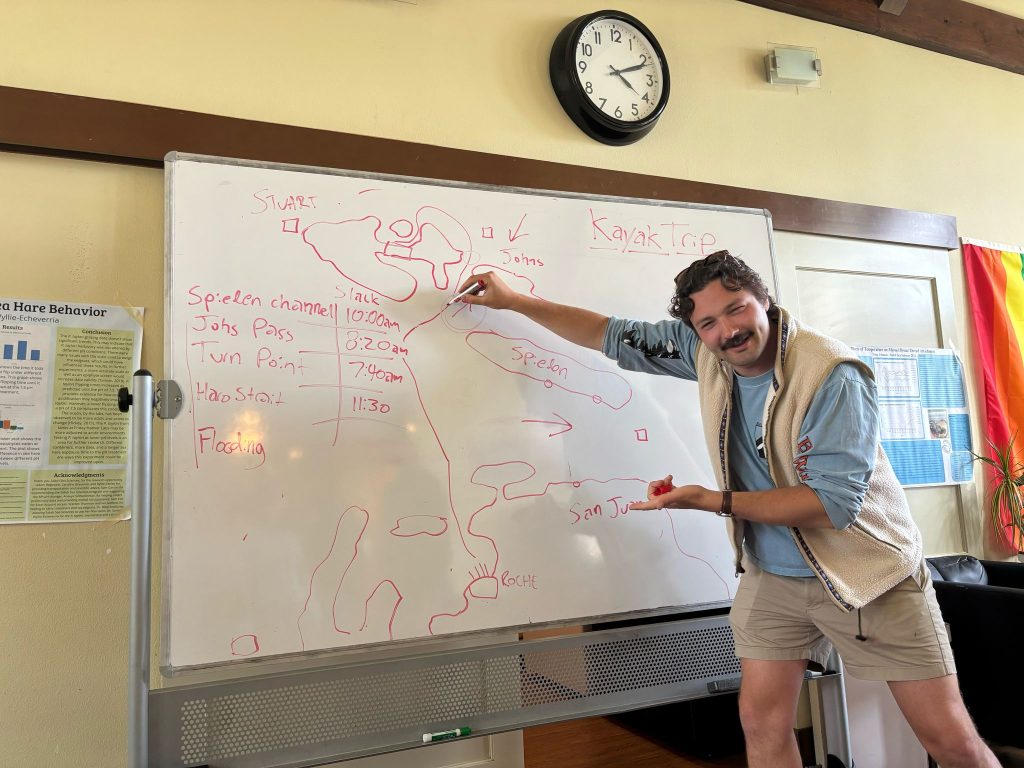
After our tour of the park, we returned(belatedly) to the dorm, where Adam, our instructor, was to tell us about our kayaking trip that we leave for on Saturday.

Adam posing in front of his glorious map of our kayaking trip(Photo by Mira)

To end out our day, we had a delicious dinner of Indian chickpea and spinach curry, naan, salad, and fruit. Joining us were Mitch McCloskey, the Project Manager of Eelgrass Restoration for San Juan, who is in the process of completing his Masters degree at Alaska Pacific University, and Sage, an undergraduate with Western Washington University, who earned her Bachelors degree, also from Western, in geology. After dinner, they informed us of their attempts to repopulate the San Juan coasts with eelgrass by various methods. In a few days, we’ll be helping them with their research.

Overall, it was a very fun day, lots of interesting insights into the ecology of the whales and other marine mammals!

Day 4: Shark Attack!!!

Salish Sea Sciences trip to The University of Washington’s Friday Harbor Labs (FHL). Wednesday, July 2nd, 2025. By: Lars, Miles, and Leah

We were graced with a half half hour later start for breakfast – but! We also had to pack our lunches whilst making our breakfast to prepare for a full day on the University of Washington’s Friday Harbor Lab (FHL) campus. The drive over to the labs was breathtaking, each window we looked out of had the shore right in front of us. Everyone was definitely antsy to get out and meet the scientists awaiting our arrival.

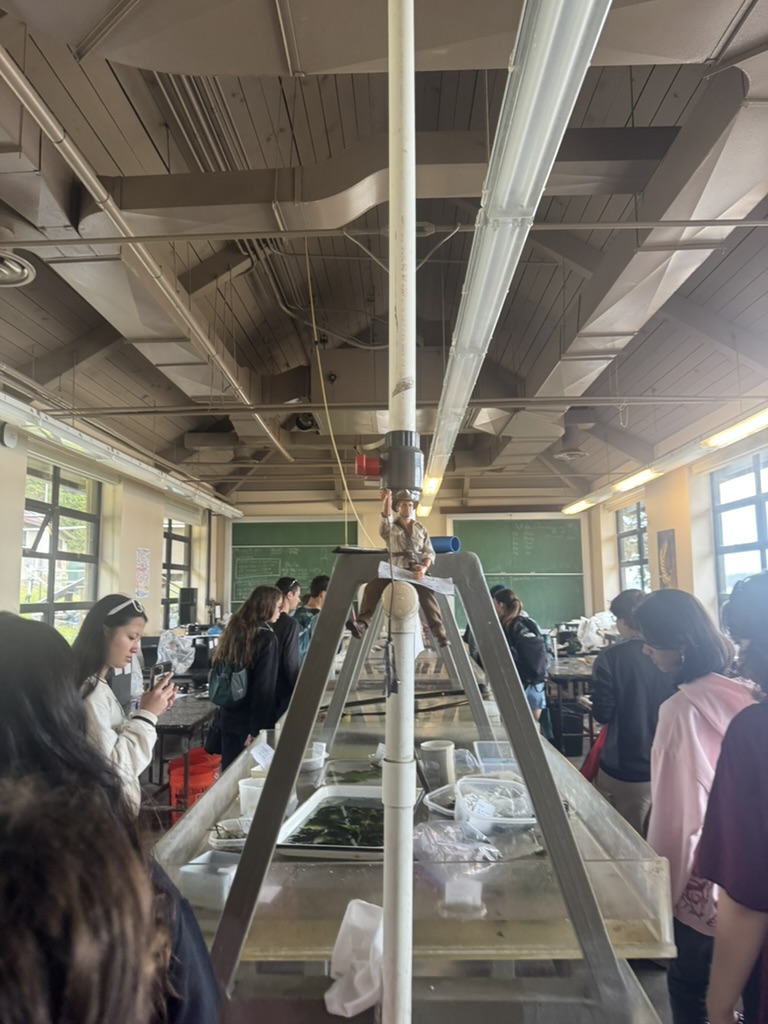
First, we met Michelle Herko, the program director of the FHL Science Outreach Program. She was very excited to tell us all about the history of the campus, and the work done at the lab on green florescent proteins. While showing us around the physyology labs, she explained how the bioluminescent reaction became widely used marker for studying gene expression and protein localization in living cells. https://pubmed.ncbi.nlm.nih.gov/31342754/#:~:text=Abstract,transgenic%20animals%20in%20biomedical%20research One aspect of the labs I found the most fascinating was its flow through water system. The system rapidly circulates water in and out, allowing scientists to observe the creatures in a natural aquatic environment. This is one of the many great features of these labs that attract world renowned scientists!

Walking through kelp lab! Photo credit to Lars Hill

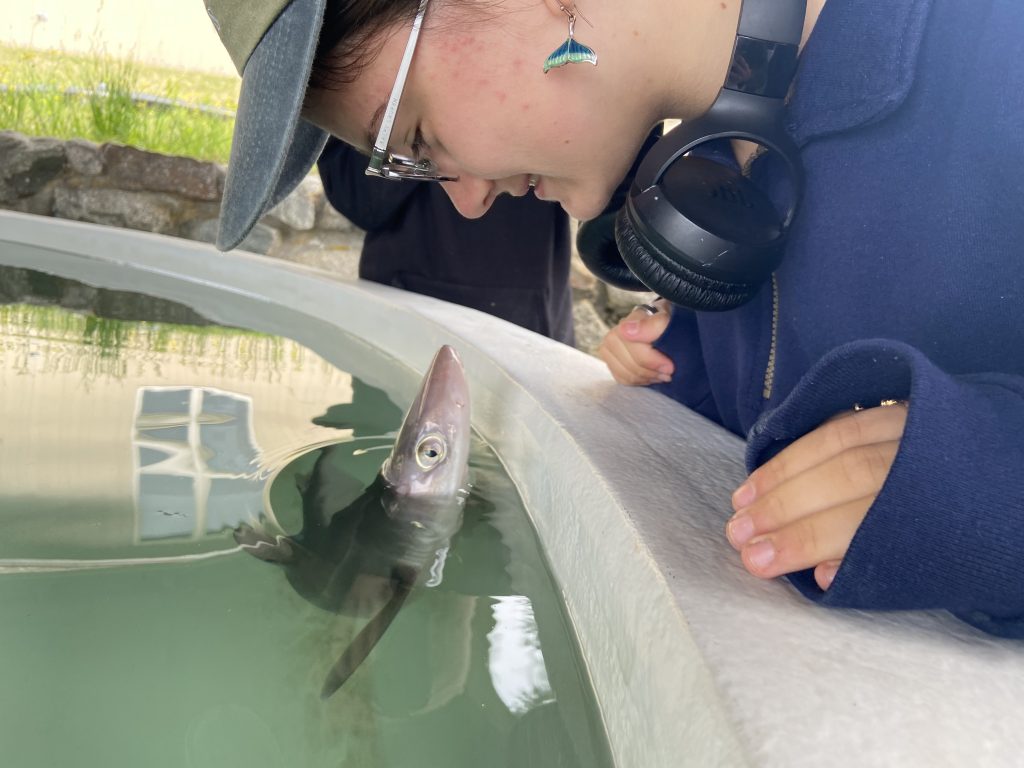
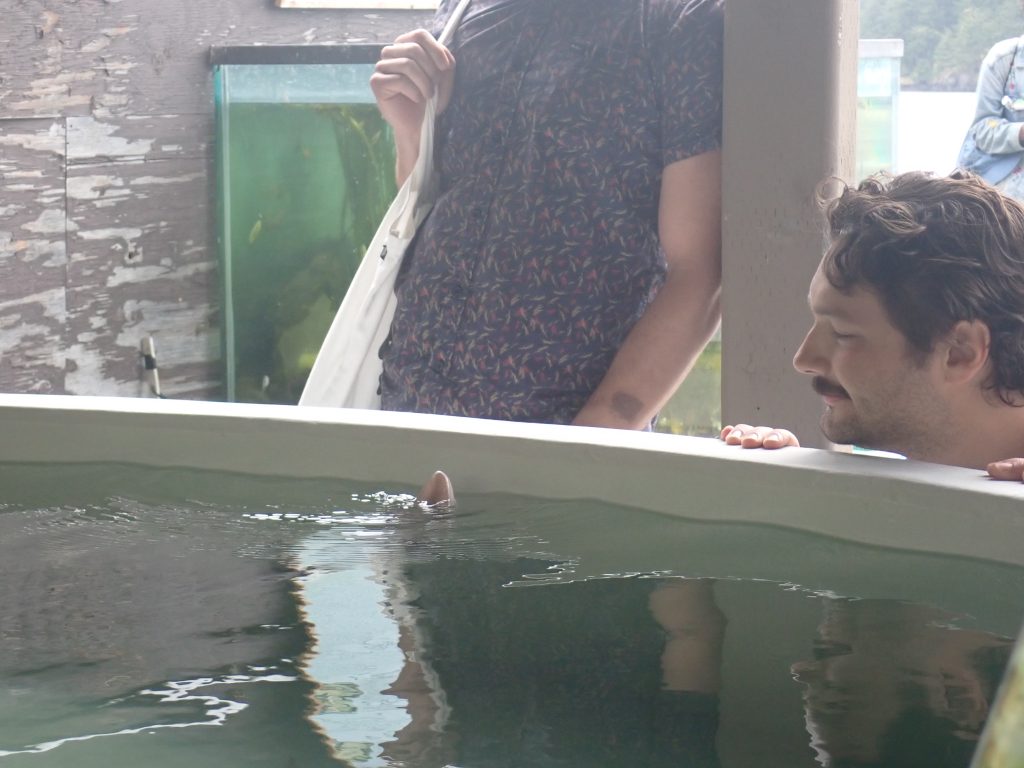
Our tour continued, as Michelle offered us the opportunity to look at some awesome high powered microscopes. We could only have about 6 students at a time through those labs, so we split up. Those who were first to see the microscopes also discovered another cool project happening in the room next store. A scientist excitedly popped in, interrupting Michelle with the opportunity to see her spawning sea cucumbers! Of course we took her up on the rare opportunity, especially sense the sea cucumber spawning is not a simple process. Their study included injecting peptides to stimulate spawning, very neat! While the others waited, the stumbled upon a tank of dog fish! A sneak peak for a future tour! They were very friendly, and our young scientists quickly chose names corresponding with their spot patterns. As the groups switched off, some groups began opening their lunch boxes and digging in!

Adam adoring the snout of a dog fish. Photo credits to Lars Hill

After a decently satisfying lunch, our tours prevailed. We met Cassandra Donatelli, an assistant professor at UW’s School of Engineering and Technology. Donatellii got her doctorate in 2019 in biology from Tufts University in Medford, Massachusetts. Again, our group split up. Half of us continued with Dr. Donatelli, who, along with several other undergraduate researchers, guided us through the lab and introduced their individual projects. A highlight for many students was listening to an undergrad from The University of Massachusetts Amherst explain his project. He used CT scans to study the animals physical structures through their skeleton. Another researcher was 3D printing different crushing structures to study when fish bones may buckle and how to avoid that. Each of these researchers were surrounded by a supportive team from the University getting personalized feedback on each decision. The majority of these researchers were also from universities outside of the Seattle or Friday Harbor areas. Continuing the trend, a group of mostly undergraduate researchers studying aerodynamics showed us around their lab to better understand how to incorporate the swimming habits of Dog Fish into engineering. This tour also included a portion of the tour returning to our beloved dog fish in the pool, where we learned the researchers had also given them name based on their spot patterns! Clearly scientists think alike!

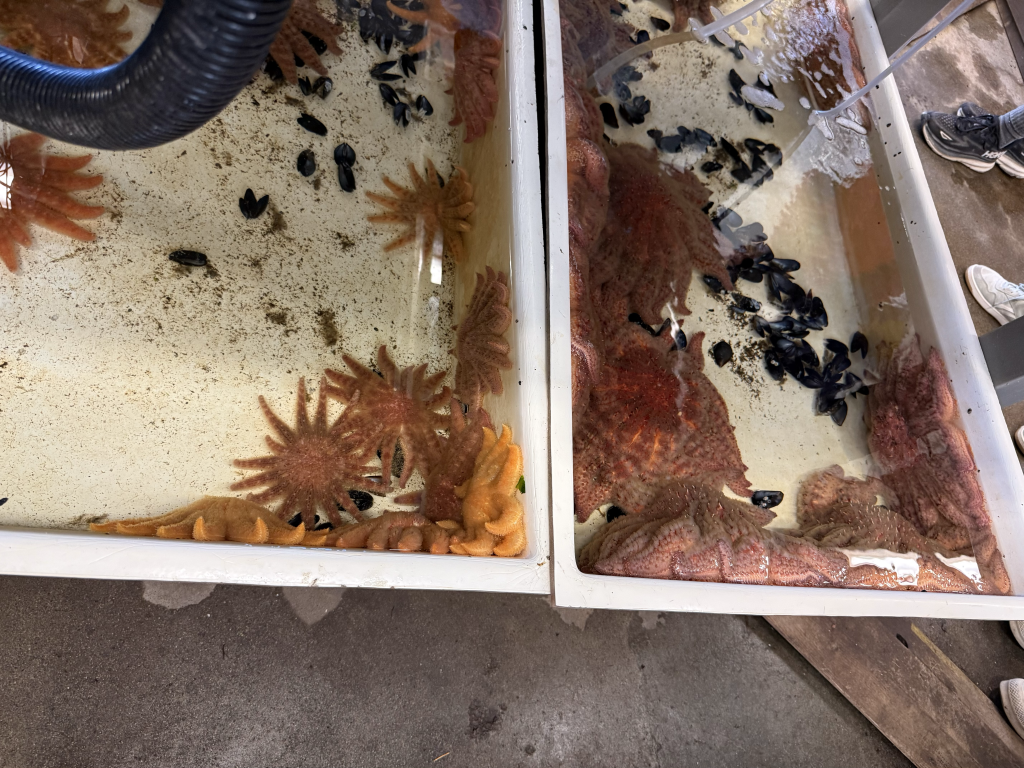
At this point in the day, attention spans were getting smaller, legs were beginning to hurt, and eyes were getting heavy. Yet we prevailed into our final set of tours! Our last introduction of the day was to the lovely Becca Guenther (who wrote this amazing newsletter on her ocean acidification lab, which we also toured!) She is currently the lab manager for FHL’s Sea Star center. (but may also be or have previously held the role as the lab manager for the ocean acidification lab?) The Sea Star lab was very visually satisfying! Many little oysters, clams, sea urchin and sea stars sat in tanks of varying size and length! Their biggest Sea Star was 7 years old, and a whopping 60 pounds! Becca detailed the danger she puts her and the organism in when she attempts to move him during routine tank cleanings. When he began to understood that he was being moved from his comfy spot, he would latch his suction feet on even stronger to the sides. This lab was established during the rise of Sea Star Wasting Disease, which has nearly wiped out any wild population of the Pacific Sunflower Stars. The researchers’ dedication to supporting these species—through feeding, tank maintenance, and ongoing study—is truly inspiring and deserves to be shared with a wider audience. If your interested in learning more, we recommended reading this fascinating article by Jason Hodin. https://depts.washington.edu/fhl/tidebites/Vol93/index.html

Size comparison of a tank with 2 year old Sunflower Sea Stars and 3 year old Sunflower Sea Stars. Photo taken by Hitomi

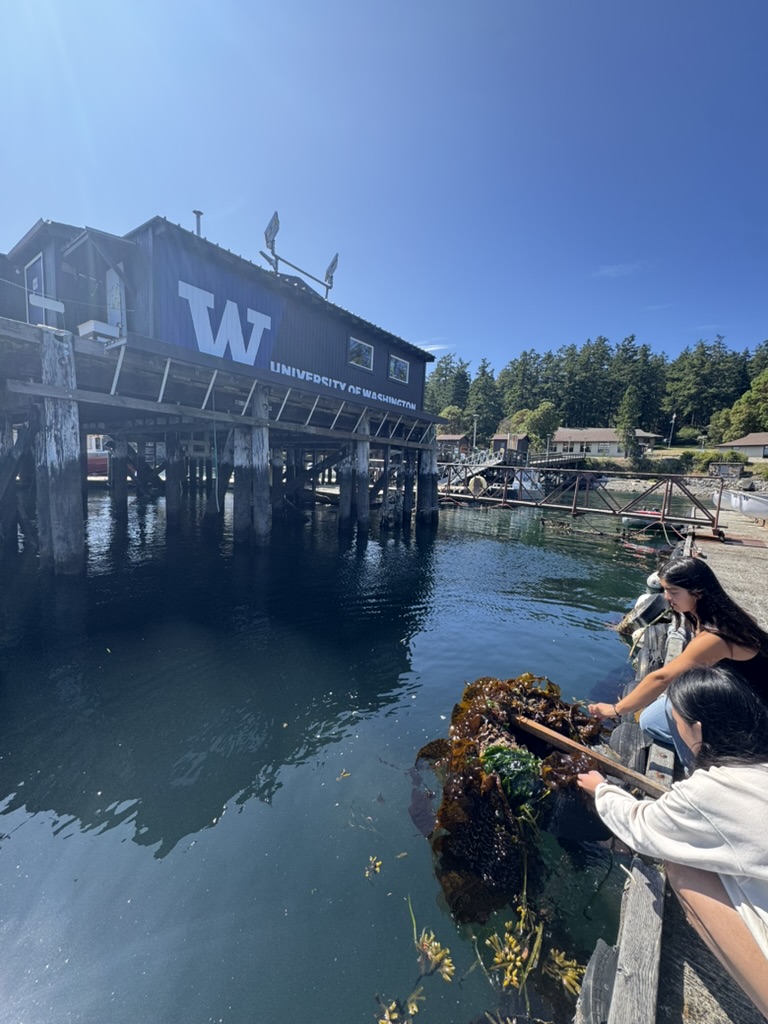
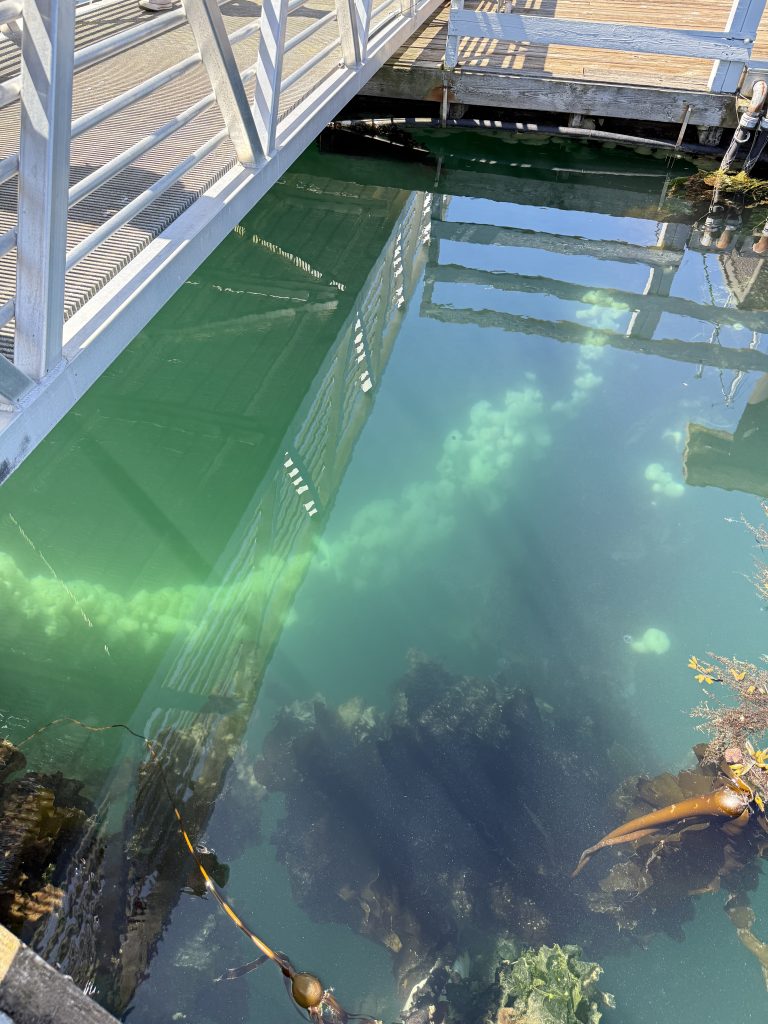
The final rotation of the day trip involved searching for a variety of marine phyla by pulling up the tires hanging off the side of the boat dock. The first group’s favorite find was a nudibranch, while the second group discovered a crab. It was fascinating to see the wide range of life—sponges, kelp, algae, and more—thriving on these tires, originally placed as buffers for the boats. I also noticed how much clearer the water was around this dock compared to the murkier water downtown, likely due to less boat traffic and runoff. This difference in water quality may very well explain the greater diversity of marine life we observed. Overall, it was a memorable way to end the day—full of discovery and a deeper appreciation for the subtle factors that shape marine ecosystems.

Pulling the tires up to the docks. So much giant kelp! Photo taken by Lars Hill

We left the labs ten times more tired than when we arrived. After a well-earned and satisfying dinner, we decided to skip the evening lecture in favor of some much-needed rest and preparation for the day ahead. Most of us spent the evening unwinding—watching TV, playing games with friends, or relaxing at the beach. The downtime was just what we needed to recharge and return even more excited for another science-filled day tomorrow!

Day 3: Adam has Crabs!?!

By: Hitomi, Eden, Trevor, and Harper

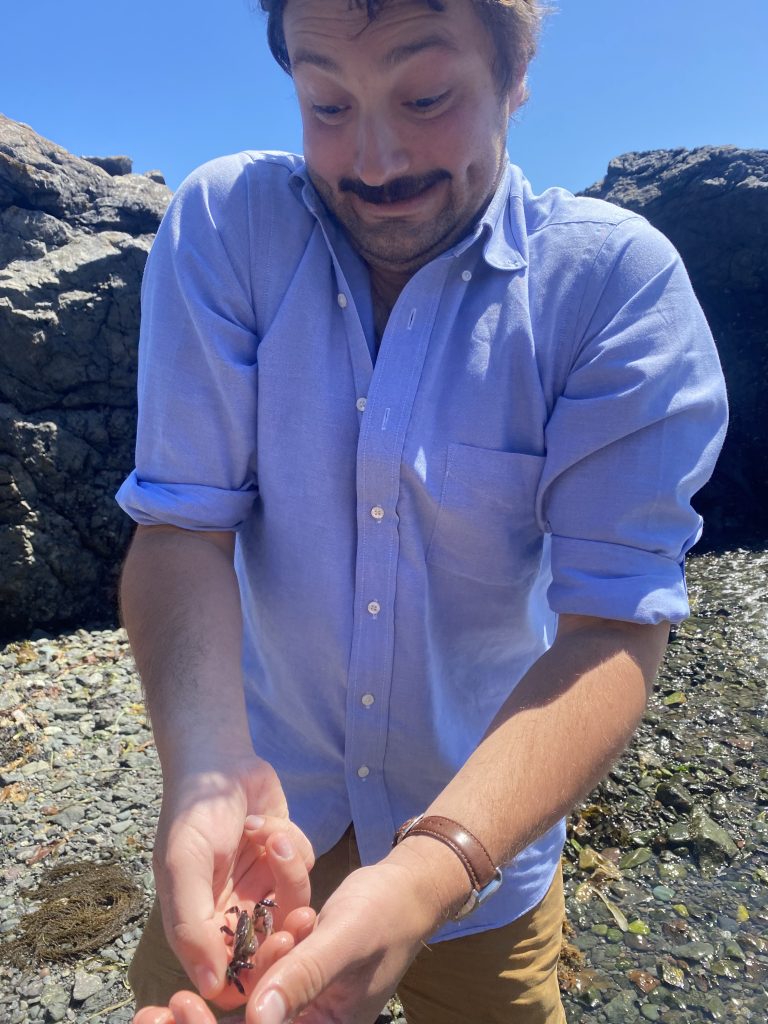
Adam holding crabs at tide pools (photo by Eden)

The dorm woke up to beautiful sunny weather and the breakfast crew’s spread of scrumptious cereals, yogurt, granola, bread, and fresh berries. Some eager folks went out for a quick morning workout, while others helped themselves to coffee in the area. First, we were introduced to the structure of our Pilot Project and shown examples from past years projects. Maya and Riley led a tour of our on-campus lab, which will act as a workspace for some over the next 4 weeks, and shortly after, we were delighted by Adam’s “Phyla of the Salish Sea” presentation. We gained base-level knowledge of local marine organisms, which was later used to explore the tide pools at Deadman’s Cove.

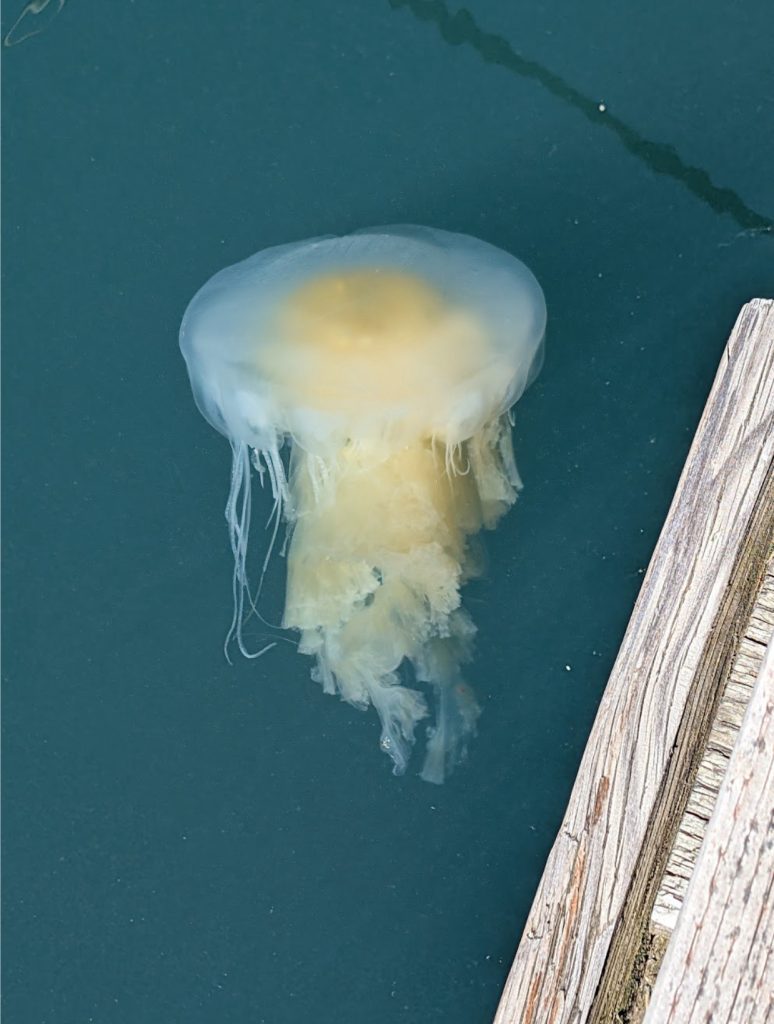
After Adam’s phylum presentation, we strolled into town to put our knowledge to use at the marina. Our main focus there was the fouling communities, which are congregations of animals found on man-made objects. We spent about an hour exploring over, under, and around the docks, searching for any organism we could find. While we were there, we had to apply our newly acquired knowledge of species and phyla to identify patterns in organism density, dispersion, and relationship to other organisms. In our full-group meetup afterwards, we all agreed that there was more seaweed on the upper section of the pilings (due to photosynthesis) and that there was a higher concentration of organisms, specifically plumose anemone, in the gaps between the dock (because of current and nutrient flow). Notably, we also saw plumose anemones, a red rock crab, and a few massive egg yolk jellyfish. Afterwards, we enjoyed a short hike back up through town and settled in for lunch.

Fouling anemones (photo by Hitomi)
Egg yolk jellyfish (photo by Trevor)
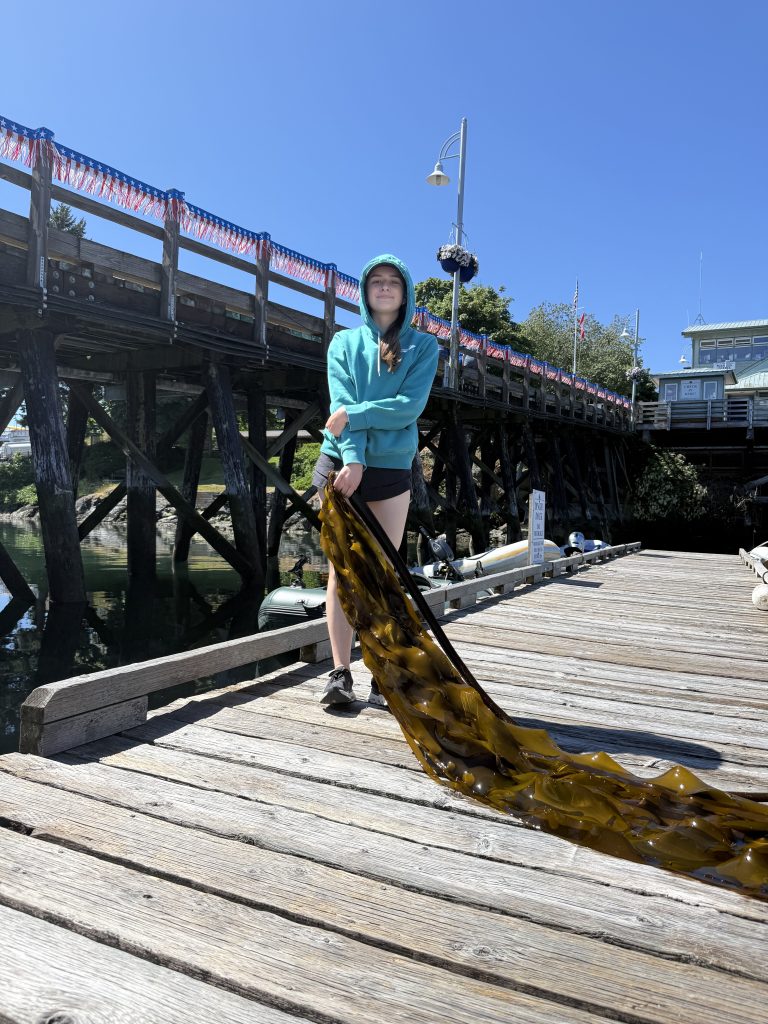
Ella holding Bull Kelp (photo by Hitomi)

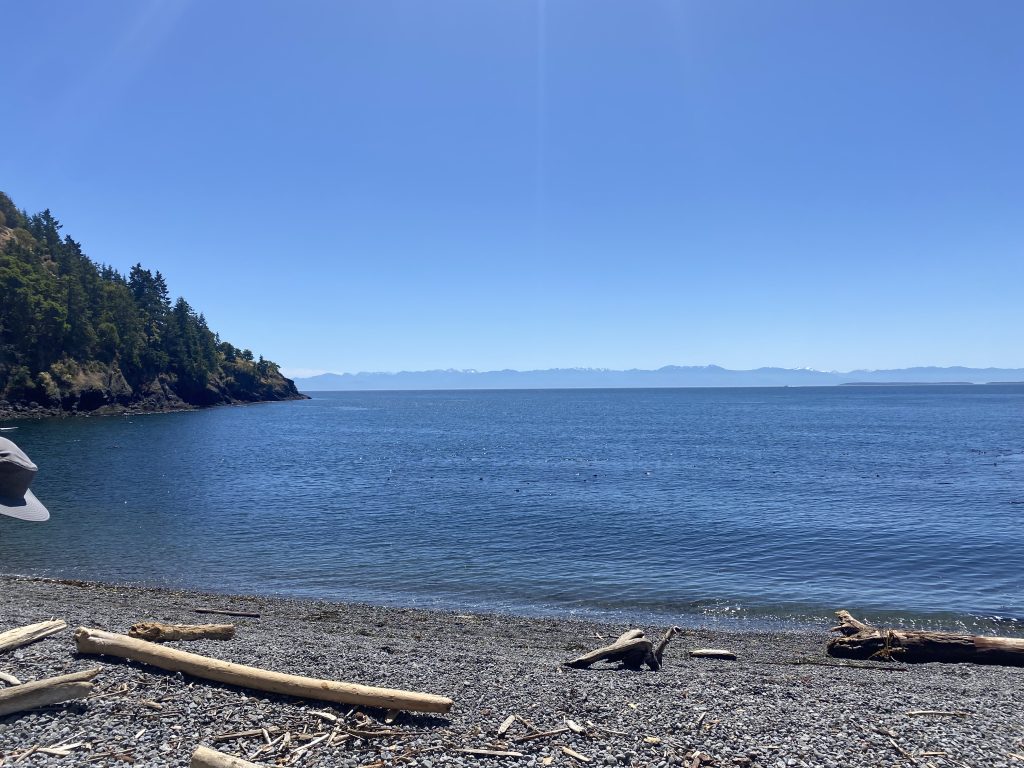
Following a lunch of sandwiches and fruit, we packed up our supplies and piled into the van as we set out for our last event of the day: studying tidepools at the ominously-named “Deadman’s Bay”. After a winding drive which took us west along the slopes of a cliffside forest, we parked beside the road and made our way down a steep trail to the shoreline. From the pebble-laden beachfront, the distant figure of Canada’s Vancouver Island sat in the shadow of the Olympic Mountains, which stood as a row of massive dark teeth against the blue sky. Once settled, our directors asked us to reflect on the potential biotic and abiotic factors around us. After this, we were handed “Tidepool Bingo” sheets and instructed to find the organisms on the sheet among the tidepools off to our right. Among the tidepools, we found rock crabs, barnacles, snails, algae, anemones, the occasional tidepool sculpin, and even a few sea stars. Unfortunately, we had to leave after a few hours due to the rising tide, though one of our directors was lucky enough to find the carcass of a sea urchin on her way back to the group. After our adventure at Deadman’s Bay, we drove back to the dorms and settled down for a snack while our dinner crew prepared for the arrival of our evening’s guest: Dr. Olivia Graham.

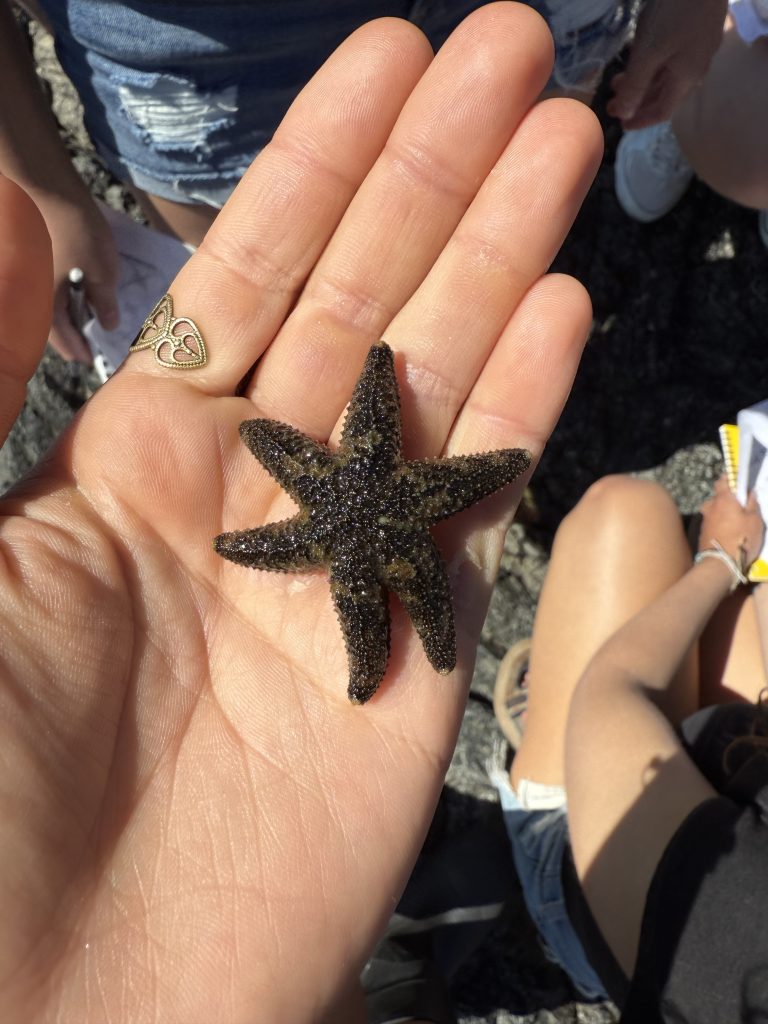
Starfish in the tide pool (photo by Hitomi)
Deadman’s cove (photo by Eden)

After a short break following tide pooling, a special guest Dr. Olivia Graham joined our dinner table! She is a marine disease ecologist and research associate at Cornell University. At dinner, Dr. Graham will present and discuss her research on the effect of seagrass wasting disease on eelgrass beds throughout the Northeast Pacific. We will be able to dine with her and ask her questions about her research and scientific goals, creating a comfortable space to talk scientist-to-scientist. Following dinner, we will have some free time to chill before heading to bed, ready for our next long day.

Days 1 & 2: Travelling the Country and Eelgrass Exploration with Dr. Olivia Graham

Blog by Orrin Spiess, Anisa Singh, Isabelle van Thiel, and Violet Marshall

After months of anticipation, we finally all arrived here on San Juan Island, one way or another. Some of us drove directly to campus, others flew in from across the nation to be picked up at the airport or along the way by our wonderful directors, Caroline Grauman-Boss and Tom Grauman. The commute to our dorms took us across the Puget Sound on a scenic ferry ride and a short walk through the charming town of Friday Harbor. We got to know our roommates and peers for the coming month over a pizza dinner and some recreational time walking around town.

After a somewhat tumultuous but restful night of sleep, we woke up to a blinding sunrise at 5:30am and our first day of life at camp. After everyone ate breakfast and reaquainted themselves with each other, we made our way to the common area for an informative orientation with Ms. Caroline. Having much more knowledge inside our heads, we got into our groups and began exploring the harbor with a scavenger hunt in hand. Winning with 420 points, Team Sunny Calirado ended up crushing all of us; although one team was late while allegedly helping an old man across the the street.

Entering mid-day, we packed our lunch and were off to at South Beach for a sandy and hot lunch of PB and J’s–though to be fair, the view was amazing. Later, we made our way to meet up with Dr. Olivia Graham, Postdoctoral Research Associate at Cornell University. She introduced us to the importance of eelgrass through a hands-on data collection and presentation experience. We then spent around 2 hours out on the 4th of July Beach collecting data on eelgrass populations: seedings, flowering, and alike! We also met her gorgeous dog, Michi, and Vidita surviving an attack from a fox (Adam chased it away). Having had a great time, our quest was sadly terminated as we left to go back to the dorms. Some time spent toiling away in the kitchen, we were able to enjoy exactly 21 baked pototoes with a glorious, amazing, beautiful, spectacular, jaw-dropping, mouth-watering, and scrumptious bean sauce with cheese.

Soon after our feast, we headed to the annual Illg lecture by Dr. Leslie Babonis, an assistant professor at Cornell who got her Ph. D at the University of Florida. We learned why particular sea anemone cells don’t sting and the future possibilities regarding RNA, CRISPR, and how modifying genes can change whole organisms’ biology and/or morphology. Following a quick walk back to the dorms, we arrived at the dorms to be met with some free time to eat some ice cream; soon, we were in bed and dreaming of the next day.